Alcohol-Free Drinks Through History
Posca, whey, barley water, orgeat, switchel, penny cocoa and soda fountain drinks: what people drank without alcohol, era by era, and which held a little.
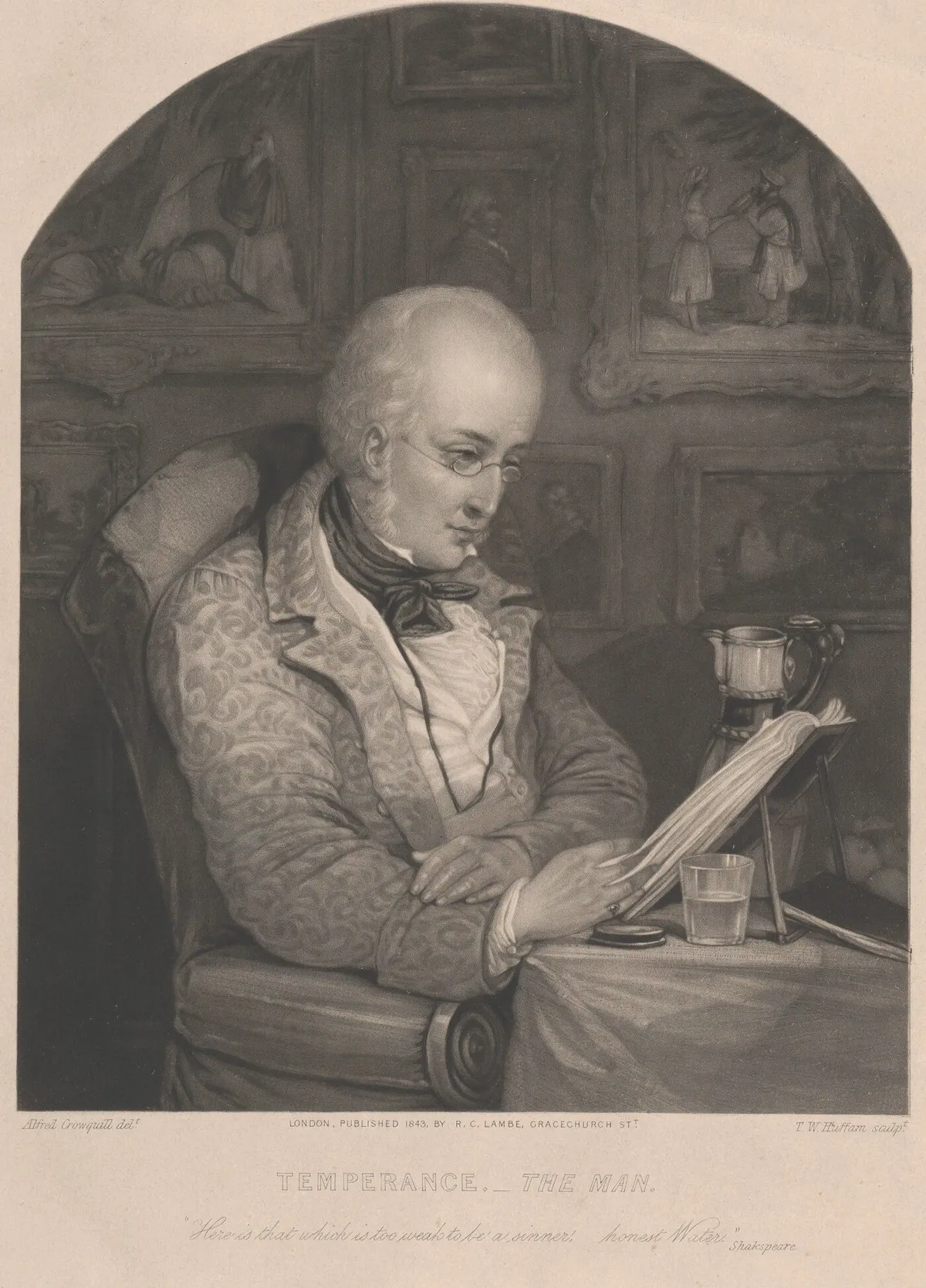
Water came first, in every century. Around it stood a long line of drinks made without alcohol: vinegar and honey drinks in Rome, whey and almond milk in the Middle Ages, coffee, tea and chocolate from the 1650s, barley water and orgeat in Georgian kitchens, switchel in American hayfields, penny cocoa in Victorian coffee taverns, then the soda fountain and the dry party of Prohibition. Most were filed under the sickroom, the farm or the temperance cause. A few sold as non-alcoholic were brewed with yeast, and those held a little alcohol. The ones most worth reviving, with and without alcohol, are gathered in Forgotten Drinks Worth Making Again.
This story is part of our Dry January Drinks From History guide.
- Ancient Rome: water chilled with snow, posca (vinegar and water), oxymel (honey and vinegar), fresh grape juice and boiled-down grape syrup.
- Middle Ages and Tudor England: water, whey, almond milk on fast days, thin oat gruel for the sick, distilled rose water.
- 1600s and 1700s: coffee, tea and chocolate; saloop at London’s dawn stalls; barley water with lemon.
- Around 1800: orgeat, lemon water, apple water, toast-and-water, and capillaire stirred into water.
- Early America: switchel, molasses and water, for the harvest.
- Victorian Britain: cocoa, coffee and tea in coffee taverns, lemonade, fountain ginger beer.
- 1880s to 1920s: temperance cookbooks, hot and cold soda fountain drinks, then grape juice highballs, phosphates and ginger ale punch.
The names changed more than the drinks did: drinks for the sick, harvest drinks, temperance drinks, soft drinks. The labels were always looser than the recipes, and where a drink on this list wasn’t quite sober, it says so.
Rome: vinegar, honey and grape juice
Romans drank water, piped in from the hills and, for those who could pay, chilled with snow; What Did Romans Drink Besides Wine? follows it to the table. Soldiers and slaves drank posca, wine vinegar stirred into water. Boiled with honey, sea salt and rain-water, the vinegar became oxymel, a sharp-sweet syrup to dilute.
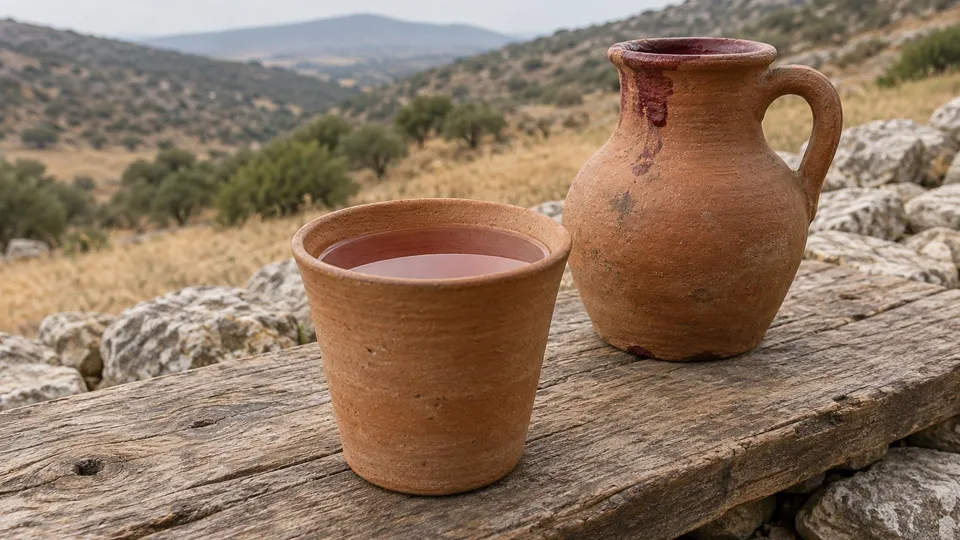 Always alcohol-freePosca, the Roman Soldier’s Vinegar Drink
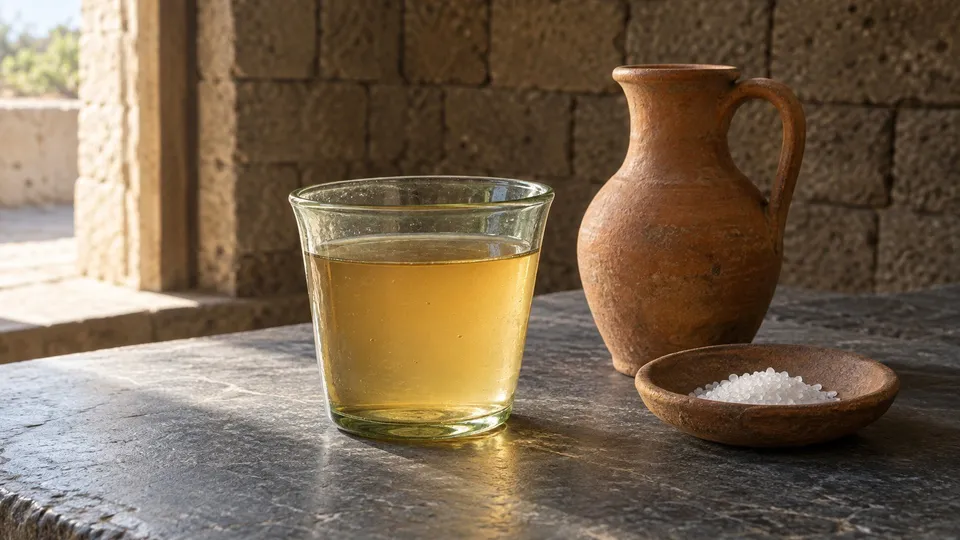 Always alcohol-freeOxymel, Pliny’s Honey and Vinegar Drink
The vineyard gave the rest. Mustum was fresh grape juice, drunk before it could turn to wine. Defrutum was must boiled down to a dark syrup that kept, and Pliny’s adynamon was a “wine” boiled out of must and water for invalids who were not allowed the real thing. Quinces steeped in honey made melomeli, stirred into cold water. Only posca needs a footnote: nothing alcoholic goes into it, but vinegar made from wine can keep a faint trace.
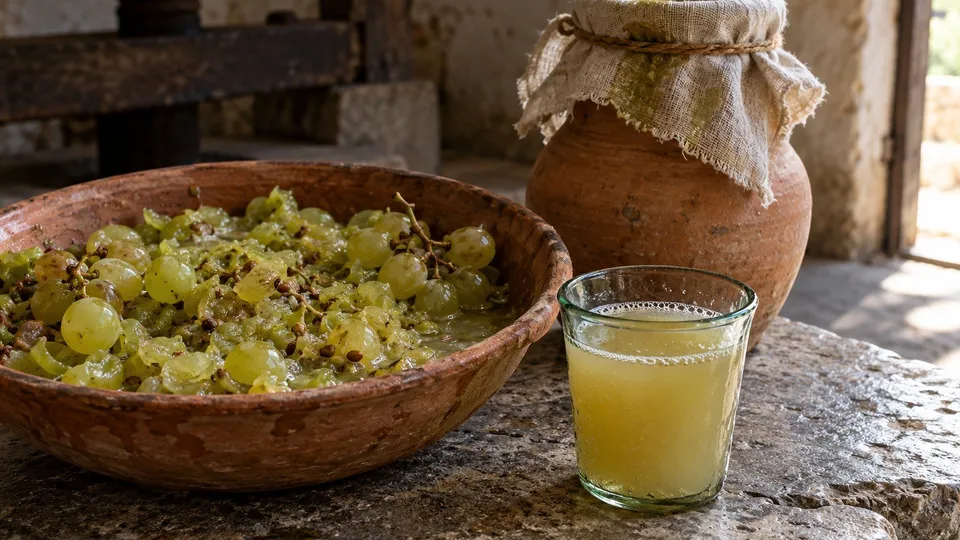 Always alcohol-freeMustum, Roman Fresh Grape Juice
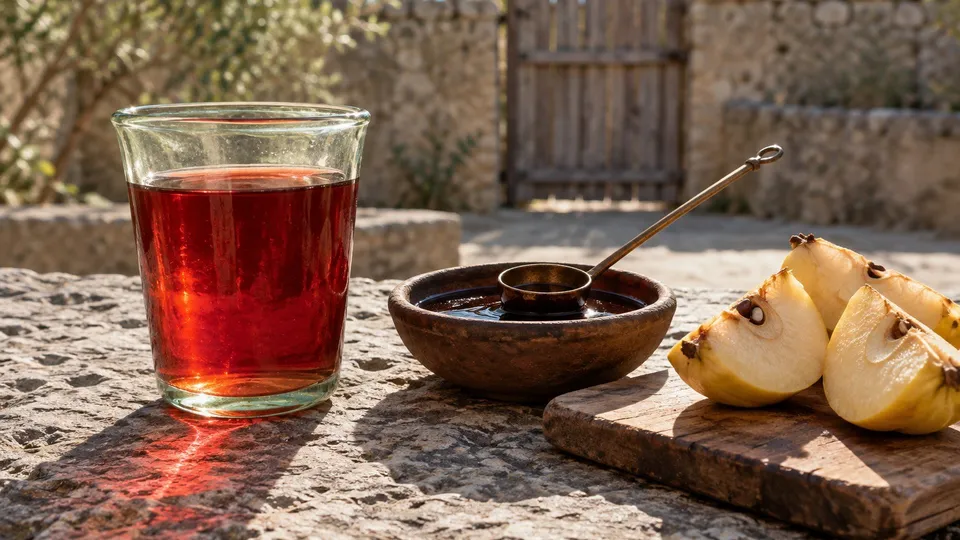 Always alcohol-freeDefrutum Cooler, Roman Grape Syrup and Water
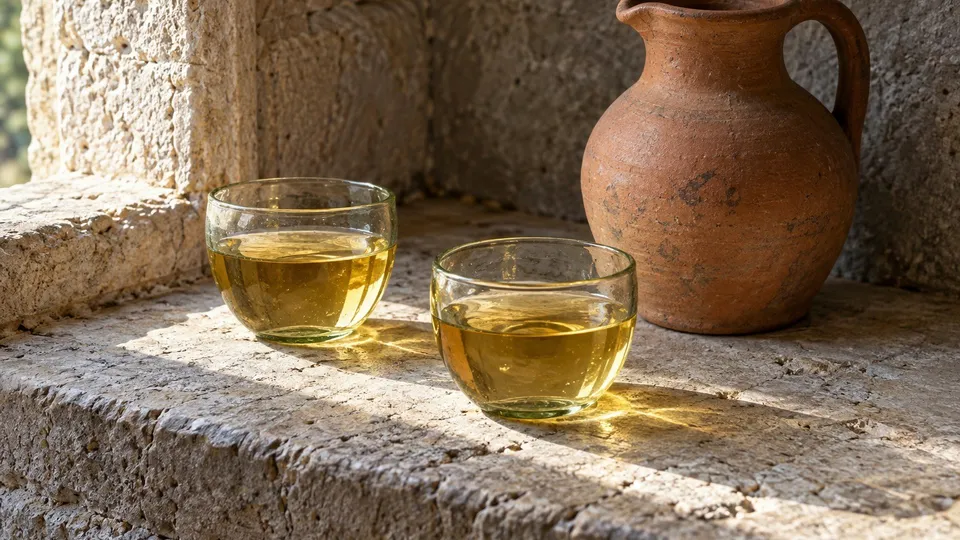 Always alcohol-freeAdynamon, Pliny’s Wine Without Strength
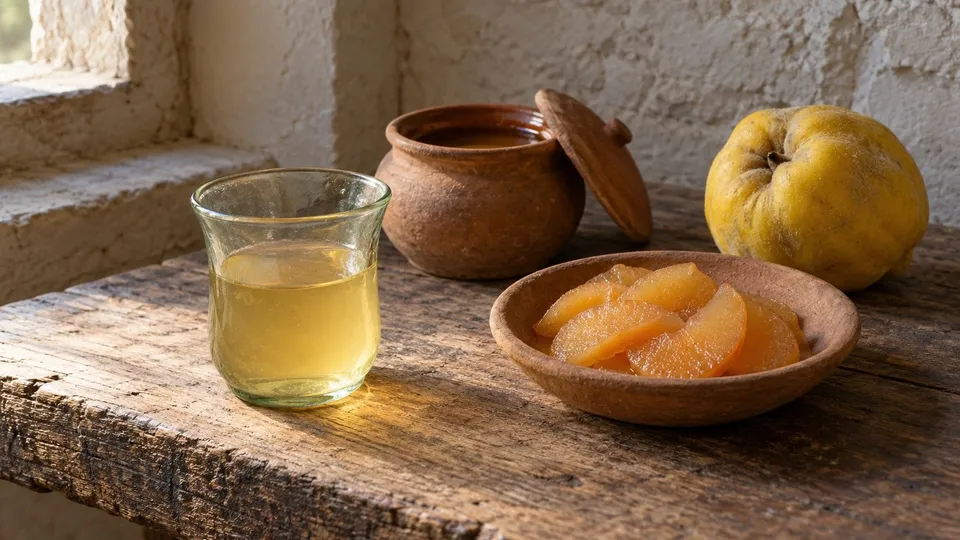 Always alcohol-freeMelomeli, Roman Quince and Honey Syrup
Whey, almond milk and gruel
Medieval households drank ale when they could brew or buy it, and water too, above all the poor, the young and servants; Did Medieval People Really Drink Beer Instead of Water? sorts out the evidence. Ale, even weak, was alcoholic, so it stays off this list.
What belongs on it is mostly pale and plain. Whey, the thin liquid that runs from fresh curds, was the drink of shepherds and the poor. Lemon whey, hot milk turned with lemon juice, was still being offered in 1747 in place of the wine under a whipt syllabub, and our alcohol-free whipt syllabub serves it that way. Almond milk, almonds ground with water and strained, stood in for cow’s milk when the Church ruled it out on fast days, and boiled once and sweetened it became cheaut. For the sick there was water gruel, oats simmered with honey and strained thin. By the Tudor years the still-room added distilled flower waters, and a distilling book of 1527 doses rose water by the ounce.
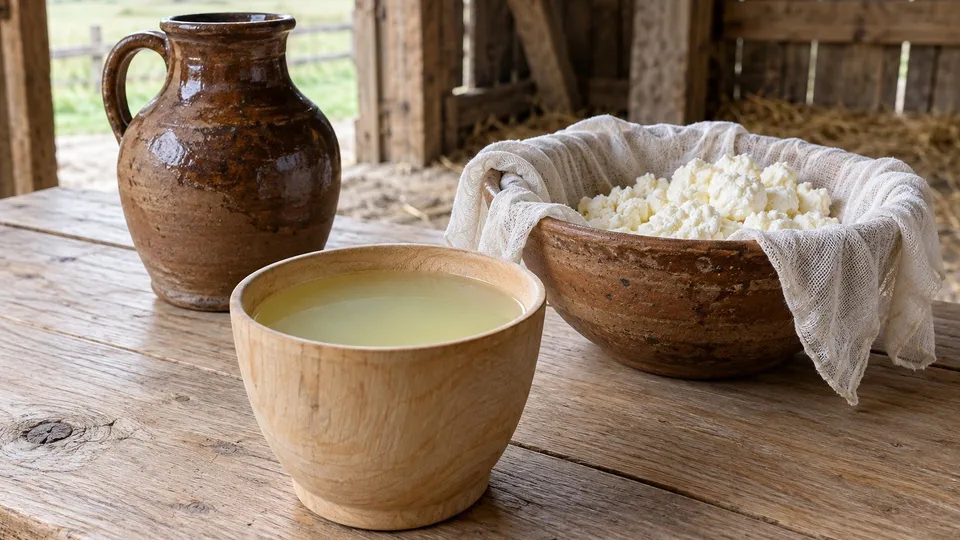 Always alcohol-freeWhey, the Drink Left Over from Cheese
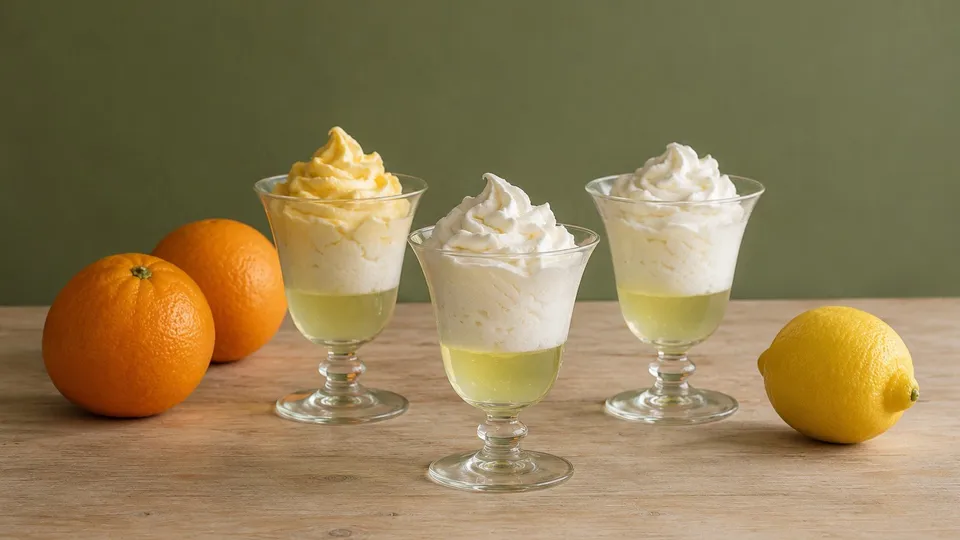 Alcohol-free versionAlcohol-Free Whipt Syllabub over Lemon Whey
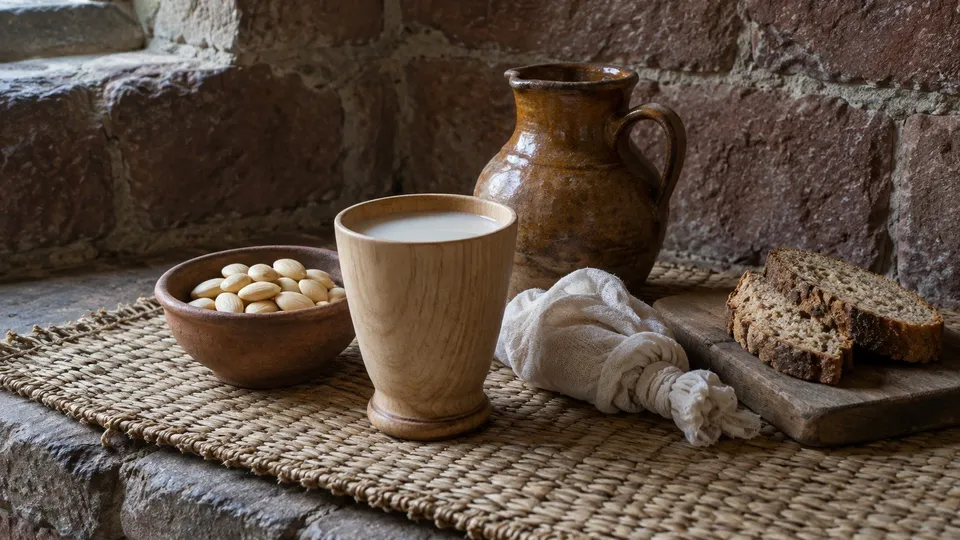 Always alcohol-freeAlmond Milk, the Medieval Fast-Day Milk
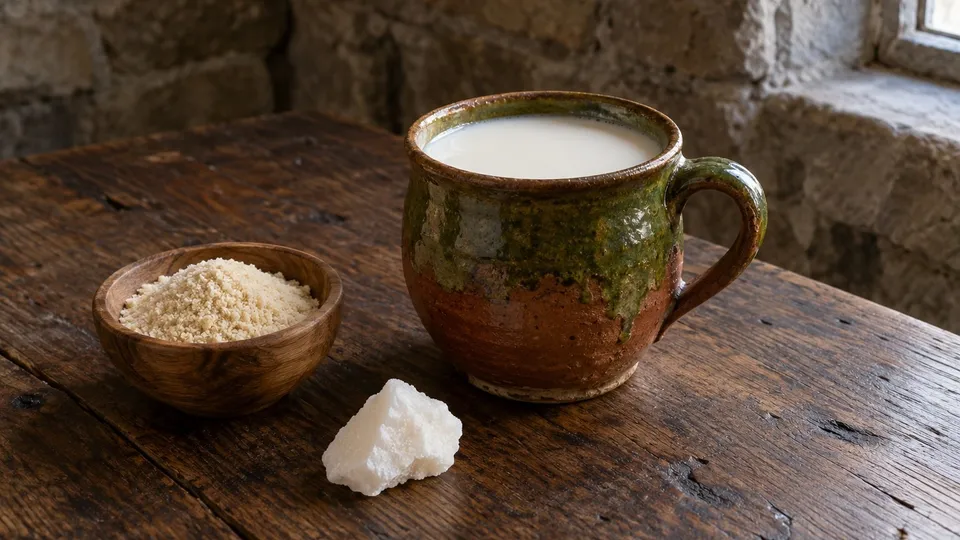 Alcohol-free versionCheaut, Hot Almond Milk from a Medieval Kitchen
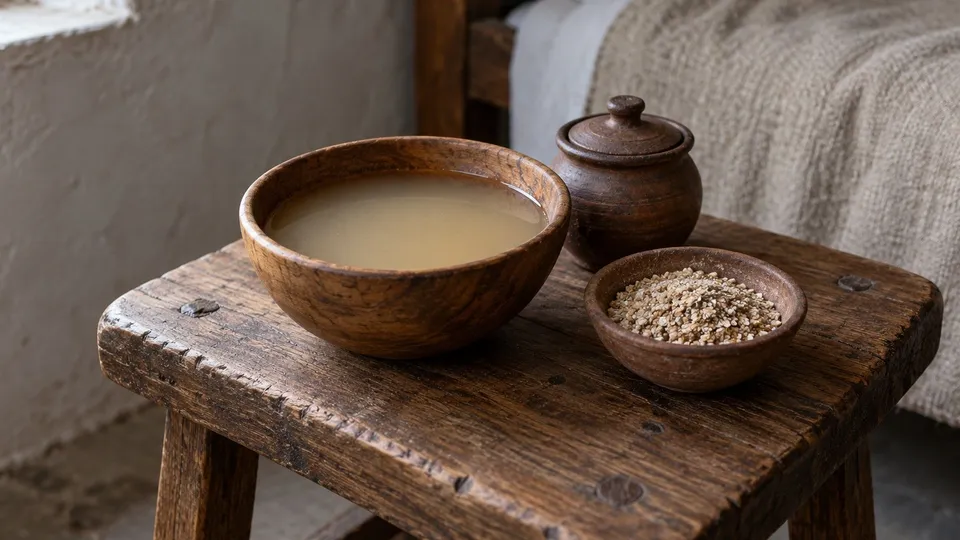 Always alcohol-freeWater Gruel, a Medieval Oat Drink for the Sick
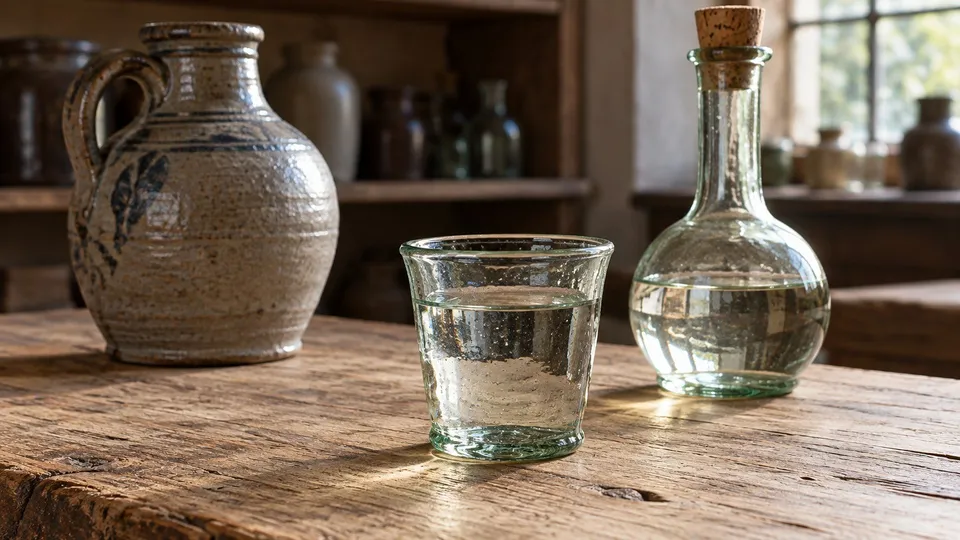 Always alcohol-freeRose Water, a Tudor Still-Room Drink
Coffee, tea, chocolate and saloop
London had all three hot newcomers by the 1650s, and a handbook printed there in 1685 still had to explain how to make them. How Were Coffee, Tea and Chocolate Made in 1685? works through its methods: coffee boiled with a little sugar, green tea in a covered pot and chocolate ground with chile and aniseed.
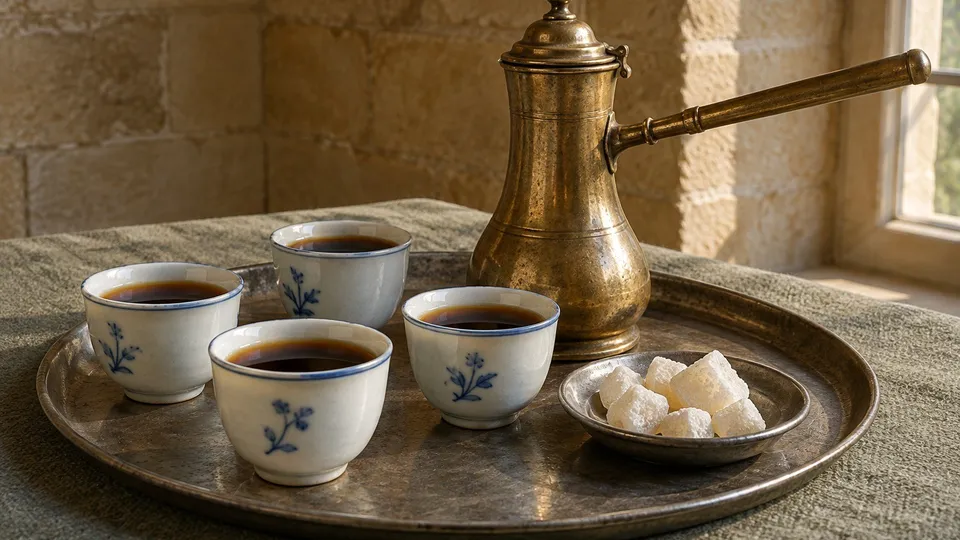 Always alcohol-freeDufour’s Coffee, Boiled with a Little Sugar
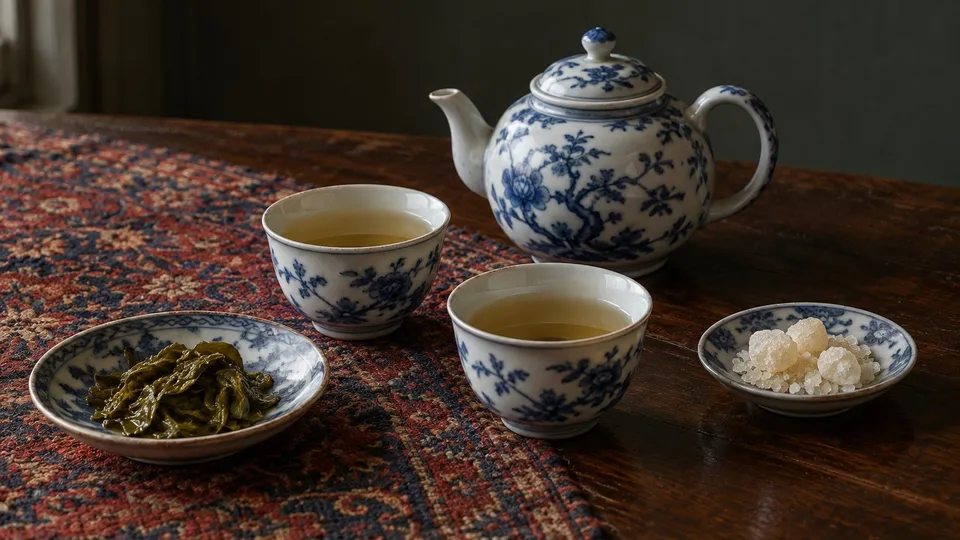 Always alcohol-freeTea the Chinese Way, with a Little Sugar
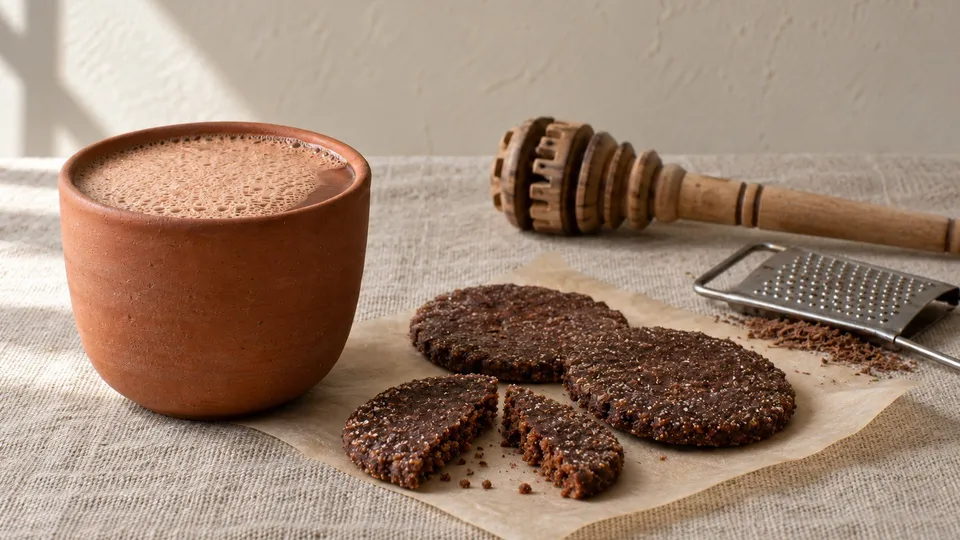 Always alcohol-freeColmenero’s Spiced Chocolate, Frothed with Hot Water
From the 1700s to the 1840s, chimney sweeps and early workmen bought saloop at London’s dawn stalls, a hot, slightly thick drink of orchid root or sassafras. Neither belongs in a kitchen now, so the versions to make are clear saloop with lemon peel and saloop with milk, both thickened with arrowroot.
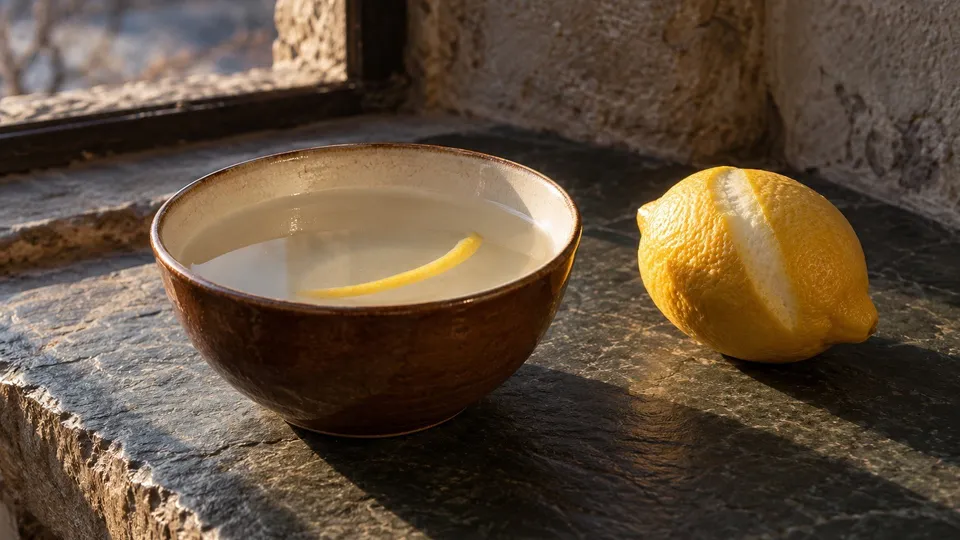 Alcohol-free versionClear Saloop with Lemon Peel
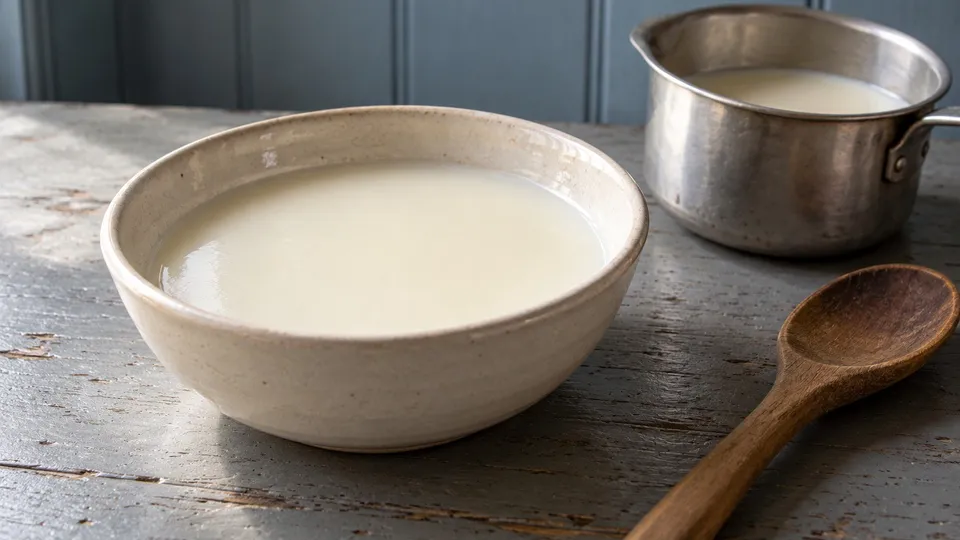 Always alcohol-freeSaloop with Milk
Barley water between two wines
Barley water was already a household standby when Eliza Smith’s The Compleat Housewife reached its ninth edition in 1739. Her recipe boils four ounces of pearl barley, adding water “till ’tis of a good thickness to drink,” then mace or cinnamon, the juice of two or three lemons and fine sugar, and ends with a storage note: “it will keep three or four days.”
It is the one sober drink on its page. Elder wine sits above it. Below it comes Barley Wine: French barley boiled in three waters, then mixed with a quart of white wine, borage and clary waters, lemon and sugar, “pleasant in hot weather, and very good in fevers.” The same grain made a drink for each side of the table. Barley Water with Lemon and Mace is Smith’s recipe as printed, with the water measured out.
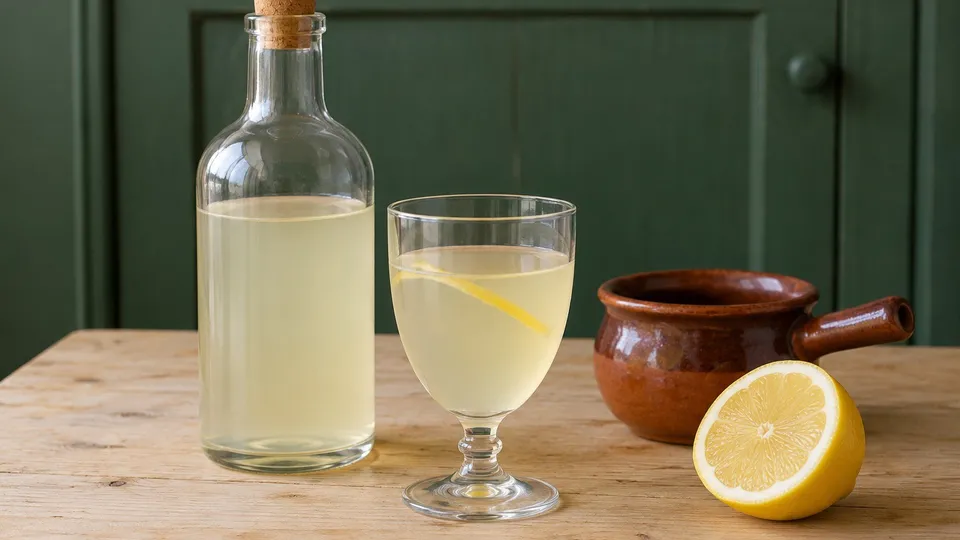 Always alcohol-freeBarley Water with Lemon and Mace
Orgeat and the sickroom waters
The fullest set of plain household drinks from around 1800 is in Maria Eliza Rundell’s A New System of Domestic Cookery, first published in London in 1806 and reprinted “By a Lady” in Philadelphia the next year. The chapter headed “For the Sick” reads like a menu of waters. A tumbler of cold water takes a tablespoon each of capillaire, a sweet syrup, and vinegar. Lemon water is steeped in a teapot, “a delightful drink.” Boiling water goes over sliced or roasted apples, and toast-and-water is bread toasted “till extremely brown and hard, but not the least black” and left an hour in a jug of cold water.
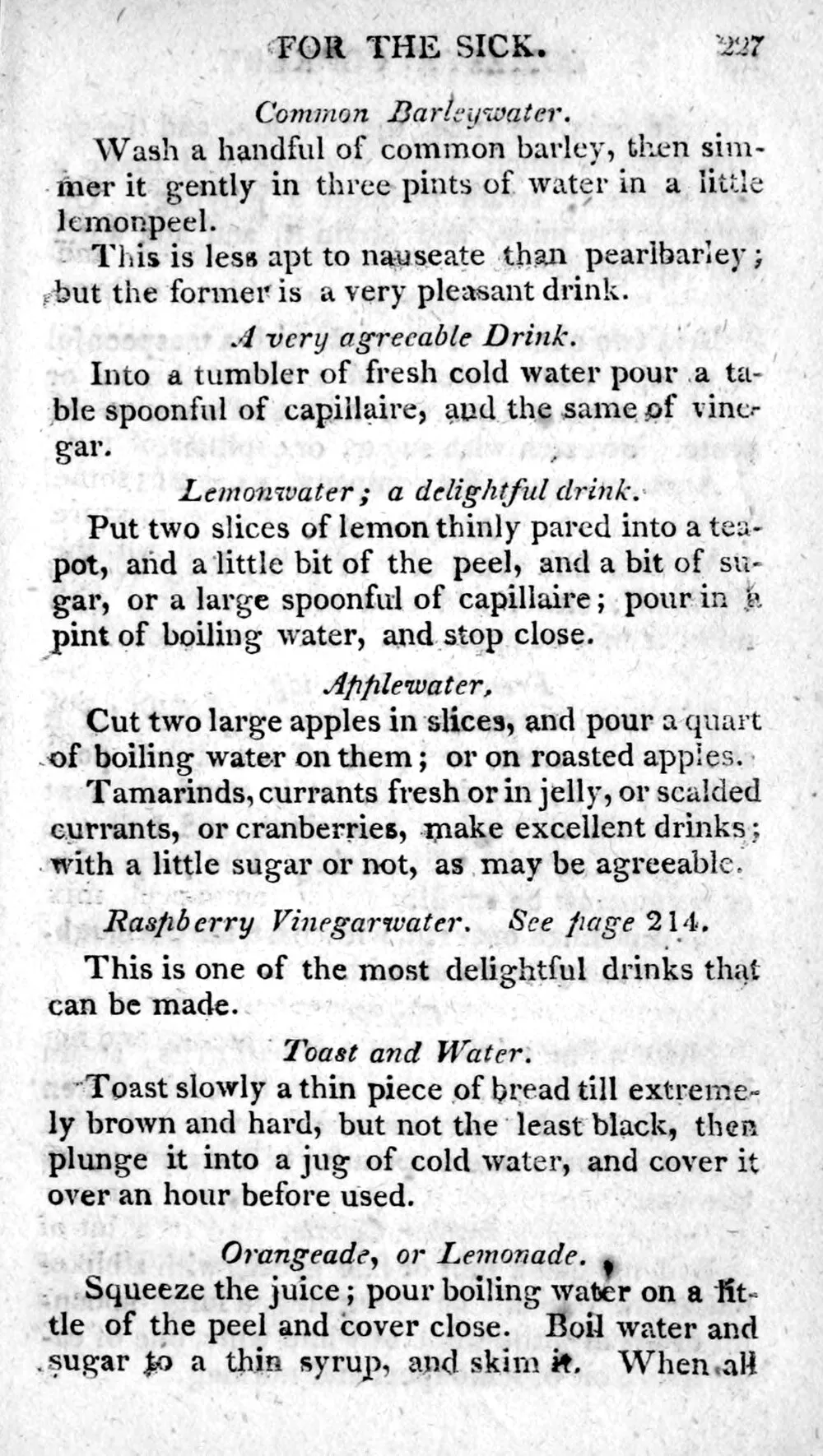 Drinks “For the Sick,” p. 227 in [Maria Eliza Rundell], A New System of Domestic Cookery (Philadelphia: Benjamin C. Buzby, 1807).
Almonds made two drinks in the same book. The sickroom orgeat on the next page is almonds beaten “with a teaspoonful of orange flour water, and a bitter almond or two,” let down with a quart of milk and water and sweetened. Back in the brewing chapter, the orgeat for company boils milk with cinnamon, adds almond paste and finishes with “half a glass of brandy.” Only the invalid’s version was sober. Orgeat, Almond Milk with Orange-Flower Water makes that one, with almond extract in place of the bitter almonds.
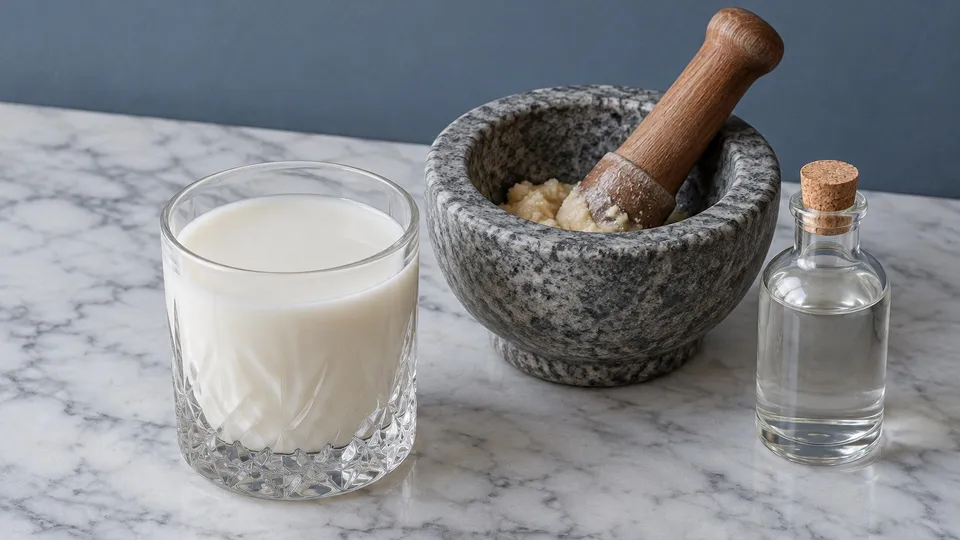 Always alcohol-freeOrgeat, Almond Milk with Orange-Flower Water
Rundell’s party lemonade, “to be made a day before wanted,” borrows milk punch’s trick without the spirit: lemon juice, rinds and sugar are mixed with three quarts of milk made boiling hot and poured through a jelly bag “till perfectly clear.” Lemonade has a longer history than most of these drinks, and A Short History of Lemonade follows it.
Switchel for the hay-makers
American farmers had a sour-sweet drink of their own. “Attention, Hay-Makers!” called a Philadelphia magazine, The Evening Fire-Side, in June 1805, telling them to skip the flip and toddy and drink switchel, “molasses or maple sugar mixed with water,” or else whey, or milk and water. By 1856 the Quaker Friends’ Intelligencer printed a harvest drink of ten gallons of cold water, a gallon of molasses, a quart of vinegar and a quarter-pound of ground ginger, “a thousand times better than with rum.”
The name promised nothing. A Harvard Advocate writer of 1867, remembering the college some fifty years before, described its favorite switchel as “a compound of rum, molasses, and ginger.”
Coffee taverns and two kinds of ginger beer
In 1861 Isabella Beeton’s Book of Household Management sorted drinks into classes, and the first, drinks with no fermentation, ran: “water, toast-and-water, barley-water, eau sucré, lait sucré, cheese and milk whey, milk-and-water, lemonade, orangeade, sherbet, apple and pear juice, capillaire, vinegar-and-water, raspberry vinegar and water.” Nearly every one was already in Rundell, and capillaire had its own recipe by 1829 in Meg Dods’s Edinburgh cookbook: Capillaire is her orange-flower syrup stirred into cold water with a little lemon. Beeton’s own raspberry vinegar, though, takes a wineglass of brandy to the pint. Her lemonade, made with boiling water, is sober, though the children’s parties it was poured at were not always. What Did Victorian Children Drink at Christmas? finds weak negus in the jug, and the alcohol-free bishop is a warm jug without it.
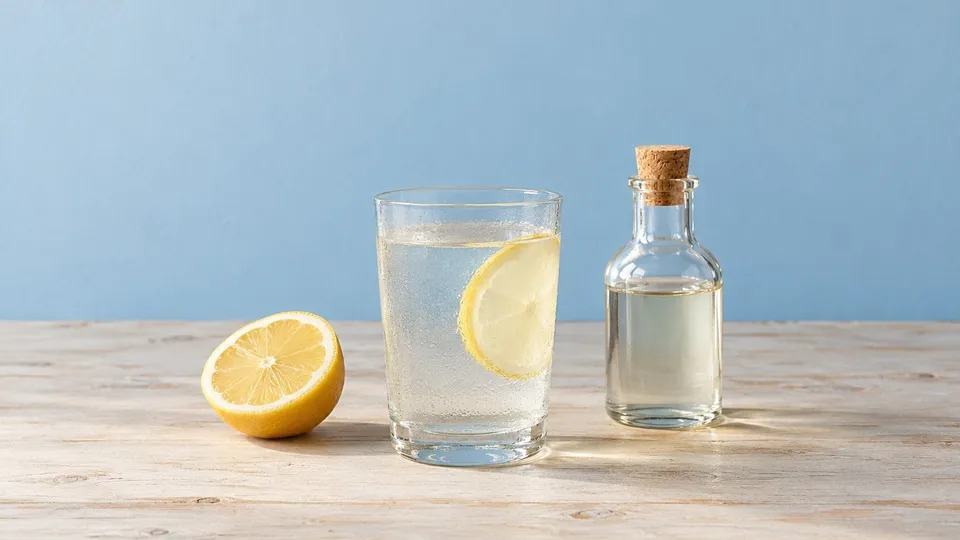 Always alcohol-freeCapillaire, the 1829 Orange-Flower Summer Draught
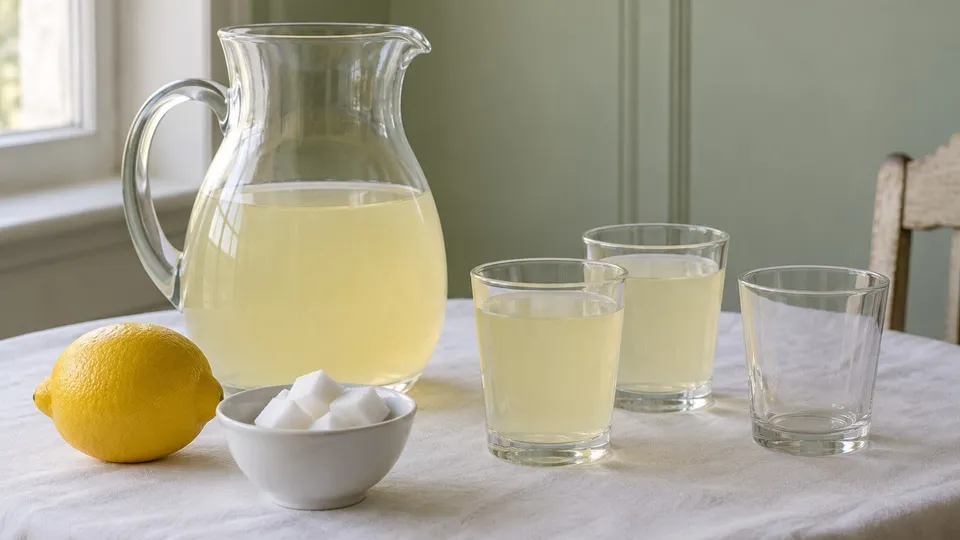 Always alcohol-freeMrs. Beeton’s Lemonade, Made with Boiling Water
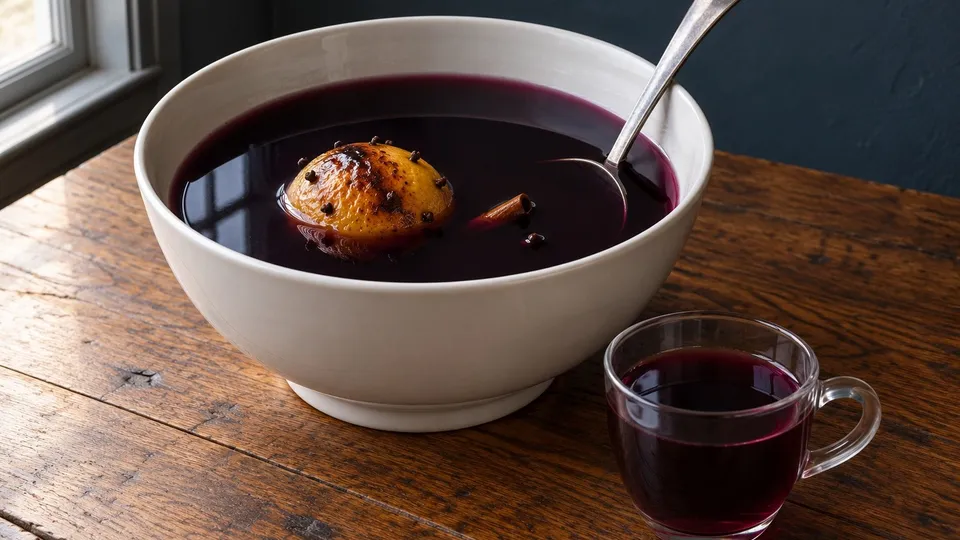 Alcohol-free versionAlcohol-Free Bishop, Spiced Grape Juice with a Roasted Lemon
From the 1870s reformers took on the pub with coffee taverns, selling cocoa, coffee and tea from urns over a pub-style bar. A London manual of 1878 reckoned coffee and tea could be sold “at 1d. per cup, holding half-a-pint,” about 43p today, by UK consumer prices (Bank of England). Coffee Taverns, the Victorian Answer to the Pub tells how the taverns fared, and their urn methods are Coffee-Tavern Coffee at a Penny a Cup and Coffee-Tavern Tea, Steeped Ten Minutes.
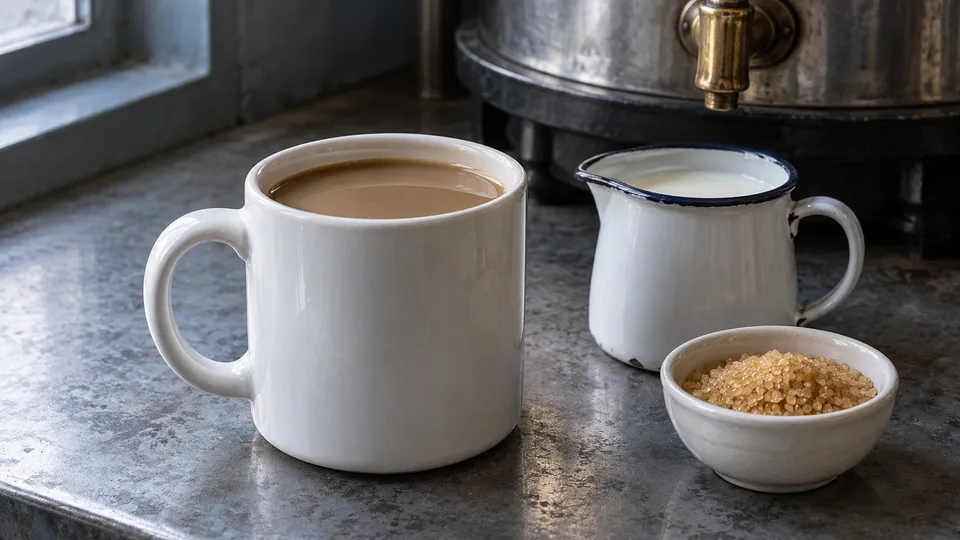 Always alcohol-freeCoffee-Tavern Coffee at a Penny a Cup
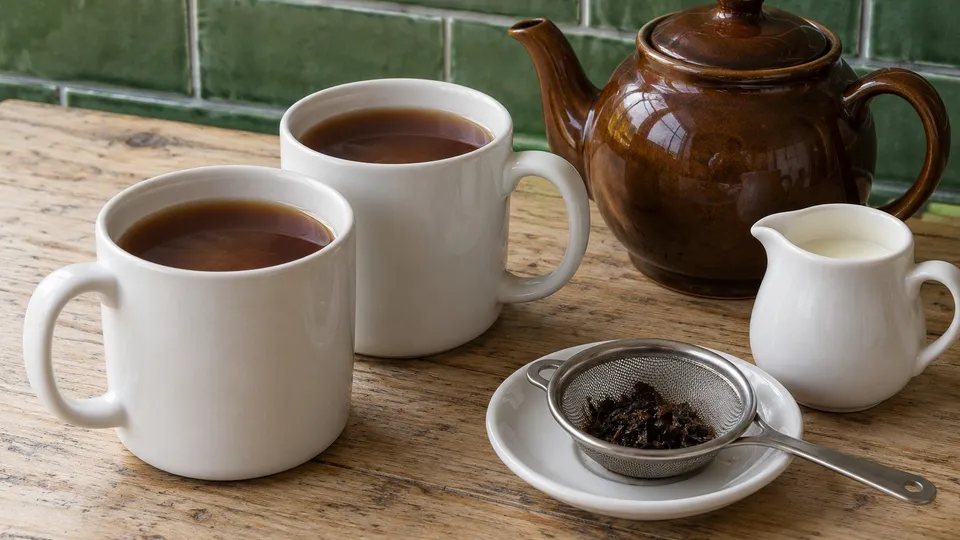 Always alcohol-freeCoffee-Tavern Tea, Steeped Ten Minutes
Ginger beer is the clearest case. The bottled ginger, lemon and hop beers were mostly brewed with yeast and corked while still working, so they held a little alcohol, as What Were Victorian Non-Alcoholic Beers? shows. The exception was the street fountain of about 1850, lemon water pumped full of gas, which needed, in Henry Mayhew’s words, “No process of brewing or fermentation.” Alcohol-Free Ginger Beer, the Fountain Way works on the same principle. Russian bread kvass was brewed with yeast too, and Alcohol-Free Bread Kvass with Lemon and Mint steeps Elena Molokhovets’s 1887 rye bread and mint without it, then lifts the drink with soda water.
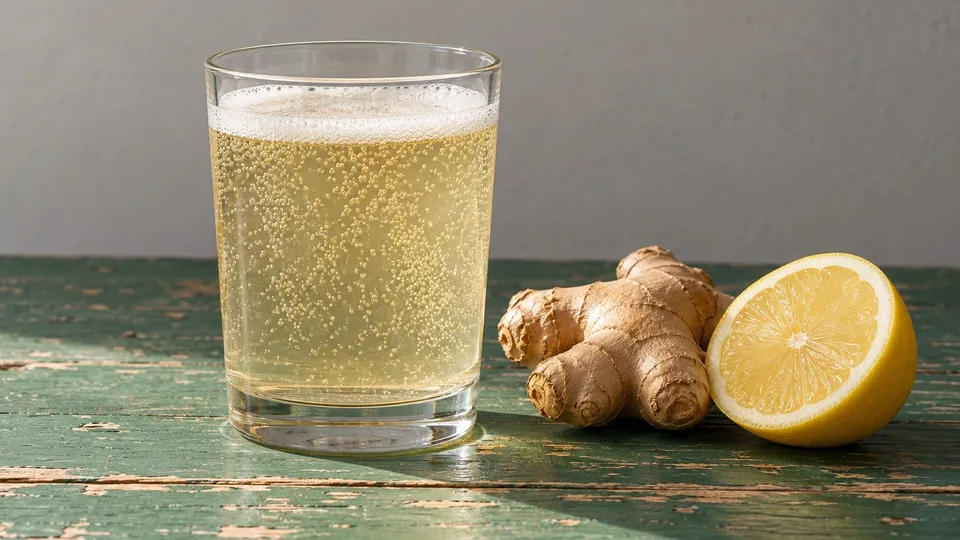 Alcohol-free versionAlcohol-Free Ginger Beer, the Fountain Way
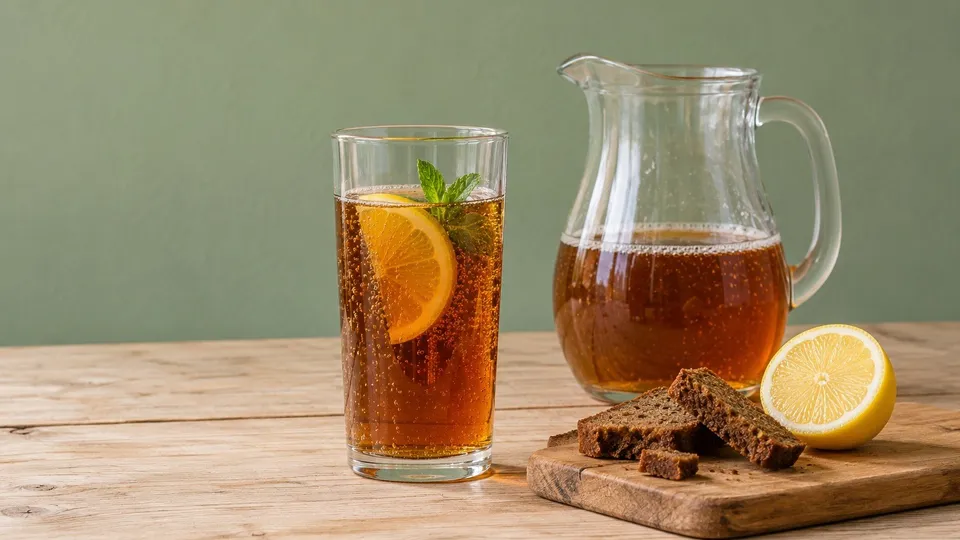 Alcohol-free versionAlcohol-Free Bread Kvass with Lemon and Mint
A temperance cookbook with yeast in it
Mrs. Mary G. Smith of San Jose brought out the second edition of her Temperance Cook Book in 1887, holding that “There should be nothing in our eatables to awaken the appetite of the reformed.” Most of her drinks keep that promise: lemonade over lumps of ice, fruit vinegars fizzed in the tumbler with a little baking soda (shrubs by another name; TuneMyRecipe has an 1862 raspberry shrub (opens in a new tab)), and a “white tea” for children of sugar, milk and boiling water.
Two of her recipes held alcohol all the same. Her Temperance Ginger Wine has no wine in it, only loaf sugar, tartaric acid and boiling water, heated with two drachms each of essence of ginger and essence of capsicum. In the shops of the day essence of ginger was a tincture: Arnold Cooley’s Cyclopaedia of Practical Receipts (1880) steeps bruised Jamaica ginger in “rectified spirit” for a fortnight. By our arithmetic, the essences leave about a quarter of one percent of alcohol in the five quarts, below the half percent the US allows a drink labeled non-alcoholic. Alcohol-Free Temperance Ginger Wine swaps the essences for fresh ginger and chile simmered in the water, which takes the trace out.
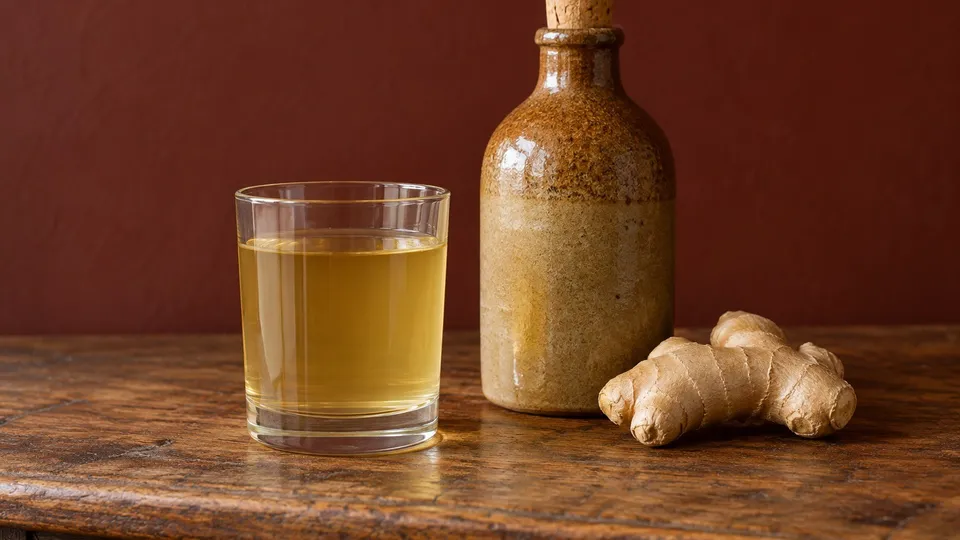 Alcohol-free versionAlcohol-Free Temperance Ginger Wine
Her Summer Beverage goes further. Oils of sassafras, spruce and wintergreen in sweetened water are started with “three gills of distillery yeast” and bottled after twenty-four hours. That is a brewed drink, like the street ginger beers, and would have held a little alcohol. She calls it “a delicious beverage.” It is not one to copy: safrole, the main compound in sassafras oil, may no longer be added to food in the US, the EU or the UK.
The soda fountain in winter
The American soda fountain, a drugstore counter mixing soft drinks to order, had its heyday from about 1890 and did not close for winter. What Did Soda Fountains Sell in Winter? covers the “hot soda” that had no soda in it: Hot Ginger, Hot Egg Lemonade and Hot Malted Milk with Salt and Pepper. Its ginger extract was another alcohol tincture, so the period mug held a trace; ours uses fresh ginger.
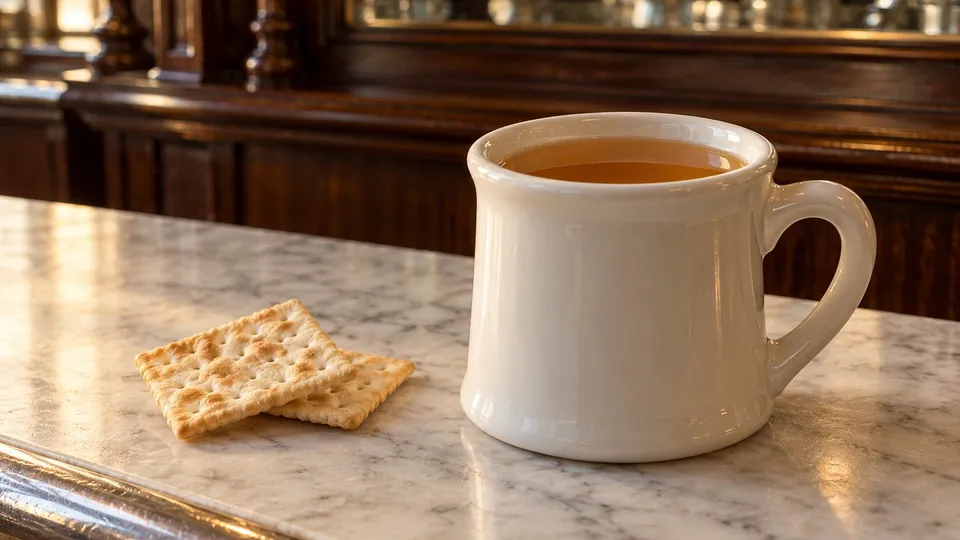 Always alcohol-freeHot Ginger, the Soda Fountain’s Winter Drink
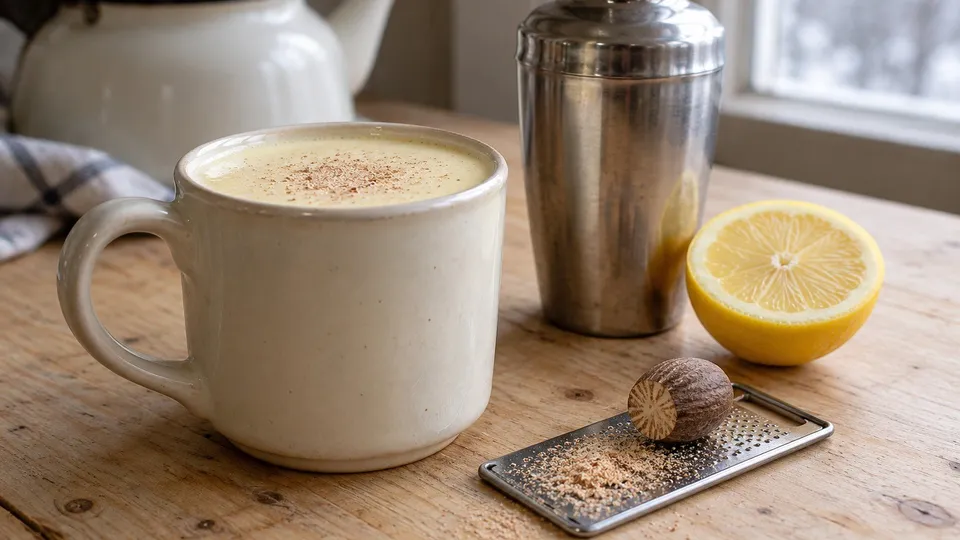 Always alcohol-freeHot Egg Lemonade from the Soda Fountain
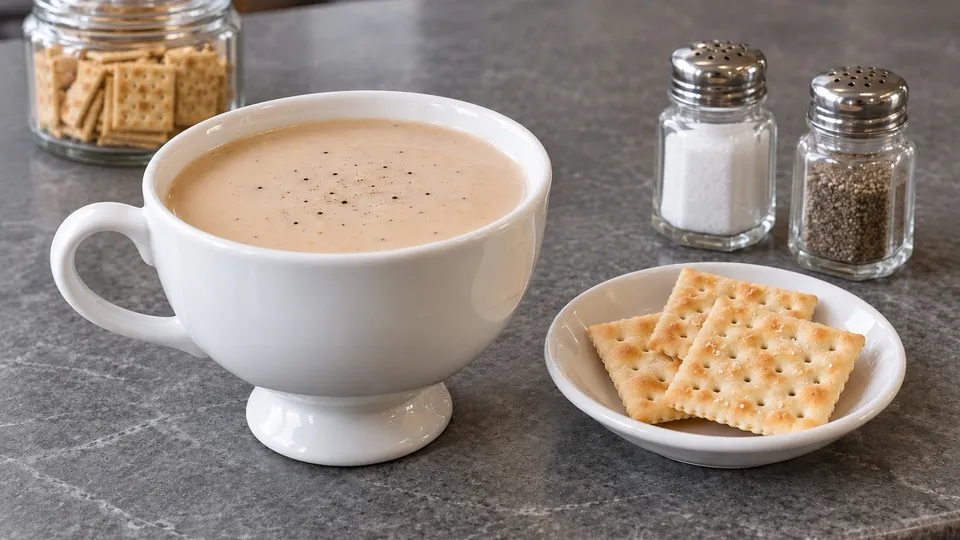 Always alcohol-freeHot Malted Milk with Salt and Pepper
Prohibition paradise
National Prohibition took effect on January 17, 1920. That year Bertha E. L. Stockbridge’s What to Drink faced its foreword with “Omar up to Date,” an anonymous verse that swaps the jug of wine for “An ice cream cone, some lemonade,” and ends: “Make prohibition Paradise enow.” The dry party poured drinks the soda counter had made familiar, and Five Alcohol-Free Drinks for a 1920s Party sets out a party’s worth: the grape juice highball, lemon egg phosphate, ginger ale punch, fresh orangeade and American lemonade as London made it.
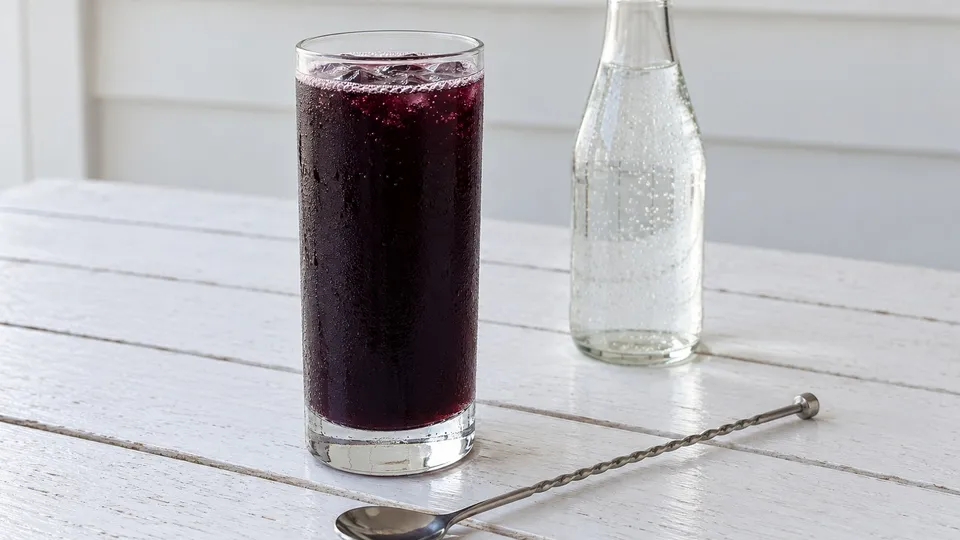 Always alcohol-freeGrape Juice Highball, the Prohibition Soft Drink
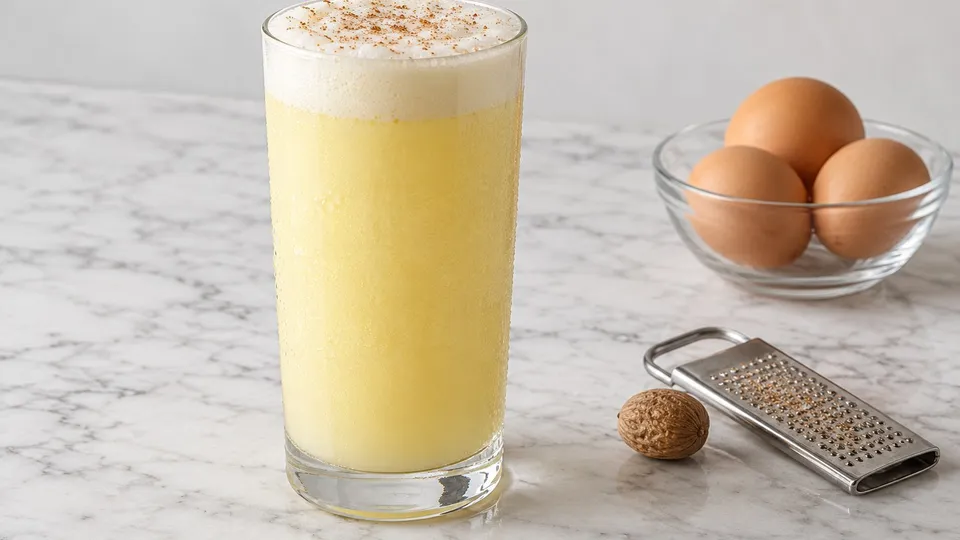 Always alcohol-freeLemon Egg Phosphate, the Soda Fountain Sour
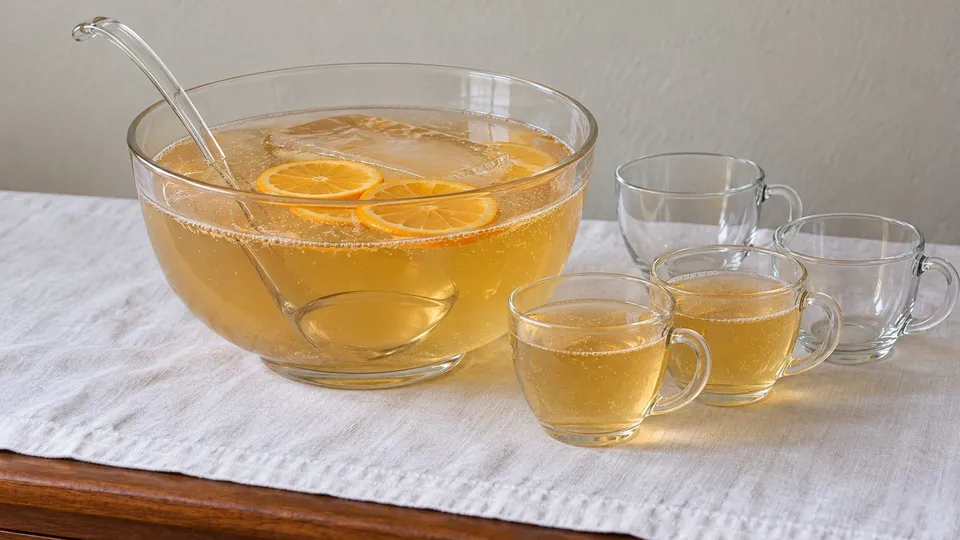 Always alcohol-freeGinger Ale Punch for a Dry Party
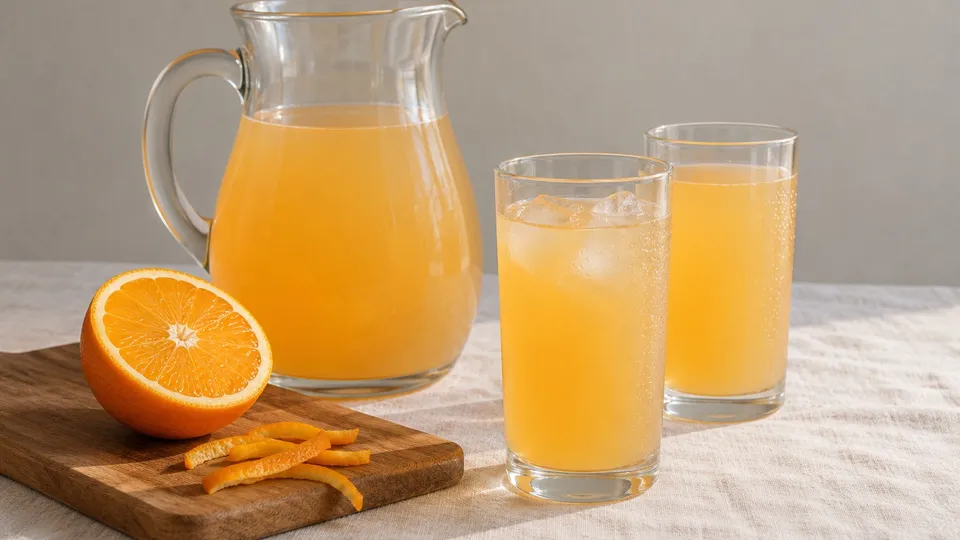 Always alcohol-freeFresh Orangeade, Juice, Sugar and Water
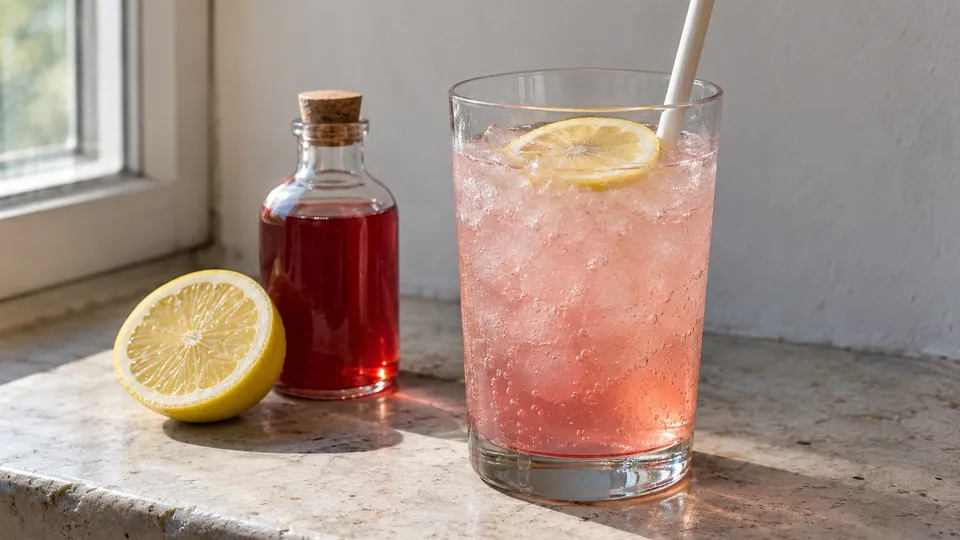 Always alcohol-freeAmerican Lemonade, as London Made It
Her foreword told the hostess that “it were well to go back to the habits and customs of our grandmothers,” and her book went back further than that. Barley water sits in its chapter for invalids, boiled, strained, sweetened and “more palatable with milk.” Orgeat returns as a syrup of sweet and bitter almonds and orange flower water, a tablespoon of it stirred into lemonade. Both were in Rundell’s sickroom chapter of 1807, and barley water in Eliza Smith’s kitchen nearly seventy years before that. Pearl barley, lemons, mace and sugar are all Smith’s barley water asks for.
Sources
- Eliza Smith, The Compleat Housewife: or, Accomplish’d Gentlewoman’s Companion, 9th ed. (London, 1739), p. 221.
- [Maria Eliza Rundell], A New System of Domestic Cookery, “By a Lady” (Philadelphia: Benjamin C. Buzby, 1807), pp. 213–214, 227–228.
- The Evening Fire-Side; or, Literary Miscellany (Philadelphia), June 22, 1805, p. 222, “Attention, Hay-Makers!”
- “Harvest Drink,” Friends’ Intelligencer (Philadelphia), July 5, 1856, p. 254.
- “They Never Do So Now,” The Harvard Advocate 4, no. 1 (1867), p. 3.
- Isabella Beeton, The Book of Household Management (London: S. O. Beeton, 1861), p. [871].
- Coffee Publichouse Association, The Coffee Publichouse: How to Establish and Manage It (London, 1878), p. 28.
- Henry Mayhew, London Labour and the London Poor, vol. 1 (London: Griffin, Bohn, 1861), pp. 186–187.
- Mrs. Mary G. Smith, Temperance Cook Book, for the Benefit of All Housekeepers, 2nd ed. (San Jose, Cal.: Mercury Book and Job Printing Office, 1887), preface and pp. 218–220.
- Arnold J. Cooley, Cooley’s Cyclopaedia of Practical Receipts, 6th ed., vol. 1 (London: Churchill, 1880), p. 653.
- Bertha E. L. Stockbridge, What to Drink: The Blue Book of Beverages (New York and London: D. Appleton and Company, 1920), “Omar up to Date,” pp. vii, 7, 73, 114.
- T. W. Huffam after Alfred Crowquill, Temperance.—The Man, mezzotint (London: R. C. Lambe, 1843), The Metropolitan Museum of Art, 24.63.1200.