Whey, the Drink Left Over from Cheese
Reader ratingsThe thin, pale liquid that runs from fresh curds, made safely at home from pasteurized milk and rennet and drunk cold: a Tudor drink of shepherds and the poor.
- Recipe makes
- About 1.5 l whey, plus fresh curds
- Prep
- Cook
- Total
Allows up to about 45 minutes for the milk to set, which varies with the rennet, 30 minutes to drain and about 1 hour to chill the whey.
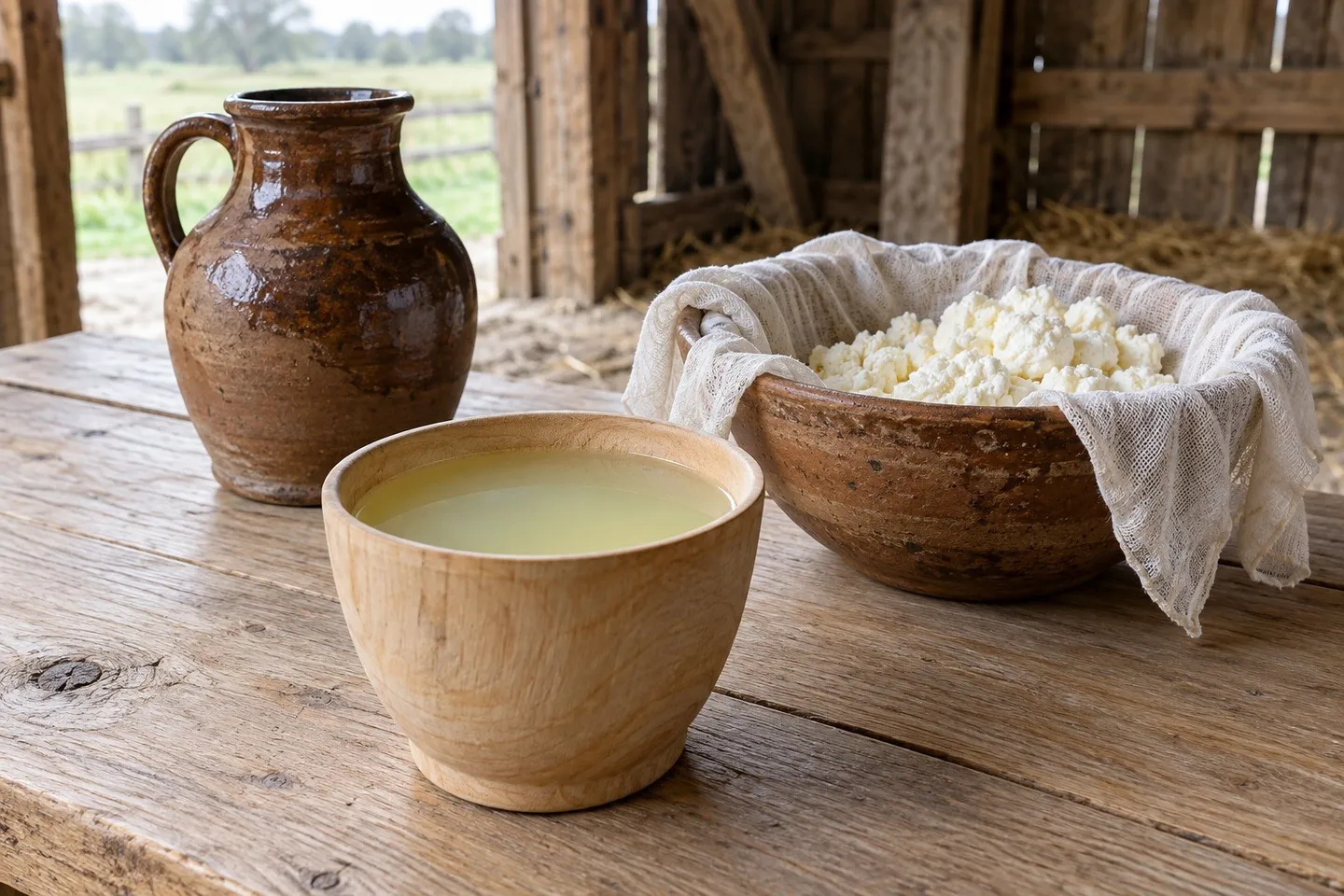
Cold whey in a wooden cup, with the fresh curds draining beside it.
The story behind the recipe
Make a soft cheese and a thin, pale liquid runs out of the curds. That is whey, and in Tudor England people drank it. The physician Andrew Boorde, in his Dyetary of Helth of 1542, files it between metheglin and posset ale and calls whey, “yf it be wel ordered,” a “temporate drynke.” He was less kind about the people who lived on it.
What the curds left behind
Whey came free with every cheese. Medieval cookbooks make curds and pour it off: a fifteenth-century recipe for fritters begins with milk made into curds “in þe maner of a chese al tendyr,” then says to “take owt þe whey as clene as þou may.” Some of that whey was drunk. Boorde’s editor, F. J. Furnivall, adds a line from Roy’s Satire about poor shepherds “Lyvynge on mylke / whyg / and whey,” with whyg glossed as “butter-milk, or sour whey,” and another, from 1530, in which the speakers complain that they “are fayne to drycncke whygge and wheye.”
Boorde himself prefers “that whay the which doth come of butter,” and lists among its virtues that it “doth nourysshe,” which is his claim, not ours. In the Introduction of Knowledge, printed with the Dyetary, he is blunter. Wales, he writes, has “muche pouerty, and many reude and beastlye people, for they do drynke mylke and whay.” In these sources whey is the drink of shepherds, farms and the poor.
Read more about this recipe
Safe whey at home
Fresh whey is thin and pale, with the mild taste of the milk it came from. The safe way to make it is the cheesemaker’s way: pasteurized whole milk, warmed and set with rennet. Raw milk can carry Listeria, Salmonella and E. coli, so it stays out of this kitchen. Ultra-pasteurized milk sets only into a weak curd, so check the label. A little honey is our addition; Boorde doesn’t mention sweetening. The curds make a fresh soft cheese. Whey’s neighbor in Boorde’s list, Posset Ale, splits hot milk with ale instead of rennet.
Recipe makes: About 1.5 l whey, plus fresh curds
Ingredients
For About 1.5 l whey, plus fresh curds. Quantities are shown as written.
Quantities as written here, for About 1.5 l whey, plus fresh curds.
- Pasteurized whole milk2 l
- Liquid rennet1/8 metric tsp (5 ml per tsp)
- Cool unchlorinated water2 metric tbsp (15 ml per tbsp)
- Honey, to taste (optional)
Measurement notes
Ingredients as written here
- 2 l pasteurized whole milk
- 1/8 tsp liquid rennet
- 2 tbsp cool unchlorinated water
- honey, to taste (optional)
Equipment
 Large heavy saucepan
 Instant-read thermometer
 Long knife
 Colander lined with muslin or cheesecloth
 Large bowl and jug
Instructions
Pour the pasteurized whole milk into a large heavy saucepan and warm it gently over low heat, stirring, until it reaches 32°C (90°F). Take the pan off the heat.
Stir the liquid rennet into the cool unchlorinated water, then stir it into the milk with slow up-and-down strokes for 30 seconds.
Cover the pan and leave it completely still until the milk has set like a soft custard and splits cleanly when you push a finger in at an angle, with clear whey in the split. Check after 15 minutes, then every 10 minutes.
Cut the curd into 2.5 cm (1 inch) squares with a long knife, cutting right to the bottom of the pan, and leave it for 5 minutes as the whey begins to run.
Ladle the curds into the muslin-lined colander set over a large bowl and let the whey drain for about 30 minutes, without pressing.
Pour the whey into a jug, cover and chill it for about 1 hour. Serve it cold, plain or with a little honey stirred in.
Nutrition
70calories per serving
- Recipe makes
- About 1.5 l whey, plus fresh curds
- Servings
- 6
Estimated from the USDA FoodData Central value for fluid sweet whey, for six 250 ml glasses, without honey, which adds about 20 calories a teaspoon.
Recipe notes
When adjusting quantities
Use the rennet dose your bottle gives for the volume of milk; the recipe works with any amount.
Notes
Quantities mentioned in these notes don’t change when you adjust the batch.
The rennet dose here is scaled from a university extension recipe that uses 1/4 tsp of liquid rennet for 1 US gallon (3.8 l) of milk. Rennets vary in strength, so follow your bottle if it gives a different amount. Traditional rennet comes from calves; vegetarians can use a microbial or vegetable rennet, sold beside it.
Keep the whey in the fridge and drink it within a day. Salt the curds lightly and eat them fresh.
For whey’s place between water and ale in the medieval cup, see Did Medieval People Really Drink Beer Instead of Water?.
Scaling changes the ingredients only; glassware, ice and timings need their own judgment. To adapt this recipe further, try the recipe tool at TuneMyRecipe (opens in a new tab), our sister site.

Sources and attribution
Andrew Boorde, A Compendyous Regyment or a Dyetary of Helth (1542), ed. F. J. Furnivall, The Fyrst Boke of the Introduction of Knowledge (London: N. Trübner for the Early English Text Society, 1870), pp. 127 and 257
Recipe details
- Drink
- Alcohol-free
- Drink family
- Sodas & Soft Drinks
- Region
- British
- Base
- Milk & whey
- Difficulty
- Intermediate
- Season
- Summer