Adynamon, Pliny’s Wine Without Strength
Reader ratingsWhite grape must boiled with half its volume of water until the water is gone: the Roman ‘wine’ given to people who were not allowed wine. Alcohol-free.
- Recipe makes
- About 1 liter, 6 small glasses
- Prep
- Cook
- Total
Includes about 1 hour to cool and chill.
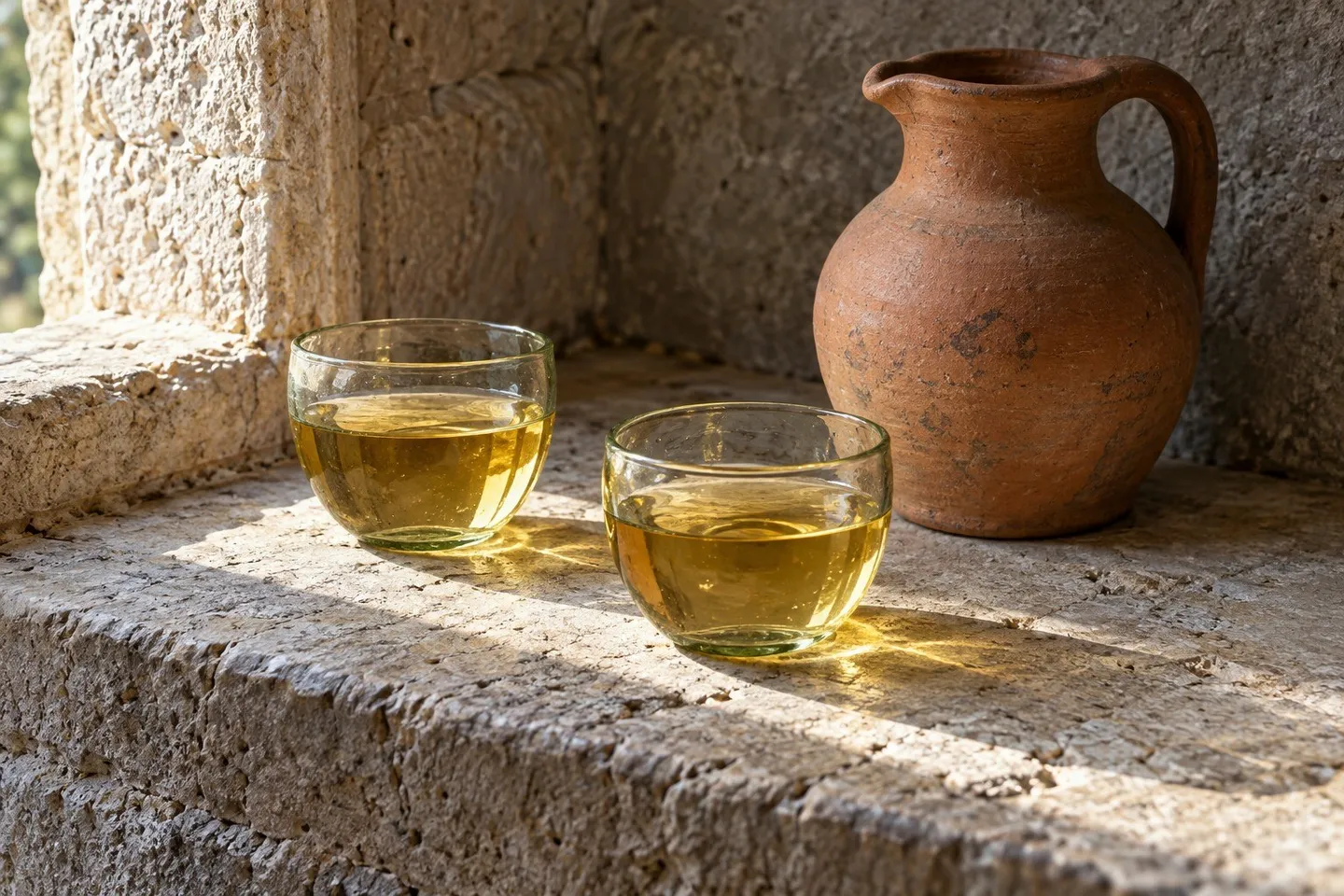
Adynamon, boiled white grape must, served cold in small glass cups with a terracotta jug.
The story behind the recipe
Romans who were told to keep off wine got a wine of their own, adynamon. Pliny the Elder puts it first in his list of artificial wines: white must, the fresh juice of the grape, boiled with water until the water had gone. It was meant, he says, for invalids who might be harmed by wine. The name is Greek and means “without strength.”
A drink for the sickroom
Wine was the default at a Roman table. “After water and milk, wine was the ordinary drink of the Romans of all classes”: so Harold Whetstone Johnston summed it up in The Private Life of the Romans (1903). A patient told to avoid it still needed something from the grape to drink, and adynamon filled that place.
Pliny gives two recipes. In the first, the must is boiled with half its volume of water until the water has gone. In the second, some makers added sea-water and rain-water and left the mixture out in the sun for forty days. He files the whole family under medicine; the artificial wines, he says, “are all of them employed for medicinal purposes.”
Not everyone approved. His 1855 translators pass on the verdict of the French commentator Fée, whom they quote throughout: the mixture “would appear to be neither potable nor wholesome.”
Read more about this recipe
Juice, water and half an hour
This version follows the first recipe and leaves out the sea-water, and the forty days in the sun, which could start a ferment. A bottle of white grape juice does the work of fresh must. The added water keeps the juice simmering for half an hour and then boils off again, so it should taste cooked without turning syrupy. Pliny doesn’t say how it was served, so the cold small glass is our idea. The same juice unboiled is mustum.
The first of the artificial wines has wine for its basis; it is called “adynamon,” and is made in the following manner. Twenty sextarii of white must are boiled down with half that quantity of water, until the amount of the water is lost by evaporation. Some persons mix with the must ten sextarii of sea-water and an equal quantity of rain-water, and leave the whole to evaporate in the sun for forty days. This beverage is given to invalids to whom it is apprehended that wine may prove injurious.

Recipe makes: About 1 liter, 6 small glasses
Ingredients
For About 1 liter, 6 small glasses. Quantities are shown as written.
Quantities as written here, for About 1 liter, 6 small glasses.
- White grape juice1 l
- Water500 ml
Measurement notes
Ingredients as written here
- 1 l white grape juice
- 500 ml water
Equipment
 Wide stainless steel or enameled saucepan
 Wooden spoon
 Carafe or jug
Instructions
Pour a volume of water equal to your grape juice into a wide stainless steel or enameled saucepan and mark the level on the handle of a wooden spoon. Tip the water out.
Pour in the white grape juice and the water and bring to a simmer over medium heat. Skim off any foam.
Keep it at a steady simmer for about 30 minutes, until it has reduced back to the mark on your spoon.
Pour into a carafe and leave to cool for about 30 minutes, then chill for about 30 minutes more. Serve cold in small glasses.
Nutrition
105calories per serving
- Recipe makes
- About 1 liter, 6 small glasses
- Servings
- 6
Estimated from the ingredients using USDA FoodData Central values for bottled white grape juice; boiling off the added water leaves the calories unchanged.
Recipe notes
When adjusting quantities
Use half as much water as grape juice by volume, and boil it back down to the volume of juice you started with.
Notes
Quantities mentioned in these notes don’t change when you adjust the batch.
Pliny’s batch is 20 sextarii of must to 10 of water. At about 546 ml to the sextarius (Wikipedia, Ancient Roman units of measurement (opens in a new tab), accessed October 20, 2026), that is roughly 11 liters of must and 5.5 liters of water; this recipe keeps his two-to-one ratio at about a tenth of the size.
Look for a white grape juice with nothing added to it. Pliny says “white must” and nothing about the grape.
Adynamon, the drink Romans gave the sick, is one of the alcohol-free drinks in What Did Romans Drink Besides Wine?.
Scaling changes the ingredients only; glassware, ice and timings need their own judgment. To adapt this recipe further, try the recipe tool at TuneMyRecipe (opens in a new tab), our sister site.
Sources and attribution
Pliny the Elder, The Natural History of Pliny, vol. 3, trans. John Bostock and H. T. Riley (London: Henry G. Bohn, 1855), Book XIV, ch. 19, p. 256
Recipe details
- Drink
- Alcohol-free
- Drink family
- Sodas & Soft Drinks
- Era
- Ancient Rome
- Base
- Fruit & juice
- Difficulty
- Easy
- Occasion
- Dry JanuaryDinner party