Melomeli, Roman Quince and Honey Syrup
Reader ratingsRipe quince warmed in honey and steeped overnight: Columella’s quince-scented honey, stirred into cold water for an alcohol-free Roman drink.
- Recipe makes
- About 300 ml syrup, enough for 10 drinks
- Prep
- Cook
- Total
Includes about 30 minutes of cooling and an overnight steep of about 12 hours in the fridge.
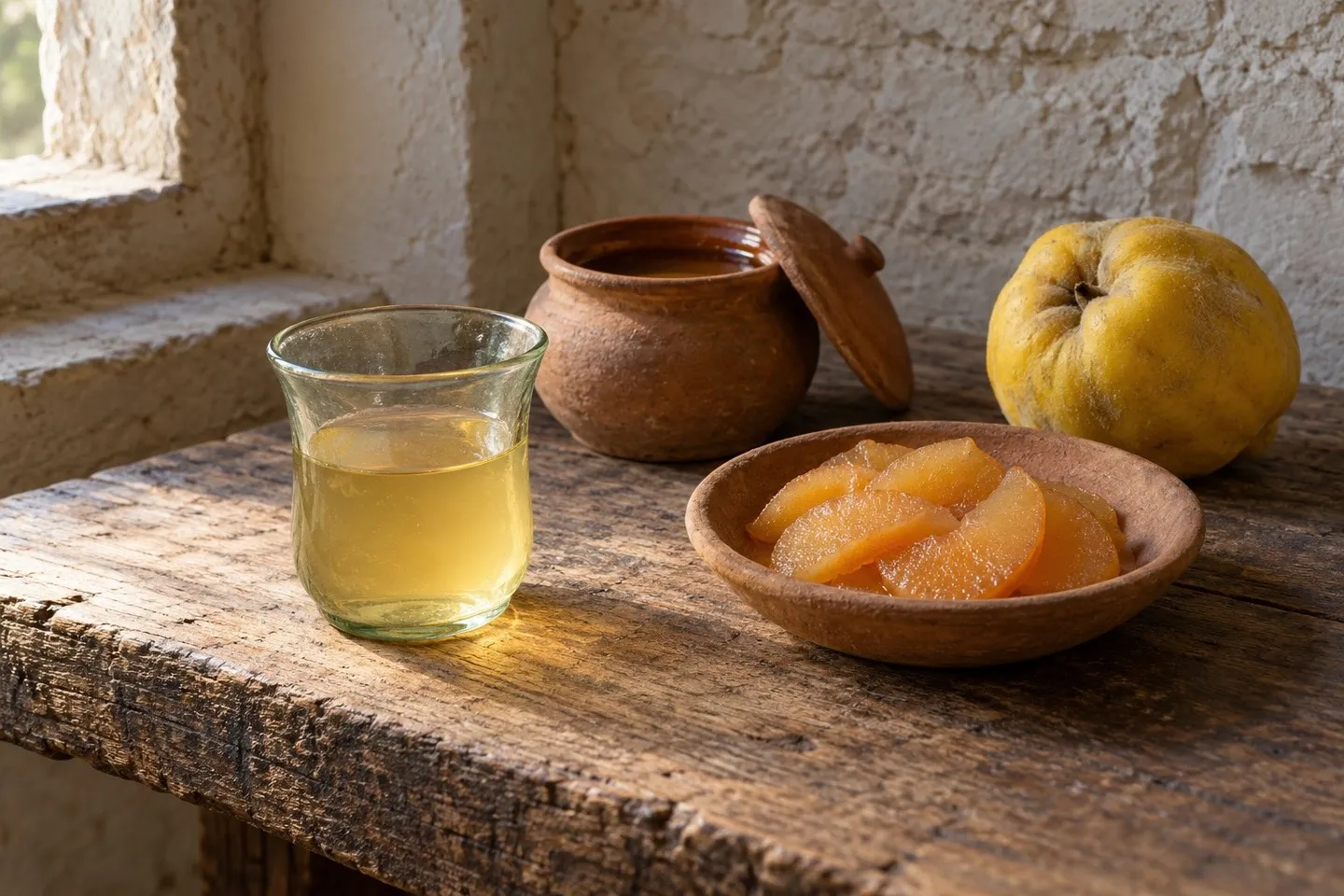
Melomeli diluted with water in a pale green glass cup, with the terracotta syrup pot, cooked quince slices and a ripe quince.
The story behind the recipe
Pack ripe quinces into a jar of honey, Columella advises, and the honey you later pour off is melomeli, a quince-scented liquor with, he says, “an honey-wine taste.” He thought it gentle enough for fever patients, and he trusted honey so far that he added, without blinking, that it “preserves also a dead human body sound and intire for very many years.”
Golden apples in honey
Quinces had a reputation. Pliny the Elder says they came “from the island of Crete,” lists a golden kind, an “Italian” one with “a most exquisite smell,” and notes that only one variety, the Mulvian, was “eaten raw.” The rest were kept for their scent “in the antechambers of great men” and hung on the statues in bedrooms. To store them, he advises, they “should be boiled in honey or soaked in it.”
Columella, in his twelve books on farming, gives the soaking method in full, down to the willow twigs that hold the fruit under the honey. His 1745 translator calls the liquor a syrup of quinces and honey; Columella’s Latin word is melomeli. The honey-wine of his comparison was a drink every Roman knew as mulsum, wine sweetened with honey four measures to one. The fever advice is Columella’s, not ours.
Read more about this recipe
A quicker, safer jar
Columella’s jar works over months, and raw fruit slowly thins the honey with its juice. Honey and water left to stand is how Romans made mead, so that slow route can end up with some alcohol in it. This version takes Pliny’s other option and warms the quince in the honey, then steeps it overnight, which keeps it alcohol-free and ready the next day.
The cores come out. Columella called removing the seeds “intirely superfluous,” but quince seeds contain amygdalin, which can break down into cyanide. Choose a fully yellow, strongly scented quince and a mild honey such as acacia or orange blossom, so the fruit’s perfume comes through. Columella doesn’t say to dilute it; the cold water is ours. More drinks like it are collected under historic non-alcoholic drinks.
Nevertheless, we have not experienced any thing surer or better, than, in fair weather, and in the wane of the Moon, to gather the ripest quinces, that are sound, and without any blemish; and after the down, which is upon the apples, is wiped off, to put them up lightly, and very loose, that they may not be bruised the one against the other, in a new stone bottle with a very wide mouth; then, when they are stowed up to the neck of the bottle, to thrust them down close to one another, with willow-twigs laid cross them in such a manner, as gently to compress the apples, and not suffer them to be lifted up with the liquor, when it is poured in upon them; then to fill the vessel to the brim with the best and the most liquid honey, so that the apples may be intirely covered with it. This method not only preserves the apples themselves safely, but also affords a liquor of an honey-wine taste, which sometimes may be given, without any hurt, to such as are sick of a fever; and it is called syrup of quinces and honey.

Recipe makes: About 300 ml syrup, enough for 10 drinks
Ingredients
For About 300 ml syrup, enough for 10 drinks. Quantities are shown as written.
Quantities as written here, for About 300 ml syrup, enough for 10 drinks.
Syrup
- Large ripe quince1
- Mild liquid honey300 ml
To serve
- Cold water per drink200 ml
Measurement notes
Ingredients as written here
- 1 large ripe quince
- 300 ml mild liquid honey
- 200 ml cold water per drink
Equipment
 Small heavy saucepan
 Fine sieve
 Clean glass jar with a lid
Instructions
Rub the gray down off the ripe quince with a dry cloth. Quarter it, cut out the core and every seed, and slice the quarters about 5 mm thick, leaving the skin on.
Put the quince slices and the mild liquid honey in a small heavy saucepan and warm over low heat until the honey turns thin and fluid.
Keep it just below a simmer, with only a few lazy bubbles at the edge, for about 20 minutes, until the slices are soft and look translucent. Don’t let it boil hard; honey scorches easily.
Take the pan off the heat and leave it to cool for about 30 minutes. Cover and steep in the fridge overnight, about 12 hours.
Strain the syrup through a fine sieve into a clean jar, pressing the slices lightly. Keep the slices for eating with yogurt or cheese.
For each drink, stir about one part syrup into seven parts cold water, then taste and add more syrup or water as you like.
Nutrition
135calories per serving
- Recipe makes
- About 300 ml syrup, enough for 10 drinks
- Servings
- 10
Estimated from USDA FoodData Central values for honey and quince, for one drink of 30 ml syrup in water, assuming the quince slices are eaten separately.
Recipe notes
When adjusting quantities
Use about 300 ml honey for each large quince; serve about 30 ml of syrup per 200 ml of cold water.
Notes
Quantities mentioned in these notes don’t change when you adjust the batch.
Columella packs whole quinces in honey and leaves them; he gives no quantities beyond filling the jar to the brim. The 300 ml of honey here is simply enough to cover the slices of one large quince in a small pan. The yield depends on the fruit, which gives up some juice as it warms.
The 1745 translation spells “intire” and “an honey-wine”; those spellings are kept inside the quotations. The Latin name melomeli is given for this passage in Lewis and Short’s Latin dictionary (Lewis and Short, “mēlŏmĕli,” on Perseus (opens in a new tab), accessed October 27, 2026).
Don’t give this drink to babies under 12 months: honey can cause infant botulism.
Melomeli sits with the other honey and fruit drinks of Rome in What Did Romans Drink Besides Wine?.
Storage
Keep the strained syrup in a closed jar in the fridge and dilute just before serving.
Scaling changes the ingredients only; glassware, ice and timings need their own judgment. To adapt this recipe further, try the recipe tool at TuneMyRecipe (opens in a new tab), our sister site.
Sources and attribution
Lucius Junius Moderatus Columella, Of Husbandry, in Twelve Books, anonymous English translation (London: A. Millar, 1745), Book XII, ch. XLV, pp. 550–551
Recipe details
- Drink
- Alcohol-free
- Drink family
- Shrubs, Syrups & Cordials
- Era
- Ancient Rome
- Difficulty
- Easy
- Season
- Autumn