Tea the Chinese Way, with a Little Sugar
Reader ratingsGreen tea in just-boiled water in a covered pot, drunk when the leaves sink, with a little sugar against the bitterness: tea as Europe learned it in 1685.
- Recipe makes
- About 300 ml, 2 small cups
- Prep
- Cook
- Total
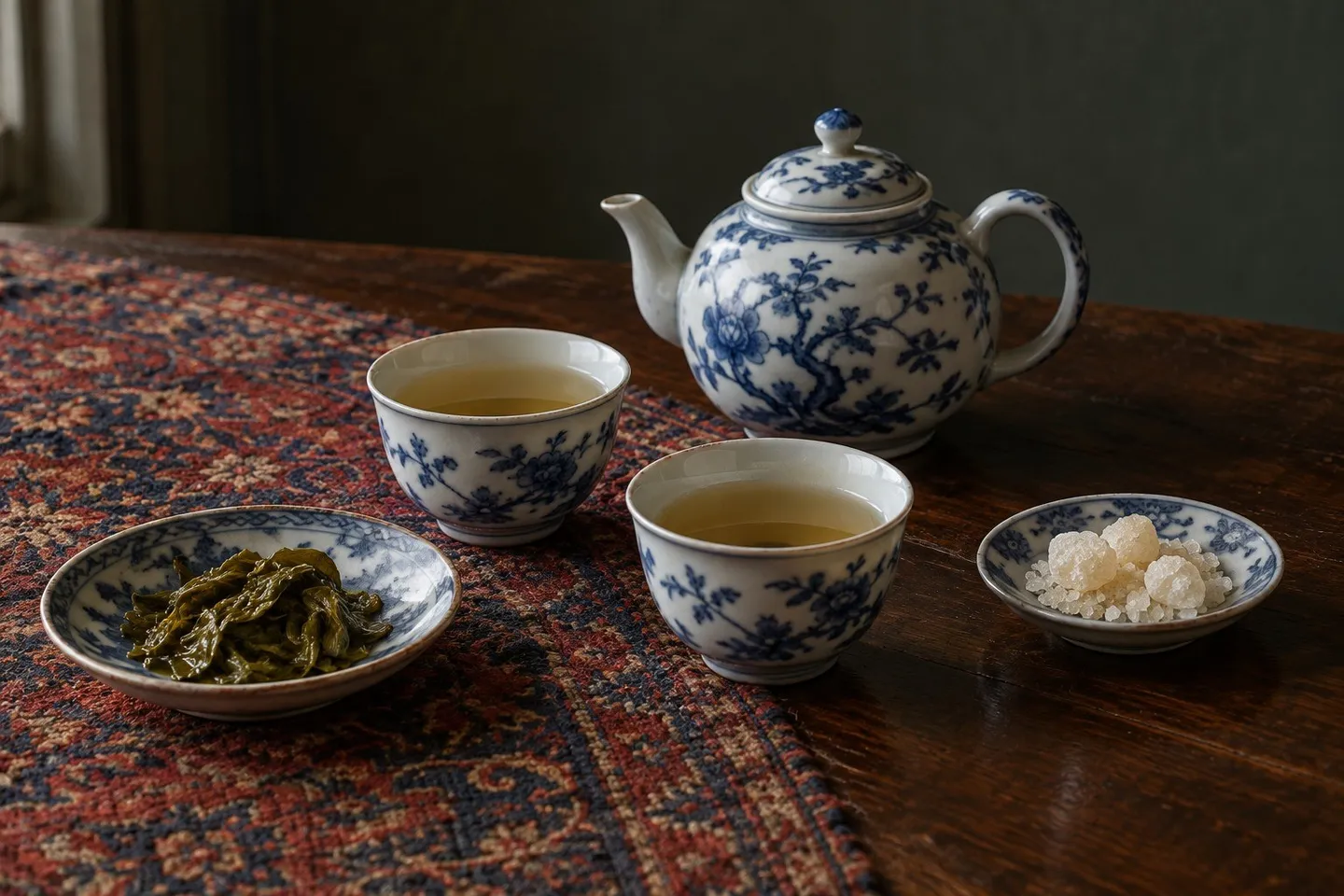
Green tea in two handleless cups beside its lidded pot, the brewed leaves and a dish of sugar.
The story behind the recipe
Rhodes made his tea strong and green, in a covered pot, and drank it as soon as the leaves sank. Alexander of Rhodes was a Jesuit who had known the drink for thirty years. Philippe Sylvestre Dufour printed his account of the Chinese method in a handbook that came out in English in 1685. In English it starts with a lot of leaf: “into a good large glass of Water, they put about an Ounce of Tea.”
Green leaf from two provinces
Rhodes says tea grew in only two provinces of China. The growers took as much care over the crop “as there is in our Vintages.” Once dried, the leaf was packed in tin boxes, “for if it takes wind, ‘tis spoiled.” Good tea was green and bitter. It was dry enough to crumble under a finger.
The Japanese, he adds, beat the leaf to powder. They stirred it into boiling water and would “swallow it all together.” Rhodes preferred the Chinese way. He had “always found that way of the Chineses to be exceeding good.”
For this recipe, buy a whole-leaf Chinese green tea, such as a pan-fired Longjing or a gunpowder tea. Whole leaves sink, as his do.
Read more about this recipe
Off the boil, under a lid
Rhodes boiled the water in “a little pot very clean.” Then it came off the fire. The leaves went in and the pot was covered. Modern guides heat water for green tea to 70 or 80°C. Rhodes used it straight off the boil, which gives a more bitter cup. That bitterness is what his sugar was there to correct. The same leaves served a second and a third time. For those rounds they were boiled with the water.
That ounce, about 28 grams, is the English translator’s. The French original of the same year has half a drachm, about 2 grams, to a good glass, and Dufour’s own advice is about a drachm to a chopine of water for two cups: both under 1 gram per 100 ml. This version takes the ISO 3103 tasting ratio, 2 grams per 100 ml, between the two. It keeps the rest: the covered pot, the boiling water and the sugar.
A reddish cup
The Chinese, Rhodes says, “drink it as hot as they can.” In his words the leaves gave the water “a reddish dye.” At the modern ratio most green teas turn pale amber-green instead. The Bishop of Beryte’s party, at Siam, took theirs “very hot” with sugar and “found it very wholsom.” This cup is grassy and lightly bitter, and the sugar takes the edge off.
In the book, Rhodes’s chapter sits between the coffee and Colmenero’s chocolate ground with chile. How Were Coffee, Tea and Chocolate Made in 1685? takes the three in turn.
The fashion of the Chineses when they make use of this Tea is to boyl some Water in a little pot very clean; when it boyls well, they take it from the fire, and put therein, so many leaves according to the proportion of Water, that is to say into a good large glass of Water, they put about an Ounce of Tea; they Cover the pot well, and when the leaf sinks to the bottom of the Water, then is the time to drink it, for ‘tis then that the Tea Communicates its vertue to the Water, giving it a reddish dye, they drink it as hot as they can, for if it should cool it would be good for nothing; the same leaf which tarries at the Bottom of the pot will serve a second or third time, but then they boyl it with the water.
The Japeneses take it another way, for they first beat the Tea to powder, then they put it into boyling water and swallow it all together: I know not whether this way of taking it be more wholsom then the former: I have made use of, and always found that way of the Chineses to be exceeding good: both of them mingle a little sugar therewith to correct the bitterness of the Tea, which nevertheless methinks is not so very unpleasant.

Recipe makes: About 300 ml, 2 small cups
Ingredients
For About 300 ml, 2 small cups. Quantities are shown as written.
Quantities as written here, for About 300 ml, 2 small cups.
- Chinese green tea leaves6 g
- Water300 ml
- Sugar1 metric tsp (5 ml per tsp)
Measurement notes
Ingredients as written here
- 6 g Chinese green tea leaves
- 300 ml water
- 1 tsp sugar
Equipment
 Small saucepan or kettle
 Small pot or teapot with a lid
Instructions
Bring the water to a full boil in a small saucepan or kettle, then take it off the heat.
Put the Chinese green tea leaves into a small pot, pour the water over them and cover the pot.
Leave it for 3 to 4 minutes, until most of the leaves have sunk to the bottom.
Pour the tea into the cups, holding back the leaves, share the sugar between them, and drink it hot.
For a second cup, put the leaves in a small saucepan with the same amount of water again, bring to a boil and simmer for 1 minute, then pour off and sweeten as before. Rhodes does this a third time too.
Nutrition
10calories per serving
- Recipe makes
- About 300 ml, 2 small cups
- Servings
- 2
Estimated from USDA FoodData Central values for brewed green tea and granulated sugar, for one cup with 1/2 tsp sugar.
Recipe notes
When adjusting quantities
Use about 2 g of tea and 100 ml of water per 100 ml cup, with sugar to taste.
Notes
Quantities mentioned in these notes don’t change when you adjust the batch.
Rhodes gives about an ounce (28 g) of tea to a large glass of water in the English, and half a drachm (about 2 g) in the French. This recipe uses 6 g to 300 ml, the ISO 3103 tasting ratio of 2 g per 100 ml, our choice; for a cup closer to the French, use about 3 g. Half a teaspoon of sugar a cup is our reading of his unmeasured sweetening. For Tulp’s salted version, use a few grains of salt in place of the sugar.
Scaling changes the ingredients only; glassware, ice and timings need their own judgment. To adapt this recipe further, try the recipe tool at TuneMyRecipe (opens in a new tab), our sister site.
Sources and attribution
Alexander of Rhodes, in Philippe Sylvestre Dufour, The Manner of Making of Coffee, Tea, and Chocolate, trans. John Chamberlayne (London: William Crook, 1685), pp. 44–46
Recipe details
- Drink
- Alcohol-free
- Drink family
- Hot Drinks
- Region
- Chinese
- Era
- 17th century
- Difficulty
- Easy