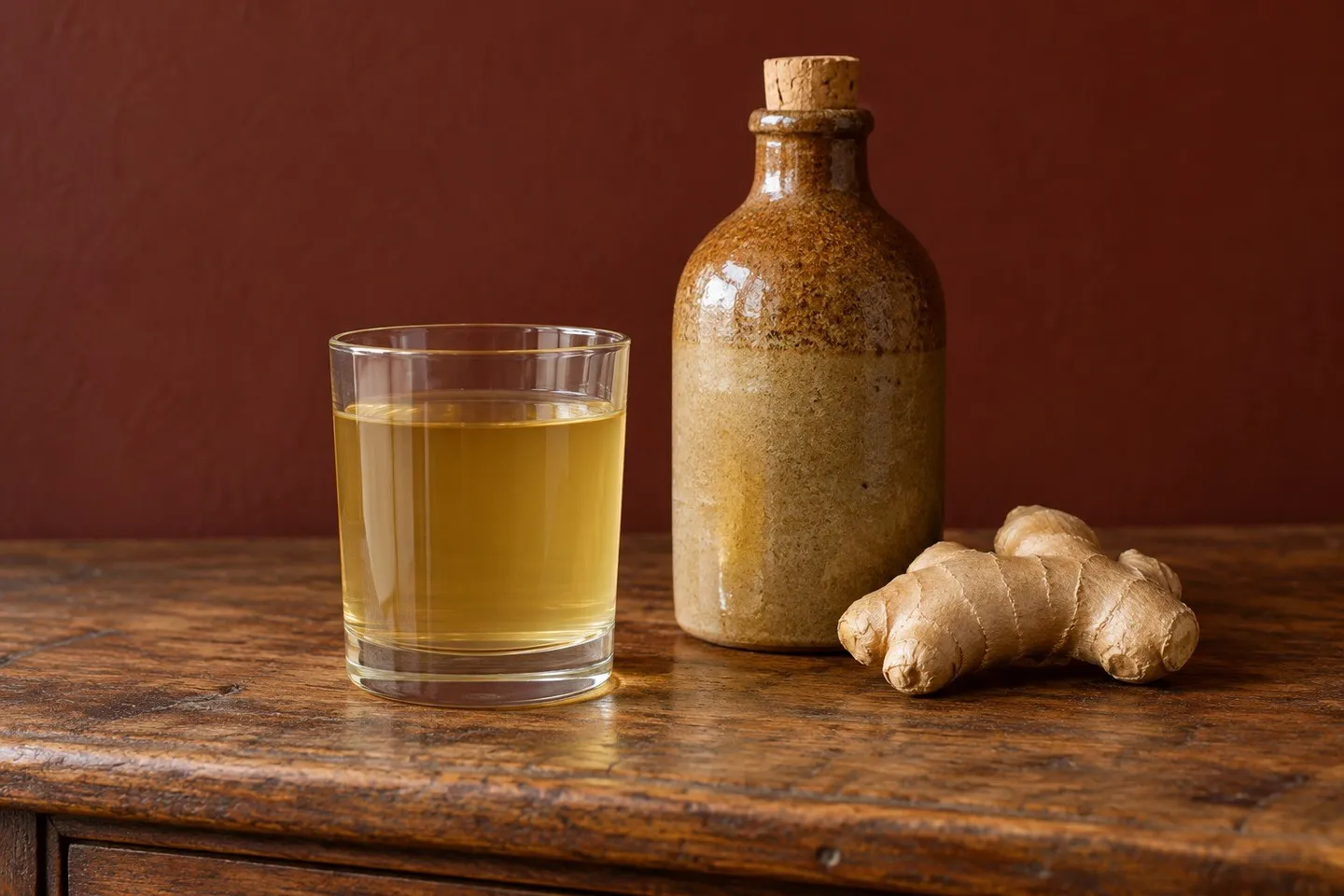
Alcohol-Free Temperance Ginger Wine
Reader ratingsA still ginger drink with no wine in it: sugar, tartaric acid and boiling water heated with ginger and chile, after an 1887 Temperance Cook Book. A modern alcohol-free version.
- Recipe makes
- About 1 liter, 4 glasses
- Prep
- Cook
- Total
Includes about 1 hour for the ginger wine to cool before bottling.
Temperance ginger wine in a straight-sided glass, with a stoneware bottle and fresh ginger root.
The story behind the recipe
Despite the name, this is sugared water made sharp with tartaric acid and hot with ginger and chile, with no grape anywhere in it. Mrs. Mary G. Smith printed it in the second edition of her Temperance Cook Book, published in San Jose, California, in 1887. The preface opens under a verse, “Up with the temperance banner!”
A wine that was never fermented
No yeast goes into it and nothing is left to work, which sets it apart from the brewed drinks on the same pages. Five quarts of boiling water go over loaf sugar and tartaric acid, and two drachms each of essence of ginger and essence of capsicum go in once it is cold.
The essences are the catch. In the 1880s essence of ginger was a strong tincture, bruised ginger steeped in spirit, and cayenne was a known partner for it: Arnold Cooley’s Cyclopaedia of Practical Receipts (1880) describes one brand of ginger essence as the plain kind “with the addition of a very small quantity of essence of cayenne.” Smith’s two tinctures left a trace of alcohol, about a quarter of one percent by our arithmetic. That is far below beer, but it means the period drink was not quite the abstainer’s glass its name promised.
Read more about this recipe
Fresh ginger in place of the essence
This version replaces both tinctures with fresh ginger and a pinch of cayenne simmered in the water, so it contains no alcohol at all. Shop essences varied in strength, so the amount of ginger here is our choice, enough for a clear heat; add more chile if you want more burn. The sugar works out at a little sweeter than a regular soda, and the drink is still, not fizzy. Tartaric acid is sold for winemaking and gives a clean, sharp edge; citric acid tastes a little fruitier.
Smith gives no serving advice. Serve it cold, or warm it in winter, as the soda fountains did with Hot Ginger, which makes the same swap of fresh ginger for a tincture. The temperance cookbooks get their own section in Alcohol-Free Drinks Through History.
Recipe makes: About 1 liter, 4 glasses
Ingredients
For About 1 liter, 4 glasses. Quantities are shown as written.
Quantities as written here, for About 1 liter, 4 glasses.
- Fresh ginger, about a 6 cm piece30 g
- Cayenne pepper1/8 metric tsp (5 ml per tsp)or Small dried red chile1/2
- Water950 ml
- Sugar135 g
- Food-grade tartaric acid, or citric acid4 g
Measurement notes
Ingredients as written here
- 30 g fresh ginger, about a 6 cm piece
- 1/8 tsp cayenne pepper, or 1/2 small dried red chile
- 950 ml water
- 135 g sugar
- 4 g food-grade tartaric acid, or citric acid
Equipment
 Saucepan
 Heatproof jug or bowl
 Sieve
 Bottle or carafe with a stopper
Instructions
Slice the fresh ginger thinly; there is no need to peel it.
Put the ginger and the cayenne pepper, or dried red chile in a saucepan with the water. Bring to a boil, then simmer gently for 15 minutes.
Put the sugar and the food-grade tartaric acid in a heatproof jug or bowl. Strain the hot ginger water over them and stir until both have dissolved.
Leave to cool, then taste. Add a few more grains of cayenne if you want more heat, stirring well.
Pour into a clean bottle, cap it and keep it in the fridge. Shake before pouring and serve cold, or warm it gently in a saucepan.
Nutrition
130calories per serving
- Recipe makes
- About 1 liter, 4 glasses
- Servings
- 4
Estimated from the USDA FoodData Central value for granulated sugar; ginger, chile and acid add almost nothing. For one of four 250 ml glasses.
Recipe notes
When adjusting quantities
This is one-fifth of the 1887 batch, which was made with five US quarts of water. Multiply everything by five for the full amount.
Notes
Quantities mentioned in these notes don’t change when you adjust the batch.
The 1887 batch is two drachms each of essence of ginger and essence of capsicum, one and a half pounds of loaf sugar, three-quarters of an ounce of tartaric acid and five quarts of boiling water. Smith was writing in California, so these are US quarts (about 4.7 liters). This recipe is one-fifth of that. Its 4 g of tartaric acid is about 1 teaspoon.
Our strength estimate for the period drink: the two essences come to about 15 ml, and at roughly 85 percent alcohol they add about 12.6 ml of alcohol to a batch of about 5.2 liters, or about 0.24 percent.
Nothing is meant to ferment in this version, but wild yeast can start it in a warm bottle, so throw it away if it turns fizzy. Keep it in the fridge and drink it within a week. The UK Food Standards Agency advises keeping the fridge at 0 to 5°C.
Scaling changes the ingredients only; glassware, ice and timings need their own judgment. To adapt this recipe further, try the recipe tool at TuneMyRecipe (opens in a new tab), our sister site.
Sources and attribution
Adapted from Mrs. Mary G. Smith, Temperance Cook Book, 2nd ed. (San Jose, Cal.: Mercury Book and Job Printing Office, 1887), “Temperance Ginger Wine”, p. 218
Recipe details
- Drink
- Alcohol-free
- Drink family
- Sodas & Soft Drinks
- Region
- American
- Era
- 19th century
- Source decade
- 1880s
- Base
- Spices
- Difficulty
- Easy
- Occasion
- Dry January