Fresh Orangeade, Juice, Sugar and Water
Reader ratingsOrange rind steeped in hot syrup, fresh orange juice and cold water: the real orangeade a 1921 state chemist demanded, from a 1924 London drinks book.
- Recipe makes
- About 1.5 liters, depending on the oranges
- Prep
- Cook
- Total
Includes about 1 hour for the syrup to cool on the orange rind. Chill longer if you like.
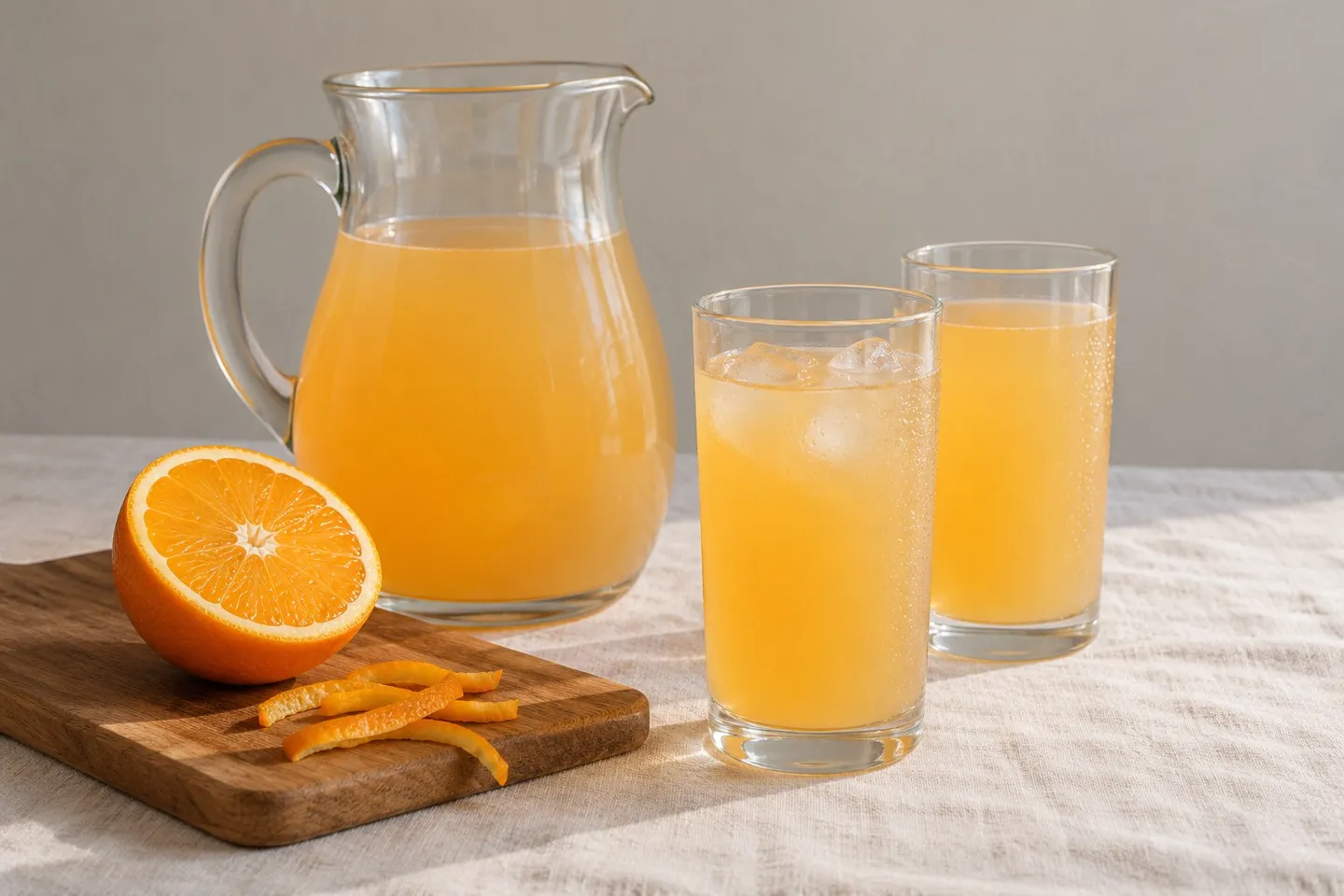
Fresh orangeade in a glass jug and two tall glasses, with oranges.
The story behind the recipe
True orangeade, said Dr. LaWall, the Pennsylvania State chemist, in 1921, is orange juice, sugar and water, and most of what was sold under that name wasn’t. He analyzed samples taken by inspectors from stands in Philadelphia and elsewhere. “Only 10 per cent of it is orange juice,” The Soda Fountain reported. The rest was “orange oil, citric acid, sugar, water and some coloring matter.”
The dyed globe
Orangeade was a soda counter fixture, served from a tank topped by a glass globe. In May 1921 a druggist from East Lynn, Massachusetts, wrote to the magazine that such globes ended up “marked with successive rings of sediment as the orangeade is used,” and shared his fix. He filled the globe half full of water, “with enough orange diamond dye for wool to give it the right color, and a little formaldehyde to keep it,” then corked and sealed it: a dummy kept apart from the drink, so the tank always looked clean. Extra orangeade waited in glass bottles in the ice chest.
The real thing sold, too. That summer Boyer’s Pharmacy on Seventh Avenue in New York filled its window with California oranges around a juicing machine, and its fresh orangeade trade went “from practically nothing” to one to three boxes of oranges a day. LaWall’s verdict on the stand product was blunt: “It does not quench thirst. It is a thirst provocative.”
Read more about this recipe
How was orangeade made?
A London book of 1924, Home-Made Summer and Winter Drinks by M. E. Steedman and C. Herman Senn, gives exactly the orangeade LaWall asked for, with one refinement. The thin outer rind of a quarter of the oranges is steeped in the hot syrup, so the orange oil comes from the fruit itself. Its American lemonade took the opposite road, built glass by glass over shaved ice with strawberry syrup and soda.
This version is half of the book’s jug, with its Imperial pints converted to milliliters. All the orange in it is fresh juice and rind. Pare only the colored rind, leaving the white pith behind, and taste before serving: oranges vary in sweetness. It sits well among the period’s alcohol-free drinks, and the book’s one serving note still holds: it is “much improved if it is iced.”
Recipe makes: About 1.5 liters, depending on the oranges
Ingredients
For About 1.5 liters, depending on the oranges. Quantities are shown as written.
Quantities as written here, for About 1.5 liters, depending on the oranges.
- Oranges6
- Sugar170 g
- Water285 ml
- Cold water850 ml
Measurement notes
Ingredients as written here
- 6 oranges
- 170 g sugar
- 285 ml water
- 850 ml cold water
Equipment
 Vegetable peeler
 Saucepan
 Heatproof bowl or jug
 Citrus juicer
 Fine sieve
 Large jug
Instructions
Wash and dry the oranges. With a vegetable peeler, pare the thin colored rind from one orange and half of a second, without the white pith, and put it in a heatproof bowl or jug.
Put the sugar and the water (not the cold water) in a saucepan and stir over medium heat until the sugar has dissolved. Bring to a boil, then pour the hot syrup over the orange rind.
Leave the syrup to cool on the rind, about 1 hour.
Squeeze the juice from all six oranges and stir it into the cooled syrup.
Strain through a fine sieve into a large jug, pressing lightly on the rind, then stir in the cold water.
Chill well, or serve over ice in tall glasses.
Nutrition
150calories per serving
- Recipe makes
- About 1.5 liters, depending on the oranges
- Servings
- 6
Estimated from USDA FoodData Central values for orange juice and sugar, for six 250 ml glasses; the figure varies with the size and sweetness of the oranges.
Recipe notes
When adjusting quantities
This is half of the book’s batch. Doubling every ingredient gives the full quantity.
Notes
Quantities mentioned in these notes don’t change when you adjust the batch.
The full recipe is ¾ lb sugar boiled with 1 pint of water, poured onto the thinly pared rind of 3 oranges, the juice of 12 oranges stirred in when cold, then strained, with 3 pints of cold water added. Its pint is the Imperial pint of about 568 ml, so this half batch uses 285 ml of water for the syrup and 850 ml cold water to finish.
Oranges vary a lot in how much juice they give. If yours are small or dry, squeeze one or two more.
For a dry party, it pours well beside the other four drinks in Five Alcohol-Free Drinks for a 1920s Party.
Scaling changes the ingredients only; glassware, ice and timings need their own judgment. To adapt this recipe further, try the recipe tool at TuneMyRecipe (opens in a new tab), our sister site.
Sources and attribution
M. E. Steedman and C. Herman Senn, Home-Made Summer and Winter Drinks, new edition (London: Ward, Lock & Co., 1924), p. 30
Recipe details
- Drink
- Alcohol-free
- Drink family
- Sodas & Soft Drinks
- Era
- Jazz Age
- Source decade
- 1920s
- Base
- Fruit & juice
- Difficulty
- Easy
- Occasion
- Summer party
- Season
- Summer