Mustum, Roman Fresh Grape Juice
Reader ratingsRipe grapes crushed and strained into cloudy fresh juice, the Roman mustum drunk before it could become wine, kept cold and drunk the same day.
- Recipe makes
- About 500 ml, 3 small glasses
- Prep
- Total
Includes about 1 hour to chill the juice. Drink it the same day.
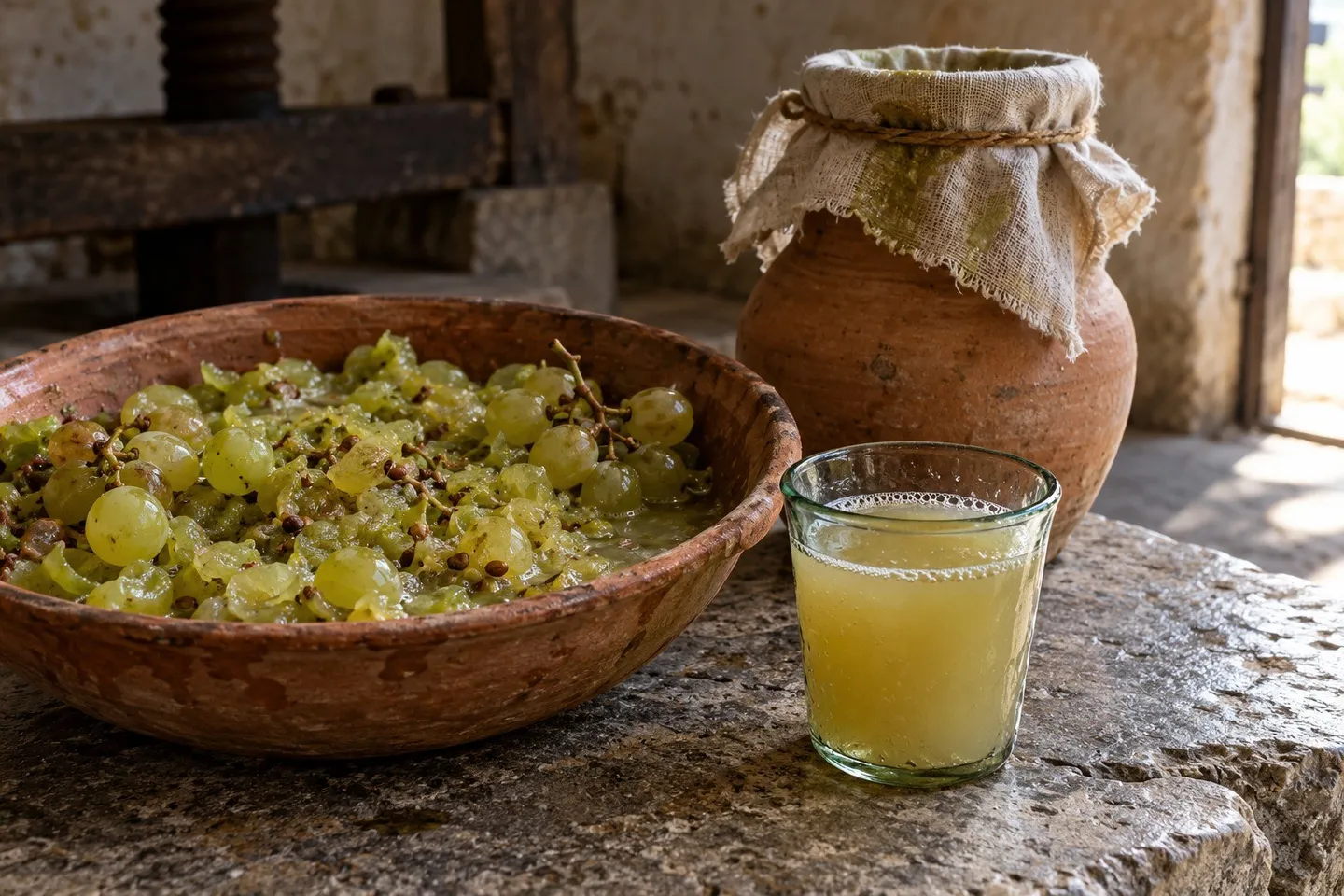
Fresh mustum in a greenish glass cup, with a terracotta bowl of crushed white grapes and a linen-covered clay jug.
The story behind the recipe
To stop grape juice turning into wine, Romans sank it in cold water. That juice, fresh from the press and drunk before it could ferment, was mustum, and the cold trick was serious work: Columella kept a sealed jar under a pond for forty days so that it would “continue sweet for a whole year.”
Water as the cellar’s refrigerator
The name is plain Latin. Juice “as it came from the press was called mustum, ‘new,’ and was often drunk unfermented,” Harold Whetstone Johnston explains in his 1903 handbook The Private Life of the Romans. Poured into the great jars and left uncovered, it fermented, a process he says lasted “about nine days.”
So the Romans used cold. Pliny the Elder describes a must the Greeks called aigleucos and Romans semper mustum, “always must,” which sat “of middle quality, between the sirops and what is properly called wine.” To make it, “the must is taken from the vat and put into casks, which are immediately plunged into water, and there left to remain until the winter solstice is past, and frosty weather has made its appearance.” Columella’s version is a farm job: the freshest must, drawn off before the skins go under the press, sealed in a new pitched amphora so that no water could get in, then sunk in a cold freshwater pond and lifted out after forty days.
Pliny also names the juice that runs from the grapes before anyone treads them, protropum. That one went the other way: “Directly it flows it is put into flaggons, and allowed to ferment.”
Read more about this recipe
Pressing it at home
The fridge does the pond’s work today, but for hours, not a year, so this mustum is made to drink the same day. Crushing by hand and letting the juice drain gives the cloudy, sweet first run that Columella preferred. Ripe white wine grapes are ideal at harvest; seedless white table grapes work. If the juice starts to fizz or smell of yeast, it has begun to turn into wine and is no longer alcohol-free; pour it away. Fresh, unpasteurized juice can carry harmful bacteria, and the FDA warns that children, older adults, pregnant women and anyone with a weakened immune system are most at risk; for them, use pasteurized white grape juice. Boiled down by half, the same juice becomes the Roman syrup defrutum.
That must may continue always sweet, as if it were new, manage it thus: Before the husks of the grapes are put under the press, take the very freshest must out of the wine-fat, and put it into a new amphora, and daub it, and pitch it carefully, that no water at all may enter into it; then sink the whole amphora into a pond of cold and sweet water, so that no part of it may stand out of it; then, after forty days, take it out of the pond: thus it will continue sweet for a whole year.

Recipe makes: About 500 ml, 3 small glasses
Ingredients
For About 500 ml, 3 small glasses. Quantities are shown as written.
Quantities as written here, for About 500 ml, 3 small glasses.
- Ripe white grapes1 kg
Measurement notes
Ingredients as written here
- 1 kg ripe white grapes
Equipment
 Large bowl
 Potato masher
 Sieve lined with muslin or cheesecloth
 Jug
Instructions
Rinse the ripe white grapes well under cold running water and pull them off their stems, discarding any that are split or moldy.
Put the grapes in a large bowl and crush them with a potato masher until every grape has burst.
Tip the crushed grapes into a sieve lined with muslin set over a jug, and let the juice run through for about 10 minutes.
Gather the muslin around the pulp and squeeze gently to press out a little more juice. Stop before you crush the seeds.
Cover the jug and chill the juice in the fridge for about 1 hour. Stir and serve cold the same day.
Nutrition
105calories per serving
- Recipe makes
- About 500 ml, 3 small glasses
- Servings
- 3
Roughly estimated from USDA FoodData Central values for grape juice; the figure depends on how ripe and sweet the grapes are.
Recipe notes
When adjusting quantities
Expect roughly 500 ml of juice per kilogram of grapes; the yield depends on the grapes.
Notes
Quantities mentioned in these notes don’t change when you adjust the batch.
The yield depends on the grapes: juicy wine grapes give more than firm table grapes. As a rough guide, a kilogram gives about 500 ml.
Fresh must is cloudy and settles as it stands. Stir it before pouring, or let it settle and pour off the clearer juice.
Must drunk fresh, before it became wine, is one of the drinks in What Did Romans Drink Besides Wine?.
Scaling changes the ingredients only; glassware, ice and timings need their own judgment. To adapt this recipe further, try the recipe tool at TuneMyRecipe (opens in a new tab), our sister site.
Sources and attribution
Columella, Of Husbandry, in Twelve Books (London: A. Millar, 1745), Book XII, ch. XXIX, p. 536; Pliny the Elder, The Natural History of Pliny, vol. 3, trans. John Bostock and H. T. Riley (London: Henry G. Bohn, 1855), Book XIV, ch. 11, pp. 249–250
Recipe details
- Drink
- Alcohol-free
- Drink family
- Sodas & Soft Drinks
- Era
- Ancient Rome
- Base
- Fruit & juice
- Difficulty
- Easy
- Season
- Autumn