Alcohol-Free Bishop, Spiced Grape Juice with a Roasted Lemon
Reader ratingsHot red grape juice with a roasted clove-studded lemon, boiled-down spices, fresh lemon and nutmeg: the 1847 Oxford bishop made without the port.
- Recipe makes
- About 900 ml, 6 small cups
- Prep
- Cook
- Total
Includes 30 to 40 minutes for roasting the lemon; the spice water reduces at the same time.
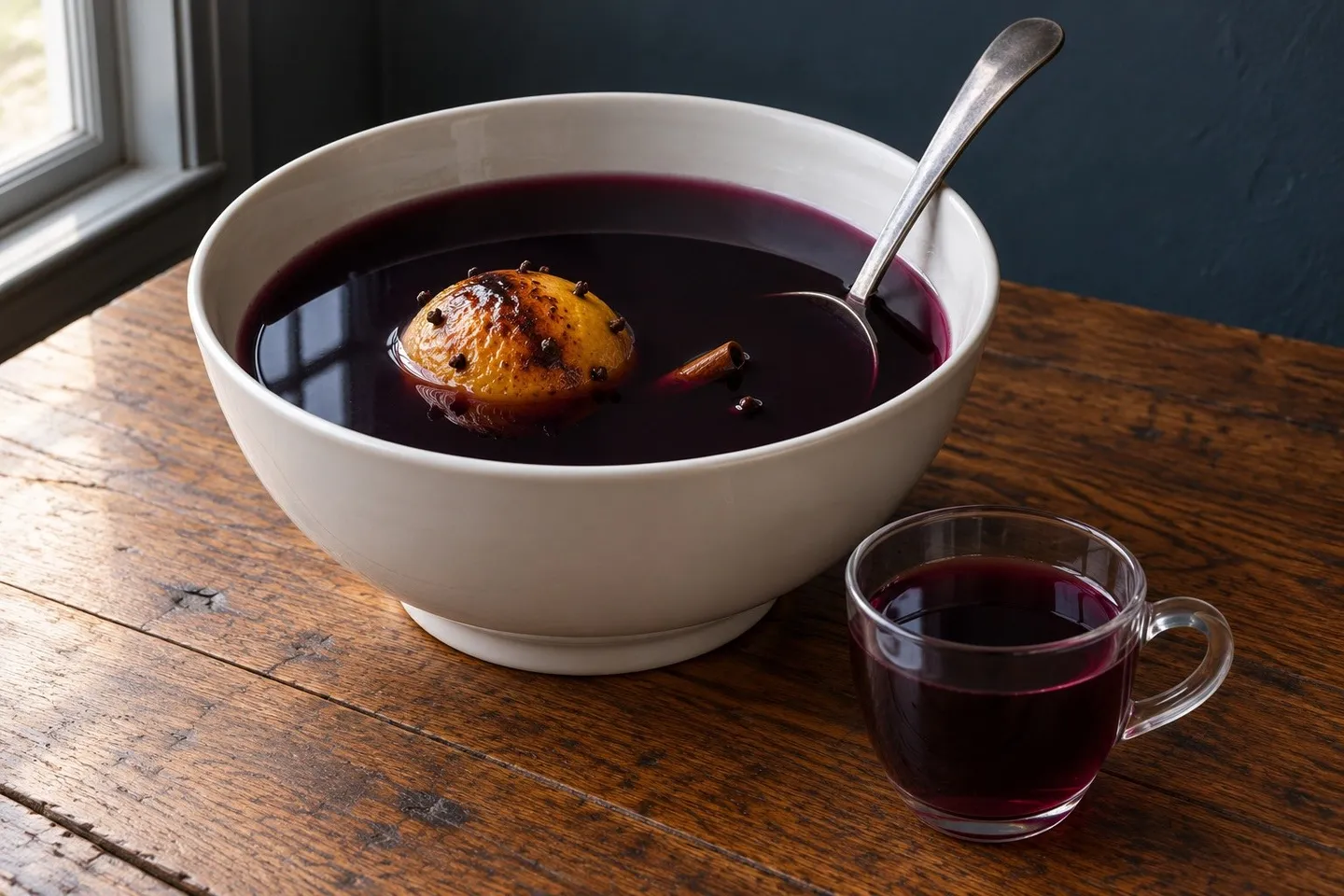
Hot spiced grape juice in a white bowl with a roasted, clove-studded lemon, beside a small glass cup.
The story behind the recipe
Alcohol-free bishop is the Oxford Christmas bowl rebuilt on hot red grape juice, for the people at the table who aren’t drinking. No Victorian printed such a recipe, so this one is our own adaptation: it keeps the color and spice of the bowl Scrooge offered Bob Cratchit, and a child can drink it.
Scrooge’s total abstinence
Dickens closes A Christmas Carol by saying that Scrooge had nothing more to do with Spirits, meaning the ghosts, and lived by total abstinence ever after. The joke borrows the temperance movement’s own words. “Total abstinence” was its name for giving up drink altogether, and in Preston, Lancashire, about 1833, that pledge picked up the nickname “teetotal,” a word barely ten years old when the Carol appeared in 1843. What went into the bowl he promised Bob Cratchit is told in our story of smoking bishop.
Read more about this recipe
A warm jug for the children
Victorian children had a hot wine drink of their own at Christmas parties. In 1861 Mrs. Beeton called negus, a pint of port let down with a quart of boiling water and sweetened, the drink “more usually drunk at children’s parties than at any other.” By the arithmetic in our story of what Victorian children drank at Christmas, each child’s share held more than a UK unit of alcohol. This version replaces the wine with grape juice, so the bowl fills the same place with no alcohol in it.
A dry bishop is a modern idea, but grape juice had a place on the dry table by 1920, when Bertha Stockbridge’s What to Drink put a cup of it into a Grape Juice Highball.
Picking the juice
Look for a dark, unsweetened red grape juice of the Concord type; its deep color is the nearest thing to ruby port. A pale or blended juice makes a lighter bowl. Juice labeled 100% grape with no added sugar still carries the natural sugar of the grapes, about 80 calories a serving by USDA figures, so one sugar cube is a starting point and none is fine.
The shape of the method comes from Oxford Night Caps (1847), whose text is printed with the port bishop, the bowl to make for the grown-ups: the clove-studded lemon, the spice water boiled down by half, sugar rubbed on lemon rind, and nutmeg. The changes are ours. Grape juice replaces the port and is heated below a simmer, where Oxford boils the wine and burns off part of its spirit; the lemon roasts in an oven, not by the fire; and the clove and spice counts and the small amount of sugar, which the book leaves to the cook, are our choices.
Recipe makes: About 900 ml, 6 small cups
Ingredients
For About 900 ml, 6 small cups. Quantities are shown as written.
Quantities as written here, for About 900 ml, 6 small cups.
Roasted lemon
- Lemon1
- Cloves12
Spice water
- Cinnamon stick, about 7 cm1
- Cloves6
- Blades mace2
- Allspice berries6
- Water285 ml
Bishop
- Unsweetened red grape juice750 ml
- Unwaxed lemon, for the zest and juice1
- Sugar cubes (optional)1–2
- Whole nutmeg, for grating
Measurement notes
Ingredients as written here
- 1 lemon
- 12 whole cloves
- 1 cinnamon stick, about 7 cm
- 6 whole cloves
- 2 blades mace
- 6 allspice berries
- 285 ml water
- 750 ml unsweetened red grape juice
- 1 unwaxed lemon, for the zest and juice
- 1 to 2 sugar cubes (optional)
- whole nutmeg, for grating
Equipment
 Small baking dish
 Small saucepan
- Medium saucepan
 Heatproof bowl or jug, warmed, to serve
 Ladle and small heatproof cups
Instructions
Set the oven to 200°C. Make 12 small, shallow cuts in the skin of the lemon you are roasting and stud each cut with a whole clove. Put it in a small baking dish and roast for 30 to 40 minutes; it is ready when the skin has browned in places and the lemon feels soft under a gentle press.
Meanwhile, put the allspice berries, mace, whole cloves and cinnamon stick in a small saucepan with the water and let them bubble gently for 20 to 25 minutes, until only half the liquid is left.
Heat the unsweetened red grape juice slowly in a medium saucepan until steam rises from it, keeping it below a simmer.
Tip in the spice water, spices and all, along with the roasted lemon. Give it a stir and hold it on the lowest heat for 10 minutes.
In the meantime, scrape 1 sugar cube firmly across the rind of the unwaxed lemon until it is yellow and fragrant, then drop it into a heatproof bowl or jug warmed with hot water. To skip the sugar, grate a little zest into the bowl instead. Add the juice of half that lemon (of half of each lemon, if you have scaled up).
Pour in the hot spiced juice with its lemon and spices and stir. Finish with a grating of nutmeg, taste, and only then rub and add the second cube if it wants more sweetness.
Ladle it into small heatproof cups straight away, leaving the roasted lemon and spices in the bowl.
Nutrition
80calories per serving
- Recipe makes
- About 900 ml, 6 small cups
- Servings
- 6
Roughly estimated from USDA FoodData Central values for unsweetened grape juice and lemon juice, without added sugar.
Recipe notes
When adjusting quantities
750 ml of grape juice matches one bottle of port in the 1847 recipe. For twice as much, double every ingredient, including the roasted lemon.
Notes
Quantities mentioned in these notes don’t change when you adjust the batch.
There is no alcohol here: unfermented grape juice, water, fruit and spices. Warm the bowl with hot water first, serve in heatproof cups, and set it where small children can’t reach, since hot sweet juice sticks to skin and scalds.
Oxford’s half pint of water is an imperial one, 284 ml, which we round to 285 ml. The book names no number of cloves and no weight for the spices, so the counts here are ours. Mace is sold in blades, dried strips of the red web that wraps a nutmeg; 1/4 tsp ground mace works as a swap.
Swift’s verse has oranges in it, and a clove-studded orange can replace the roasted lemon or join it.
Scaling changes the ingredients only; glassware, ice and timings need their own judgment. To adapt this recipe further, try the recipe tool at TuneMyRecipe (opens in a new tab), our sister site.
Sources and attribution
A modern alcohol-free adaptation of “Bishop, or Spiced Wine” in [Richard Cook, attrib.], Oxford Night Caps, 4th ed., enlarged (Oxford: Henry Slatter, 1847), pp. 1–3
See the original pages (scan at Internet Archive) (opens in a new tab)
Recipe details
- Drink
- Alcohol-free
- Drink family
- Hot Drinks
- Region
- British
- Era
- 19th century
- Difficulty
- Easy
- Occasion
- Christmas
- Season
- Winter