Posca, the Roman Soldier’s Vinegar Drink
Reader ratingsWine vinegar stirred into cold water: the sour, cheap drink of Roman soldiers and slaves, alcohol-free and ready in a minute.
- Recipe makes
- 1 drink
- Prep
- Total
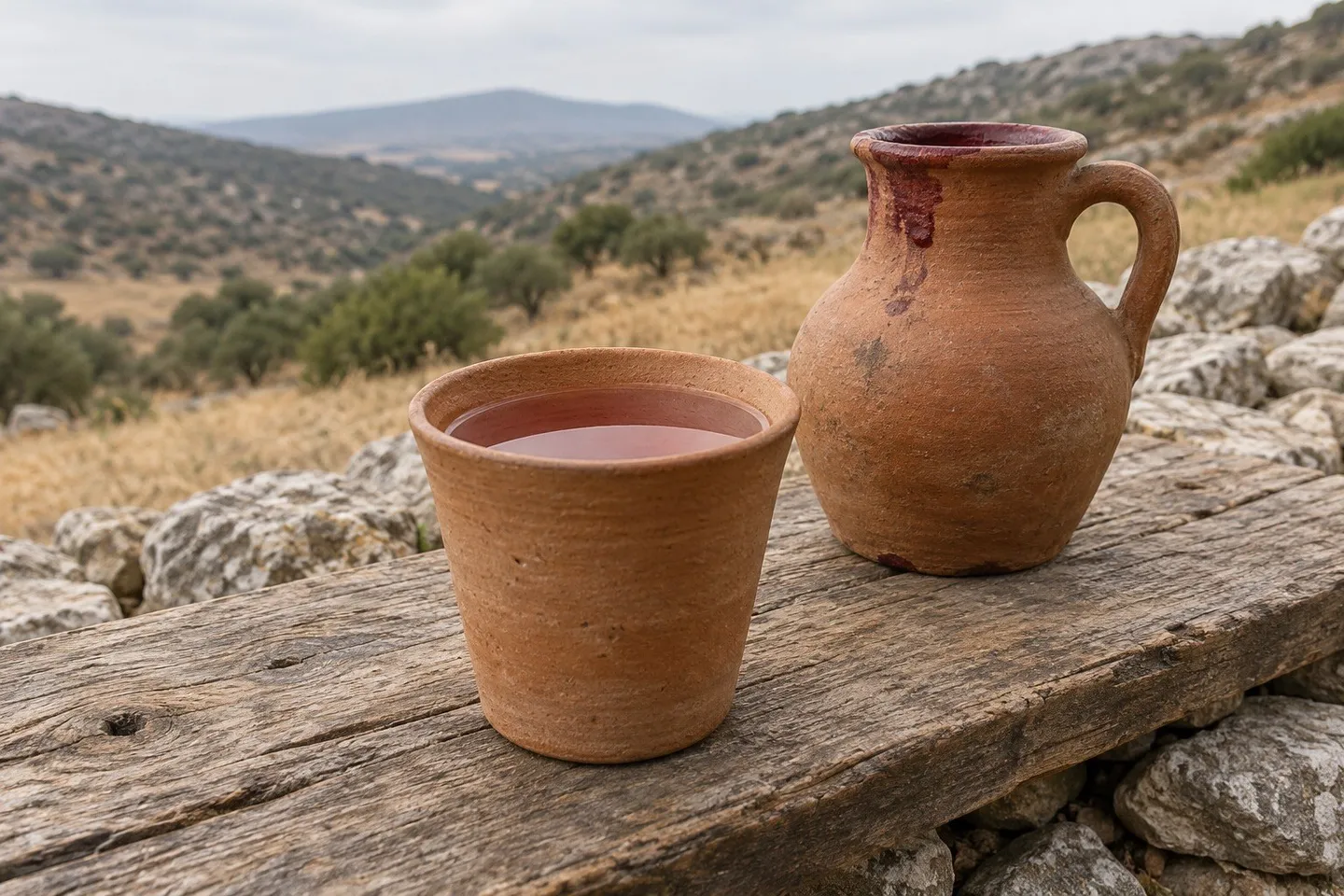
Posca, vinegar in water, in a plain earthenware beaker beside a small terracotta vinegar jug, outdoors on a dry-stone wall.
The story behind the recipe
“Some are drunk, others are drinking posca.” A line of Plautus splits a Roman household in two, and posca, wine vinegar mixed with water, was the half without the wine. Slaves drank it, and so did soldiers in the field. Its vinegar was often wine that had spoiled.
Vinegar-water for the ranks
W. A. Becker’s Gallus (1891 translation), a tale of Augustan Rome carried on long scholarly notes, puts the drink in a tavern of the Subura, where two slaves share a goblet. The younger one’s flushed face shows “that the earthen vessel before him had contained something besides vinegar.” Becker’s footnote does the explaining: “Vinegar-water, posca, a common drink of soldiers in the field, as well as of slaves.” It then quotes the Plautus line in Latin, alii ebrii sunt, alii poscam potitant, and notes that the slave Palaestrio “is evidently himself amongst those who indulge in posca,” while two of his fellows “intoxicate themselves by wine.”
The vinegar came from the wine jar. “Spoiled wine was used as vinegar (acētum),” Harold Whetstone Johnston writes in The Private Life of the Romans (1903), and vinegar that went flat was vappa, a word also thrown at “shiftless and worthless men.”
Becker’s evidence for soldiers is the life of an emperor. The Historia Augusta, a late Roman collection of imperial lives, says Hadrian on campaign “cheerfully ate out of doors such camp-fare as bacon, cheese and vinegar.”
Read more about this recipe
What to pour today
None of these sources gives a measure; we use one part vinegar to ten of water. Made that way it is pale, clean and plainly sour. Nothing alcoholic goes in, although vinegar made from wine may keep a faint trace. Use a red or white wine vinegar you would happily put on a salad. Add honey and sea salt and boil it, and you are on the way to posca’s grander relation, oxymel.
Recipe makes: 1 drink
Ingredients
For 1 drink. Quantities are shown as written.
Quantities as written here, for 1 drink.
- Red wine vinegar25 ml
- Cold water250 ml
Measurement notes
Ingredients as written here
- 25 ml red wine vinegar
- 250 ml cold water
Equipment
 Glass or tumbler
Instructions
Pour the red wine vinegar into a glass and top up with the cold water. Stir.
Taste, and add a little more water if it is too sharp for you, or a few drops more vinegar if you want it rougher.
Nutrition
5calories per serving
- Recipe makes
- 1 drink
Estimated from the USDA FoodData Central value for red wine vinegar; water adds nothing.
Recipe notes
When adjusting quantities
Keep about one part vinegar to ten parts water by volume when you scale.
Notes
Quantities mentioned in these notes don’t change when you adjust the batch.
Wine vinegars vary in strength, so taste before adding more.
Who drank posca, and what else Romans poured besides wine, is the subject of What Did Romans Drink Besides Wine?.
Scaling changes the ingredients only; glassware, ice and timings need their own judgment. To adapt this recipe further, try the recipe tool at TuneMyRecipe (opens in a new tab), our sister site.
Sources and attribution
W. A. Becker, Gallus, or Roman Scenes of the Time of Augustus, trans. F. Metcalfe (London: Longmans, Green, and Co., 1891), Scene VI, p. 77, note 14
Recipe details
- Drink
- Alcohol-free
- Drink family
- Sodas & Soft Drinks
- Era
- Ancient Rome
- Base
- Vinegar
- Difficulty
- Easy
- Season
- Summer