Almond Milk, the Medieval Fast-Day Milk
Reader ratingsBlanched almonds ground with boiled, lightly sweetened water and drawn through a cloth: the milk medieval cooks used when the Church ruled out the cow’s.
- Recipe makes
- About 450 ml, 2 glasses
- Prep
- Cook
- Total
Includes 4 hours soaking the almonds, which softens them for a blender. The sweetened water boils and cools in the same time.
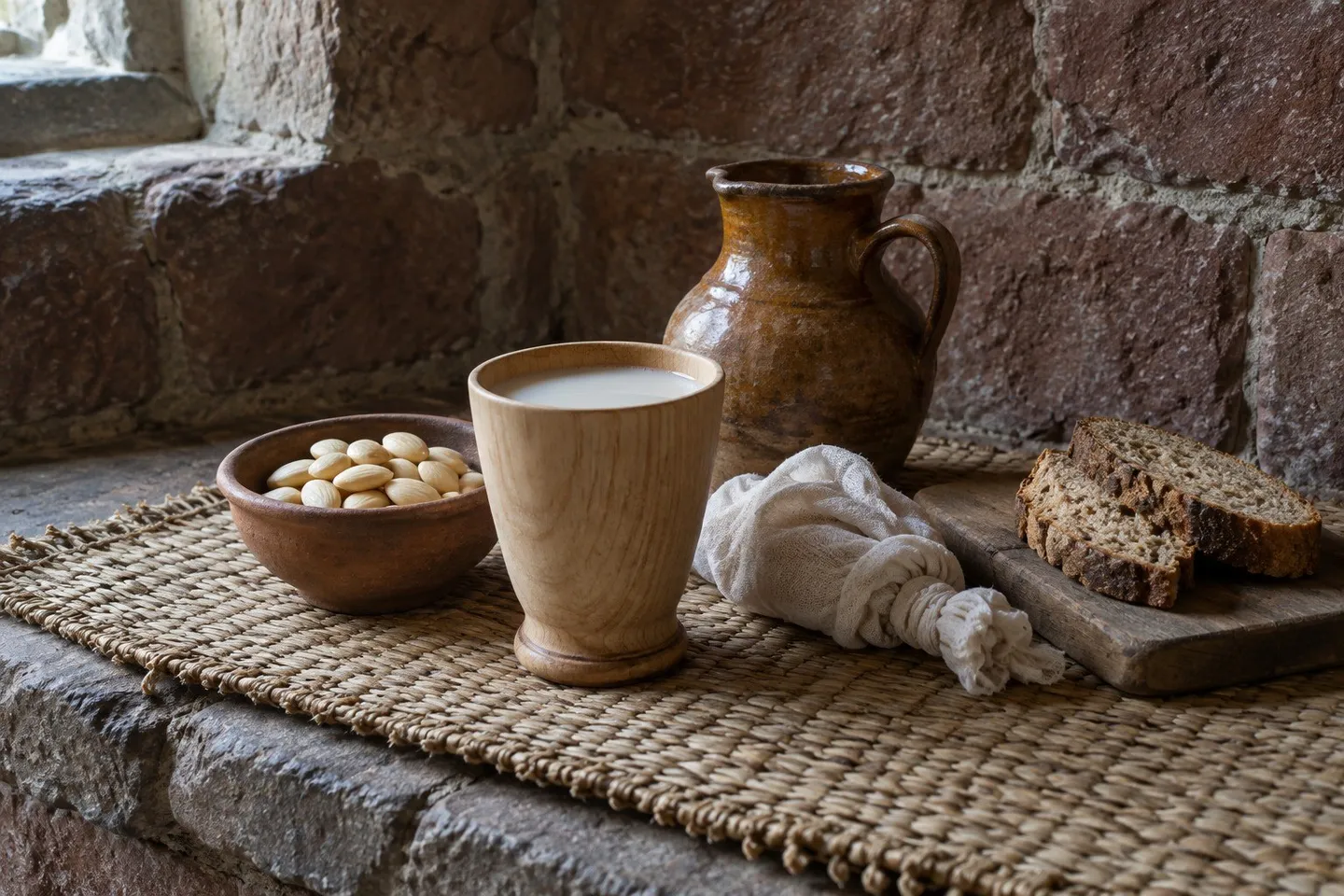
Cold almond milk in a wooden cup, with blanched almonds, the straining cloth and bread on the side.
The story behind the recipe
On medieval fast days, when the Church ruled out dairy, the milk in the pot came from almonds. Cooks ground them blanched, worked them with water and squeezed the paste through a cloth, and the white liquid that ran out went wherever cow’s milk would have gone. The Forme of Cury, the recipe roll of Richard II’s master cooks, uses it again and again.
Milk for fish days
The Lenten fast banned dairy as well as meat, and many other days of the year were fish days. The cooks’ answer was a milk that came from a tree. Samuel Pegge, who printed the roll in 1780, glosses it as “Almonds blanch’d and drawn thickish with good broth or water.” Drawe is the cooks’ verb: pressing ground nuts through a strainer with liquid.
The swap ran both ways. An apple pottage in a second manuscript Pegge printed, which he dates to about 1381, takes beef broth and white grease “on flesch dayes” and “almande mylk on fysch dayes.” A rose-flavored dish in the roll ends: “If þᵘ wilt in stede of Almande mylke, take swete crem of kyne,” that is, sweet cream from cows. Cooks even pressed the almonds twice. A dish of wheat with porpoise is boiled in the “secunde mylk of Almand” and finished with the “first mylke,” the richer one.
Read more about this recipe
The cold cup, without the wine
Most of these recipes treat almond milk as a kitchen liquid. One that serves it as itself comes from a household book that Robina Napier printed in 1882 as A Noble Boke off Cookry, from a manuscript she reckoned “written four hundred years ago.” Its “cold mylk of almondes” starts with water boiled with sugar or honey “so that it be douce,” that is, sweet, then salted and cooled. The almonds are ground with that water “in to a good thik mylk,” and bread toasted hard comes in a separate dish, so the milk sat at the table more like a sop to dip into than a cup to drink.
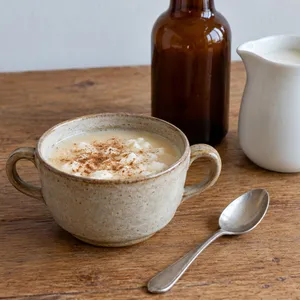
That cook finished the milk with wine, “that it may haue a good flavour.” This version leaves the wine out and keeps the rest. What runs from the cloth is pale, opaque and mild, only just sweet, with the taste of the nut and a trace of salt, and thinner than cow’s milk. A blender stands in for the mortar. The same kitchens also boiled their almond milk and drank it hot, as Cheaut.
Recipe makes: About 450 ml, 2 glasses
Ingredients
For About 450 ml, 2 glasses. Quantities are shown as written.
Quantities as written here, for About 450 ml, 2 glasses.
- Water500 ml
- Honey10 ml
- Fine sea salt1 pinch
- Blanched almonds100 g
- Water, for soaking
Measurement notes
Ingredients as written here
- 500 ml water
- 10 ml honey
- 1 pinch fine sea salt
- 100 g blanched almonds
- water, for soaking
Equipment
 Small saucepan
 Blender
 Fine sieve lined with muslin, or a nut-milk bag
 Bowl and jug
Instructions
Put the blanched almonds in a bowl, cover them with water and leave them to soak for about 4 hours.
Meanwhile, bring the measured water to the boil in a small saucepan with the honey and fine sea salt. Skim off any foam, let it boil for 1 minute, then take it off the heat and leave it to cool completely.
Drain and rinse the almonds. Blend them with the cooled honey water for 1 to 2 minutes, until smooth and white.
Pour the mixture into the lined sieve over a bowl and squeeze the cloth hard until no more liquid runs out.
Chill the almond milk and stir it before pouring, as it settles on standing. Serve dry toast on the side if you like, as the household book did.
Nutrition
140calories per serving
- Recipe makes
- About 450 ml, 2 glasses
- Servings
- 2
Roughly estimated from USDA FoodData Central values, assuming about 40 percent of the almonds’ calories pass into the milk and the pulp is discarded.
Recipe notes
When adjusting quantities
Keep 5 ml of water to every gram of almonds; the honey and salt scale with the water.
Notes
Quantities mentioned in these notes don’t change when you adjust the batch.
The medieval cooks wrote down no measures. We use 100 g of almonds to 500 ml of water and 10 ml of honey, just enough honey to soften the edge, as the “douce” water suggests. For a cooking milk, leave out the honey.
For a second, thinner milk in the medieval way, blend the pressed almond pulp again with another 200 ml of cooled boiled water and squeeze it out. The cooks didn’t waste the pulp either: one recipe calls for the draf of Almaundys.
Keep almond milk in the fridge and drink it the same day. It isn’t for babies under 12 months, who shouldn’t have honey.
The fast-day milk is one of the drinks without alcohol gathered in Did Medieval People Really Drink Beer Instead of Water?.
Scaling changes the ingredients only; glassware, ice and timings need their own judgment. To adapt this recipe further, try the recipe tool at TuneMyRecipe (opens in a new tab), our sister site.
Sources and attribution
Samuel Pegge (ed.), The Forme of Cury, a Roll of Ancient English Cookery, Compiled, about A.D. 1390, by the Master-Cooks of King Richard II (London: J. Nichols, 1780), Nos. 51, 52 and 116, pp. 31 and 56; MS. Ed. II, No. 17, p. 96; glossary p. 124. Robina Napier (Mrs. Alexander Napier) (ed.), A Noble Boke off Cookry ffor a Prynce Houssolde (London: Elliot Stock, 1882), p. 76
Recipe details
- Drink
- Alcohol-free
- Drink family
- Sodas & Soft Drinks
- Region
- British
- Era
- Medieval
- Difficulty
- Easy