Did Medieval People Really Drink Beer Instead of Water?
They drank both. What Andrew Boorde and the medieval cookbooks say about water, who drank it, everyday ale, and the drinks without alcohol in between.
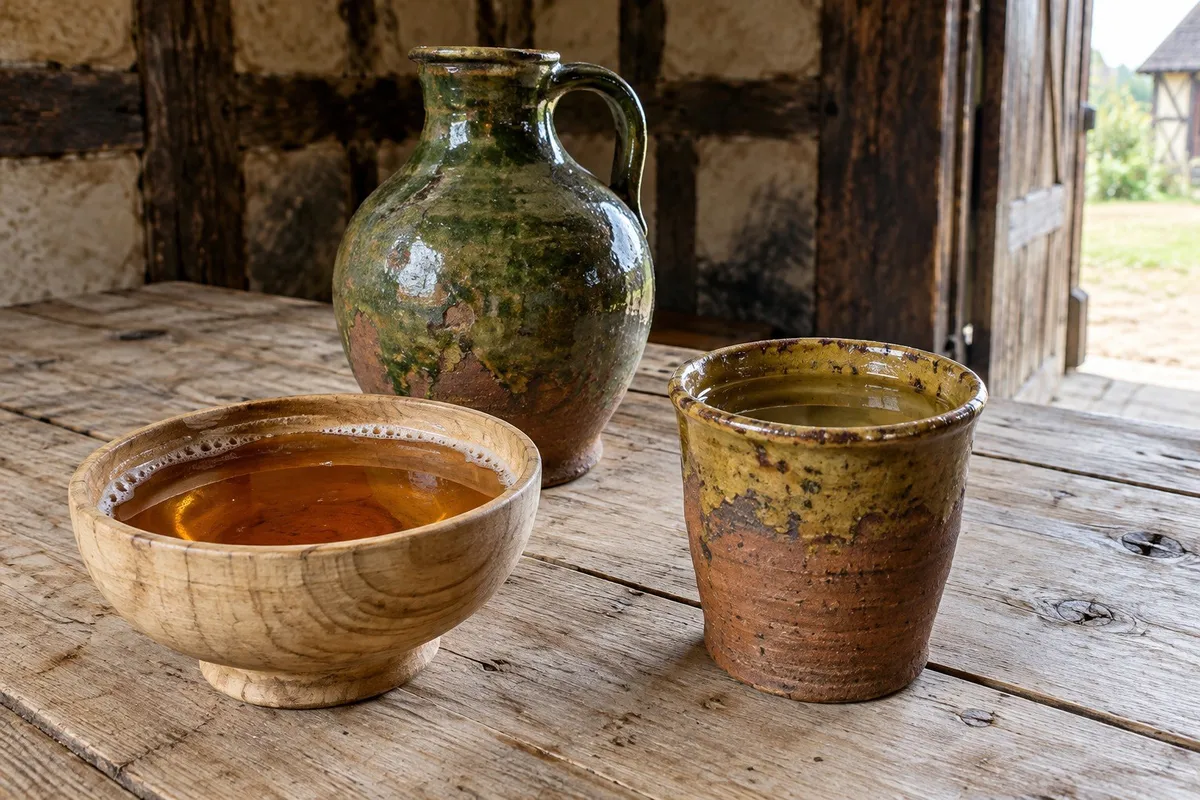
They drank both. Ale was the everyday drink of English households that could brew or buy it, valued as food as well as pleasure. Water was drunk too, above all by the poor, the young and servants, and every cook used it. Andrew Boorde, the physician usually quoted as proof that water was feared, disliked it mainly because he thought it cold and hard to digest, and in the same chapter he tells his readers which water to choose.
This story is part of our Medieval and Tudor Drinks guide.
The myth’s star witness wrote under the Tudors. Boorde’s Dyetary of Helth came out in 1542, and his Introduction of Knowledge followed a few years later, a guide to Wales, the German lands, Spain and more that notes what people drank along the way. The cookery books from the medieval kitchens he is made to speak for are a century or more older.
The story everyone repeats
The popular version: medieval water was filthy, everybody knew it, so men, women and children drank weak beer from morning to night. When it cites anyone, it cites one line of Boorde. The line is real, and the pages around it complicate it.
What Boorde actually wrote
Boorde’s Dyetary, read here in the edition F. J. Furnivall made of his books in 1870, opens its chapter on drinks with water. His verdict: “water is not holsome, sole by it selfe, for an Englysshe man, consyderynge the contrarye vsage, whiche is not concurraunt with nature: water is colde, slowe, and slacke of dygestyon.” His two reasons are habit, since Englishmen weren’t used to it, and the medicine of his day, which judged foods by their heat and moisture.
He then ranks the waters, an odd thing to do with a drink nobody touched. “The best water is rayne-water, so be it that it be clene and purely taken,” then running water over “stones or pybles,” then river water, with well water lower down. Only now does he mention dirt. Standing water “putryfyed with froth, duckemet, and mudde” will, if used for baking, brewing or cooking, “ingender many infyrmytes.” His cure is practical: let running water stand two or three hours, then strain off the top through a thick linen cloth.
His own taste was plain. In his Breviary of Health (1547) he admits “I can not away with water,” and so takes himself “to good Ale.” In his Introduction of Knowledge he tells of nine English and Scottish pilgrims he traveled with to Compostela. On the way back through Spain they died, “all by eatynge of frutes and drynkynge of water, the whych I dyd euer refrayne my selfe.” That is a traveler’s fear of strange water, from a man who already disliked the stuff.
Who drank water in the Middle Ages?
The poor, servants and the young, above all, and every cook used it. Boorde’s own books are full of water drinkers. In parts of the German highlands, he reports, girls drank nothing but water until they married, and “Saruants also do drynke water to theyr meat.” The usual drink there “for youth, is fountayn water,” he adds in the Dyetary, drawn from the fountain or well in every town. He writes it up as foreign custom, which tells us what he expected at home: a grown Englishman drank ale when he could.
At home the poor drank water as a matter of course. London’s citizens were granted springs at Tyburn in 1237, and the Great Conduit in Cheapside was standing by 1261. In 1345, the Historical Gazetteer of London Before the Great Fire records, it was said to have been built “so that rich and middling persons might have water for preparing food and the poor for their drink.” In Wales, Boorde sniffs, “they do drynke mylke and whay,” though the market towns had “competent Ale.”
Kitchens used water constantly. A cook of about 1450 grinds almonds “with faire water,” and the fifteenth-century cookery poem Liber cure cocorum makes its gruel with “playd,” or boiled, water, though it never says why.
Ale in the household
“Ale is made of malte and water,” Boorde writes, and “Ale for an Englysshe man is a naturall drynke.” It had to be “fresshe and cleare,” at least five days old, and not past its best: “sowre ale, and deade ale the which doth stande a tylt, is good for no man.” Ale didn’t keep, so somebody was always brewing. Beer, with hops, he calls “a naturall drynke for a Dutche man,” adding that “nowe of late dayes it is moche vsed in Englande to the detryment of many Englysshe men.” Roman writers had filed beer itself among the habits of foreigners, as What Did Romans Drink Besides Wine? tells. How the Dutchman’s drink became England’s own is the story of When Did English Beer Get Its Hops?.
That somebody was usually a woman. Judith Bennett’s Ale, Beer, and Brewsters in England (1996) shows most ale being brewed by women as part of their household work, with any surplus sold.
How much they drank depended on who they were. At St Paul’s Cathedral in the late thirteenth century, as the beer historian Martyn Cornell summarizes the accounts, canons and their staff were allowed a bolla of ale, about a gallon, a day. Working from Philip Slavin’s figures for how much grain went to malt, Cornell estimates that the average English adult got roughly a third of a pint of ale a day, far too little to replace water.
Ale also turned up in the sickroom. Boorde allowed “Ale-brues, caudelles, and colesses, for weke men and feble stomackes,” and his posset ale “is made with hote mylke & colde ale.” Those lines lie behind our ale caudle and posset ale.
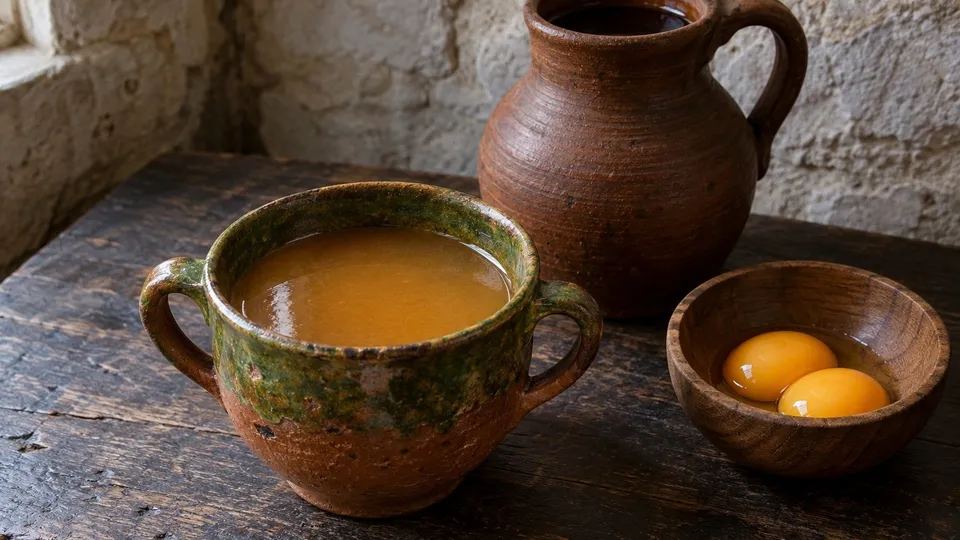 Make it todayAle Caudle, Warm Ale Thickened with Egg Yolks
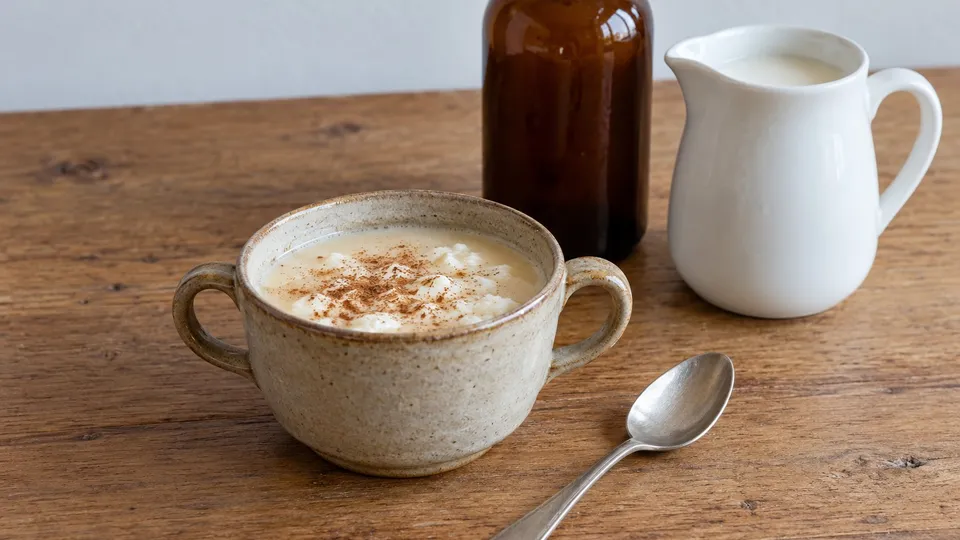 Make it todayPosset Ale, Hot Milk Curdled with Ale
What did medieval people drink without alcohol?
Between water and ale sat drinks with no alcohol at all, which no brewed drink quite managed: centuries later, even the Victorian ginger beers sold as non-alcoholic beers held a little. Boorde’s list of drinks comes round to whey, which, “yf it be wel ordered,” he calls “a temporate drynke.” His editor’s footnote adds a satire’s poor shepherds “Lyvynge on mylke / whyg / and whey.” Whey was the dairy’s free drink, and here the drink of the poor.
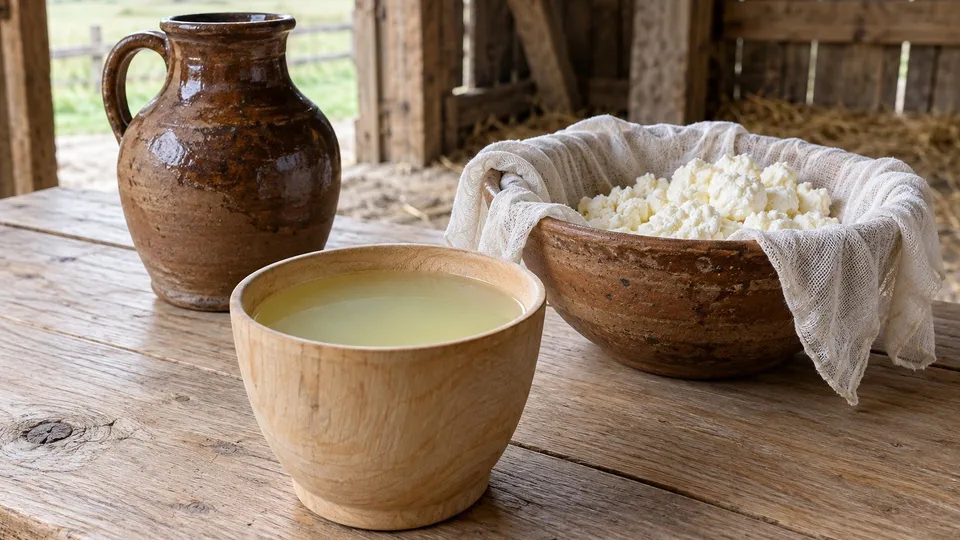 Always alcohol-freeWhey, the Drink Left Over from Cheese
Fast days had their own milk. When the Church ruled out dairy, cooks pressed ground almonds and water through a cloth, and The Forme of Cury, the roll of Richard II’s cooks from about 1390, uses that milk again and again. It could be drunk cold, as in almond milk, or boiled once and sweetened as cheaut, which sits in its manuscript directly beneath an almond caudle made with ale.
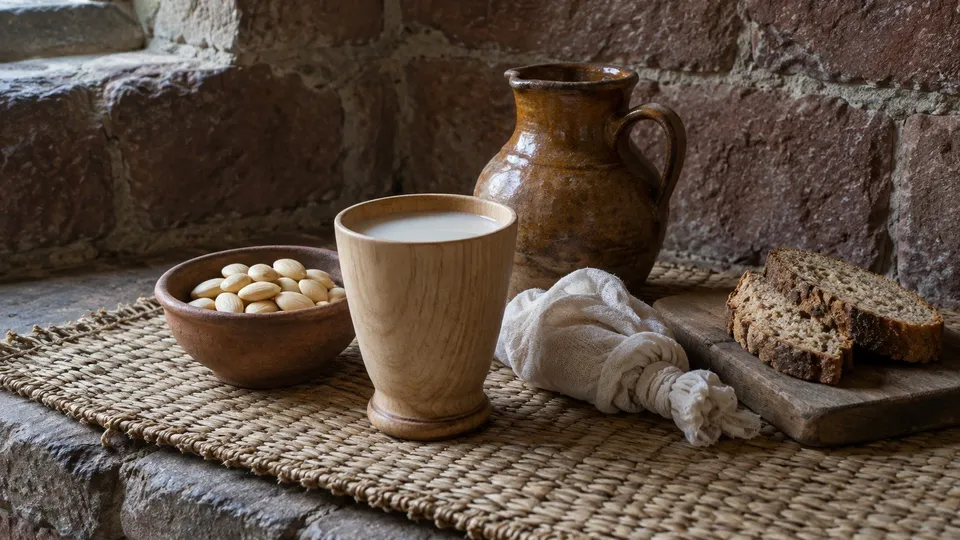 Always alcohol-freeAlmond Milk, the Medieval Fast-Day Milk
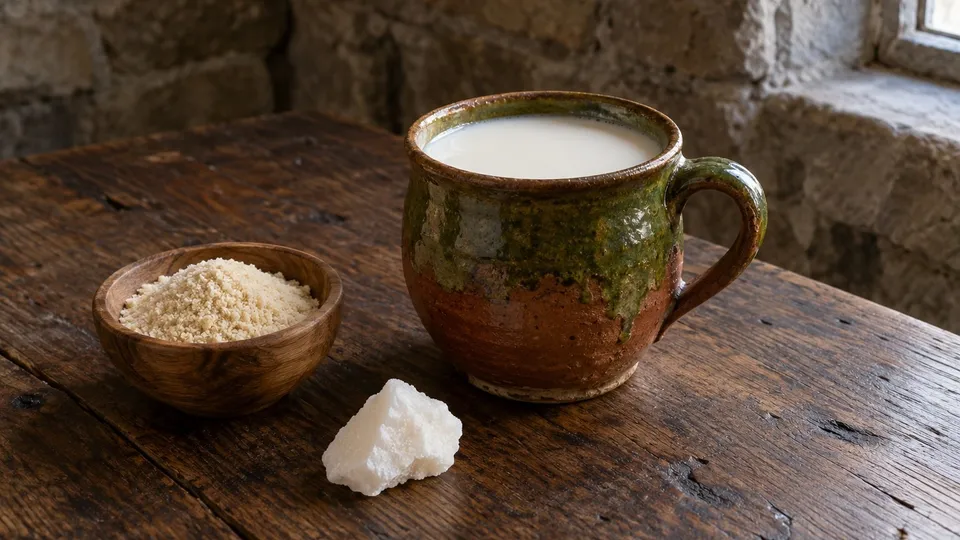 Alcohol-free versionCheaut, Hot Almond Milk from a Medieval Kitchen
The sick were not only given ale. Under the heading “For seke menne,” Liber cure cocorum pairs an ale broth with its sober twin: “Take playd water with hony, I wote, / For water gruel made with grote.” It is the source of our water gruel.
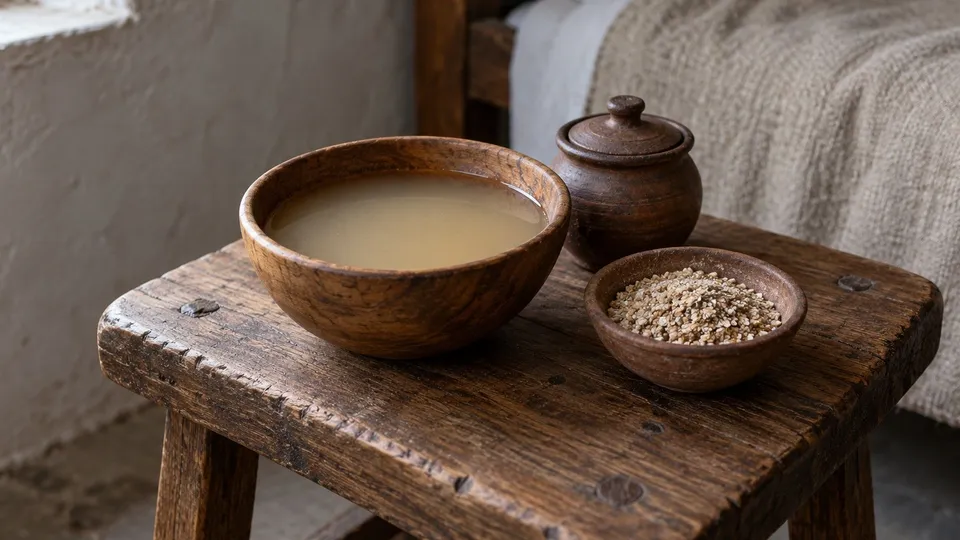 Always alcohol-freeWater Gruel, a Medieval Oat Drink for the Sick
“Water” could also mean something else. An English translation of Hieronymus Brunschwig’s book on distilling, printed in 1527, promises on its title page that “the waters be better than the Herbes.” These distilled herb waters, like our Tudor rose water, were remedies, and Boorde thought them better than plain water for mixing with wine.
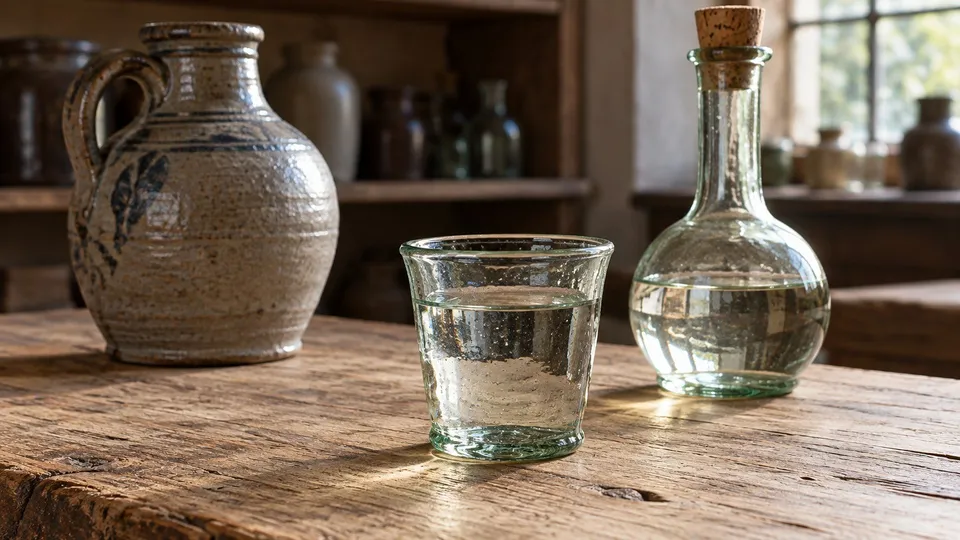 Always alcohol-freeRose Water, a Tudor Still-Room Drink
Was beer safer than water?
The period sources quoted here never say people chose ale because water was contaminated. Boorde’s doubts were mainly about cold and digestion, though he warned against putrid standing water, and modern historians still argue the point.
Many modern historians reject the myth, though not all. Eleanor Janega, writing in 2022, calls it “an old myth that people drank ale because water was unsafe to drink in the medieval period,” and argues that country people “had access to pretty good water.” Cornell, in 2014, quoted Stephen Harris and Bryon Grigsby’s Misconceptions About the Middle Ages: “water was available to drink in many forms.”
Bennett, in her study of brewing, leaned the other way, writing (as JSTOR Daily quotes her) that ale was “virtually the sole liquid consumed by medieval peasants” and that water “was considered to be unhealthy.” The farmhouse-brewing writer Lars Marius Garshol adds a caution from old Norwegian farms, where wells often lay below the farmyard: the risk from water was real, though he finds the evidence on what people thought of it thin and mixed.
Part of the gap is whom each writer has in view: Bennett’s brewing households, or the conduit’s poor, the satire’s shepherds and Boorde’s Welsh, who mostly couldn’t brew.
Beer, water, or both
For an English adult with a brewing pot or a few pence, ale was the ordinary drink, as much food as refreshment. Water was what the poor, servants and the young drank, what every kitchen used, and what doctors ranked and strained. The period record shows a physician with doubts about water. A whole population avoiding it for fear of contamination belongs to the modern story.
And Boorde himself was remembered as a water drinker. By his own account he could not abide water, but a hostile bishop, John Ponet, mocked him in print as a physician “that thryse in the week would drink nothinge but water,” listing it with his hair shirt as a show of holiness. The Oxford antiquary Anthony Wood, writing in the 1690s, repeated that it was “his custom to drink water three days in a week,” guessing it was a habit kept from his years as a Carthusian monk. Furnivall, his Victorian editor, doubted parts of both accounts. Either way, the story treats three water days a week as a penance for an ale drinker, and nobody in it suggests the water might kill him. Boorde did praise one sober drink, whey, “yf it be wel ordered,” and our whey orders it in about three hours, setting curds from pasteurized milk with rennet and draining off the pale drink to serve cold.
Sources
- Andrew Boorde, The Fyrst Boke of the Introduction of Knowledge and A Compendyous Regyment or a Dyetary of Helth (1542), ed. F. J. Furnivall (London: N. Trübner for the Early English Text Society, 1870), pp. 66, 70, 74–75, 127, 160, 206, 252–257, 264.
- Liber cure cocorum, ed. Richard Morris (London: Philological Society, 1862), p. 53.
- Thomas Austin (ed.), Two Fifteenth-Century Cookery-Books (London: Early English Text Society, 1888), p. 96.
- Samuel Pegge (ed.), The Forme of Cury (London: J. Nichols, 1780).
- Hieronymus Brunschwig, The Vertuose Boke of Distyllacyon of the Waters of All Maner of Herbes (London: Laurens Andrewe, 1527), title page.
- Derek Keene and Vanessa Harding, “St. Mary Colechurch 105/36: the great conduit,” Historical Gazetteer of London Before the Great Fire: Cheapside (London: Centre for Metropolitan History, 1987), British History Online.
- Judith M. Bennett, Ale, Beer, and Brewsters in England: Women’s Work in a Changing World, 1300–1600 (Oxford University Press, 1996), as reviewed in Times Higher Education (1998) and quoted in JSTOR Daily (2023).
- Martyn Cornell, “Was water really regarded as dangerous to drink in the Middle Ages?” (2014) and “So how much ale did a medieval peasant actually drink?” (2022), Zythophile.
- Eleanor Janega, “On Beer, or, Why Chicks Rock,” History News Network, August 18, 2022.
- Lars Marius Garshol, “Did people once drink beer every day?”, Larsblog, October 15, 2022.