Water Gruel, a Medieval Oat Drink for the Sick
Reader ratingsOat groats simmered in boiled water with honey and strained into a thin, warm drink: the sober half of a 15th-century cookery poem’s advice ‘For seke menne.’
- Recipe makes
- About 750 ml, 3 cups
- Prep
- Cook
- Total
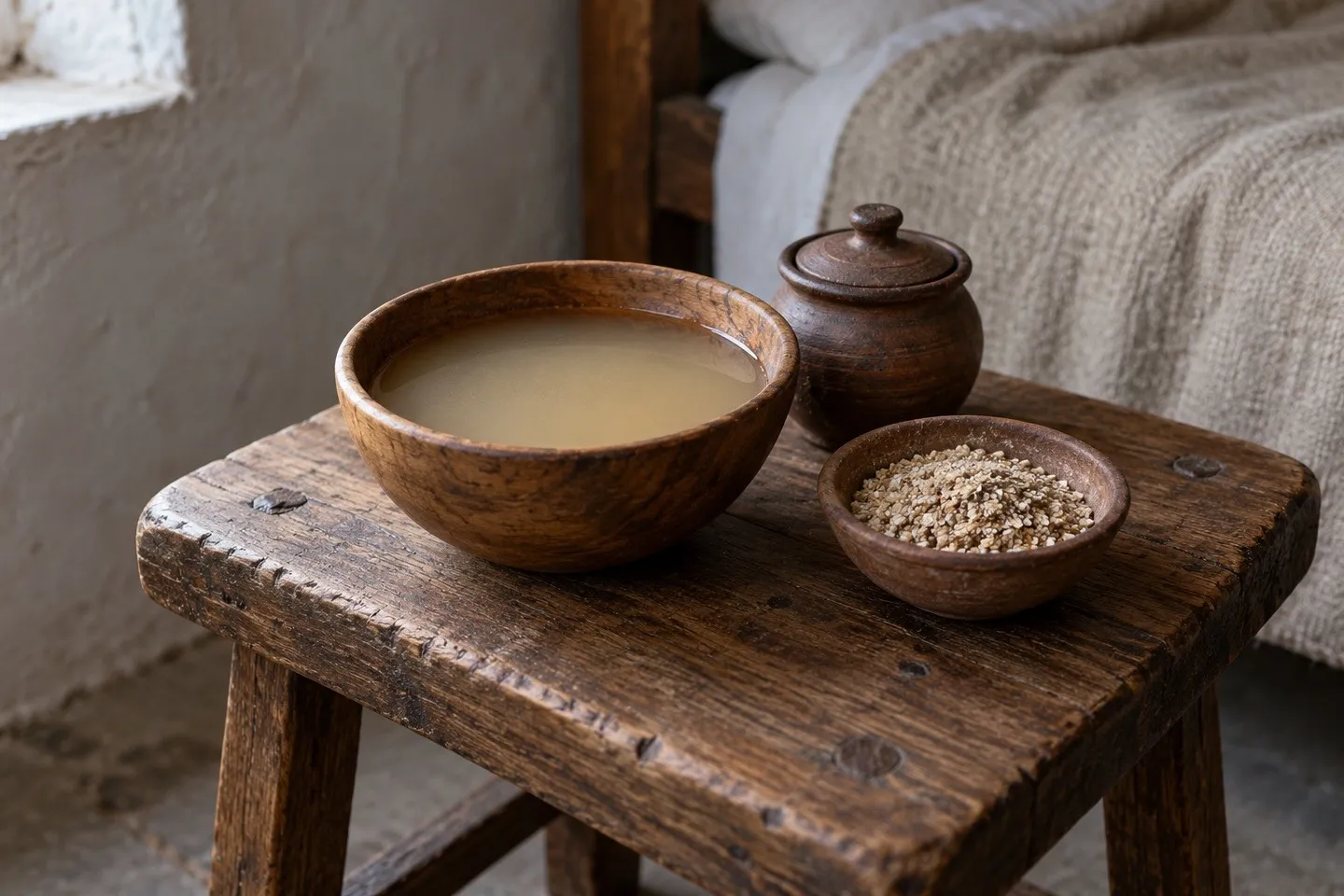
Water gruel in a turned wooden bowl, with a dish of cut oats and a honey pot on a stool by a sickbed.
The story behind the recipe
Under the heading “For seke menne,” for sick men, a fifteenth-century cookbook in rhyme gives two warm drinks made with oat groats. One is an ale broth. Beside it the poet gives a version with no ale at all: water gruel, groats boiled in water with honey. It makes a warm, thin cup, faintly sweet and tasting of oats.
Two lines for the sickroom
The book is Liber cure cocorum, which Richard Morris printed from Sloane MS. 1986 in 1862, and its author calls his subject “The Slyȝtes of Cure,” which Morris renders “The Art of Cookery.” Every recipe in it is set in rhyming couplets. The sickroom entry pairs “Ale bre,” which Morris glosses as “caudle, warm broth,” made “With grotes and safroune and good ale,” with the water version: “Take playd water with hony, I wote, / For water gruel made with grote.”
Morris’s index explains the hard words. Play is “to boil,” grotene is “grits,” and wot is “know,” so the cook takes boiled water with honey for a gruel of groats. A century later the Tudor physician Andrew Boorde had little against it. In his Dyetary of Helth (1542), “grewell made with otmell” can “do lytel displeasure, except that it doth replete a man with ventosyte,” that is, fill him with wind.
Read more about this recipe
From sickroom bowl to cup
Groats are whole hulled grains, and steel-cut oats are groats chopped into two or three pieces, so they cook faster. Here the oats simmer long enough to give up their starch and are then strained out, which makes a drink rather than a porridge; the strained grains can go to breakfast. The honey goes in at the end, so it keeps its flavor. Strained, it pours cloudy and pale gold, smooth on the tongue, with oat and honey and nothing sharp. Morris glossed the ale broth as caudle, and the same poem has a caudle proper: Ale Caudle, warm ale thickened with egg yolks.
For seke menne.
Ale bre þus make þou schalle, With grotes and safroune and good ale. Take playd water with hony, I wote, For water gruel made with grote;

Recipe makes: About 750 ml, 3 cups
Ingredients
For About 750 ml, 3 cups. Quantities are shown as written.
Quantities as written here, for About 750 ml, 3 cups.
- Water1 l
- Steel-cut oats60 g
- Honey20 ml
Measurement notes
Ingredients as written here
- 1 l water
- 60 g steel-cut oats
- 20 ml honey
Equipment
 Saucepan with a lid
 Fine sieve
 Jug
Instructions
Bring the water to the boil in a saucepan and stir in the steel-cut oats.
Lower the heat, cover the pan with the lid slightly ajar and simmer gently for 30 minutes, stirring now and then so the oats don’t stick.
Pour the gruel through a fine sieve into a jug, pressing lightly on the oats with the back of a spoon. Don’t force them through; the drink should stay thin.
Stir in the honey, taste, and serve warm in cups. Honey isn’t safe for babies under 12 months, so keep this cup for older drinkers.
Nutrition
55calories per serving
- Recipe makes
- About 750 ml, 3 cups
- Servings
- 3
Roughly estimated from USDA FoodData Central values for oats and honey, assuming about a third of the oats’ calories pass through the sieve.
Recipe notes
When adjusting quantities
Keep 60 g of oats and 20 ml of honey to every liter of water.
Notes
Quantities mentioned in these notes don’t change when you adjust the batch.
The poem leaves amounts and times to the cook; these are ours. Whole oat groats work too but take longer: simmer until the grains split, adding a little water if the pan runs low.
For a thicker, spoonable gruel, closer to a medieval sickroom bowl, don’t strain it.
The ale broth on the same line is alcoholic and isn’t made here.
The sickroom pairing of ale broth and water gruel is one of the clues weighed in Did Medieval People Really Drink Beer Instead of Water?.
Scaling changes the ingredients only; glassware, ice and timings need their own judgment. To adapt this recipe further, try the recipe tool at TuneMyRecipe (opens in a new tab), our sister site.
Sources and attribution
Richard Morris (ed.), Liber cure cocorum, Copied and Edited from the Sloane MS. 1986 (Berlin: A. Asher & Co. for the Philological Society, 1862), p. 53; index, pp. 58–59
Recipe details
- Drink
- Alcohol-free
- Drink family
- Hot Drinks
- Region
- British
- Era
- Medieval
- Difficulty
- Easy
- Season
- Winter