Hot Egg Lemonade from the Soda Fountain
Reader ratingsA whole egg shaken with strong lemon syrup and acid phosphate, then filled up with hot water and dusted with nutmeg: the winter fountain’s egg drink from 1894.
- Recipe makes
- About 1 cup lemon syrup, enough for 8 mugs
- Prep
- Cook
- Total
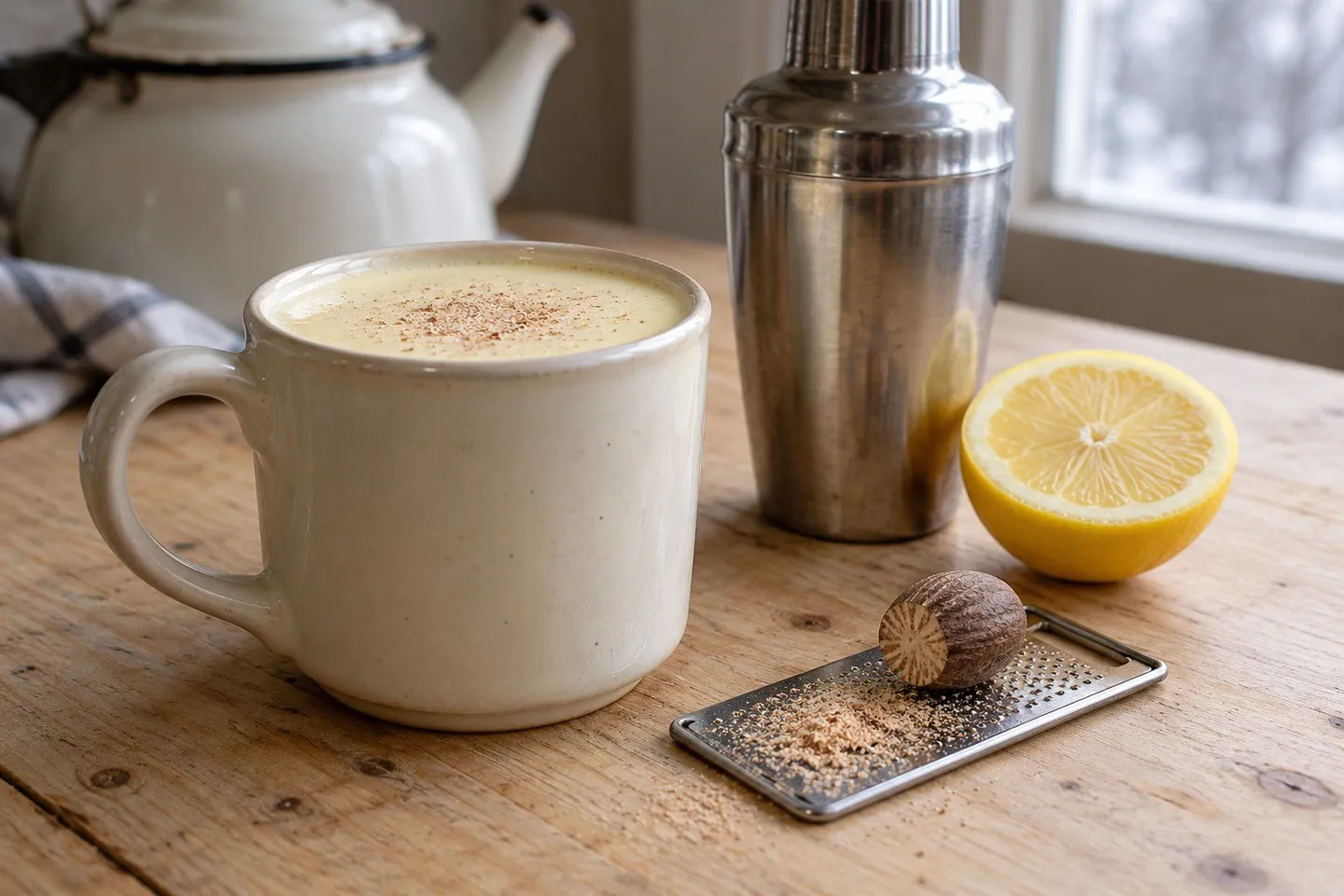
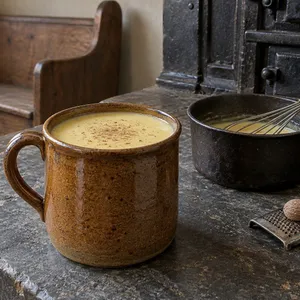
Hot egg lemonade in a stoneware mug, finished with grated nutmeg.
The story behind the recipe
Hot Egg Lemonade was the soda fountain’s egg drink made for winter: a whole egg shaken with strong lemon syrup, acid phosphate and lemon juice, then poured into a mug and filled up with hot water. De Forest Saxe printed it in 1894 as a single line after his Hot Egg Phosphate, “only add two teaspoonfuls Lemon Juice,” and both were finished with nutmeg.
A lemon syrup tinted with turmeric
Saxe’s “strong Lemon Syrup” began as his cold one, No. 54 in the same guide: 28 drops of oil of lemon and 1 1/4 ounces of citric acid to a gallon of simple syrup, colored with tincture of curcuma, which is turmeric, and given an ounce of “gum foam,” a foaming agent made from soap bark. For the hot drink he doubled the oil and made the sugar syrup heavier. This version leaves out the coloring and the foam: the egg and the zest give the drink its color, and the egg its froth.
Read more about this recipe
A safe egg and a slow pour
Saxe’s bit of ice goes into the shaker to break up the yolk as it shakes, so it lands in the mug with the egg and melts there. The egg is warmed by the water and not cooked, so use a pasteurized one. Pour the hot water in slowly while whisking, so the egg thins into a froth and doesn’t set into threads. Acid phosphate adds sourness without more lemon flavor. Buy food-grade acid phosphate sold for drinks, and never use laboratory or industrial phosphoric acid in its place. Expect a pale yellow, opaque drink under a froth that holds the nutmeg.
Egg lemonade lasted well past Saxe’s guide, mostly as a cold drink. Recipes from 1908 and 1913 shook it until a white foam stood on top, and one of them was finished with grated nutmeg, as his was. The hot form held on too: a Hot Foam Phosphate of 1921 still put an egg, syrups, acid phosphate and hot water in the cup, with nutmeg over it.
Its cold counterpart is the Lemon Egg Phosphate, and the hot list also ran to Hot Ginger and Hot Malted Milk with Salt and Pepper. How the winter fountain worked is in What Did Soda Fountains Sell in Winter?
Break a fresh egg into shaker, add a small piece of ice to break the yolk of the egg in shaking ...
Same as Egg Phosphate, only add two teaspoonfuls Lemon Juice.

Recipe makes: About 1 cup lemon syrup, enough for 8 mugs
Ingredients
For About 1 cup lemon syrup, enough for 8 mugs. Quantities are shown as written.
Quantities as written here, for About 1 cup lemon syrup, enough for 8 mugs.
Lemon syrup
- Lemons, zest only2
- Sugar1 cup
- Hot water1/3 cup
- Lemon juice1/4 cup
Per mug
- Small ice cube1
- Pasteurized egg1
- Lemon syrup2 tbsp
- Acid phosphate1 tsp
- Lemon juice2 tsp
- Hot water1/2 cup
- Grated nutmeg, to finish
Measurement notes
Ingredients as written here
- 2 lemons, zest only
- 1 cup sugar
- 1/3 cup hot water
- 1/4 cup lemon juice
- 1 small ice cube
- 1 pasteurized egg
- 2 tbsp lemon syrup
- 1 tsp acid phosphate
- 2 tsp lemon juice
- 1/2 cup hot water
- grated nutmeg, to finish
Equipment
 Fine grater or zester
 Bowl and fine strainer
 Clean bottle or jar for the syrup
 Cocktail shaker
 Kettle and whisk
 Mug, about 8 fl oz
- Nutmeg grater
Instructions
For the syrup, finely grate the zest of the lemons into a bowl, add the sugar and rub the zest into it with your fingers until the sugar is damp and smells strongly of lemon.
Pour in the hot water and stir until the sugar has dissolved, then stir in the lemon juice. Strain into a clean bottle or jar, pressing on the zest.
For each mug, warm the mug with hot water and pour it out. Put the small ice cube, pasteurized egg, the lemon syrup, the acid phosphate and the lemon juice in a cocktail shaker. Close it and shake hard for about 15 seconds, until the egg is frothy.
Pour everything into the warm mug, including any ice left. Pour in the hot water a little at a time, whisking all the while; use water at about 80°C (175°F), well off the boil.
Grate a little nutmeg over the top and serve at once.
Nutrition
160calories per serving
- Recipe makes
- About 1 cup lemon syrup, enough for 8 mugs
- Servings
- 8
Estimated from USDA FoodData Central values for sugar, lemon juice and a whole egg, for one mug with 2 tablespoons of the syrup.
Recipe notes
When adjusting quantities
Scale the lemon syrup ingredients together. The mug ingredients are for one drink; multiply them by the number of mugs.
Notes
Quantities mentioned in these notes don’t change when you adjust the batch.
Lemon zest rubbed into the sugar stands in for Saxe’s oil of lemon, and lemon juice for his citric acid, so the syrup stays strong and sharp.
His “one ounce” of syrup is a US fluid ounce, 2 tbsp. He says only “add hot water” to fill an 8-ounce mug; with the egg, syrup and juice already in, 1/2 cup of water fills it.
The ice and the cold egg and syrup take the heat out of the water, so the drink comes out warm, not scalding, as Saxe’s would have. For a hotter mug, strain the shaken egg into the mug and leave the ice behind.
Without acid phosphate the drink loses some sharpness; adding 2 more teaspoons of lemon juice is our substitute, and it makes the drink taste more of lemon.
Storage
Keep the lemon syrup in a clean, closed bottle in the fridge and use it within two weeks.
Scaling changes the ingredients only; glassware, ice and timings need their own judgment. To adapt this recipe further, try the recipe tool at TuneMyRecipe (opens in a new tab), our sister site.
Sources and attribution
De Forest W. Saxe, Saxe’s New Guide, or Hints to Soda Water Dispensers (Chicago: Saxe Guide Publishing, 1894), Nos. 187, 194 and 195, pp. 105 and 107
See the original pages (scan at Internet Archive) (opens in a new tab)
Recipe details
- Drink
- Alcohol-free
- Drink family
- Hot Drinks
- Region
- American
- Era
- 19th century
- Source decade
- 1890s
- Base
- Fruit & juice
- Difficulty
- Easy
- Season
- Winter