Coffee-Tavern Coffee at a Penny a Cup
Reader ratingsFresh-ground coffee steeped fifteen minutes in boiling water, strained, then sweetened with Demerara and hot milk: the urn coffee an 1878 manual costed at a penny a cup.
- Recipe makes
- About 1 liter, 4 mugs
- Prep
- Cook
- Total
Includes 15 minutes for the coffee to stand covered and keep hot before straining.
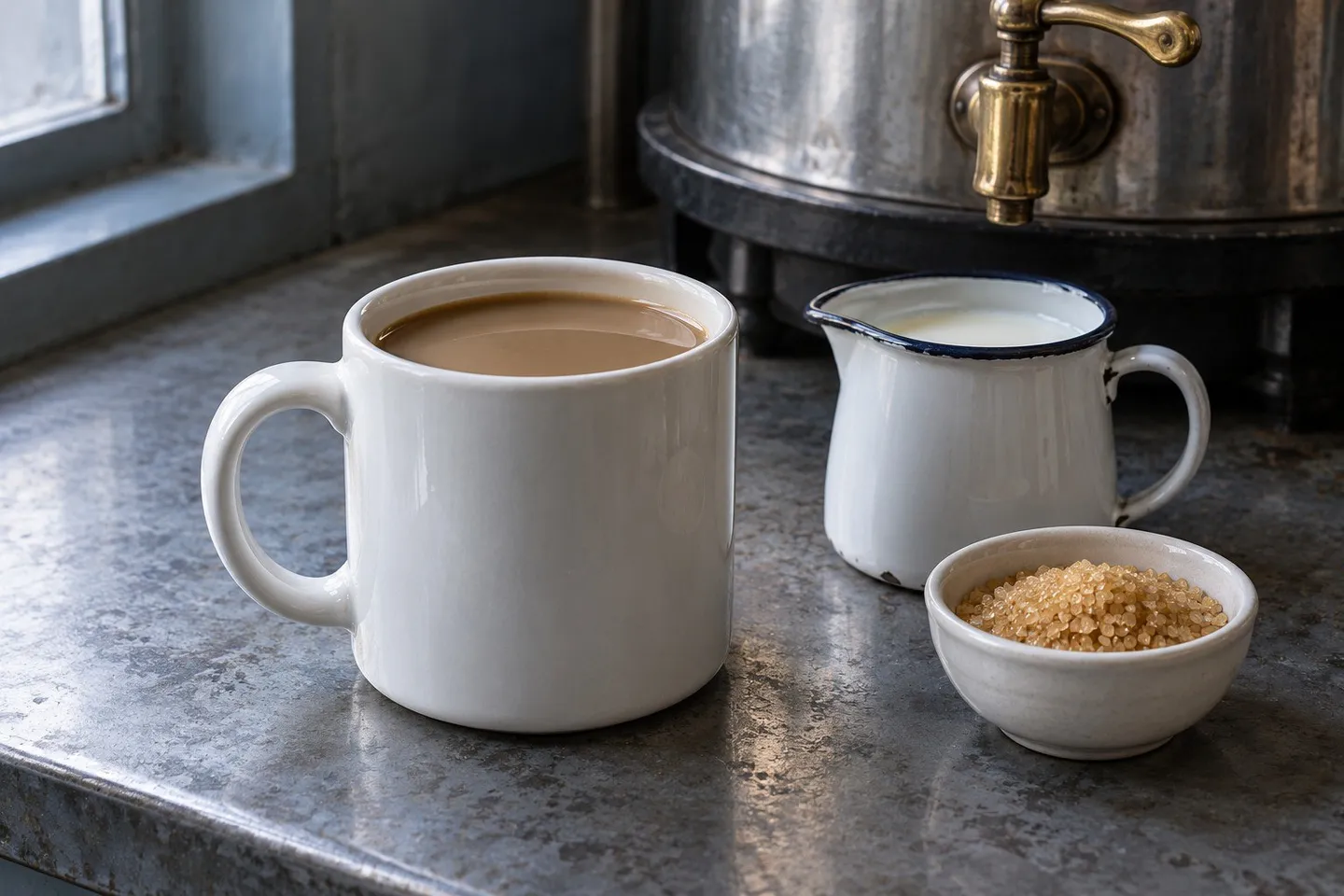
Milky coffee in a thick white mug on a zinc counter, with a jug of hot milk and Demerara sugar.
The story behind the recipe
A pound of fresh-ground coffee to thirteen pints of boiling water, left to stand a full fifteen minutes and strained through flannel: that was the coffee the Coffee Publichouse Association told its managers to sell at a penny a half-pint cup in 1878, about 43p today by UK consumer prices (Bank of England). Its manual costed every ingredient down to the farthing, and the arithmetic left a profit of about a third on cost.
Bought by the hundredweight
The manual wrote for managers who bought like grocers. The coffee was to be “the best Plantation Coffee,” estate-grown beans costing “raw about 120s. per cwt.,” a hundredweight of 112 pounds. Roasting could be sent out for “2s. 6d. per cwt.” A roaster for six pounds at a time cost around £2 (about £210 today), but roasting was “a delicate process,” and “comparatively few managers would be able to attend to it.” The beans lost about 17 per cent of their weight in the roasting. Milk was “contracted for at 4d. per quart,” and houses too small to buy wholesale might club together with neighboring houses to get wholesale prices.
The sums came to 1s. 11¾d., about £10 today, for two gallons of sweet, milky coffee: 1s. 3½d. of coffee, 6d. of milk and 2¼d. of Demerara sugar. Each gallon held sixteen half-pint cups, which at a penny each brought in 1s. 4d. against about a shilling of cost. For his penny, the customer got half a pint with the sugar already in, and the milk too, unless the house kept a small urn of hot milk on the counter to add to each cup as it was served. At a pinch the coffee could go for a halfpenny, the manual allowed, but its ten-minute tea could not be sold at a profit for less than a penny.
Read more about this recipe
One-eighth of the can
At one-eighth of the manual’s can, the coffee comes to about 62 grams to a liter of water, a little stronger than the 55 grams per liter the Specialty Coffee Association recommends for filter coffee. The long steep makes a strong, bitter brew; the milk and Demerara are there to soften it. The manual itself called the method “somewhat rough and ready.” A cloth or paper filter does the flannel’s job. Buy a medium-roast arabica and Demerara sugar, which is still sold under that name. Coffee Taverns, the Victorian Answer to the Pub follows the taverns themselves, from penny cocoa to hot gingerette.
COFFEE AT ONE PENNY A CUP.—The best Plantation Coffee should be used, such as will cost raw about 120s. per cwt. The usual charge for roasting is 2s. 6d. per cwt. The most economical arrangement would be to roast the coffee on the premises as required, a machine for roasting 6lbs. at once costing about £2; but coffee roasting is a delicate process—that is, it requires great care and attention, and comparatively few managers would be able to attend to it. The following process of making coffee will be found to give good results where there is no special apparatus for the purpose:—
The coffee should be finely ground on the premises immediately before it is required for use. It is then to be placed in an ordinary mixing can, or covered pail, and the proportion recommended in this case is one pound of coffee to thirteen pints of water. The coffee should not be boiled, but the water must be in a boiling state when poured upon it, and the can or pail should have been previously warmed. The coffee thus made is to be left standing full fifteen minutes upon or near the stove, so as to be kept hot, and is then to be cleared by pouring through a flannel strainer. If a separate milk urn is not provided, hot milk may now be added in the proportion of three pints to the thirteen pints of coffee, and Demerara sugar (about 27s. per cwt.) in the proportion of three-quarters of a pound to the same quantity. Two gallons of very good coffee are thus produced at a cost approximately as follows:—
Coffee . . . . . . 1s. 3½d.
Milk . . . . . . 6d.
Sugar . . . . . . 2¼d.
1s. 11¾d.or about 1s. per gallon. The gallon contains 16 half-pint cups, which at 1d. each would produce 1s. 4d., or about 33 per cent. profit.

Recipe makes: About 1 liter, 4 mugs
Ingredients
For About 1 liter, 4 mugs. Quantities are shown as written.
Quantities as written here, for About 1 liter, 4 mugs.
- Medium-roast coffee beans57 g
- Water925 ml
- Whole milk215 ml
- Demerara sugar3 metric tbsp (15 ml per tbsp)
Measurement notes
Ingredients as written here
- 57 g medium-roast coffee beans
- 925 ml water
- 215 ml whole milk
- 3 tbsp Demerara sugar
Equipment
 Coffee grinder
 Jug or pot with a lid, about 1.5 liters, or a large French press
 Small saucepan
 Sieve lined with a clean cotton cloth or a paper coffee filter
- Second jug, warmed
 4 mugs
Instructions
Warm a lidded jug or pot with room to spare for the water by filling it with hot water, then pour the water away.
Grind the medium-roast coffee beans medium-fine just before you make the coffee, and tip the grounds into the warm jug.
Bring the water to a full boil and pour it straight onto the coffee. Stir once and put the lid on.
Leave it to stand for 15 minutes, kept hot but never boiling: on the lowest heat with a heat diffuser under it, or wrapped in a thick towel.
A few minutes before the time is up, heat the whole milk in a small saucepan until it steams, without letting it boil.
Pour the coffee through a sieve lined with a clean cotton cloth or a paper coffee filter into a second warmed jug, leaving the grounds behind.
Stir in the hot milk and the Demerara sugar until the sugar has dissolved, and pour into mugs while it is hot.
Nutrition
75calories per serving
- Recipe makes
- About 1 liter, 4 mugs
- Servings
- 4
Estimated from USDA FoodData Central values for brewed coffee, whole milk and brown sugar, for one of four mugs.
Recipe notes
When adjusting quantities
Scale everything together. The manual’s own batch is eight times this one: a pound of coffee to thirteen pints of water.
Notes
Quantities mentioned in these notes don’t change when you adjust the batch.
The manual’s batch is 1 pound of coffee, 13 imperial pints of water, 3 pints of hot milk and ¾ pound of Demerara sugar, which it counts as two gallons. One-eighth gives 57 g coffee, 925 ml water, 215 ml milk and 42 g sugar; 3 tablespoons of Demerara weigh about 41 g. The grounds keep back some water, so the jug holds about a liter: four mugs of about 250 ml, or three and a half of the tavern’s half-pint (284 ml) cups.
The tavern sweetened the whole batch, which comes to about 10 g of sugar a mug. To sweeten each mug to taste instead, leave the sugar out of the jug and serve it on the side. The manual also allows the milk to go into each cup from a separate urn; extra hot milk at the table does the same.
“Plantation” coffee was a trade term for estate-grown beans, the better grade of the day. Any good medium-roast arabica suits. The manual warned against stretching coffee with chicory or burnt sugar, so use pure coffee.
Scaling changes the ingredients only; glassware, ice and timings need their own judgment. To adapt this recipe further, try the recipe tool at TuneMyRecipe (opens in a new tab), our sister site.
Sources and attribution
Coffee Publichouse Association, The Coffee Publichouse: How to Establish and Manage It (London: Coffee Publichouse Association, 1878), pp. 28–29
See the original pages (scan at Internet Archive) (opens in a new tab)
Recipe details
- Drink
- Alcohol-free
- Drink family
- Hot Drinks
- Region
- British
- Era
- 19th century
- Source decade
- 1870s
- Difficulty
- Easy
- Occasion
- Dry January
- Season
- Winter