Coffee Taverns, the Victorian Answer to the Pub
Penny cocoa, coffee and tea from gas-heated urns, served over a pub-style bar from 5 a.m.: the coffee taverns, coffee palaces and cocoa rooms of the 1870s.
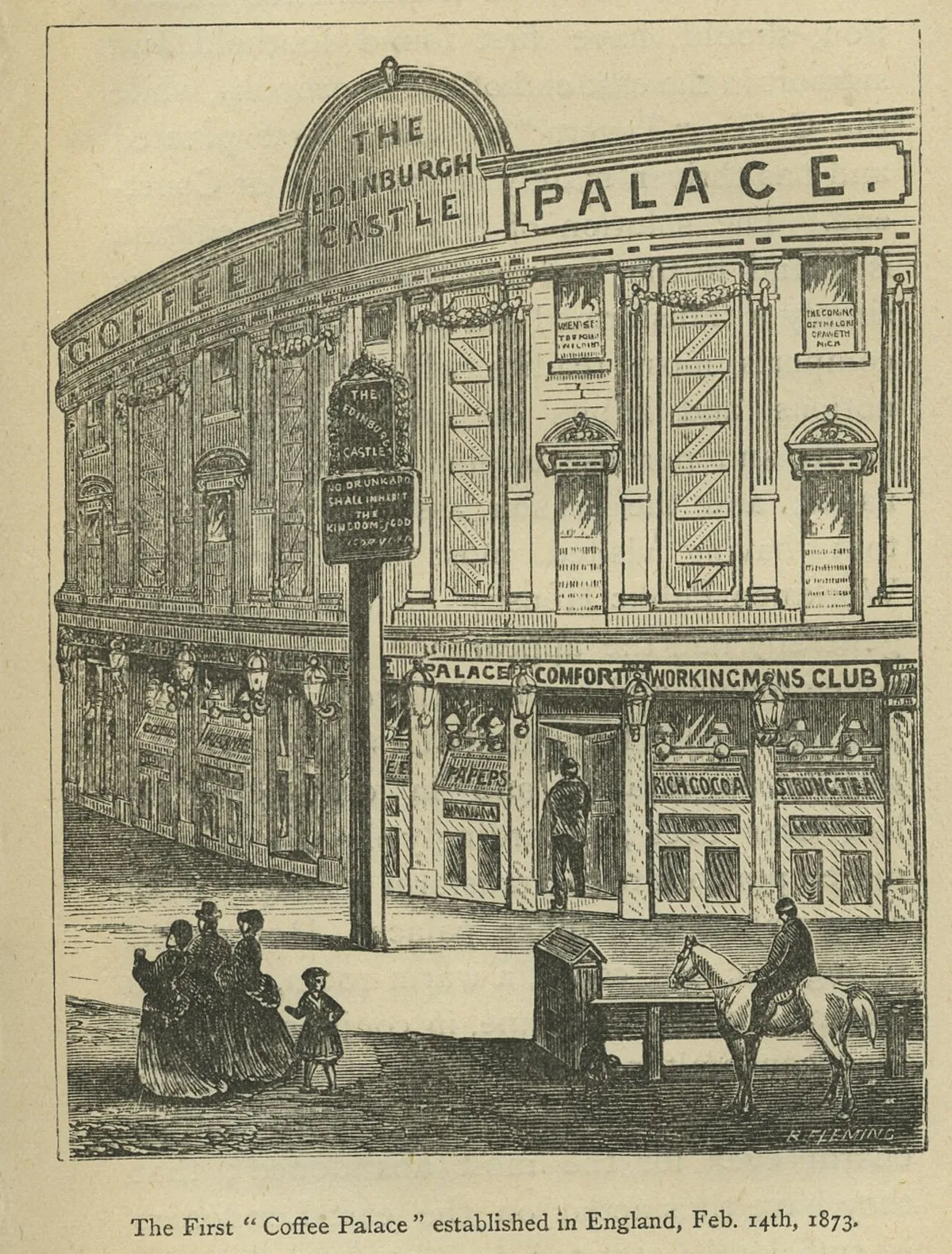
A coffee tavern sold hot drinks at a halfpenny or a penny a cup, about 21p or 43p today by UK consumer prices (Bank of England): cocoa above all, then coffee and tea, drawn from gas-heated urns on a bar built like a pub’s and sold from five in the morning, with lemonade, soda water and “hot gingerette” beside them. Reformers opened these coffee taverns, coffee palaces and cocoa rooms across Britain from the 1870s, more than 3,000 of them by 1879 on one promoter’s count. Many failed on weak drinks and charitable management. The ones run as businesses, Lockhart’s cocoa rooms above all, did far better.
This story is part of our Dry January Drinks guide.
In one week of 1877 the seventeen houses of Liverpool’s British Workman Public-house Company sold more cocoa than anything else: “4,756 gallons of cocoa, 4,100 gallons of coffee, 540 gallons of tea, and 47,238 pieces of bread,” according to figures from the company’s chairman printed in the Liverpool Mercury and repeated in The Leisure Hour. The company took £598 that week, about £60,000 today, though “very few of the sales exceed one penny in amount, whilst a vast number are represented by the modest sum of one halfpenny.”
Cocoa first
The Coffee Publichouse, the manual the Coffee Publichouse Association issued in London in April 1878, shows why cocoa won. It reckoned that cocoa made from a wholesale “extract” or “essence” cost “about 4d. per gallon, and may therefore be sold at 1d. a pint or ½d. a cup.” Its coffee, milk and sugar included, came to about a shilling a gallon (about £5.20 today), three times as much. For cocoa it gives no measures, only that “the addition of a little hot milk and sugar is necessary.”
E. Hepple Hall’s 1878 book on coffee taverns opens with an engraving of the Edinburgh Castle in East London, which it calls the first coffee palace in England, opened in 1873. One window bill reads “Rich Cocoa,” the next “Strong Tea,” and a sign on a post outside warns that “No drunkard shall inherit the Kingdom of God.”
What was a coffee tavern like?
The aim, set in italics in the manual, was “a satisfactory substitute for the ordinary publichouse from the working man’s point of view.” On top of the bar stood “a range of urns to contain coffee, tea, cocoa, and milk, all kept hot by rings of gas jets below,” each holding four to ten gallons. At one end, “a large filter with a crystal mug, offering pure water free of charge.” Where soda water and flavored drinks were sold, a small marble fountain with four or more taps went on the counter.
“In London and some other great towns these hours will usually be from 5 A.M. till midnight,” reads the advice on opening times, and Hall describes the morning trade at one house: “Soon after five, men on the way to their work … drop in for a cup of cocoa and a slice of bread and butter.” Half a century earlier, London’s early workmen had bought saloop from street stalls before dawn.
On the London price list, coffee or cocoa cost “½d. or 1d.” for a half-pint cup and a penny or three-halfpence for a pint; tea was a penny; bread and butter or jam a halfpenny. “Lemonade and soda water” cost 2d., about 86p today and four times the cheapest cocoa.
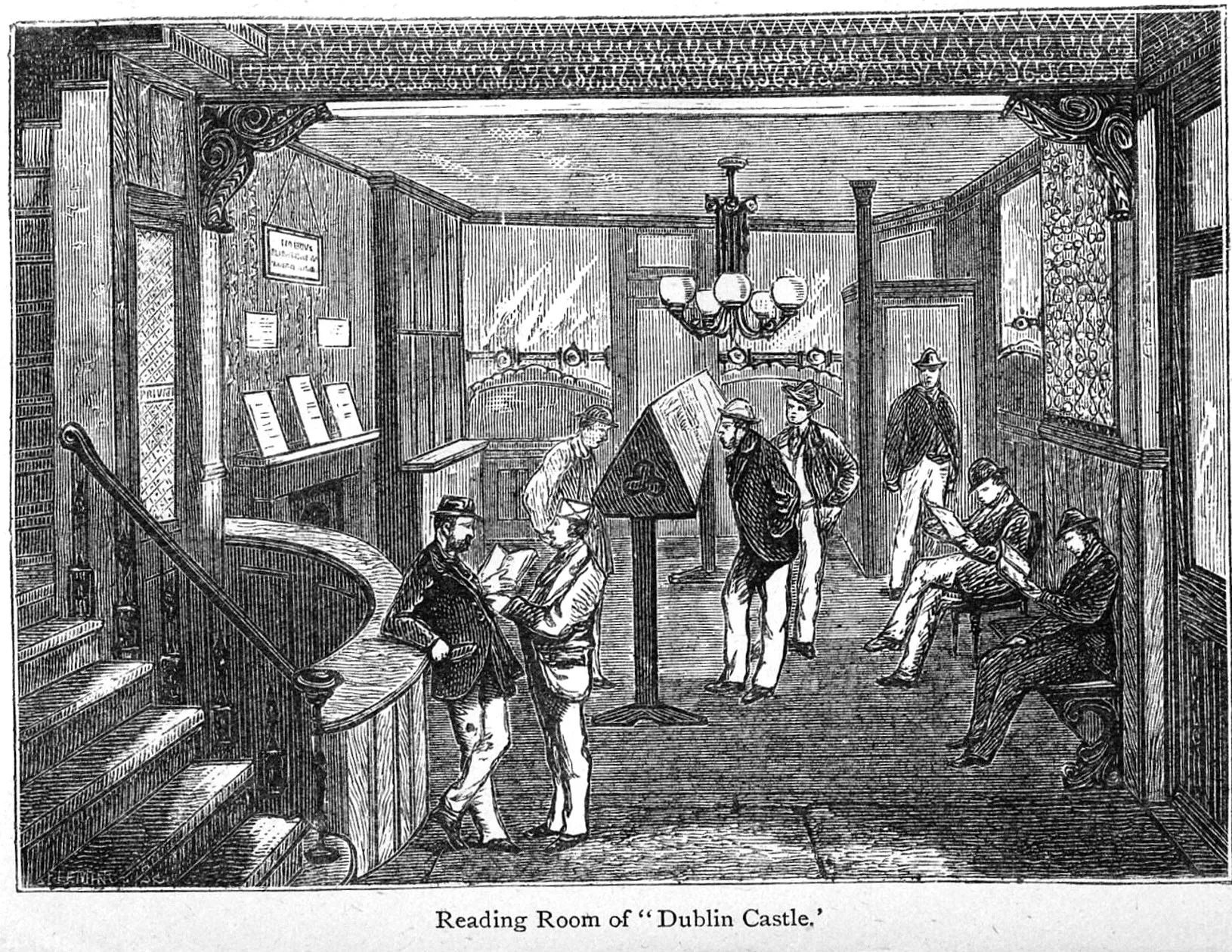 Reading room of the Dublin Castle coffee palace, Mile End Road. From E. Hepple Hall, Coffee Taverns, Cocoa Houses, and Coffee Palaces (London, 1878).
The best houses sold company too. The manual wanted a place where a man “may meet his friends, and talk and smoke, and play games,” with good coffee and tea in place of beer and gin. Florence Nightingale, in a letter printed in the manual, remembered a workhouse doctor who told every recovering drinker, “Now, my good fellow, do drink coffee for the rest of your life.” Her question followed: “Where are they to get it?”
The trouble with penny coffee
Many customers found the drinks poor, and the association said so in print. A working man trying to turn over a new leaf calls for coffee in place of his beer: “He is served with a weak and rather thick decoction, pleasant neither to taste nor smell.” It leaves him craving “a stronger liquor,” so back he goes to the public-house. A working woman fares no better with “the weak washy fluid too often sold under the name of tea.”
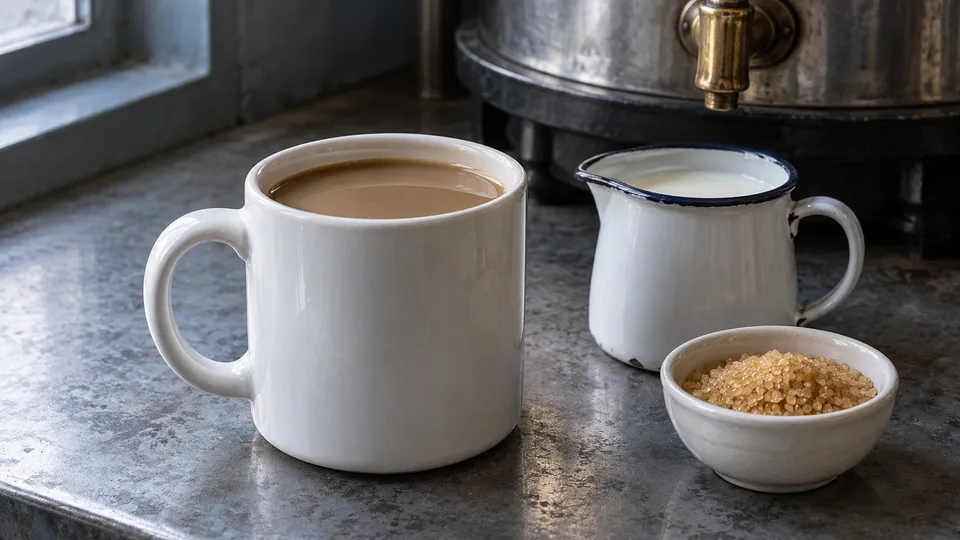
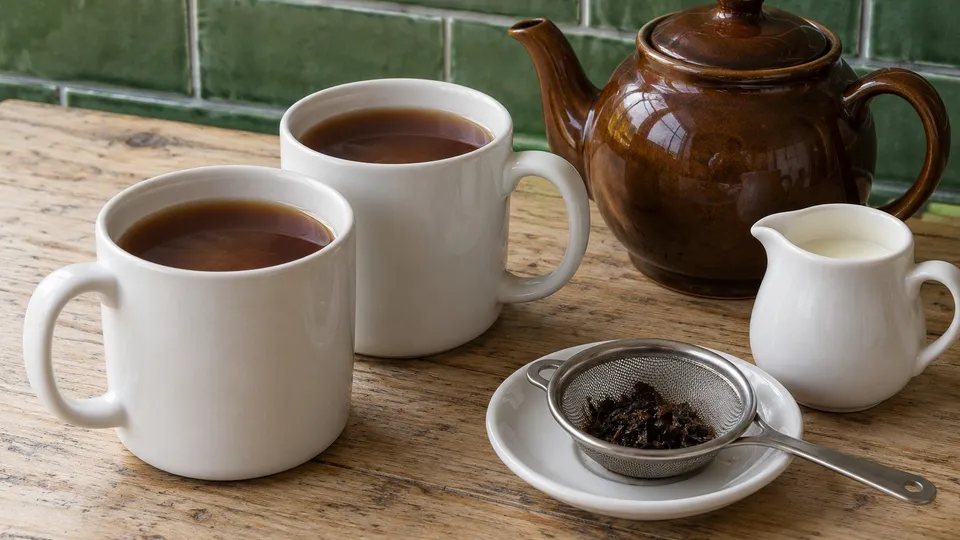
Good coffee and tea, “strong and fragrant,” could still be sold at a penny for a half-pint cup, the manual insisted. Its own urn coffee was a pound of fresh-ground coffee to thirteen pints of boiling water, a method it admitted was “somewhat rough and ready.” That batch, scaled down for a home kitchen, is our Coffee-Tavern Coffee at a Penny a Cup. Its tea came from a blend of China and Assam leaf, left to stand “exactly ten minutes”: Coffee-Tavern Tea, Steeped Ten Minutes.
 Always alcohol-freeCoffee-Tavern Coffee at a Penny a Cup
 Always alcohol-freeCoffee-Tavern Tea, Steeped Ten Minutes
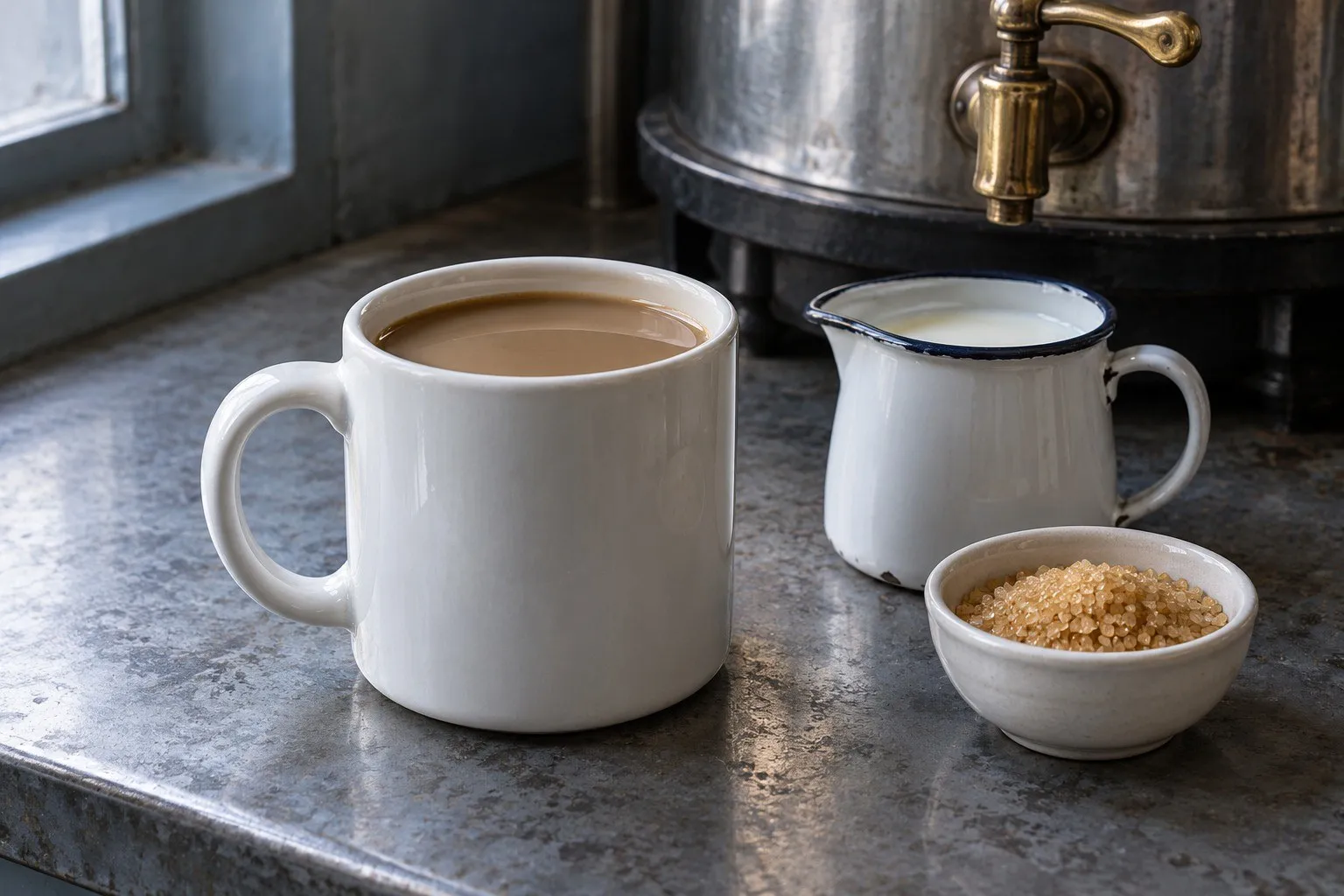 Coffee made to the manual’s urn method, in a thick white mug on a zinc counter, with hot milk and Demerara sugar beside it.
Three thousand houses
The manual counted fifty-eight companies “for the establishment of Coffee Publichouses and Coffee Taverns” by April 1878, most of them formed in the previous two years. A year later, writing in The Leisure Hour, Hall put the total at “more than eighty companies” and “more than 3,000 houses,” taking between £40,000 and £55,000 a week (about £4.3 million to £5.9 million today). Hall was a promoter, and his figures are round. Liverpool’s cocoa rooms alone numbered thirty-five, he wrote, seating 10,000 people.
He was no flatterer of the food. “Hard-boiled eggs, half-baked bread, underdone sausages” were, in his words, no fare for “a half-famished mechanic” facing an afternoon’s work outdoors. Worse, quality was already falling off in the poorer parts of London, and he warned that it must not be sacrificed to “the cupidity of landlords” or “the stupidity or carelessness of cooks.” He added: “Most men prefer a good glass of beer to an indifferent cup of coffee, tea, or cocoa.”
Hot gingerette at the Old Vic
The coffee tavern even moved into a theater: the Royal Victoria Hall, the house now known as the Old Vic, “was started at the end of 1880 by the Coffee and Music Halls Company on a temperance basis,” The Leisure Hour reported in 1885, and since then “no intoxicants have been sold within its walls.” English Heritage credits the campaigner Emma Cons with founding the company and the music hall. Its tavern served tea, coffee and cocoa “at a penny and a halfpenny the cup,” and the bars in the hall, where gin and beer had once been sold, offered lemonade, “ades” of all kinds and hot gingerette, which the magazine called the “teetotaler’s brandy-and-water.” What it tasted like went unrecorded.
Wishwash and billiards
The City Jackdaw, a Manchester weekly, headed its July 1877 piece “The Coffee Tavern Humbug.” It summed up the program as “offering to the people coffee and wishwash and pies and sandwiches and billiards.” Its verdict: “Any remedy would be better than this absurd institution of coffee taverns.”
Lockhart’s and the business of cocoa
By 1892, Charles Booth’s survey of London gave the movement a mixed report. “At first cocoa rooms, or ‘coffee palaces’ as they were then called, were the result of philanthropic or religious effort,” he wrote. “They were to pay their way; but they did not do it. They were to provide good refreshments; but tea, coffee, cocoa and cakes were alike bad. It was not till the work was taken up as a business that any good was done with it.”
The business he had in mind was Lockhart’s, “the best and the most numerous” of the cocoa-room chains, and he expected that soon there would be “no length of principal street without such a place.” He liked their rules: a customer who bought cocoa could sit down and eat the breakfast or dinner he had brought from home.
The pub learns the trick
Booth saw publicans squeezed between the cocoa rooms and the working men’s clubs, and answering in kind with early coffee and soft drinks: “Ginger beer is sold everywhere, and not infrequently kept on draught.” On draft it was called “Brewed Ginger Beer,” his footnote adds, “a sort of sheep in wolf’s clothing.” What Were Victorian Non-Alcoholic Beers? looks at what went into those bottles and barrels.
By 1915 the writer Arthur Shadwell could report that “the public-house and the club flourish, but the coffee tavern languishes.” A working man in a pub had told him why men went there: “for the pipe, the company, and the glass of beer.” The coffee tavern offered two of the three. The pub, Shadwell noted, now offered all three and let a man skip the third: “You may order a glass of ginger beer or just nothing at all.” That same year, wartime orders across much of Britain made it an offense to buy a friend a beer but not a cup of tea, as No Rounds Allowed tells.
Booth and Shadwell were judging different things. Booth praised the cocoa rooms run as a business, Lockhart’s first among them. Shadwell’s coffee tavern was the reformers’ substitute for the pub, and that was what languished. Time the tea the way the taverns did: the 1878 manual’s coffee-tavern tea stands on China and Assam leaf for “exactly ten minutes” before it is poured off into a warm pot.
Sources
- Coffee Publichouse Association, The Coffee Publichouse: How to Establish and Manage It (London: Coffee Publichouse Association, 1878), pp. 9–10, 16–17, 25, 28–35.
- E. Hepple Hall, Coffee Taverns, Cocoa Houses, and Coffee Palaces: Their Rise, Progress, and Prospects (London: S. W. Partridge & Co., 1878), frontispiece, plate and p. 81, MAK Vienna copy.
- E. Hepple Hall, “Coffee Taverns,” The Leisure Hour, May 10, 1879, pp. 301–303.
- “Cocoa versus Beer,” The Leisure Hour, March 24, 1877, p. 192.
- “The Royal Victoria Hall and Coffee Tavern,” The Leisure Hour, April 1885, p. 279.
- “The Coffee Tavern Humbug,” The City Jackdaw (Manchester), July 13, 1877, p. 274.
- Charles Booth (ed.), Life and Labour of the People in London, vol. I (London: Macmillan, 1892), pp. 115–116.
- Arthur Shadwell, Drink, Temperance and Legislation, new ed. (London: Longmans, 1915), p. 134.
- English Heritage, “Emma Cons,” Blue Plaques.