Orgeat, Almond Milk with Orange-Flower Water
Reader ratingsAlmonds pounded with orange-flower water, let down with milk and water, strained and sweetened: the alcohol-free orgeat of Rundell’s 1807 sickroom chapter.
- Recipe makes
- About 1 liter, 4 glasses
- Prep
- Total
Includes 30 minutes for the almond milk to rest in the fridge before straining.
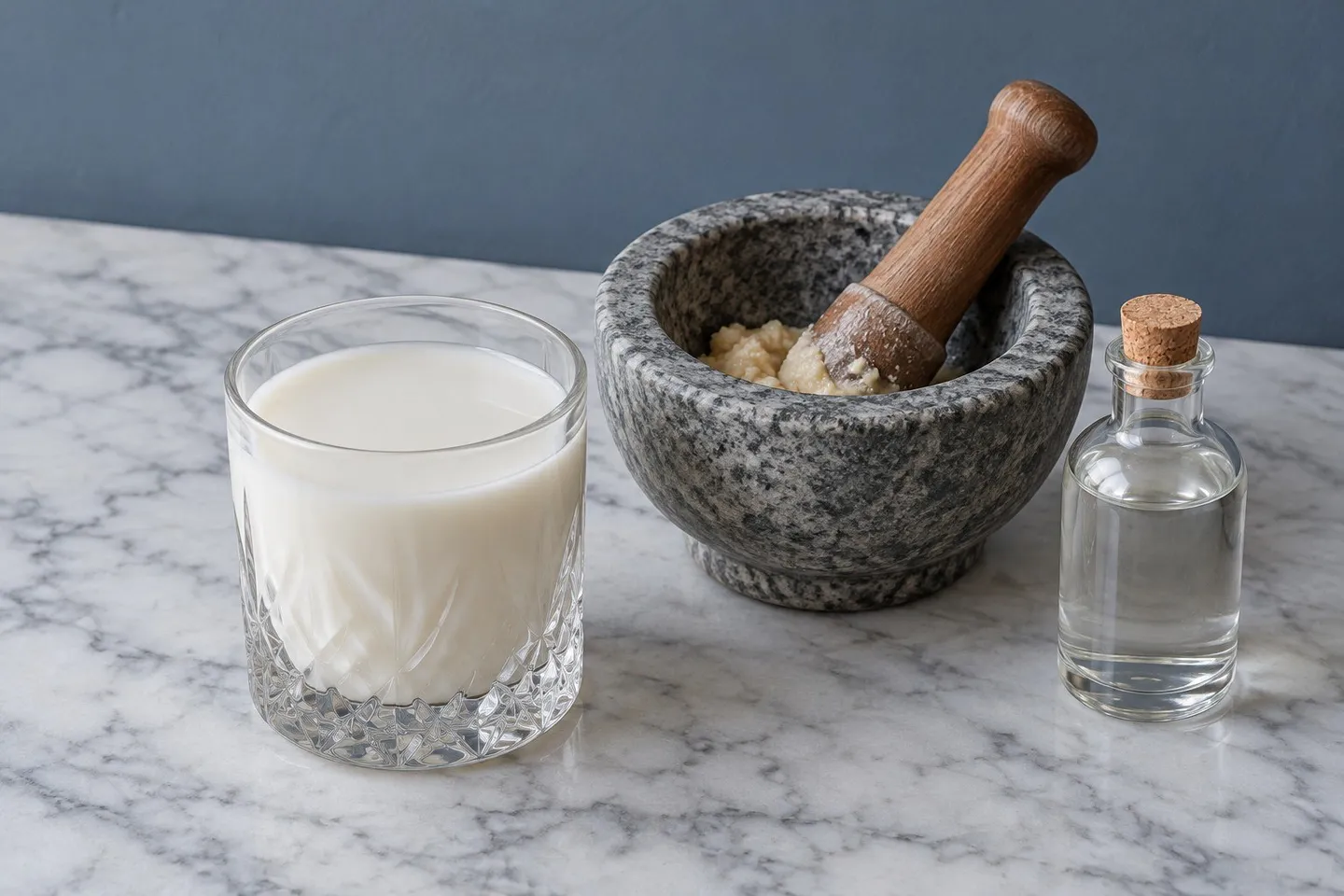
Orgeat in a cut-glass tumbler, with a mortar of almond paste and a bottle of orange-flower water.
The story behind the recipe
Orgeat is almond milk scented with orange-flower water, and before it became a cocktail syrup it was a drink in its own right. Maria Eliza Rundell’s A New System of Domestic Cookery gives it twice, and this is the version from her chapter for the sick, made with no spirit at all.
Two orgeats in one book
The Philadelphia edition of 1807 (her book first appeared in London the year before) puts the plain orgeat on page 228, among the invalid’s drinks: almonds beaten “with a teaspoonful of orange flour water, and a bitter almond or two,” a quart of milk and water poured onto the paste, and a final line, “Sweeten with sugar, or capillaire.” Orange flour water is her printer’s spelling of orange-flower water. Capillaire was a sweet syrup.
The same page points the reader to “Another orgeat for company, page 213.” That one sits in the brewing chapter, and it is richer and stronger: new milk boiled with cinnamon, three ounces of sweet almonds and twenty bitter ones, and brandy to finish. The sickroom version works on two ounces of almonds and has no cinnamon, so the orange-flower water does the scenting.
Read more about this recipe
Bitter almonds, then and now
The “bitter almond or two” gave orgeat its marzipan edge. It can’t be copied safely. Raw bitter almonds can contain high levels of cyanide, and Food Standards Scotland advises people “not [to] consume raw bitter almonds.” A little pure almond extract, flavored with benzaldehyde, gives the same marzipan note.
Rundell doesn’t say how much of the quart is milk, so half and half is our choice. Her company orgeat runs closer to three parts milk to two of water. She doesn’t strain this one either. We borrow the cloth from her company version, which gives a smooth drink. Without capillaire, plain sugar or a spoonful of simple syrup does the job.
The medieval kitchen made a similar drink from water alone and without the flowers: compare almond milk, the medieval fast-day milk. Rundell’s sickroom orgeat turns up again in 1920 as a lemonade syrup, one stop in Alcohol-Free Drinks Through History.
Orgeat.
Beat two ounces of almonds with a teaspoonful of orange flour water, and a bitter almond or two; then pour a quart of milk and water to the paste. Sweeten with sugar, or capillaire.

Recipe makes: About 1 liter, 4 glasses
Ingredients
For About 1 liter, 4 glasses. Quantities are shown as written.
Quantities as written here, for About 1 liter, 4 glasses.
- Blanched almonds60 g
- Orange-flower water1 metric tsp (5 ml per tsp)
- Pure almond extract1/8 metric tsp (5 ml per tsp)
- Cold water475 ml
- Whole milk475 ml
- Sugar, or to taste30 g
Measurement notes
Ingredients as written here
- 60 g blanched almonds
- 1 tsp orange-flower water
- 1/8 tsp pure almond extract
- 475 ml cold water
- 475 ml whole milk
- 30 g sugar, or to taste
Equipment
 Mortar and pestle
 Jug
 Fine sieve lined with muslin, or a nut-milk bag
Instructions
Pound the blanched almonds in a mortar with the orange-flower water, the pure almond extract and a splash of the cold water until you have a fine paste. A small blender works too.
Scrape the paste into a jug. Stir in the whole milk and the rest of the water a little at a time, so the paste breaks up evenly.
Cover and leave in the fridge for 30 minutes.
Pour through a fine sieve lined with muslin, or a nut-milk bag, squeezing to get all the liquid out. Discard the almond pulp, or use it in baking.
Stir in the sugar until it dissolves. Taste, and add a few more drops of orange-flower water if you like.
Serve cold.
Nutrition
140calories per serving
- Recipe makes
- About 1 liter, 4 glasses
- Servings
- 4
Roughly estimated from USDA FoodData Central values for whole milk, blanched almonds and granulated sugar, assuming about half the almond solids pass through the cloth, for one of four 240 ml glasses.
Recipe notes
When adjusting quantities
Rundell’s batch is two ounces of almonds to a quart of milk and water; keep that ratio when you scale.
Notes
Quantities mentioned in these notes don’t change when you adjust the batch.
Orange-flower waters vary a great deal in strength, so start with the teaspoon and add more to taste.
Rundell’s quart is the old English wine quart of about 946 ml, the same size as the US quart, rounded here to 950 ml of milk and water together.
Use pasteurized milk, keep the orgeat in the fridge and drink it within two days. It contains tree nuts and milk.
Scaling changes the ingredients only; glassware, ice and timings need their own judgment. To adapt this recipe further, try the recipe tool at TuneMyRecipe (opens in a new tab), our sister site.
Sources and attribution
[Maria Eliza Rundell], A New System of Domestic Cookery, “By a Lady” (Philadelphia: Benjamin C. Buzby, 1807), “Orgeat”, p. 228
See the original pages (scan at Internet Archive) (opens in a new tab)
Recipe details
- Drink
- Alcohol-free
- Region
- British
- Era
- 19th century
- Difficulty
- Easy
- Occasion
- Dry January