Dufour’s Coffee, Boiled with a Little Sugar
Reader ratingsA third of a spoonful of fine coffee a head, boiled briefly with a little sugar and sipped scalding from small cups: coffee as a 1685 handbook made it.
- Recipe makes
- 4 small cups, about 120 ml each
- Prep
- Cook
- Total
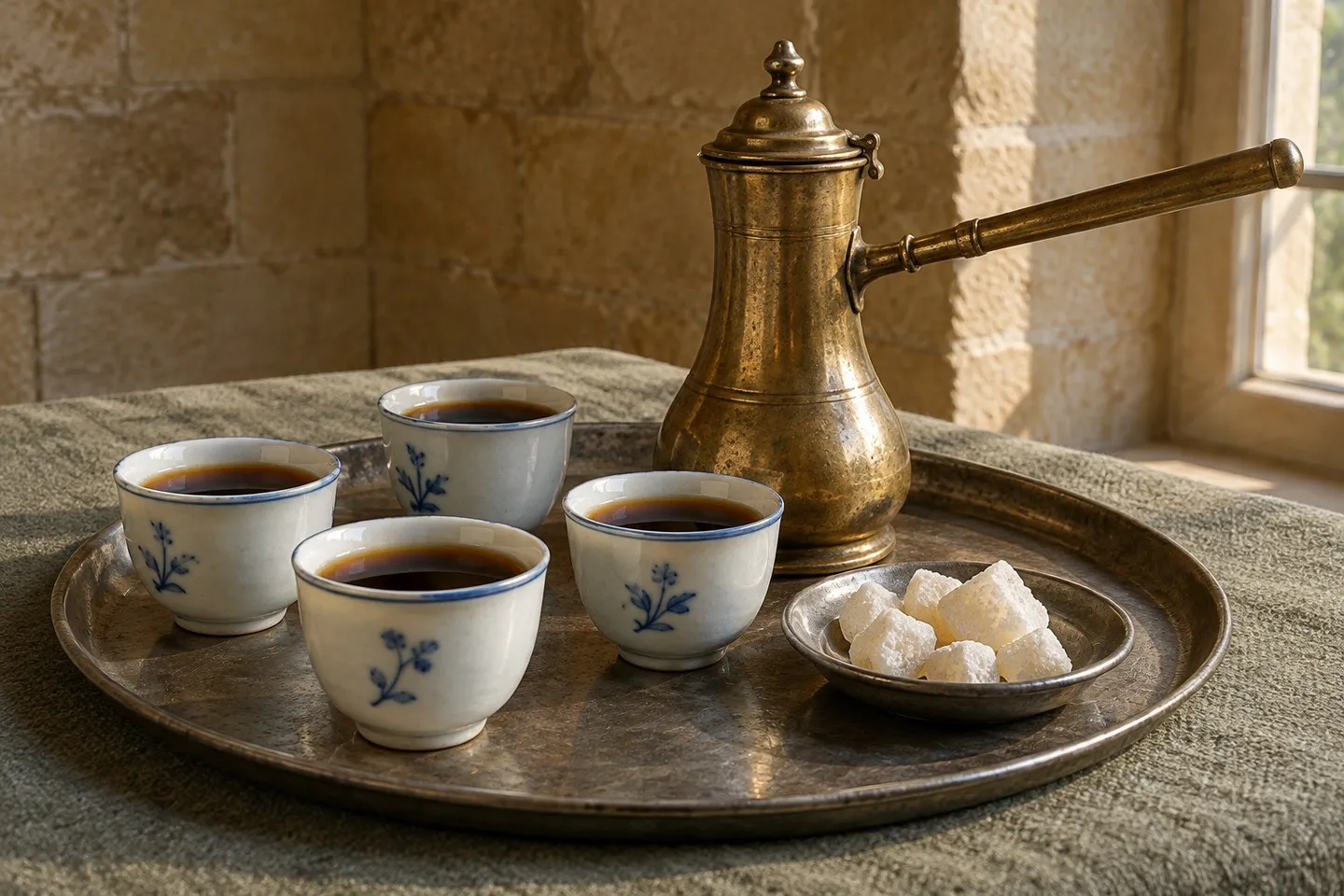
Black coffee in small handleless cups, with the long-handled brass pot it was boiled in and a dish of sugar.
The story behind the recipe
Dufour’s coffee was boiled in a pot with its sugar already in, poured off the grounds into small dishes and sipped scalding, and it came out thin. His 1685 handbook allows “the third part of a spoonful for each person” and lets it “boyl a small time.” The pot, the grind and the cup he leaves to the reader.
Philippe Sylvestre Dufour was a merchant of Lyon. His coffee chapter rests on a Latin text by an unnamed German physician and on travelers’ reports, and those travelers fill in much of what his recipe skips. The rest of his book, from the first London coffee seller to the tea and chocolate chapters, is in How Were Coffee, Tea and Chocolate Made in 1685?
Pot and powder
Dufour names one vessel, the closed iron drum the beans were roasted in on a spit. For the boiling he names none. The plate that opens the coffee treatise in his French edition shows one, though: a tall-necked pot, the ibrik, beside a seated drinker with a shallow dish of coffee. A long-handled cezve or a small saucepan does the same job now.
The beans were beaten to powder. The nearest thing on sale today is coffee ground for Turkish or Greek coffee, and a dark roast stands in for beans roasted in front of an open fire. A level teaspoon of that grind weighs roughly 2 grams, perhaps nearer 3. Read as a third of a tablespoon, Dufour’s measure is that teaspoon, about a quarter of the strength of a modern filter cup.
Read more about this recipe
Boil and sugar
The sugar goes into the pot with the powder, so the whole brew boils sweet. That was one choice among several. Pietro della Valle, an Italian traveler Dufour quotes, saw Turks add “much Sugar, Cinnamon, and Cloves well beaten.” The tea the Chinese way in the same book was sweetened as well, to soften its bitterness.
Coffee had a bitterness of its own. Disputing Avicenna, Dufour writes that “it has a sweet with a kind of bitterness, without any sharpness or acrimony.” The boil itself is brief. When the foam climbs toward the rim, lift the pot off the heat for a moment.
Dish and dregs
The coffee goes into “little dishes of porcelain or any other sort.” Dufour says nothing about straining, but Della Valle does: “the thick sinks down and remains at the bottom of the Pot.” So the grounds settle for a minute or two and the coffee is poured slowly off them. Turkish coffee today goes into cups of about 70 ml. Dufour’s thinner brew fills a cup of about 120 ml here, a dark amber you can see through at the rim, faintly sweet and slightly gritty.
The Grain Bon whose figure (with the Tree whereon it grows) you see here before you, being first well skinn’d and pill’d, is put into an Iron Instrument firmly shut, together with the coverlid; through this Instrument they thrust a Spit, by the means whereof they turn it before the Fire, till it shall be well rosted; after which having beaten it into very fine Powder, you may make use thereof, in an equal proportion according to the number of the people that will drink it: Viz. the third part of a spoonful for each person, and put it into a glass of boyling Water, putting a little Sugar thereto: And after having let it boyl a small time, you must pour it into little dishes of porcelain or any other sort, and so let it be drunk by little and little, as hot as it can possibly be indur’d, but especially fasting.

Recipe makes: 4 small cups, about 120 ml each
Ingredients
For 4 small cups, about 120 ml each. Quantities are shown as written.
Quantities as written here, for 4 small cups, about 120 ml each.
- Very finely ground dark-roast coffee4 metric tsp (5 ml per tsp)
- Water600 ml
- Sugar2 metric tsp (5 ml per tsp)
Measurement notes
Ingredients as written here
- 4 tsp very finely ground dark-roast coffee
- 600 ml water
- 2 tsp sugar
Equipment
 Small saucepan, or a long-handled coffee pot (cezve)
 4 small cups
Instructions
Bring the water to a boil in a small saucepan or coffee pot.
Stir in the very finely ground dark-roast coffee and the sugar, and let it boil gently for about 1 minute, lifting the pan off the heat for a moment if the foam rises toward the rim.
Take the pan off the heat and leave it for 1 to 2 minutes so the grounds sink.
Pour slowly into small cups, leaving the thick sediment in the pan, and sip it while it is very hot.
Nutrition
10calories per serving
- Recipe makes
- 4 small cups, about 120 ml each
- Servings
- 4
Estimated from USDA FoodData Central values for brewed coffee and granulated sugar, for one cup with 1/2 tsp sugar.
Recipe notes
When adjusting quantities
Use 1 teaspoon of coffee, 150 ml of water and 1/2 teaspoon of sugar per person, as Dufour measures by the head.
Notes
Quantities mentioned in these notes don’t change when you adjust the batch.
Dufour gives one-third of a spoonful of coffee per person. We read the spoon as a tablespoon, so the third is a teaspoon, about 2 grams of powder-fine coffee. His “glass” of water is taken as 150 ml, our choice; some boils away and some stays with the grounds, which leaves about 120 ml a cup. He gives no measure for the sugar; half a teaspoon a cup is our choice, so add more or less to taste.
The settling and careful pour follow Della Valle, quoted above; Dufour himself does not say whether the grounds were strained.
For a stronger, Turkish-style cup, follow Thévenot: one spoonful of coffee to about two cups of water, brought up to the boil ten or twelve times.
Scaling changes the ingredients only; glassware, ice and timings need their own judgment. To adapt this recipe further, try the recipe tool at TuneMyRecipe (opens in a new tab), our sister site.
Sources and attribution
Philippe Sylvestre Dufour, The Manner of Making of Coffee, Tea, and Chocolate, trans. John Chamberlayne (London: William Crook, 1685), pp. 8–10
Recipe details
- Drink
- Alcohol-free
- Drink family
- Hot Drinks
- Region
- French
- Era
- 17th century
- Difficulty
- Easy