What Did Victorian Children Drink at Christmas?
Tea, coffee, lemonade and a jug of weak negus: what Mrs. Beeton, Punch and an 1893 etiquette book say Victorian children drank at Christmas parties.
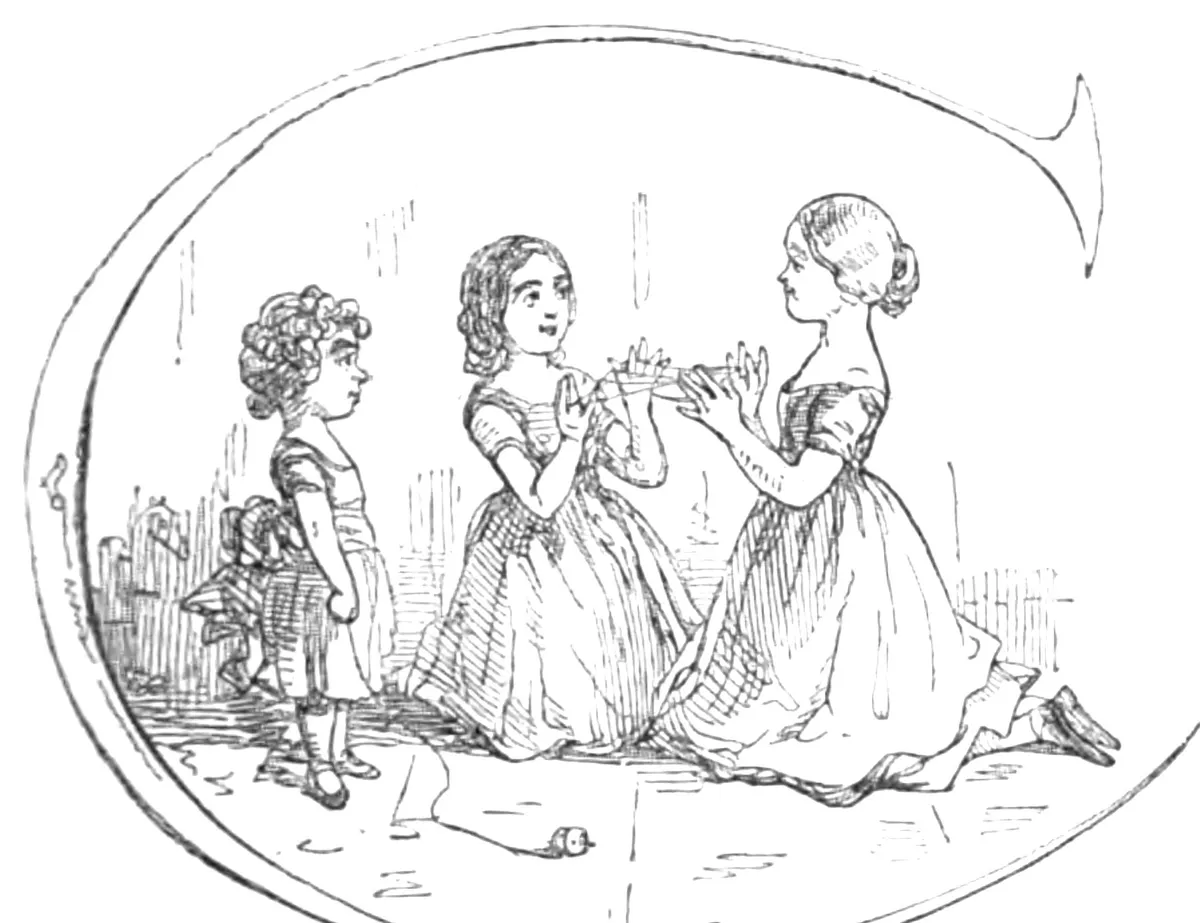
Victorian children at a Christmas party drank tea and coffee at the tea table, lemonade later in the evening, and, in the accounts from 1849 and 1861, a jug of weak negus: port wine with twice its volume of boiling water, sugar, lemon and nutmeg. Mrs. Beeton’s Book of Household Management (1861) calls negus the drink “more usually drunk at children’s parties than at any other.” By 1893 an etiquette book on juvenile parties was listing “lemonade, wine and water” among the light refreshments, and by 1899 Beeton’s own book had quietly taken the children out of her recipe.
Christmas was the season for these parties. In 1849 Punch printed a father’s complaint that the holidays meant one children’s party after another, and in 1893 Manners and Rules of Good Society set out how the evening ran: tea first, then light refreshments between the games and the dancing.
The Juvenile Season
In January 1849 Punch ran a long letter from a harassed father who signs himself “Spec,” a pen name W. M. Thackeray used in the magazine in those years. “The awful spread of JUVENILE PARTIES, Sir, is the fact to which I would draw your attention,” he begins. “There is no end to those entertainments, and if the custom be not speedily checked, people will be obliged to fly from London at Christmas, and hide their children during the holidays.” He has warned his family that he will take a house at Margate next winter, “for that, by Heavens! I could not bear another Juvenile Season in London.”
Spec and his household are inventions, but the jokes only work if readers knew the parties. As proof of his suffering he encloses eighteen invitations. One comes from Miss Fanny, “aged seven, who hopes, in round hand, that her dear cousins will come and drink tea with her on New Year’s Eve, her birth-day.” Another asks the family to “a ball, a conjuror, and a Christmas Tree.” To be asked to a child’s party was to be asked to tea.
A pint of port for ten children
Mrs. Beeton heads her recipe simply “TO MAKE NEGUS” (no. 1835). The method says who it was for: “As this beverage is more usually drunk at children’s parties than at any other, the wine need not be very old or expensive for the purpose, a new fruity wine answering very well for it.” Sugar rubbed on the lemon rind goes into a jug with the port, the strained juice and grated nutmeg, a quart of boiling water is poured over, the jug is covered, and “when the beverage has cooled a little, it will be fit for use.” It was meant to be drunk warm. Her quantity: “Allow 1 pint of wine, with the other ingredients in proportion, for a party of 9 or 10 children.”
Beeton gives no strength, so the figures that follow are our own arithmetic. An imperial pint of port at about 20 percent alcohol, near the middle of today’s legal range for port, ends up in roughly 1.8 liters of negus once the water, sugar and lemon juice are in. The result is about 6 percent alcohol, the strength of a strong beer and about half that of table wine. Shared among nine or ten children, each gets about 190 ml, holding a little over one UK unit of alcohol. Victorian port may have been stronger than modern bottles, and boiling water drives a little alcohol off; neither can be measured now.
Wine for children is not a custom to revive. For a warm, spiced jug without the wine, make the alcohol-free bishop, which swaps port for grape juice. The grown-up bowl behind it, the one Scrooge promises Bob Cratchit, has its own story in what smoking bishop was.
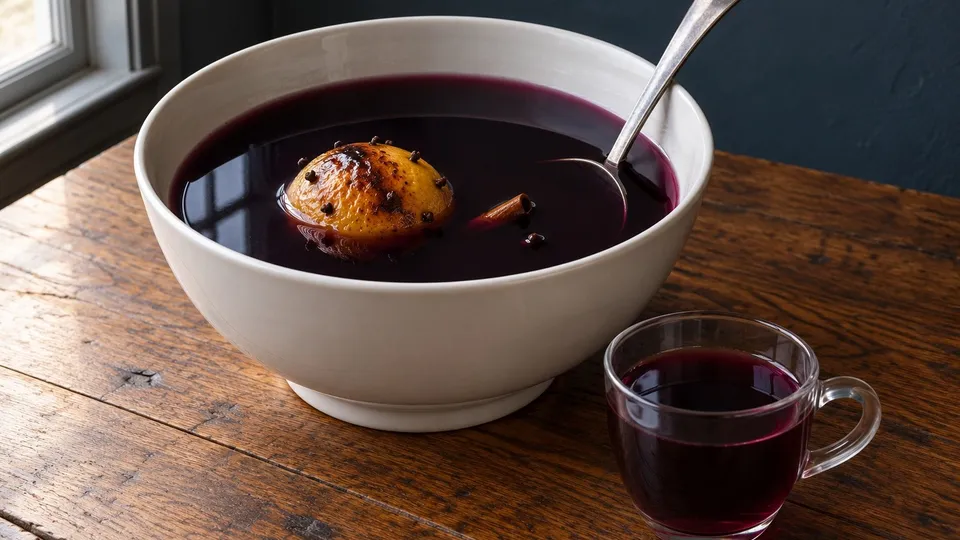 Alcohol-free versionAlcohol-Free Bishop, Spiced Grape Juice with a Roasted Lemon
Weak negus and Master Swilby
Spec’s complaint is the quality of the negus, which he finds thin and poor. In the second part of the letter, watching the children play, he is so overcome that “I go below and get some of the weak negus with which Children’s Parties are refreshed.” Later he returns to it: “I have mentioned the wretched quality of the negus. How they can administer such stuff to children I can’t think. Though only last week I heard a little boy, MASTER SWILBY, at MISS WATERS’ say, that he had drunk nine glasses of it,” after which, full of “tasteless sandwiches and insipid cakes,” the boy offered to fight Spec’s youngest son.
Master Swilby is a comic invention with a comic name, and nine glasses is the joke. Punch’s Almanack for the same year has a similar one in “The Wife’s Almanack,” where October brings “a quiet juvenile party for GEORGY’S birth-day” with “Malaga and pound-cake,” a sweet Spanish wine for a child “only four years.” Neither joke works unless readers found wine at a small child’s party normal enough to laugh at.
Tea at one end, coffee at the other
By the 1890s the order of the evening was written down as etiquette. Manners and Rules of Good Society (1893), by “A Member of the Aristocracy,” gives juvenile parties a chapter of their own. Children were invited for four hours or so, from four to eight or as late as seven to eleven, and tea was served in the dining-room about half an hour after the time on the card. “Tea is generally dispensed at one end of a long table, and coffee at the opposite end,” the book says. “The governess usually pours out the tea, and one of the daughters of the house the coffee; or failing her, the head nurse or lady’s maid does so.”
After tea came the games, perhaps a little play, dancing, and presents handed out by a grown-up dressed as Father Christmas. The light refreshments set out in the dining-room were “lemonade, wine and water, every description of cake, sandwiches, crystallised fruits, French plums, figs, almonds and raisins, oranges, &c.,” served twice in the evening, with “bon-bons containing paper caps” to pull. The book gives that list for juvenile parties in general, the kind given at Christmas and New Year. Spec had watched little girls “seeking them out to pull crackers with them” in 1849, so the crackers were not new.
The lemonade may well have been made the way Beeton made hers, in the recipe just before the negus: sugar rubbed on lemon rind, juice and a quart of boiling water, strained and left to cool. It is our companion recipe, Mrs. Beeton’s lemonade.
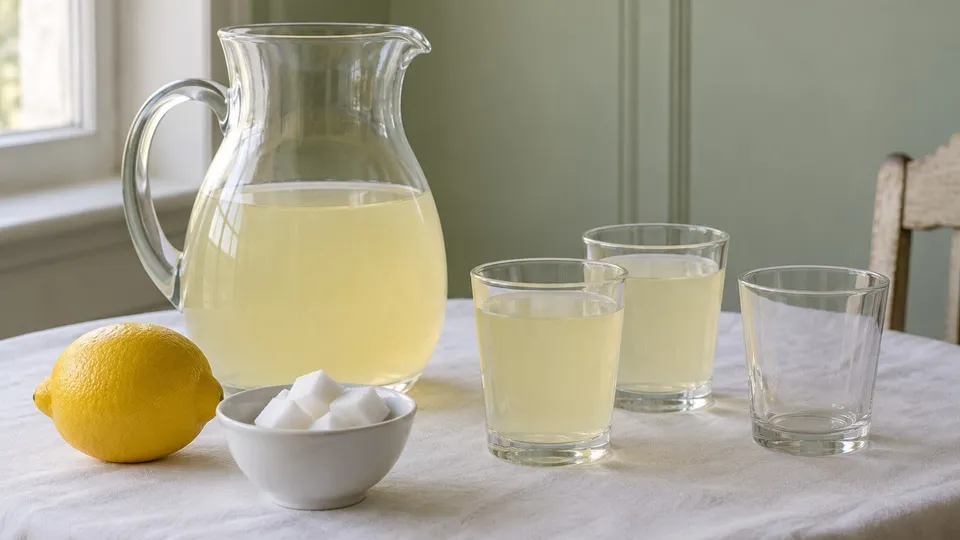 Always alcohol-freeMrs. Beeton’s Lemonade, Made with Boiling Water
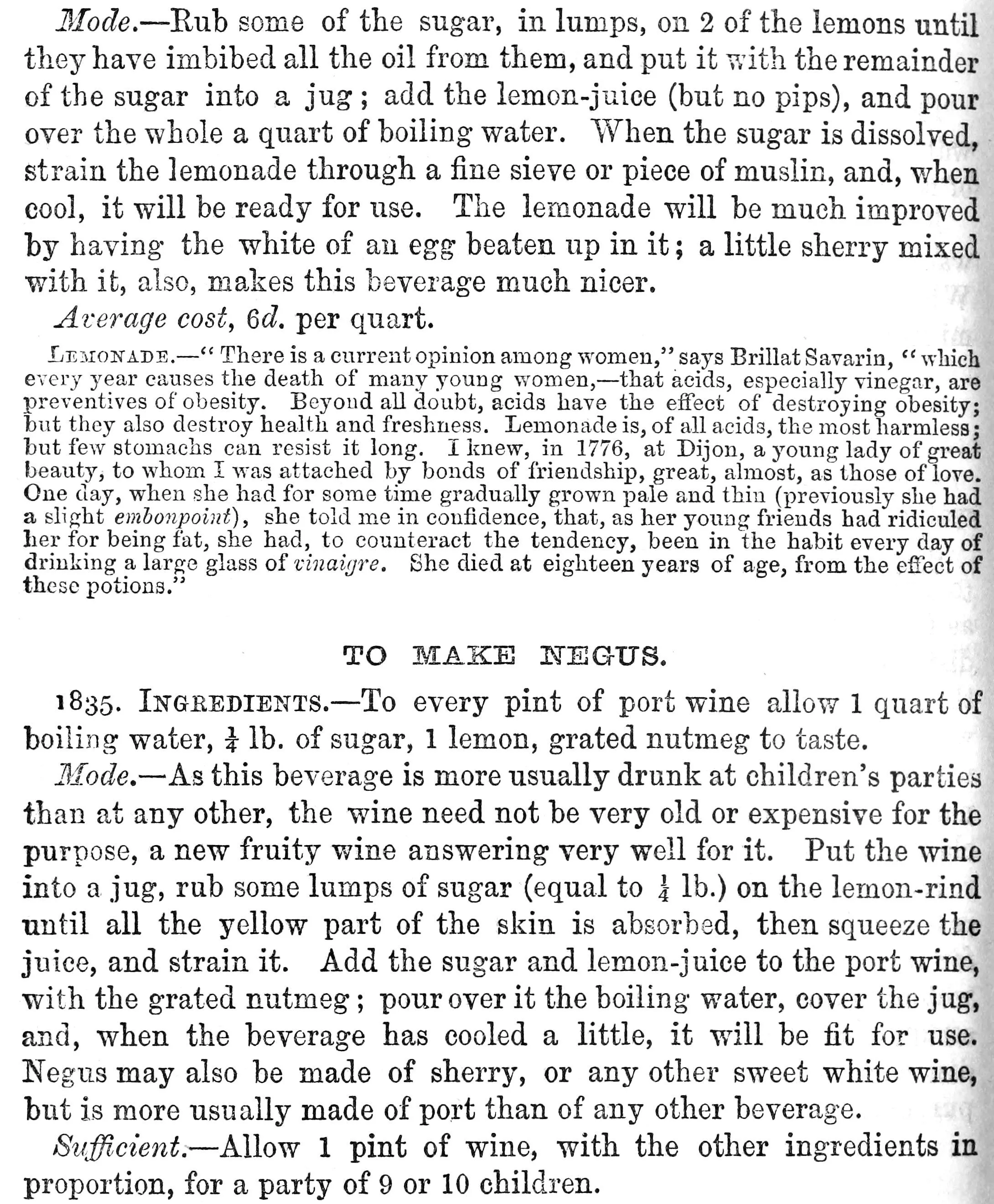 Beeton’s lemonade, its footnote and the negus below it, p. 890 in The Book of Household Management (London: S. O. Beeton, 1861).
Nine or ten persons
In an 1899 edition of the book the same recipe, now no. 2736, “TO MAKE NEGUS. (Another Mode.),” keeps every ingredient, the sugar rubbed on the lemon rind and the covered jug. Its first sentence has lost a clause. “The wine need not be very old or expensive for this purpose,” it now begins, and the purpose is never named. The last line reads “for a party of 9 or 10 persons.”
The book doesn’t say why the editors changed it, and the edit itself is all the evidence there is. The proportions stayed the same. What children drank in its place over the next century, from cambric tea to the kiddie cocktail, is in A History of Kiddie Cocktails.
Twenty-five little notes
Thackeray’s letter never reaches its end. Just as Spec starts on the Christmas tree, “which we have from the Germans,” he breaks off: “My dear Sir, my manuscript must here abruptly terminate.” His wife has come into the study, and his daughter is grinning behind her “with twenty-five little notes, announcing that MASTER and MISS SPEC request the pleasure of MISS BROWN, MISS F. BROWN, and M. A. BROWN’S company on the 25th instant.” The man who threatened to flee to Margate was sending out invitations of his own.
Working men were being offered much the same drinks in public. From the 1870s temperance reformers opened coffee taverns as a substitute for the pub, selling tea, coffee and cocoa, and at the Royal Victoria Hall, the house now known as the Old Vic, run on a temperance basis from the end of 1880, the bars that had once sold gin and beer poured lemonade and hot gingerette. The Leisure Hour called the gingerette the “teetotaler’s brandy-and-water.”
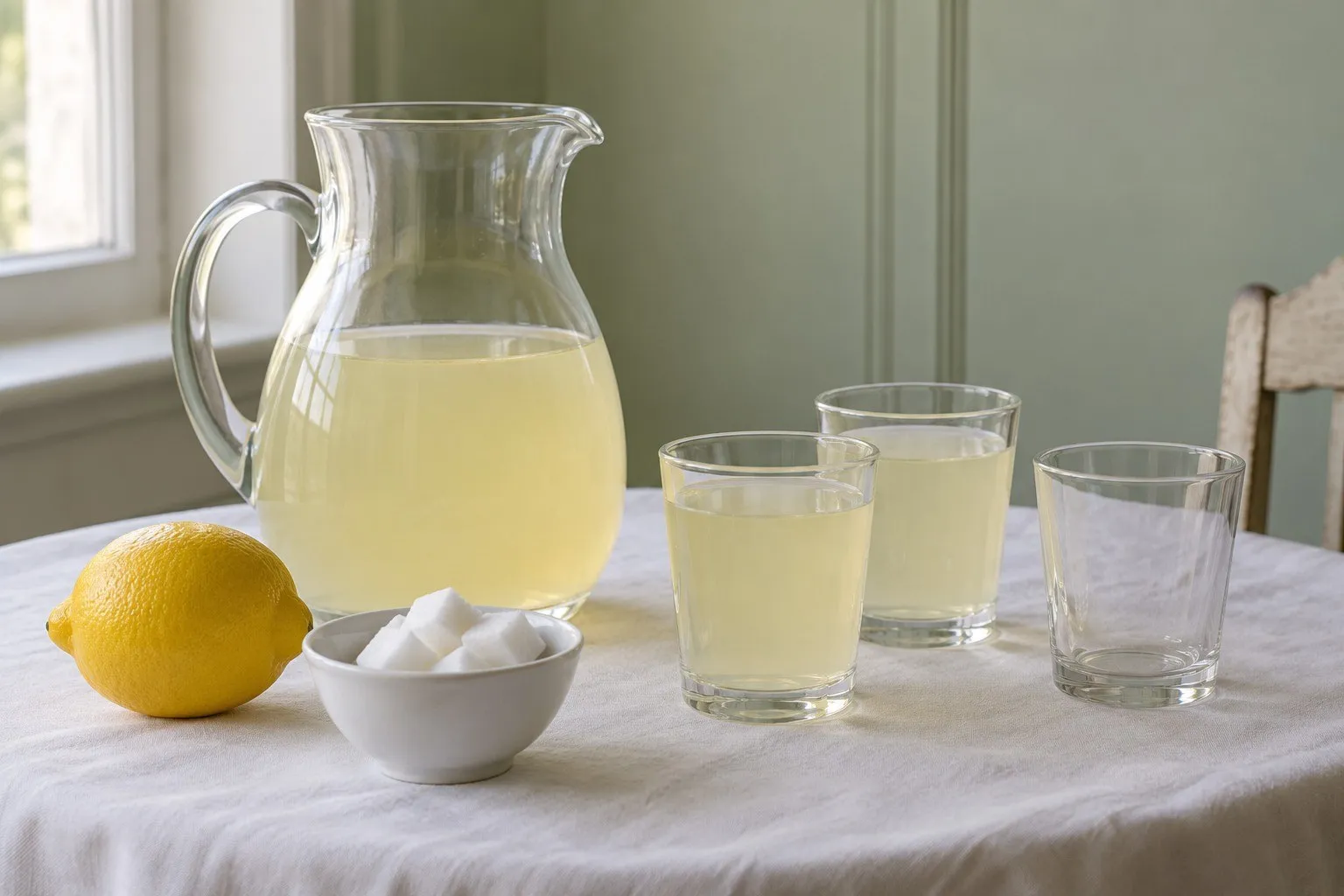 Beeton’s lemonade made today: still, unchilled and strained, in a plain jug and small tumblers.
Beeton’s lemonade still suits a children’s Christmas party, and it wants starting an hour or two ahead, since the strained lemonade needs about an hour to cool from the kettle.
Sources
- Isabella Beeton, The Book of Household Management (London: S. O. Beeton, 1861), pp. 889–890, recipes 1834 and 1835. Wellcome Library copy, Internet Archive.
- [Isabella Beeton], The Book of Household Management, new edition (London: Ward, Lock, 1899), p. 1219, recipe 2736. University of Leeds copy, Internet Archive.
- [W. M. Thackeray, signed “Spec”], “Child’s Parties: and a Remonstrance concerning them,” Punch, or the London Charivari, vol. XVI (January 1849), pp. 13 and 35.
- “The Wife’s Almanack,” Punch’s Almanack for 1849, bound in Punch, vol. XVI.
- A Member of the Aristocracy, Manners and Rules of Good Society, or Solecisms to be Avoided (London and New York: F. Warne, 1893), ch. XXIV, “Juvenile Parties,” pp. 170–172.
- “The Royal Victoria Hall and Coffee Tavern,” The Leisure Hour, April 1885, p. 279.