Saloop with Milk
Reader ratingsHot milk poured onto a smooth paste of arrowroot and sugar and stirred until lightly thick: the milk saloop of an 1821 vegetarian cookbook that also renounced drink.
- Recipe makes
- About 500 ml, 2 basins
- Prep
- Cook
- Total
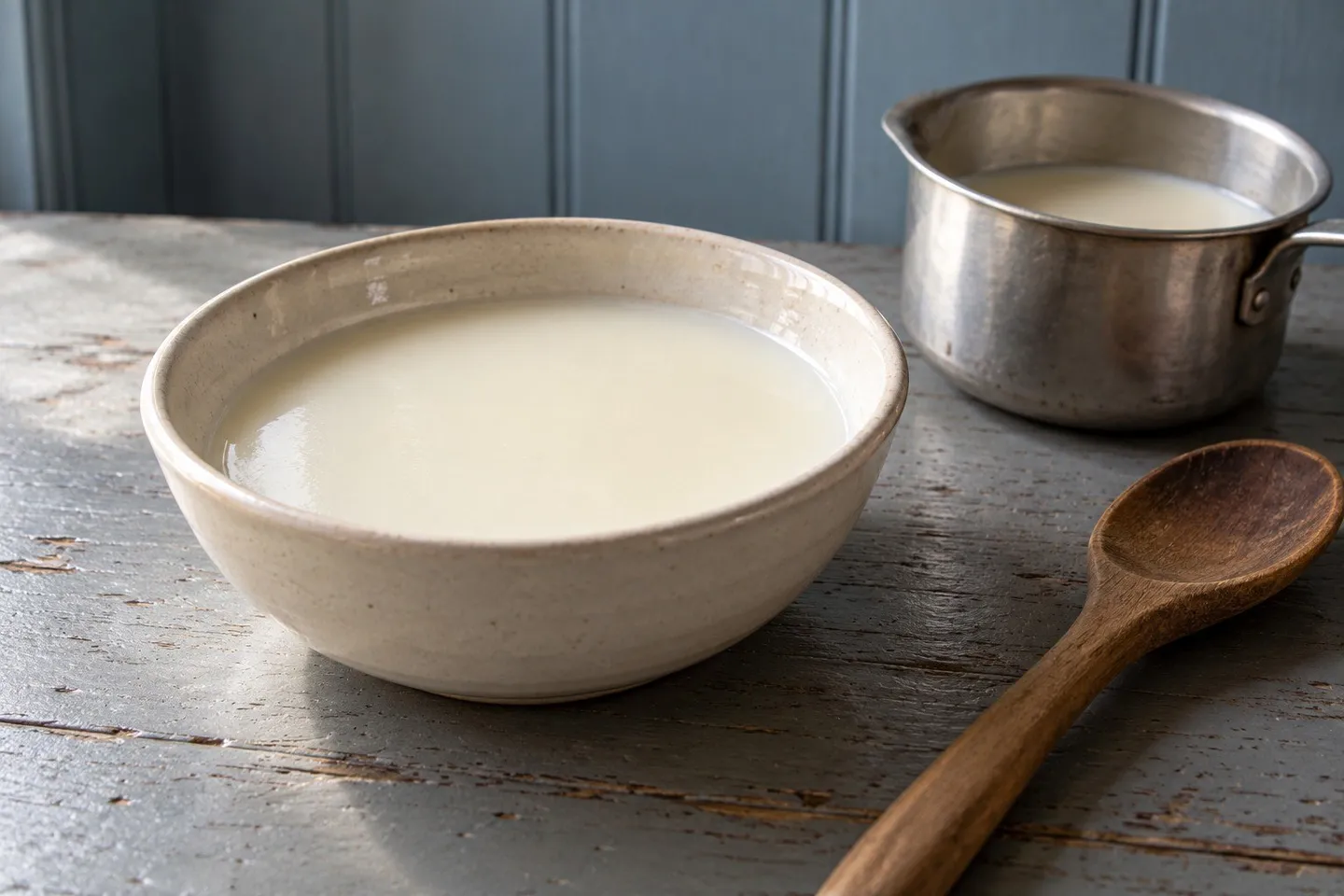
Saloop with milk in a plain earthenware basin, beside a small milk pan and a wooden spoon.
The story behind the recipe
Saloop with milk is hot milk, sweetened and stirred onto a spoonful of starch until it thickens lightly: the version of London’s dawn drink that a cookbook sworn off alcohol could print without apology. A New System of Vegetable Cookery, published in Salford in 1821 “by a member of the Society of Bible-Christians,” gave it a number, 709, and a single line of advice that saves the modern cook a problem: arrowroot works too.
A cookbook against meat and drink
The book’s title page announces “an introduction recommending abstinence from animal food and intoxicating liquors,” so the wine other cookery books of the time poured into their saloop has no place here. In the book’s miscellaneous chapter, Saloop with Milk sits among plain milk dishes, after sago simmered in new milk and before a milk porridge of oatmeal to be poured “into a basin either with or without bread.”
The author treats saloop powder, sago and arrowroot as near relations, interchangeable thickeners for hot milk. A few pages on, the book recommends milk “prepared with saloop-powder or arrow-root” as “very nourishing food for infants.”
Read more about this recipe
Arrowroot in the basin
Arrowroot is a fine white starch from the roots of Maranta arundinacea, a plant native to the West Indies and Central and South America. It thickens to a clear, glossy body and adds no flavor of its own, so the drink should taste of sweetened hot milk, smooth and just thick enough to coat a spoon. Long boiling thins it again, so the book’s brief “minute or two” on the fire suits it. Real salep comes from orchids that are mostly dug in the wild, so arrowroot stands in here, as the book allows. Buy it where cornstarch is sold. A year after this book, in 1822, Lamb put the price of a basin of saloop from a London street stall at three halfpence, which comes to about 69p today by UK consumer prices (Bank of England). His chimney sweeps and the sassafras saloop of Fleet Street belong to Saloop, London’s Pre-Dawn Street Drink.
709. Saloop with Milk.
SET a pint of milk on the fire, when near boiling, pour it upon a dessert-spoonful of saloop powder previously mixed smooth with cold water; pour the milk gently upon it stirring it constantly, return it into the pan and stir it on the fire a minute or two. The powder will mix better if the sugar be mixed with it previous to being moistened with water.
Arrow-root, and the patent sago powder may be prepared in a similar way.

Recipe makes: About 500 ml, 2 basins
Ingredients
For About 500 ml, 2 basins. Quantities are shown as written.
Quantities as written here, for About 500 ml, 2 basins.
- Whole milk500 ml
- Arrowroot1 1/2 metric tbsp (15 ml per tbsp)
- Sugar2 metric tbsp (15 ml per tbsp)
- Cold water3 metric tbsp (15 ml per tbsp)
Measurement notes
Ingredients as written here
- 500 ml whole milk
- 1 1/2 tbsp arrowroot
- 2 tbsp sugar
- 3 tbsp cold water
Equipment
 Small saucepan
 Heatproof bowl or jug
 Wooden spoon or small whisk
 2 wide bowls or basins
Instructions
Stir the arrowroot and sugar together in a heatproof bowl or jug, then stir in the cold water a little at a time to make a smooth, thin paste with no lumps.
Heat the whole milk in a small saucepan over medium heat until it is close to boiling, with small bubbles at the edge and steam rising.
Pour the hot milk onto the paste slowly, stirring all the time.
Pour everything back into the pan and stir over low heat for 1 to 2 minutes, until it thickens slightly and looks glossy. Don’t let it boil hard or keep it on the heat longer, or the arrowroot will thin again.
Pour into wide bowls or basins and serve hot.
Nutrition
220calories per serving
- Recipe makes
- About 500 ml, 2 basins
- Servings
- 2
Estimated from USDA FoodData Central values for whole milk, granulated sugar and arrowroot flour, for one of two basins.
Recipe notes
When adjusting quantities
Scale everything together. Keep the arrowroot paste smooth before the milk goes in, whatever the batch size.
Notes
Quantities mentioned in these notes don’t change when you adjust the batch.
The book’s pint is taken as 500 ml. Printed in 1821, before the imperial pint of 1824 (568 ml), it could have meant an old wine pint (473 ml) or ale pint (about 578 ml); 500 ml sits between them.
A dessert-spoonful of saloop powder is about 10 ml. Salep thickens far more strongly than arrowroot, so we use more: 1½ tablespoons, about 12 g, should give a pourable drink with a light body. These arrowroot amounts are ours, worked out from the period ratio and how arrowroot usually behaves; use 1 tablespoon for a thinner basin or 2 for one nearer a thin custard. The book gives no amount of sugar; 2 tablespoons is our choice.
Cornstarch works in the same amount but makes a cloudier, less glossy drink. If you want to try real salep, buy it only from a seller who can show it comes from cultivated orchids or another legal source, and read the ingredients on any “salep” or “sahlep” mix. Contains milk.
Scaling changes the ingredients only; glassware, ice and timings need their own judgment. To adapt this recipe further, try the recipe tool at TuneMyRecipe (opens in a new tab), our sister site.
Sources and attribution
A New System of Vegetable Cookery, 2nd ed., by a member of the Society of Bible-Christians (Salford: Academy Press, 1821), No. 709, “Saloop with Milk,” p. 271
Recipe details
- Drink
- Alcohol-free
- Drink family
- Hot Drinks
- Region
- British
- Era
- 19th century
- Base
- Milk & whey
- Difficulty
- Easy
- Season
- Winter