Saloop, London’s Pre-Dawn Street Drink
A hot, slightly thick drink sold in London before dawn from the 1700s to the 1840s: orchid-root salep in the cookbooks, sassafras tea at the stalls.
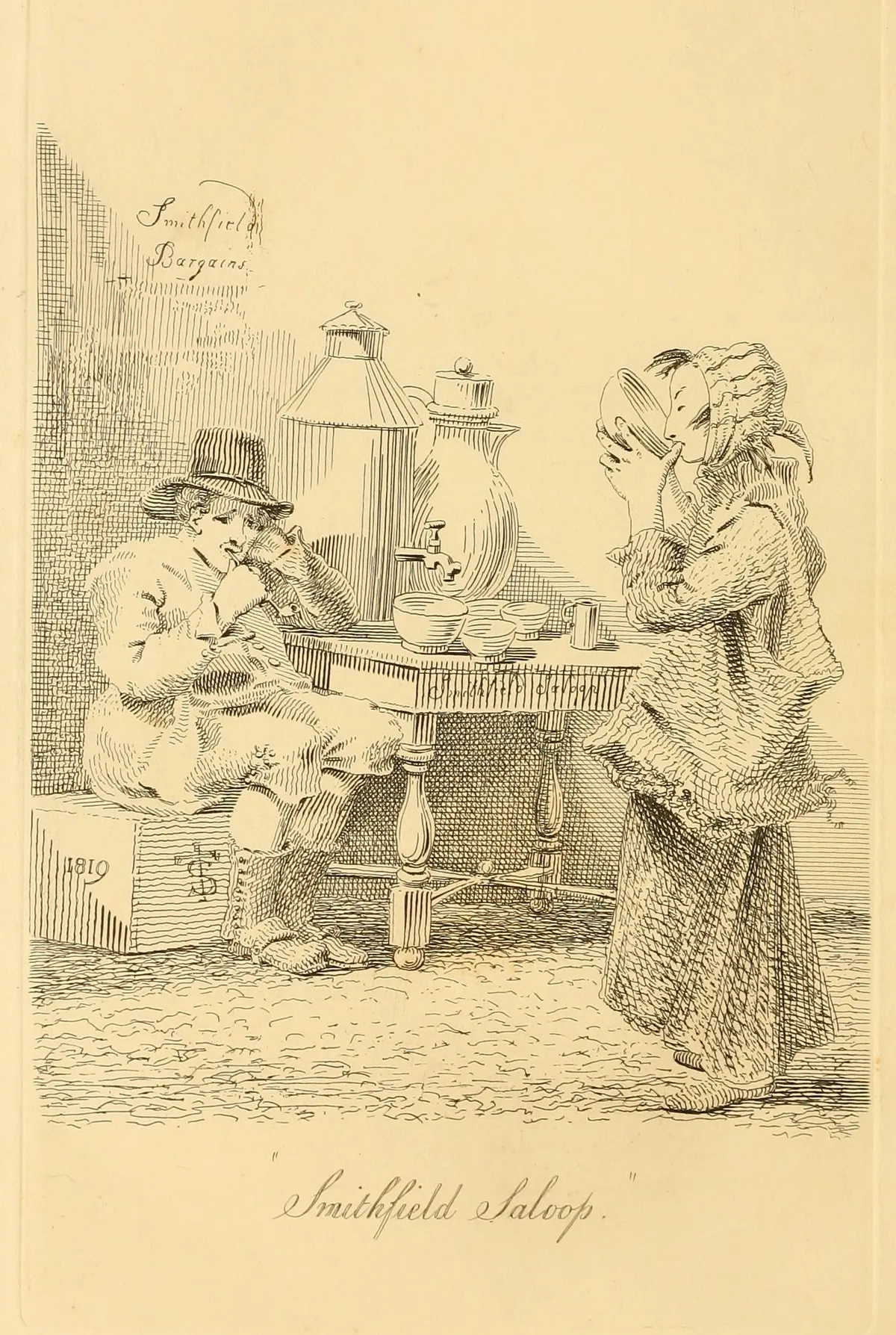
Saloop was a hot, sweet, slightly thick drink that London sold through the night and into the dawn, from a Fleet Street house said to date from 1719 and from street stalls until the 1840s. It came in a basin, cost three halfpence around 1822, about 69p today by UK consumer prices (Bank of England), and was the breakfast of chimney sweeps and early workmen. Under the one name went two different drinks. Cookery books made saloop from salep, the dried and powdered tuber of an orchid, stirred into boiling water or milk. Charles Lamb, a 1776 guide to London’s Sundays and the oldest saloop house in Fleet Street all knew it as sassafras wood boiled to a tea, which Lamb’s sellers served with milk and sugar.
This story is part of our Hot Winter Drinks From Old Recipe Books guide.
Either way it was cheap, hot and on sale when little else was. Within a generation cheaper street coffee had taken its place, and by 1851 the social investigator Henry Mayhew had to explain the word to his younger readers.
A basin before dawn
Lamb’s essay “The Praise of Chimney-Sweepers” first ran in the London Magazine in May 1822. In it the saloop sellers work “from stalls, and under open sky,” at “that dead time of the dawn” when the rake reeling home from his midnight cups and the artisan leaving his bed “jostle” on the pavement.
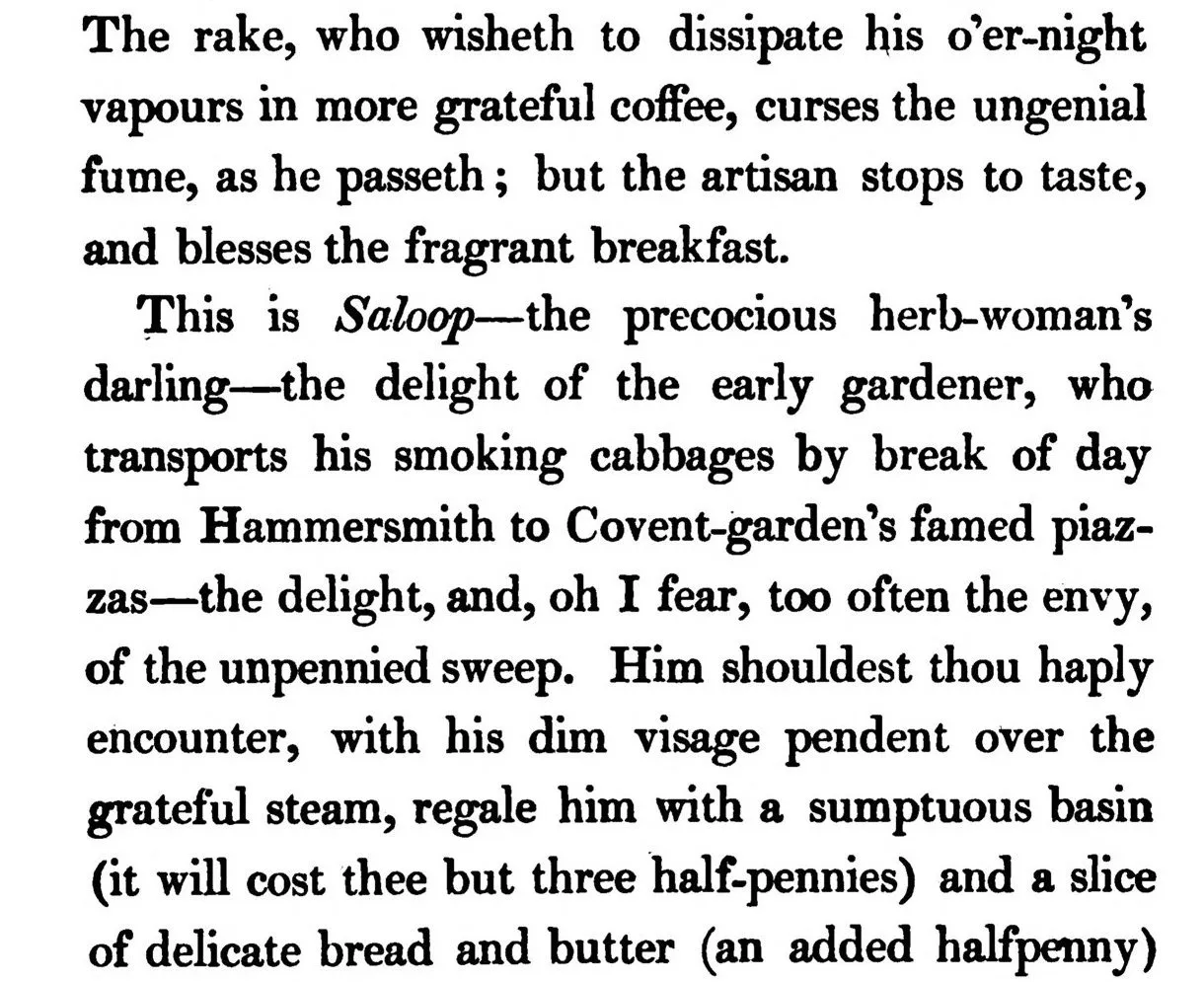 Charles Lamb, “The Praise of Chimney-Sweepers,” p. 253 in Elia (London: Taylor and Hessey, 1823).
“The rake, who wisheth to dissipate his o’er-night vapours in more grateful coffee, curses the ungenial fume, as he passeth; but the artisan stops to taste, and blesses the fragrant breakfast.” Lamb’s other regulars are the herb-woman and the gardener carting “his smoking cabbages by break of day from Hammersmith to Covent-garden’s famed piazzas.” His favorite customer is the sweep, who often can’t pay, and Lamb asks his reader to buy the boy a basin: “it will cost thee but three half-pennies,” with bread and butter “an added halfpenny.”
Mayhew had the same scene from a gentleman who had known London’s streets by night and day since about 1800. On “a bleak winter’s morning,” before daybreak, a group stood round the stall, “the prominent figures being of two callings now extinct,” the climbing-boy and the old hackney-coachman. The boy “would have his saloop smoking hot,” kept so on “a charcoal grate,” and he shifted from one bare foot to the other while it cooled. The coachman beat his arms against his chest and wished aloud he could add “a go of rum.” The old watchman, too, “would sometimes partake of the street ‘Saloop-loop-loop! Sa-loop!’”
Orchid root from the meadows
“Salep is a preparation of the root of Orchis, or Dogstones,” the physician Thomas Percival wrote in 1773, and the plant “is assiduously cultivated in the East,” where its root formed “a considerable part of the diet of the inhabitants of Turkey, Persia, and Syria.” Of the many kinds, Orchis mascula was “the most valued.”
What struck Percival was that the same plant grew wild at home “in great abundance.” He printed the method of a Mr. Moult of Rochdale: wash the new tubers, rub off the brown skin, and bake them on a tin plate for six to ten minutes, until they had “acquired a transparency like horn,” then dry them. English salep, he reckoned, might sell for eightpence or tenpence a pound, “whereas the foreign salep is now sold at five or six shillings per pound.” Those shillings come to about £33 to £40 a pound today, against about £4.40 to £5.50 for the home-grown kind. The scheme never caught on. Nearly eighty years later Mayhew described the orchid as “never cultivated to any extent in this country,” adding that the salep of commerce “was imported from India.”
A teaspoon of the powder thickened a pint of boiling water. The cookery books stirred it until it was “a fine jelly” or “a clear thick jelly,” then sweetened it and usually added wine, and two of them filed it among food for the sick. Percival tested the plain mucilage by dissolving salt in a pint of it: the salep was “by no means disagreeable to the taste,” while the same salt made a pint of spring water “extremely unpalatable.”
Sassafras in Fleet Street
Lamb’s saloop was something else. “There is a composition, the ground-work of which I have understood to be the sweet wood ’yclept sassafras,” he begins. “This wood boiled down to a kind of tea, and tempered with an infusion of milk and sugar, hath to some tastes a delicacy beyond the China luxury.” The China luxury was tea. Lamb names the shop, Mr. Read’s on the south side of Fleet Street, “the only Salopian house,” and then confesses that he has never dipped “my own particular lip in a basin,” because his nose warned him off.
He wasn’t the first to tie the name to sassafras. A Sunday Ramble, an anonymous walk through London published in 1776, passes a crowd round “a kind of cauldron filled with an infusion of sassafras well known by the name of saloop,” drinking it “with the greatest avidity.”
The engraver John Thomas Smith, whose Cries of London was published in 1839, six years after his death, spells the house Reid’s, at No. 102 Fleet Street, “the first respectable house where it was to be had, and established in the year 1719.” A board in the coffee room promised that the drink would cure the night before: “The fumes of wine, punch, drams, and beer, / It will expell.” Smith adds that saloop had long been “considered as a sovereign cure for head-ache arising from drunkenness.” The book’s footnotes settle the ingredient (the proprietor made his saloop from sassafras) and close the story. The house shut in June 1833, “the proprietor having been unfortunately too fond of liquor more spirituous than his own saloop.”
Mayhew, writing in 1851, assumed that Lamb’s saloop was orchid salep. Lamb says plainly it wasn’t. The name covered both drinks, and for most stalls no source says which one they poured, though Lamb says his stall-keepers sold “the same savoury mess” as Mr. Read. The two writers did agree that it was oily: Lamb notes that “sassafras is slightly oleaginous,” and Mayhew calls the stuff “the greasy-looking beverage.”
Pushed out by coffee
“Prior to 1824, coffee was in little demand, even among the smaller tradesmen or farmers,” Mayhew wrote, but that year the duty fell from a shilling to sixpence a pound (from about £4.80 to £2.40 today), and by 1831 the country was drinking nearly three times as much. In 1842 the duty dropped again, to fourpence on coffee from British possessions, and the street stalls multiplied. Ground chicory mixed in with the coffee made it cheaper still. By 1851 London had more than three hundred coffee stalls, most of them kept by women.
Mayhew’s old informant told him that the coffee stall “has but superseded the saloop-stall,” and that the people who had kept the saloop dealer in business now kept the coffee seller. By the late 1870s, reformers were selling coffee and cocoa at a halfpenny a cup, about 21p now, in coffee taverns built to rival the pub.
Making saloop now
Neither of saloop’s original ingredients belongs in a kitchen today. Real salep is still made from orchid tubers dug in the wild. Turkey, the traditional source, no longer allows wild salep to be exported, and all orchids are protected under CITES, the treaty that controls international trade in endangered plants and animals. Percival’s English orchids are no answer either: in Britain it is against the law to dig up any wild plant without the landowner’s permission, and the rarest orchids are protected outright. Sassafras is out for a different reason. Safrole, the main compound in sassafras oil, may not be added to food in the EU and UK, and the US Food and Drug Administration banned it as a food additive in 1960, counting sassafras tea made to carry it as adulterated.
A vegetarian cookbook of 1821 shows a way round: it follows its milk saloop with a line saying that arrowroot “may be prepared in a similar way,” and arrowroot thickens to a similar clear, glossy body. Our Saloop with Milk is that 1821 recipe, and Clear Saloop with Lemon Peel is the 1812 cookery-book version, sweetened and scented with lemon and made without its wine. Neither contains alcohol, and as far as any source says, the street drink had none either.
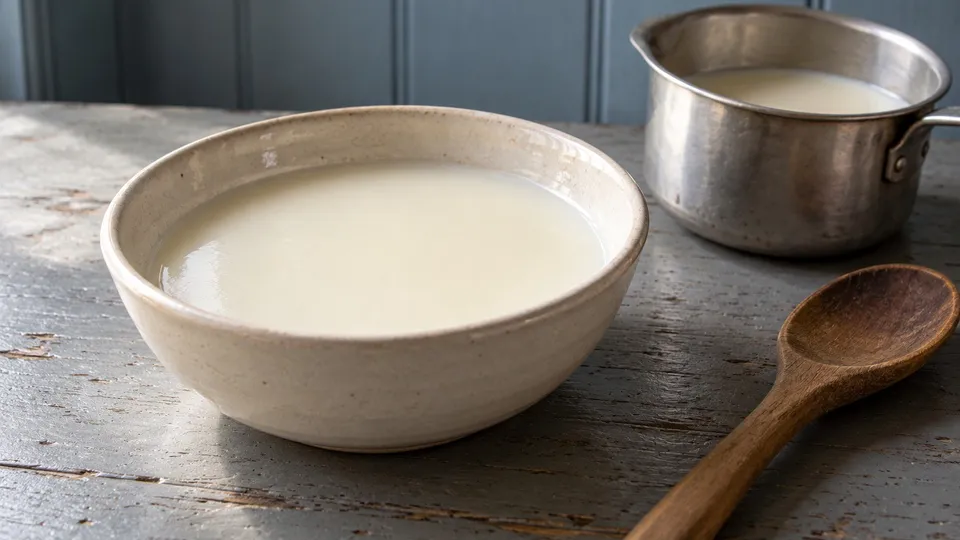 Always alcohol-freeSaloop with Milk
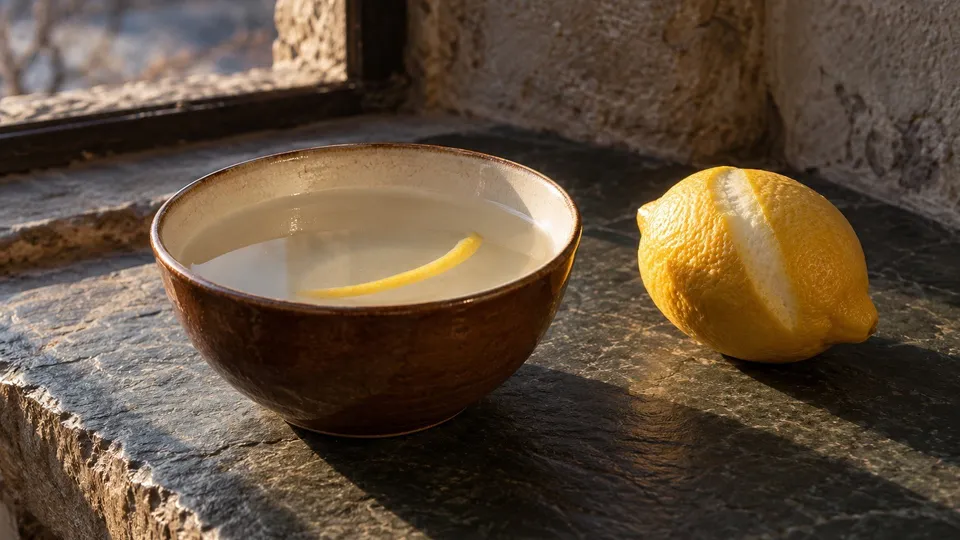 Alcohol-free versionClear Saloop with Lemon Peel
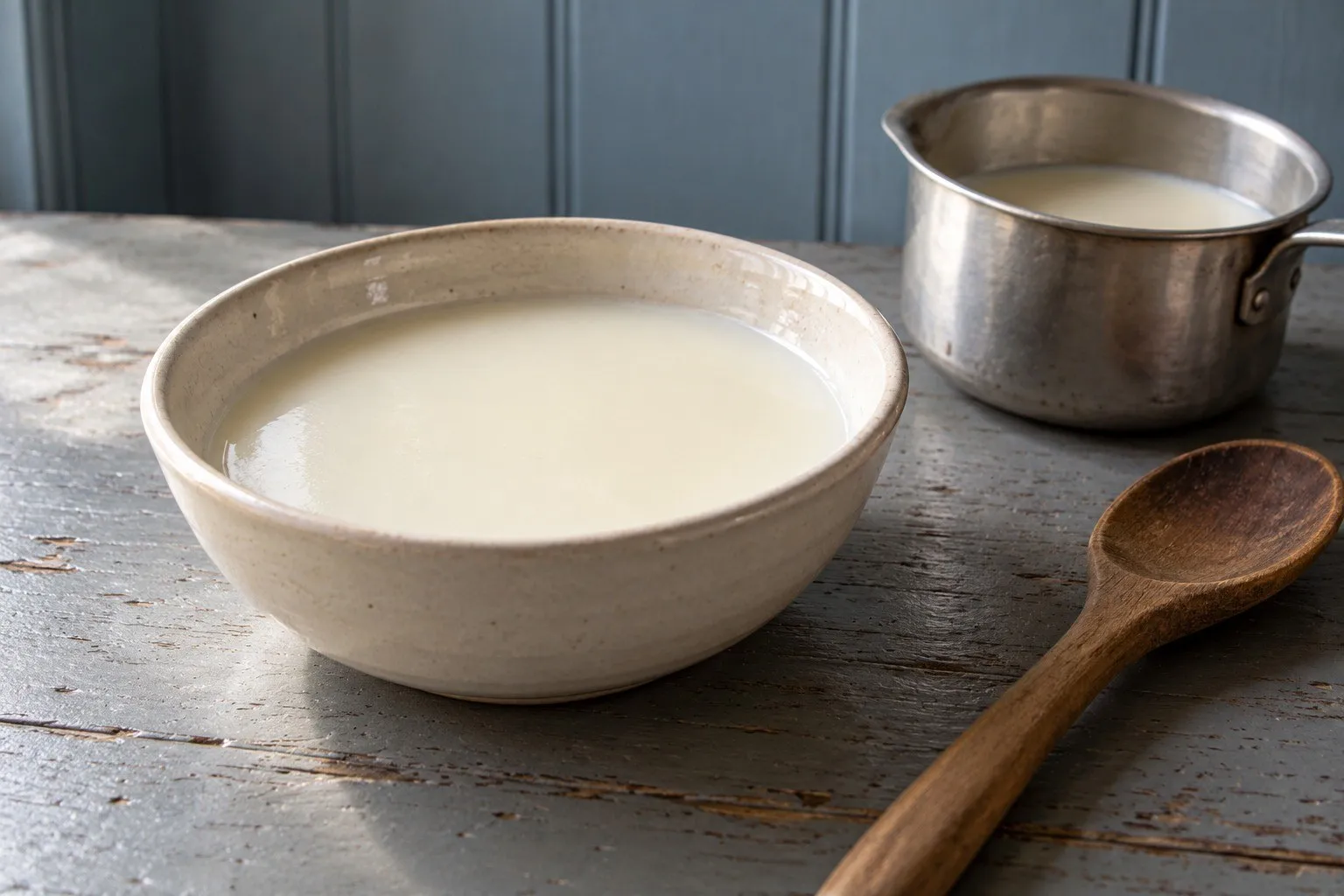 Saloop with milk, thickened with arrowroot, in a plain earthenware basin beside a small milk pan and a wooden spoon.
An American sensation
Saloop outlived its stalls in print. Smith had written that “the use of saloop is of very recent date,” though by his own account the Fleet Street house had been selling it for a century, and Mayhew heard of a clean, orderly coffee house near Billingsgate “kept by a man, I was told, who had risen from a saloop stall.” In 1869 William Terrington’s Cooling Cups and Dainty Drinks still printed a one-line recipe, an ounce of salep in a pint of boiling water. He filed it under “American Sensations,” between a brandy Stone Wall and a Rumfustian of sherry, ale and gin. Less than fifty years after Lamb’s sweeps drank it at three halfpence a basin, London’s dawn drink had become a curiosity on a fancy drinks list. Ten minutes is all the curiosity takes to revive: Saloop with Milk is milk, arrowroot and sugar, stirred until lightly thick and poured into two basins.
Sources
- Charles Lamb, “The Praise of Chimney-Sweepers,” in Elia. Essays which have appeared under that signature in The London Magazine (London: Taylor and Hessey, 1823), pp. 251–253. First printed in the London Magazine, May 1822.
- Henry Mayhew, London Labour and the London Poor, vol. 1 (London: Griffin, Bohn, 1861; text first published 1851), pp. 8, 66, 159–160, 183.
- John Thomas Smith, The Cries of London, ed. J. B. Nichols (London: J. B. Nichols, 1839), pp. 10, 85–87 and plate 28.
- A Sunday Ramble; or, Modern Sabbath-Day Journey; in and about the cities of London and Westminster (London, 1776), p. 3.
- Thomas Percival, “On the Preparation, Culture, and Use of the Orchis Root,” in Essays Medical and Experimental (London: J. Johnson, 1773), pp. 37–45.
- Ann Shackleford, The Modern Art of Cookery Improved (London, 1767), p. 96.
- [Maria Eliza Rundell], A New System of Domestic Cookery (London: J. Murray and J. Harding, 1806), p. 264.
- The Family Cookery Book; or, Improved System of Domestic Economy (Coventry: Merridew and Son, 1812), p. 307.
- A New System of Vegetable Cookery, 2nd ed., “by a member of the Society of Bible-Christians” (Salford: Academy Press, 1821), p. 271; attributed to Martha Brotherton.
- William Terrington, Cooling Cups and Dainty Drinks (London: Routledge, 1869), p. 198.
- CITES, Appendices I, II and III, cites.org.
- US Code of Federal Regulations, 21 CFR 189.180, “Safrole.”
- Regulation (EC) No 1334/2008 on flavorings, Annex III, Part A.
- Wildlife and Countryside Act 1981 (Great Britain), section 13 and Schedule 8.
- Çalışkan and Kurt, “Tarihi Kayıtlar ile Geçmişten Günümüze Salep Orkideleri,” Türkiye Tarımsal Araştırmalar Dergisi 6, no. 3 (2019): 349–355.
- Dawn Starin, “Salep,” Orchids (August 2012), reprinted by the Orchid Conservation Coalition.