What Did Soda Fountains Sell in Winter?
Hot chocolate, ginger, egg lemonade, clam broth and malted milk with pepper: how American soda fountains of the 1880s and 1890s kept selling in winter.
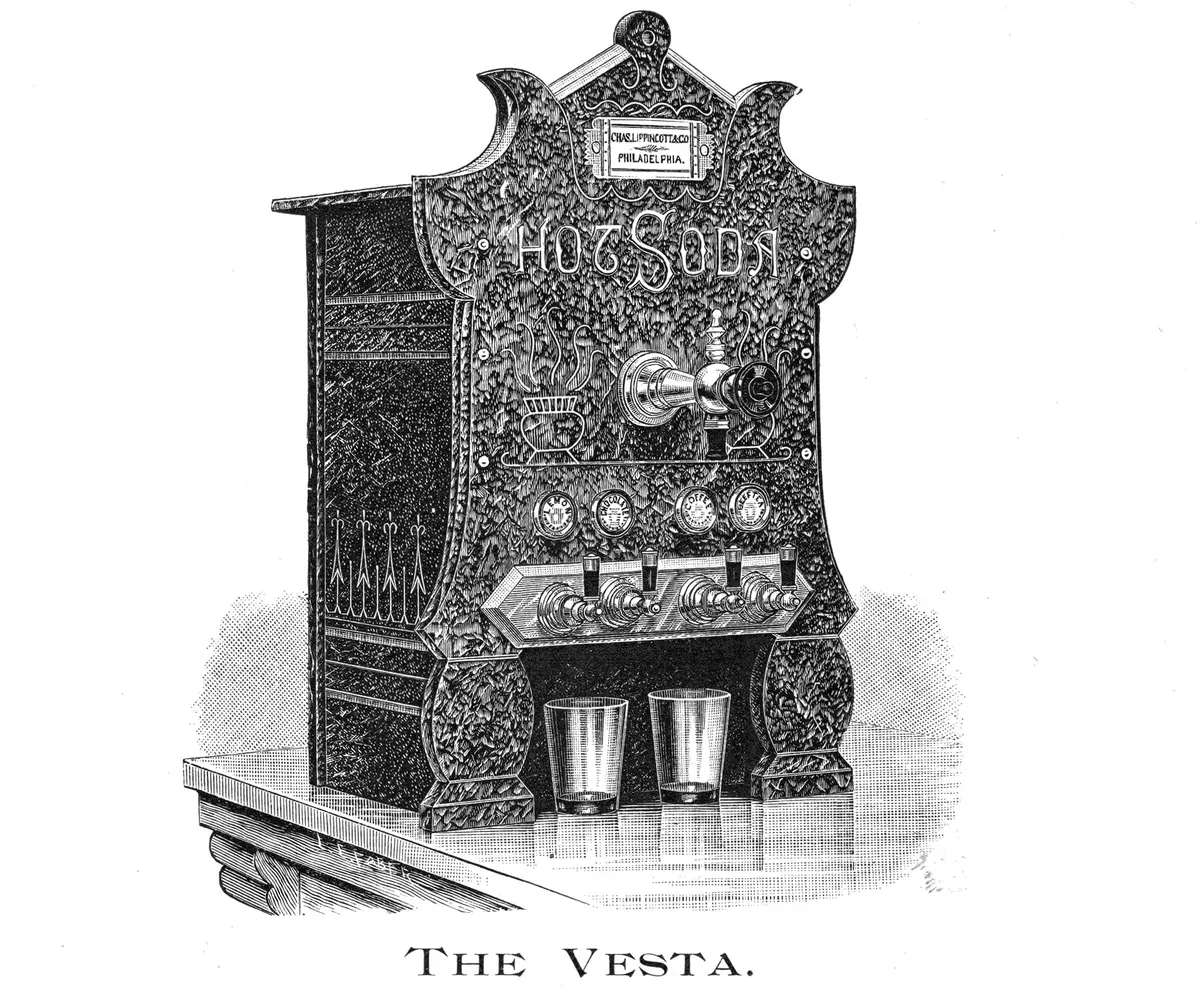
In winter the soda fountain sold “hot soda,” which had no soda in it. When the weather turned, an American soda fountain drew plain hot water from a heated urn and flavored it at the counter with syrups much like its summer ones: chocolate, coffee, lemon, ginger, or an egg shaken with lemon syrup. Next to the sweet drinks stood beef tea, clam broth and oyster juice, and a mug of malted milk seasoned with salt and pepper. The fountain makers sold the boilers and urns to dispensers who wanted their costly apparatus to earn money all year.
This story is part of our Old-Fashioned Sodas guide.
What a soda fountain was
A soda fountain was a counter, often in a drugstore, where soft drinks were mixed to order. Strictly, the fountain was the apparatus behind it, the tanks and taps that held and drew the cold carbonated water. The dispenser, or soda jerk, pulled the handle of a syrup pump, mixed the flavor with the fizzing water and served the drink in a glass. Druggists had carbonated water since early in the nineteenth century (London’s street sellers had ginger-beer fountains of their own by about 1850), and the fountain’s heyday ran from about 1890 to 1940, so Saxe and Lippincott wrote near its start. Its business was cold drinks for hot weather; one maker’s 1889 catalogue put “Summer Beverages” in its title.
A summer trade in February
De Forest W. Saxe, a working dispenser, tells his own story in Saxe’s New Guide, or Hints to Soda Water Dispensers (1894). In the winter of 1887 his business was growing fast, and on February 1 he opened a new apparatus with about 125 cold drinks and “a few hot drinks.” Until then, he writes, “we had never drawn cold soda in the winter,” and the season just past had brought in about $4,000, or about $140,000 in today’s money by US consumer prices. That February alone took $1,410, around $50 a day; in today’s terms that is about $51,000 for the month, or $1,800 a day.
Seven years later he still called hot drinks a branch of the business “still in its infancy,” and advised them wherever a dispenser could justify keeping his apparatus running all winter.
The manufacturers had been pressing the idea for some time. Chas. Lippincott & Co., a Philadelphia maker, opened the hot-soda section of its 1889 catalogue under the heading “How to Make Your Soda Apparatus Profitable in Winter.” “For several years past,” it began, “there has been an active demand for something that would take the place of the popular summer drink.” The answer was “Hot soda, so-called.” In its own city, the catalogue said, “several establishments paying heavy rents, and engaged exclusively in the business of making and dispensing Hot Soda, are securing popular favor and success.”
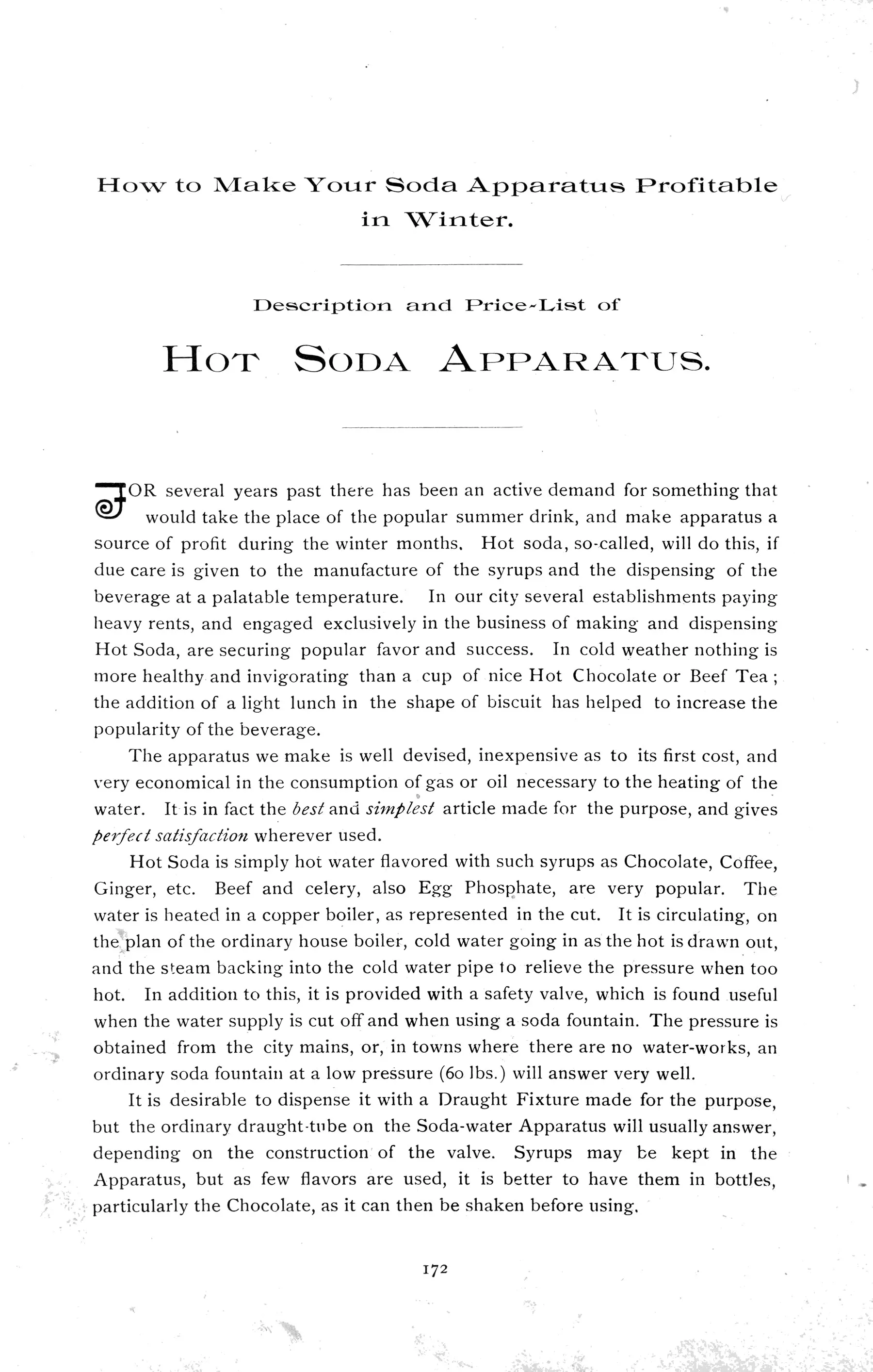 The opening page of the hot-soda section in Chas. Lippincott & Co.’s catalogue (Philadelphia, 1889), p. 172.
That is a heater maker making a sales pitch, but the shops it describes would have lived on the winter menu alone.
Hot water and a syrup
The name was a leftover. “Hot Soda is simply hot water flavored with such syrups as Chocolate, Coffee, Ginger, etc.,” Lippincott explained. Saxe agreed that what is “called Hot Soda” needs no carbonated water, “just plain hot water, and the different flavors,” so it was “not absolutely necessary to have an elaborate outfit.” The fountain kept its name, its counter and its syrups, and swapped the cold carbonated water for hot.
The water came from Lippincott’s Standard Heater, a copper vessel over a gas or oil burner, fed from the city water main on the plan of a house boiler, “cold water going in as the hot is drawn out,” with a safety valve for when the water supply was cut off. The syrups were best kept in bottles, the catalogue advised, “particularly the Chocolate, as it can then be shaken before using.”
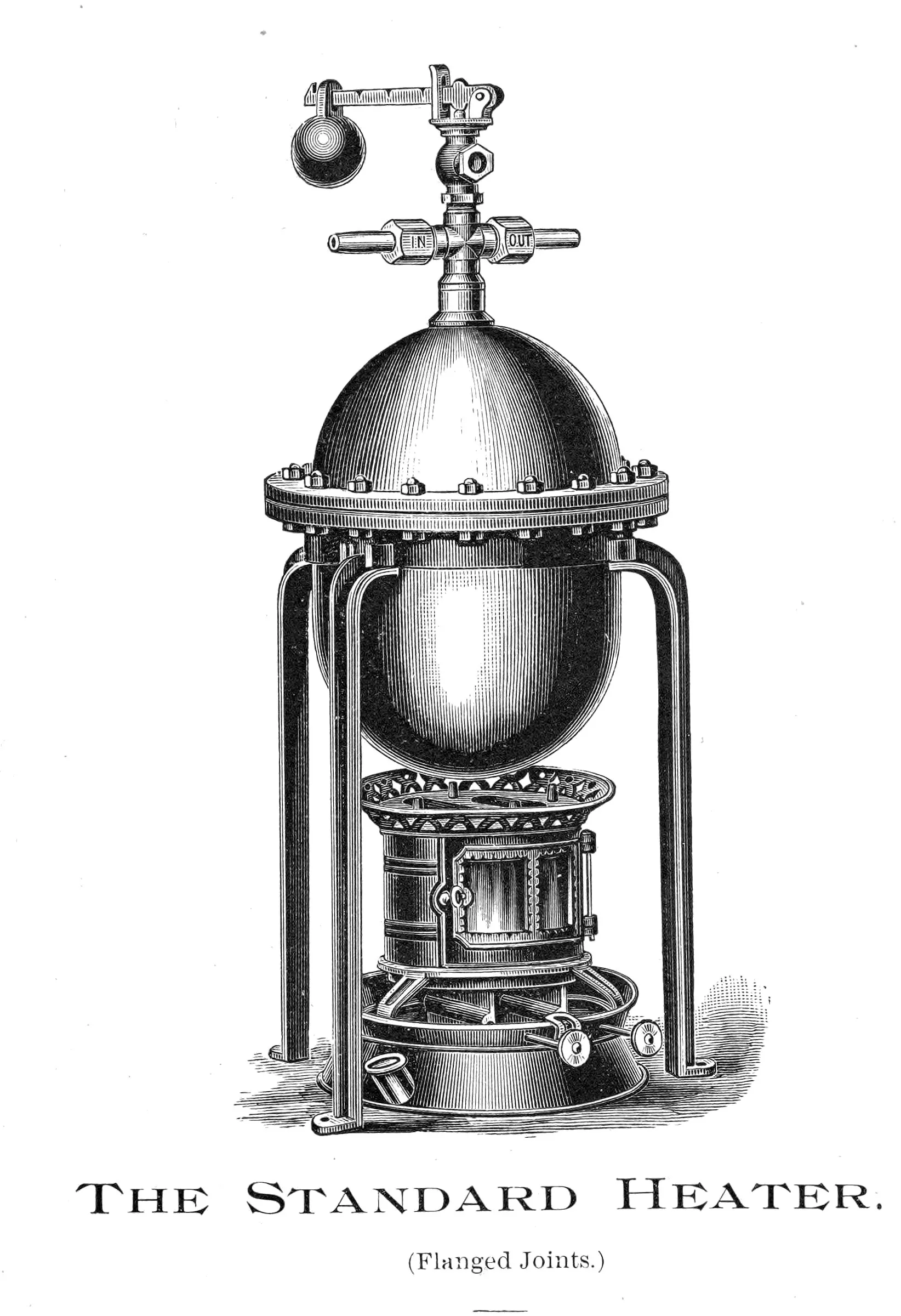 The Standard Heater, the boiler that heated water for hot soda, from Chas. Lippincott & Co.’s catalogue (Philadelphia, 1889), p. 173.
A shop that wanted to show it off could buy the Vesta, a tall cabinet with “HOT SODA” across its crest, a large faucet in the middle, and four syrup taps whose dials read lemon, chocolate, coffee and beef tea.
The drinks went into mugs. Saxe’s list of what a hot-soda counter needed starts with a cream pitcher, a sugar bowl, a chocolate pitcher and a cream whipper, and goes on to “Hot Soda Mugs to hold about 8 ounces,” long silver spoons, and sprinklers for salt, pepper and nutmeg. Lippincott sold silver-plated hot soda cups at $1.75 and $1.50 each, or six plain white china cups “made expressly for Hot Soda” for $1.25 the set. A single silver cup at $1.75 comes to about $63 today.
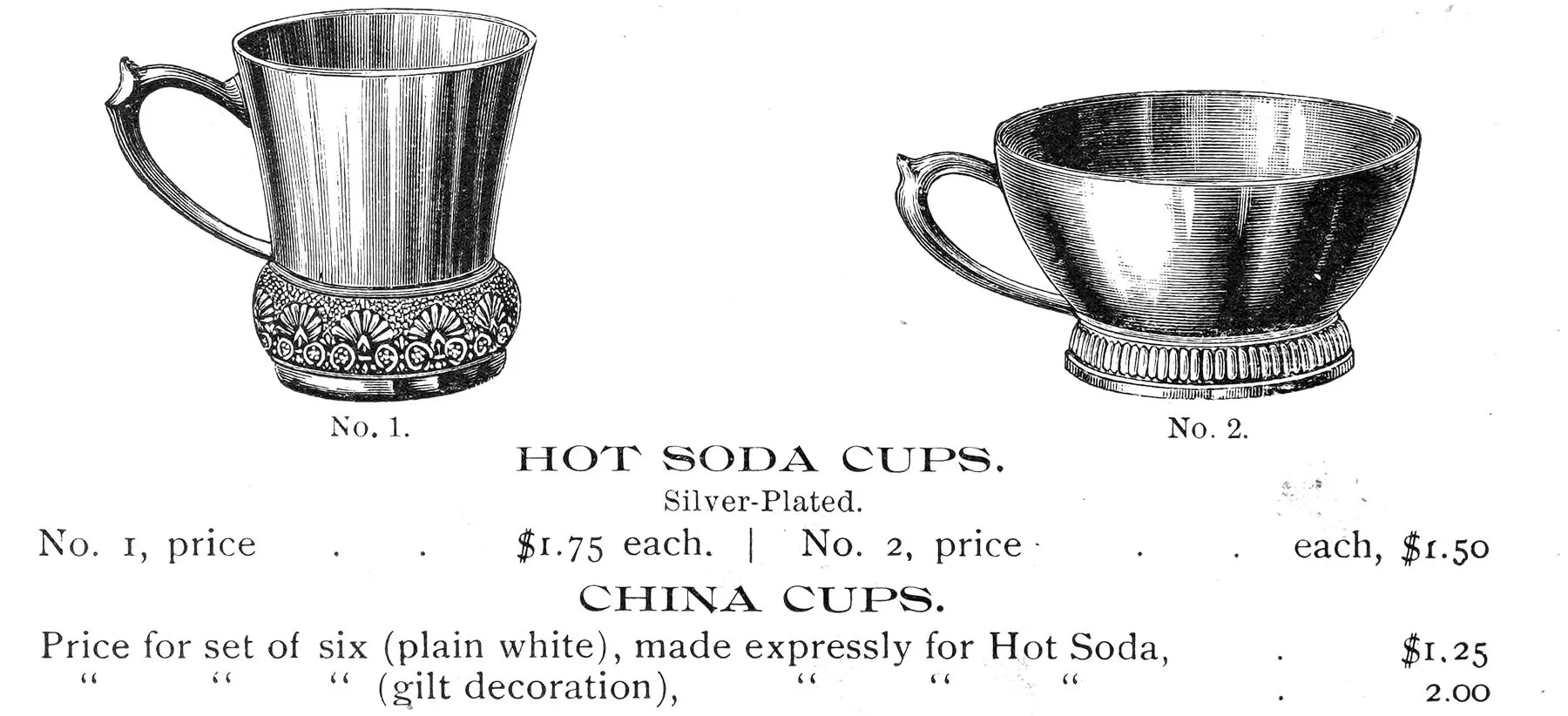 Silver-plated hot soda cups, with the price of plain white china cups below, from Chas. Lippincott & Co.’s catalogue (Philadelphia, 1889), p. 178.
Coffee, chocolate and clam broth
Saxe’s list of the most popular hot drinks reads half like a café and half like a lunch counter: “Hot Coffee, Chocolate, Beef, Beef and Celery, Clam Broth, Oyster Juice, Ginger, Lemon and the Egg Drinks.” Coffee and chocolate, he says, “are really the leaders.” Lippincott adds that beef and celery and egg phosphate were “very popular,” and that “the addition of a light lunch in the shape of biscuit” had helped sell the hot drinks. Its claim that in cold weather “nothing is more healthy and invigorating than a cup of nice Hot Chocolate or Beef Tea” is a seller’s claim of its day.
The savory drinks came out of the same urn as the sweet ones. Saxe’s hot clam broth is two tablespoonfuls of clam juice and the same of milk, filled up with hot water, stirred, and seasoned with salt and pepper “to suit taste.”
A. Emil Hiss, whose Standard Manual of Soda and Other Beverages came out in Chicago in 1897, set down the serving rules. An ounce to an ounce and a half of flavor went into an eight-ounce mug, which was then filled with hot water, and two or three thin crackers came beside it on a small china tray: soda crackers with beef tea, sweet ones with chocolate or coffee. Hiss wanted hot syrups stronger in flavor and less sweet than the cold ones. Saxe made the same point from the other side: ordinary syrup in hot coffee or chocolate, he warned, made a drink “too sweet and sickish.”
Lemon, ginger and an egg
The fruit and spice drinks were summer syrups made stronger. Saxe’s Hot Lemon used his cold lemon syrup, which already carried citric acid, with double the oil of lemon and an “extra heavy” sugar syrup: one ounce of it to seven ounces of hot water.
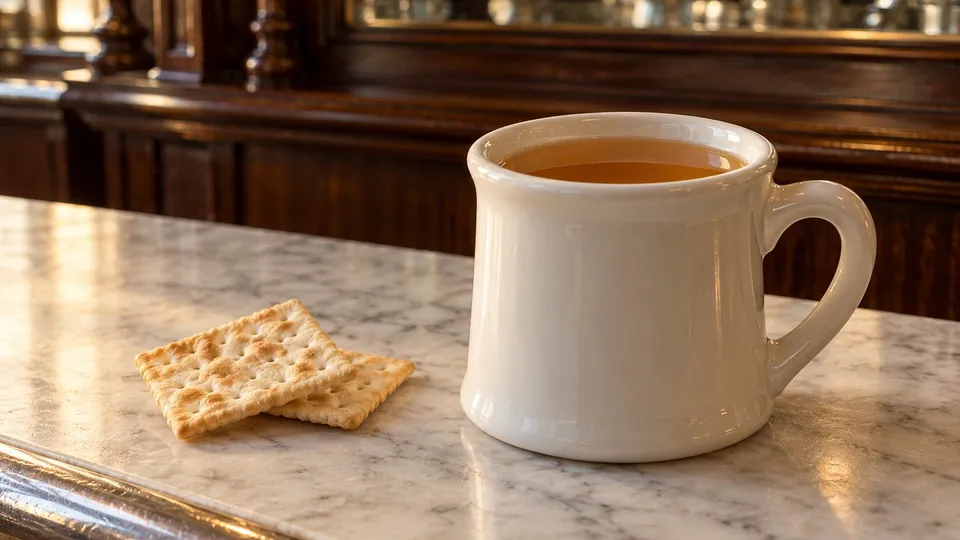
Hot Ginger was made the same way, with twice the usual dose of his ginger extract. That extract was Jamaica ginger, ginger root steeped in alcohol, so the period mug held a trace of alcohol. The Hot Ginger on this site makes its syrup from fresh ginger simmered in water instead, and has none.
 Always alcohol-freeHot Ginger, the Soda Fountain’s Winter Drink
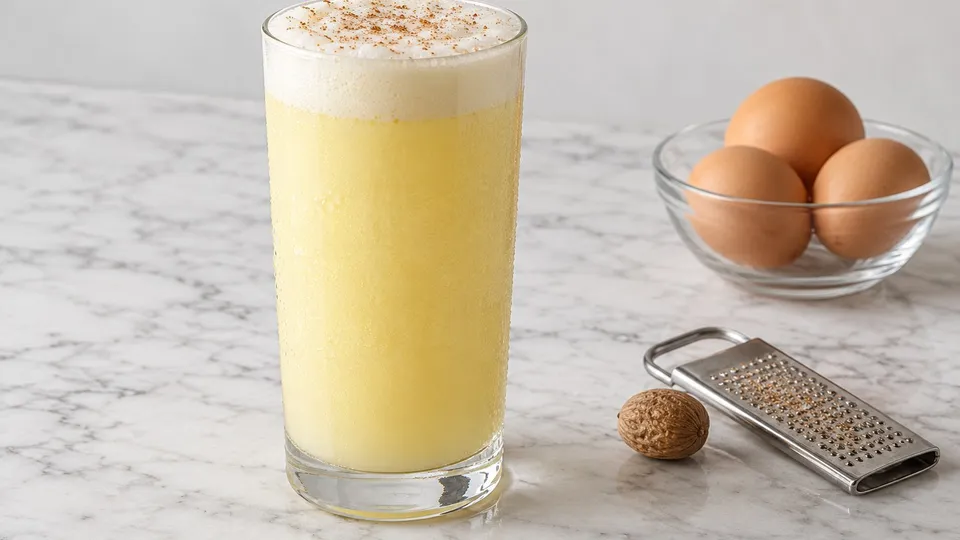
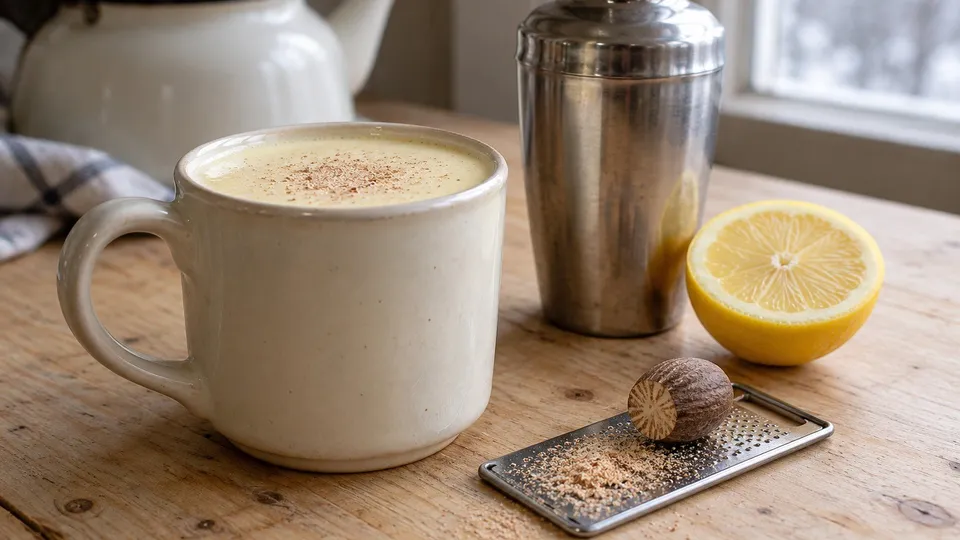
The egg drinks came closest to the summer counter. The cold Lemon Egg Phosphate, which turns up again at dry 1920s parties, shook an egg with lemon syrup and acid phosphate and filled the glass with soda. Saxe’s winter version shook a fresh egg with strong lemon syrup, acid phosphate and “a small piece of ice to break the yolk,” then poured it into a mug, filled it with hot water and topped it with nutmeg. Two teaspoons of lemon juice made it his Hot Egg Lemonade.
 Always alcohol-freeLemon Egg Phosphate, the Soda Fountain Sour
 Always alcohol-freeHot Egg Lemonade from the Soda Fountain
The hot list was alcohol-free almost to the last mug. The exceptions were a few punches, such as Saxe’s Hot Egg Punch with Jamaica rum, which he served in a long, thick soda glass.
Malted milk with salt and pepper
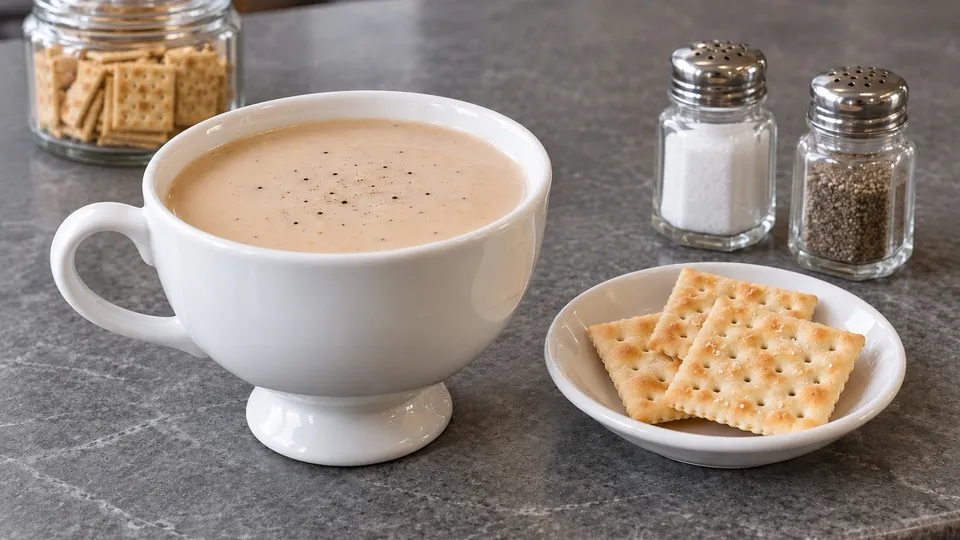
The oddest drink on the list is also the plainest. Saxe’s Hot Malted Milk is two teaspoonfuls of malted milk stirred into hot water and seasoned with salt and pepper “instead of sugar.” He called it “a very nice palatable drink” and, speaking for his own day, recommended it “for invalids and convalescents.” Hiss gives the same drink three years later, seasoned with salt and pepper or with celery salt, with soda crackers alongside, though his mug takes two tablespoons of malted milk, three times as much as Saxe’s.
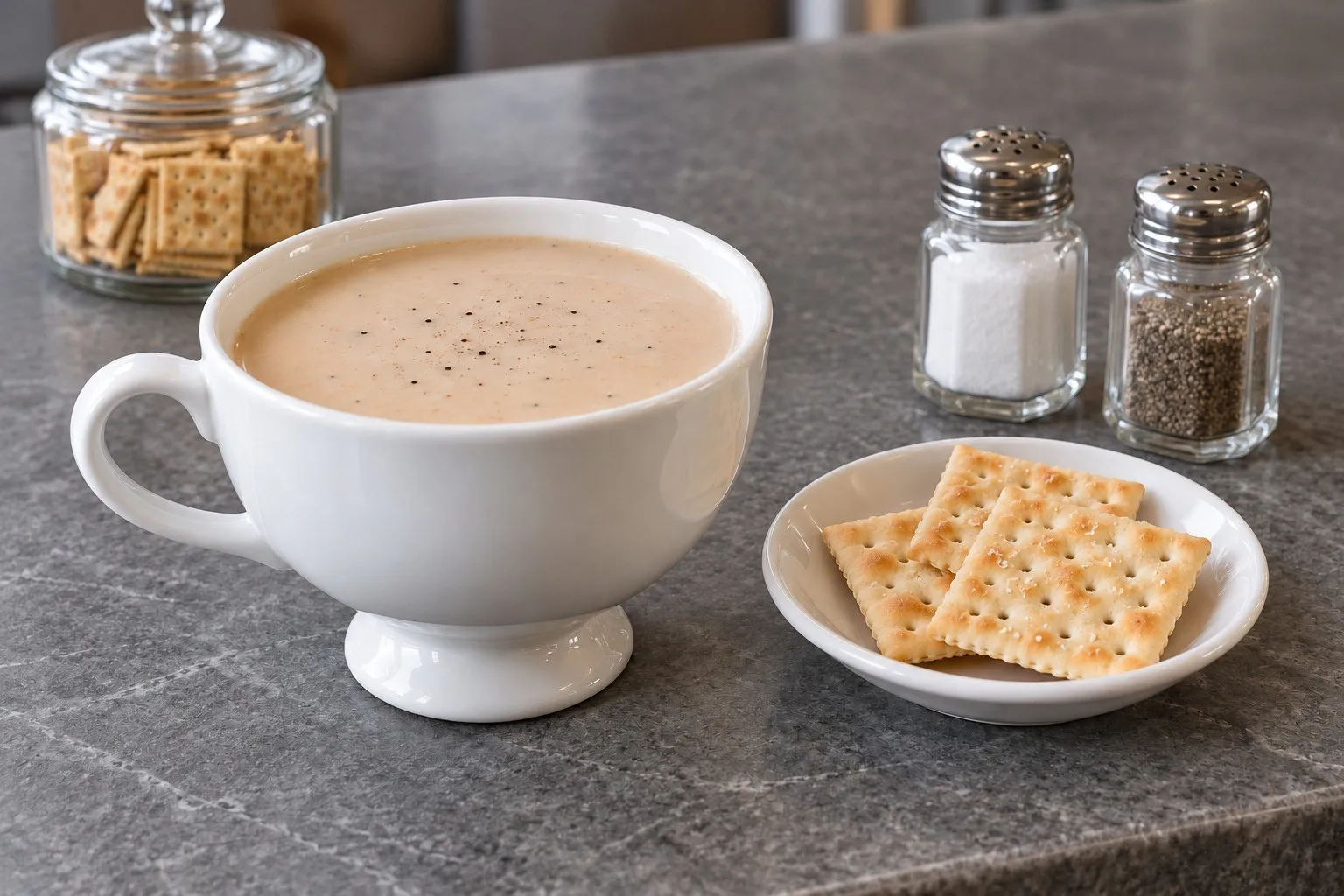 Hot malted milk in a footed white cup with a grind of black pepper, soda crackers on a dish beside it.
In January 1894, the year Saxe’s guide came out, the Malted Milk Co. of Racine, Wisconsin, advertised Horlick’s Malted Milk in the medical journal Modern Medicine “for the consideration of physicians,” as a diet in fevers, pneumonia, dyspepsia and “Nervous Prostration,” made by adding water and “acceptable to the weakest stomach.” That is the maker’s claim, and Saxe’s recipe names no brand. Hiss also describes a malted milk made from scratch: cow’s milk and finely ground malt, warmed gently for fifteen minutes, boiled for ten and strained. At the fountain, seasoned like a broth, it belonged with the beef tea and the clam broth, the savory end of the counter. The modern version is our Hot Malted Milk with Salt and Pepper.
 Always alcohol-freeHot Malted Milk with Salt and Pepper
Ten or fifteen drinks
The winter mug held mostly hot water and a strong syrup, with an egg, a spoonful of malted milk or a little clam juice for customers who wanted something nearer lunch, and crackers on the side. Coffee and chocolate led.
The list was short on purpose. Saxe pointed out that “almost any of our cold drinks can be served hot” by using hot water in place of cold carbonated water, but he saw no reason to offer “more than ten or fifteen hot drinks,” since “this number covers nearly all that are really of any account.” Set beside the 125 cold drinks he opened with in February 1887, the winter fountain ran on about a tenth of the summer menu. Salt and pepper in place of sugar are what make the fountain’s Hot Malted Milk worth a mug at home; seasoned like a broth and served with soda crackers, it takes five minutes.
Sources
- De Forest W. Saxe, Saxe’s New Guide, or Hints to Soda Water Dispensers (Chicago: Saxe Guide Publishing, 1894), pp. 10–11, 101–102, 105–109.
- A. Emil Hiss, The Standard Manual of Soda and Other Beverages (Chicago: G. P. Engelhard, 1897), “Hot Soda,” pp. 150–167, and malted milk, p. 213.
- Chas. Lippincott & Co., Catalogue of Apparatus for Making and Dispensing Soda Water, Mineral Waters, Summer Beverages, etc. (Philadelphia, 1889), hot-soda section, pp. 172–179, with its illustrations.
- Horlick’s Malted Milk advertisement, Modern Medicine and Bacteriological Review 3, no. 1 (Battle Creek, Mich., January 1894), advertising p. 1.
- Wendy Woloson, “Soda Fountains,” St. James Encyclopedia of Popular Culture, via Encyclopedia.com.
- Caroline Western-Osienski, “Museum Collections: Summertime Sips,” Hagley Museum and Library (2022).
- Alexia MacClain, “Cool off with Soda Fountains from the Past,” Smithsonian Libraries and Archives, Unbound (2015).
- Britannica Dictionary, “soda fountain.”