Clear Saloop with Lemon Peel
Reader ratingsBoiling water stirred onto arrowroot with a strip of lemon peel until clear and lightly thick, then sweetened: the 1812 cookery-book saloop, made without its wine.
- Recipe makes
- About 500 ml, 2 basins
- Prep
- Cook
- Total
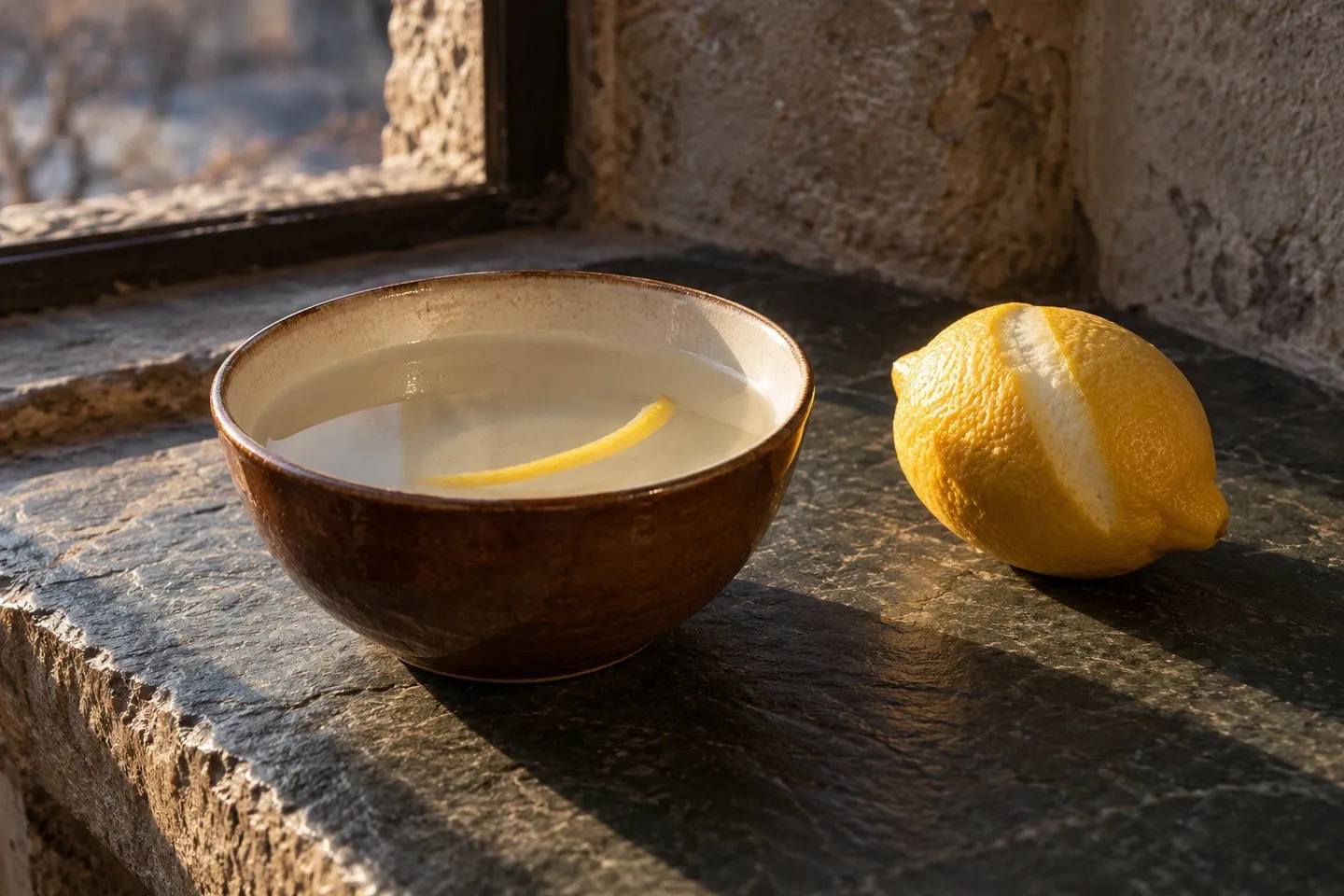
Nearly clear saloop with a thin strip of lemon peel in an earthenware basin by a stone window.
The story behind the recipe
In the cookery books, clear saloop was a pint of boiling water thickened with a teaspoon of salep, scented with lemon peel and stirred over a gentle fire “till it is a clear thick jelly,” and it was often filed with food for the sick. The Family Cookery Book, printed in Coventry in 1812, then finished it with “sugar and wine as agreeable.” Ours keeps the sugar and the peel and leaves the wine out.
The invalid’s shelf
Two of those books kept saloop with the caudles and other food for invalids, and the 1812 book’s neighbors show the company it kept. The recipe above it ends with “either port, white wine, or brandy, as suits the patient best,” and the white caudle below adds wine or brandy and, “if the patient can bear it, a little juice of lemon.” Ann Shackleford’s Modern Art of Cookery Improved (1767) made saloop the same way, stirring “till it is of a fine jelly.” Maria Rundell’s New System of Domestic Cookery (1806) boiled the wine in with the water, lemon peel and sugar, on a page that turns straight to hints for helping “the poor of their neighbourhood.”
The physician Thomas Percival had larger plans for the powder in 1773. Salep, he wrote, “is said to contain the greatest quantity of vegetable nourishment in the smallest bulk,” and he reported a proposal that every ship’s company carry it against famine at sea, dissolved with portable soup into “a rich thick jelly.” He was making a case, in an essay urging English farmers to grow the orchid.
Read more about this recipe
Clear and lightly thick
“Jelly” here means a thick, clear liquid, not a set jelly. Arrowroot gives a similar clarity and gloss without orchids, at about three times the old teaspoon of salep, since salep thickens more strongly. A Salford book of 1821 already allowed arrowroot in its saloop with milk. The drink is pale and nearly transparent, smooth, sweet and faintly lemony. Saloop, London’s Pre-Dawn Street Drink goes out to the street stalls and the early risers who drank there.
To make Saloop.
Mix by degrees a tea-spoonful of saloop; then pour upon it a pint of boiling water; put in a strip of lemon peel, and stir it over a gentle fire till it is a clear thick jelly; then sugar and wine as agreeable.

Recipe makes: About 500 ml, 2 basins
Ingredients
For About 500 ml, 2 basins. Quantities are shown as written.
Quantities as written here, for About 500 ml, 2 basins.
- Arrowroot1 metric tbsp (15 ml per tbsp)
- Cold water3 metric tbsp (15 ml per tbsp)
- Boiling water500 ml
- Strip unwaxed lemon peel, about 5 cm1
- Sugar1 1/2 metric tbsp (15 ml per tbsp)
Measurement notes
Ingredients as written here
- 1 tbsp arrowroot
- 3 tbsp cold water
- 500 ml boiling water
- 1 strip unwaxed lemon peel, about 5 cm
- 1 1/2 tbsp sugar
Equipment
 Kettle
 Small saucepan
 Wooden spoon
 Vegetable peeler
 2 wide bowls or basins
Instructions
Put the arrowroot in a small saucepan and stir in the cold water a little at a time to make a smooth, thin paste.
Pour in the boiling water slowly, stirring all the time, and add the unwaxed lemon peel.
Set the pan over low heat and stir for 1 to 2 minutes, until the liquid turns clear, glossy and lightly thick. Don’t let it boil hard.
Take the pan off the heat and stir in the sugar until it dissolves. Taste and add a little more if you like.
Pour into wide bowls or basins, with or without the strip of peel, and serve hot.
Nutrition
50calories per serving
- Recipe makes
- About 500 ml, 2 basins
- Servings
- 2
Estimated from USDA FoodData Central values for granulated sugar and arrowroot flour, for one of two basins.
Recipe notes
When adjusting quantities
Scale everything together; one strip of lemon peel does for up to a liter.
Notes
Quantities mentioned in these notes don’t change when you adjust the batch.
The 1812 pint is taken as 500 ml, between the old wine pint (473 ml) and ale pint (about 578 ml) of the time. The book’s teaspoon of saloop powder becomes 1 tablespoon (about 8 g) of arrowroot, our amount, worked out from the period ratio; if the drink comes out too thin, use 1½ tablespoons next time. The book gives no sugar amount; 1½ tablespoons is our choice.
The book’s “wine as agreeable” is left out to keep the drink alcohol-free. A splash of about 50 ml of wine in the pan would bring it to roughly 1% alcohol.
Cornstarch thickens in the same way but turns the drink cloudy, which loses the “clear” of the original. Real salep should come only from a seller who can show it is from cultivated orchids or another legal source, and it is worth reading the ingredients on any shop “salep” mix.
Scaling changes the ingredients only; glassware, ice and timings need their own judgment. To adapt this recipe further, try the recipe tool at TuneMyRecipe (opens in a new tab), our sister site.
Sources and attribution
The Family Cookery Book; or, Improved System of Domestic Economy (Coventry: Merridew and Son, 1812), “To make Saloop,” p. 307
Recipe details
- Drink
- Alcohol-free
- Drink family
- Hot Drinks
- Region
- British
- Era
- 19th century
- Difficulty
- Easy
- Season
- Winter