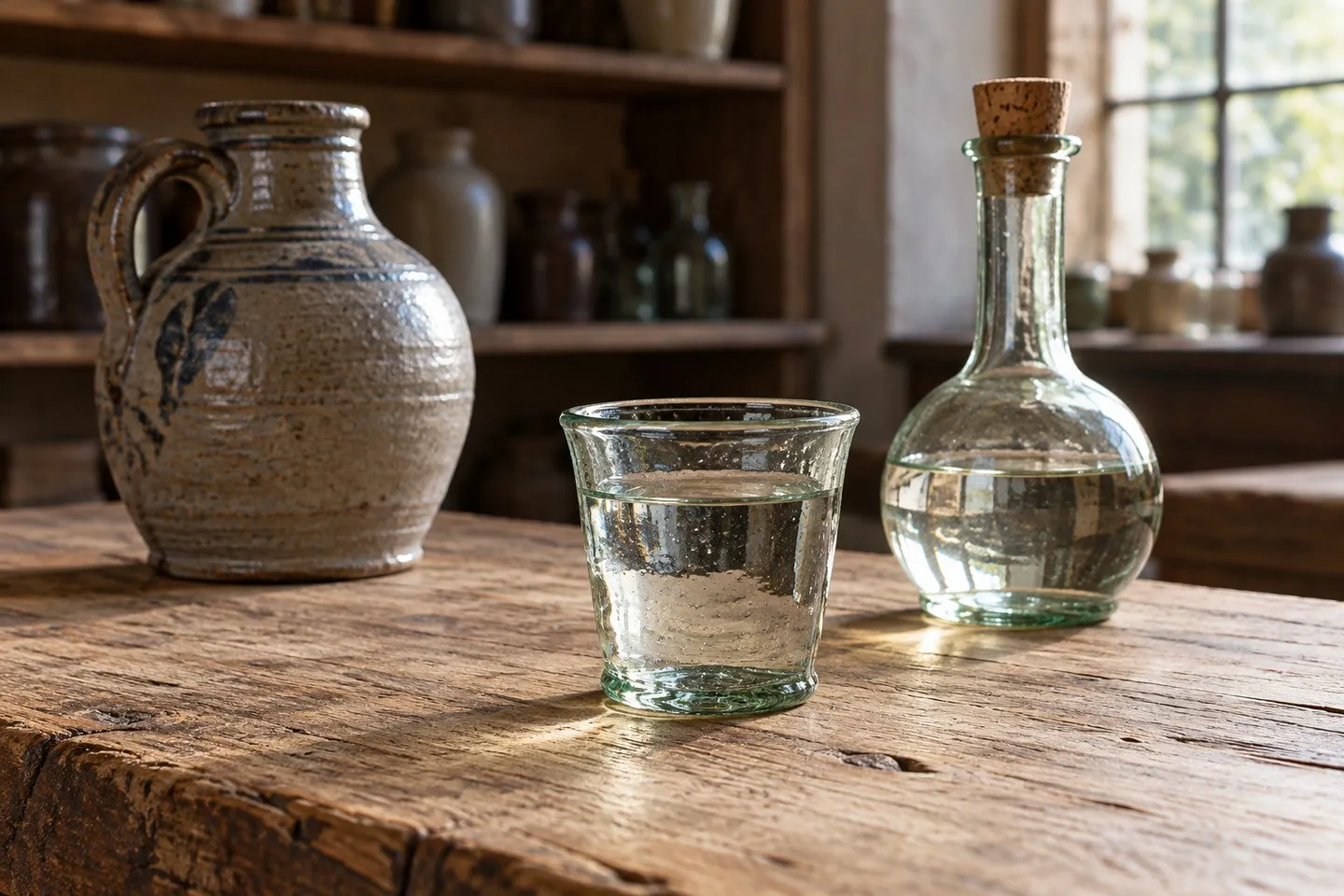
Rose Water, a Tudor Still-Room Drink
Reader ratingsRed rose water drunk by the ounce, as Brunschwig’s distilling book of 1527 doses it, lengthened with cold water into a pale, scented drink. Alcohol-free.
- Recipe makes
- 1 drink
- Prep
- Total
Rose water lengthened with cold water, with the rose water phial.
The story behind the recipe
In a Tudor still room, rose water was something you drank by the ounce. Hieronymus Brunschwig’s distilling book, printed in English in 1527, doses the water of red roses “in the mornynge and at nyght / at eche tyme an ounce or an ounce and a halfe.” Lengthened with cold water, that ounce makes a pale, scented drink, distilled from flowers and free of alcohol.
Waters from roses
Brunschwig’s book teaches how to distill “the waters of all maner of herbes,” flowers and fruits, and the waters it describes are drawn from the plants themselves. Any rose would do, he says, “but of the rede roses it is best. And there after the wylde roses / ther after the whyte roses / and there after the Eggletyne roses.” White double roses go “in balneo marie,” a gentle water bath. Kept well and “rectyfyed” every year, set in the sun or strained again, “Rede rose water dureth vnto the ende of the thyrde yere,” he says.
Spirits are a separate matter in the same book: when he wants a comparison for a strong water, he reaches for “aqua vite / or other dystylled wyne.” Rose water is not one of those.
His rose water is medicine, taken neat and measured in ounces. “Of the same water dronke an ounce,” he writes, it “conforteth the naturall hete of a bodye / and the spyryte also.” The same chapter mixes rose water with wine, tutty and sugar candy for the eyes, remedies never meant for the cup. The claims are his, made in 1527, and this page makes none.
Read more about this recipe
An ounce in a tall glass
Brunschwig’s ounce, taken neat, was a dose. Here about 30 ml goes into a tall glass of cold water, with an optional half teaspoon of sugar that only takes the edge off. The drink is almost colorless and floral. Buy rose water, the distilled kind sold for cooking. Rose extract, rose essence and rose essential oil are different products: extracts and essences are often made with alcohol, and an essential oil is far too strong to drink. Brands of rose water vary, so taste and add water as you go. The Romans went the other way and steeped roses in wine, as in Rosatum.
Of the same water dronke an ounce conforteth the naturall hete of a bodye / and the spyryte also / and preserueth them frome destroynge.

Recipe makes: 1 drink
Ingredients
For 1 drink. Quantities are shown as written.
Quantities as written here, for 1 drink.
- Food-grade rose water30 ml
- Cold water200 ml
- White sugar (optional)1/2 metric tsp (5 ml per tsp)
Measurement notes
Ingredients as written here
- 30 ml food-grade rose water
- 200 ml cold water
- 1/2 tsp white sugar (optional)
Equipment
 Tall glass
 Spoon
Instructions
Pour the food-grade rose water into a tall glass and add the cold water.
Stir in the white sugar until it dissolves, if you’re using it. Taste, and add more water if the rose is too strong.
Nutrition
10calories per serving
- Recipe makes
- 1 drink
Estimated from the USDA FoodData Central value for sugar, including the optional half teaspoon; rose water and water add almost nothing.
Recipe notes
When adjusting quantities
Per drink: 30 ml rose water to 200 ml cold water; sugar is optional and to taste.
Notes
Quantities mentioned in these notes don’t change when you adjust the batch.
Brunschwig measures the water in ounces. Taking the apothecaries’ ounce of about 31 g, and rose water at about the weight of water, an ounce is about 30 ml. The dilution and the sugar are ours; he gives neither for drinking.
Rock sugar, which Brunschwig calls “sugre candy,” works too, but takes longer to dissolve.
Brunschwig’s distilled waters, and what “water” could mean in his time, come up in Did Medieval People Really Drink Beer Instead of Water?.
Scaling changes the ingredients only; glassware, ice and timings need their own judgment. To adapt this recipe further, try the recipe tool at TuneMyRecipe (opens in a new tab), our sister site.
Sources and attribution
Hieronymus Brunschwig, The Vertuose Boke of Distyllacyon of the Waters of All Maner of Herbes (London: Laurens Andrewe, 1527), ch. ccxxxv, ‘Water of the rede roses’; ch. ccxxxviii, ‘Water of the buddes of the roses’
Recipe details
- Drink
- Alcohol-free
- Drink family
- Shrubs, Syrups & Cordials
- Base
- Herbs & flowers
- Difficulty
- Easy
- Season
- Summer