Oxymel, Pliny’s Honey and Vinegar Drink
Reader ratingsHoney, old vinegar, sea salt and water, boiled into a sharp-sweet syrup: the sweetened cousin of the Roman soldier’s vinegar drink, and alcohol-free.
- Recipe makes
- About 320 ml syrup, enough for 8 drinks
- Prep
- Cook
- Total
Includes about 30 minutes for the syrup to cool before bottling.
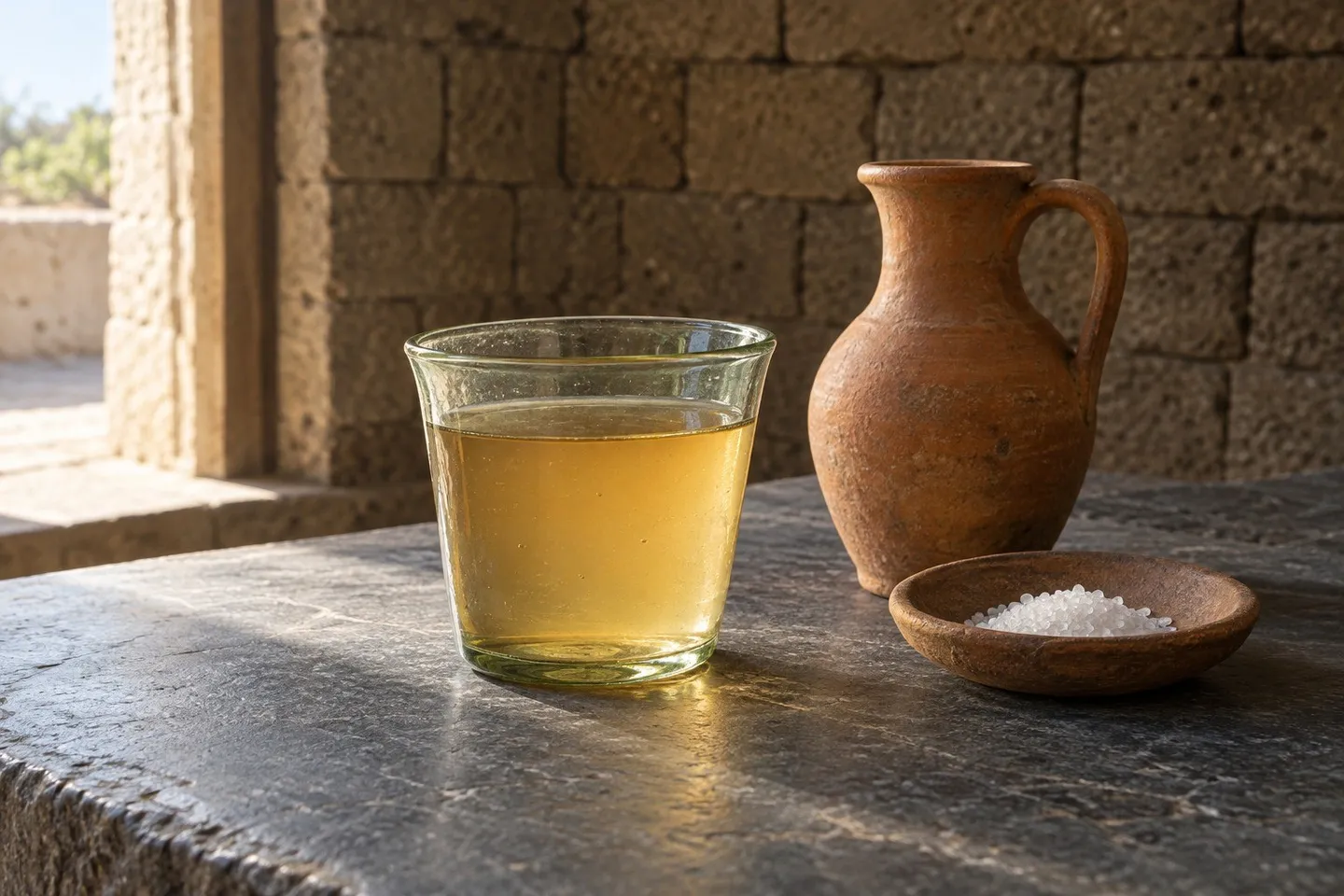
Oxymel diluted with cold water, with the syrup jug and sea salt.
The story behind the recipe
Oxymel is honey and vinegar boiled with sea salt and water, and it has no alcohol added, although Pliny the Elder files it among his “artificial wines.” He was not a fan. “Nothing, in fact, has been left untried by man,” he writes as he introduces it, and a few lines later, of the whole family: “by Hercules! the use of them does appear to be somewhat forced.”
The soldier’s drink, sweetened
Vinegar and water was an everyday Roman drink. Pliny’s Victorian translators call it posca, “the common drink of the Roman soldiers.” Pliny defends vinegar himself: “notwithstanding its tart and acrid taste, there are very considerable virtues, and without it we should miss many of the comforts of civilized life.”
Oxymel is posca dressed up. Pliny’s formula takes ten pounds of honey, old vinegar, a whole pound of sea salt and rain-water, boils it until it has “bubbled in the pot some ten times,” and keeps it until it is old. He says the artificial wines were all used as medicines, and that the physician Themison condemned every one of them. By 1855, his translators note, oxymel was “only used as a medicament,” and it no longer contained salt.
Read more about this recipe
Drinking it now
Pliny doesn’t say how oxymel was drunk, so serving the syrup diluted with cold water is our choice. Made that way it behaves like a modern shrub, sharp and sweet at once with a little salt underneath, with no alcohol added (wine vinegar can carry a trace). His ingredients and their order stay, but the salt is cut to a quarter: his proportion would put about 2 g of salt in every glass, this one about half a gram. His translators gloss the boil as “just come on the boil,” which is why this syrup is barely cooked. Any good wine vinegar works, red or white. The rest of the Roman cellar is in Seawater, Pine Resin and Honey: How Roman Wine Tasted.
Vinegar even has been mixed with honey; nothing, in fact, has been left untried by man. To this mixture the name of oxymeli has been given; it is compounded of ten pounds of honey, five semi-sextarii of old vinegar, one pound of sea-salt, and five sextarii of rain-water. This is boiled gently till the mixture has bubbled in the pot some ten times, after which it is drawn off, and kept till it is old.

Recipe makes: About 320 ml syrup, enough for 8 drinks
Ingredients
For About 320 ml syrup, enough for 8 drinks. Quantities are shown as written.
Quantities as written here, for About 320 ml syrup, enough for 8 drinks.
Syrup
- Honey115 ml
- Wine vinegar70 ml
- Fine sea salt3/4 metric tsp (5 ml per tsp)
- Water135 ml
To serve
- Cold water per drink200 ml
Measurement notes
Ingredients as written here
- 115 ml honey
- 70 ml wine vinegar
- 3/4 tsp fine sea salt
- 135 ml water
- 200 ml cold water per drink
Equipment
 Small saucepan
 Clean glass bottle or jar
Instructions
Put the honey, wine vinegar, fine sea salt and water in a small saucepan and stir over low heat until the honey and salt have dissolved.
Bring to a gentle boil and let it bubble for about 1 minute, then take the pan off the heat and skim off any foam.
Leave the syrup to cool for about 30 minutes, then pour it into a clean bottle.
For each drink, stir about one part syrup into five parts cold water, then taste and add more syrup or water as you like.
Nutrition
65calories per serving
- Recipe makes
- About 320 ml syrup, enough for 8 drinks
- Servings
- 8
Estimated from USDA FoodData Central values for honey and wine vinegar, for one drink of 40 ml syrup in water.
Recipe notes
When adjusting quantities
Scale the syrup ingredients together; serve about 40 ml of syrup per 200 ml of cold water.
Notes
Quantities mentioned in these notes don’t change when you adjust the batch.
Pliny’s quantities are 10 Roman pounds of honey, 2½ sextarii of vinegar, 1 pound of sea salt and 5 sextarii of rain-water. Using about 329 g to the Roman pound and 546 ml to the sextarius (Wikipedia, Ancient Roman units of measurement (opens in a new tab), accessed October 19, 2026), this recipe is one-twentieth of his batch. His honey works out at about 164 g, or 115 ml, and his salt at about 16 g, reduced here to 3/4 teaspoon (about 4 g).
“Old vinegar” suggests a mellow, well-aged wine vinegar. Pliny ages the finished oxymel; this version is ready as soon as it has cooled.
Oxymel and the other vinegar drinks of Rome are part of What Did Romans Drink Besides Wine?.
Storage
Keep the syrup in a clean, closed bottle in the fridge and dilute just before serving.
Scaling changes the ingredients only; glassware, ice and timings need their own judgment. To adapt this recipe further, try the recipe tool at TuneMyRecipe (opens in a new tab), our sister site.
Sources and attribution
Pliny the Elder, The Natural History of Pliny, vol. 3, trans. John Bostock and H. T. Riley (London: Henry G. Bohn, 1855), Book XIV, ch. 21, p. 261
Recipe details
- Drink
- Alcohol-free
- Drink family
- Shrubs, Syrups & Cordials
- Era
- Ancient Rome
- Difficulty
- Easy
- Occasion
- Dry January
- Season
- Summer