Coffee-Tavern Tea, Steeped Ten Minutes
Reader ratingsChina black tea and Assam steeped exactly ten minutes, poured off the leaves, sweetened in the pot and given a spoonful of milk: tea from an 1878 coffee-tavern manual.
- Recipe makes
- About 560 ml, 2 half-pint cups
- Prep
- Cook
- Total
Includes exactly 10 minutes for the tea to steep before it is poured off the leaves.
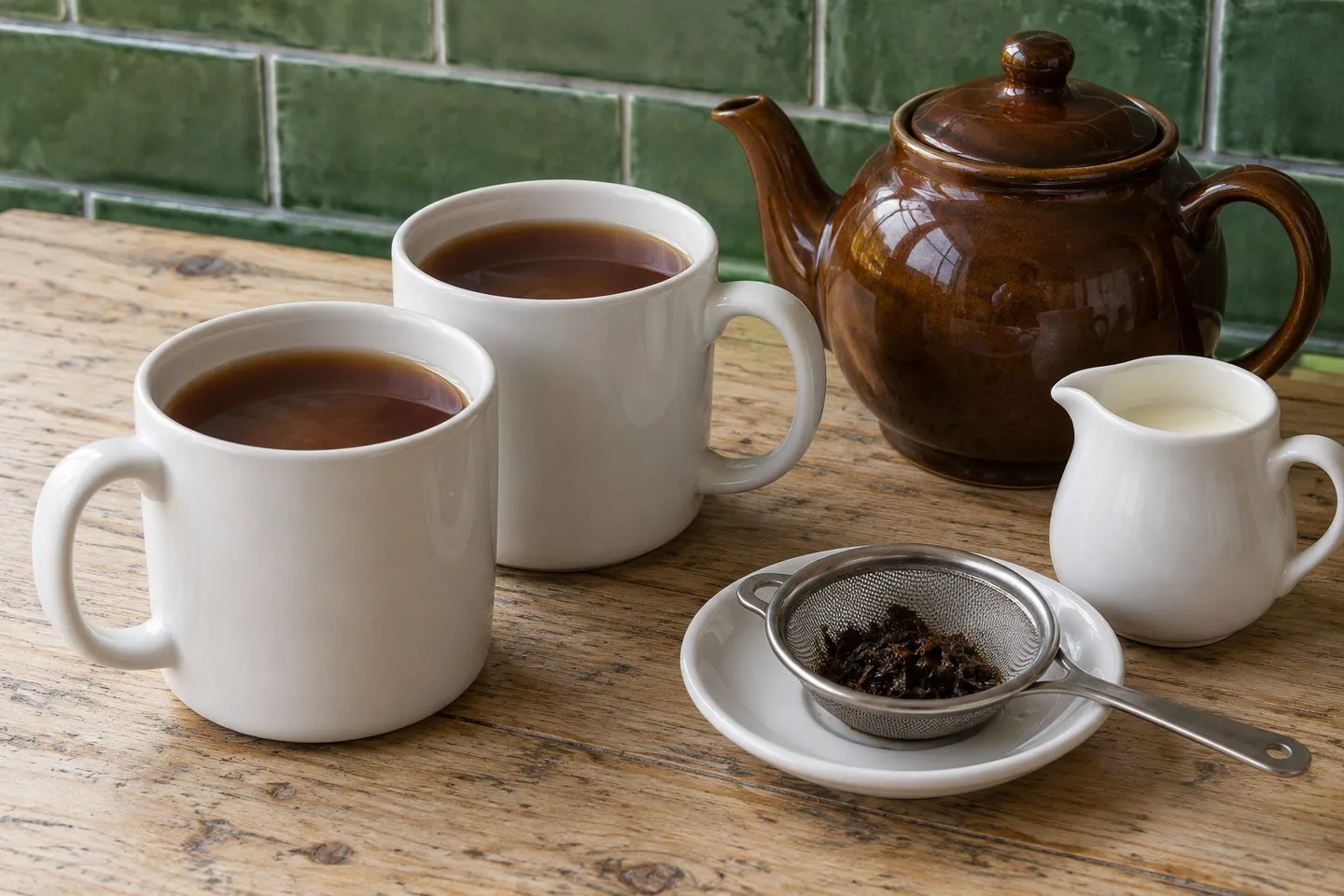
Dark sweet tea in two thick white mugs, with a brown teapot and a little jug of milk on a worn wooden table.
The story behind the recipe
Coffee-tavern tea steeped for exactly ten minutes, then went into the cup sweetened, with only two or three teaspoons of milk. The Coffee Publichouse Association’s 1878 manual, written for the coffee taverns that tried to draw working men out of the pub, printed the rule with its warning in italics: “on no account should the water be allowed to stand longer upon the tea leaves.”
A penny and not a farthing less
Tea was the dear drink at the coffee tavern. Coffee and cocoa could be cut to a halfpenny a cup, but “good tea cannot be profitably sold for less than 1d. per cup,” the manual said, and its London price list charged a penny and nothing else, about 43p in today’s money by UK consumer prices (Bank of England). The cheap stuff was no saving: “Inferior tea is not economical in use.” In Liverpool it also sold least of the three hot drinks: in one 1877 week the cocoa rooms there poured roughly nine gallons of cocoa for every gallon of tea.
The manual asked for “good Moning or Kaisow,” trade names for China black teas, at about 2s. 4d. to 2s. 5d. a pound wholesale (about £12 a pound today), mixed with Assam from India at 2s. 6d. to 2s. 8d. Equal parts would do, or two-thirds China to one-third Assam. A whole batch, three-quarters of a pound of leaf to seventeen pints of water, was sweetened in the vessel with three-quarters of a pound of sugar and came to eighteen pints with the milk, at about a shilling a gallon.
Read more about this recipe
A very dark cup
The aim, in the manual’s words, was tea “strong, wholesome, and refreshing.” Our pot takes the two-thirds China blend at a sixteenth of the batch: about 3.5 grams of leaf to every 100 ml of water, which is a lot of tea. By the tenth minute the leaf has given up its color and tannin; a spoonful of milk hardly touches the dark, brisk, sweet cup. The manual told managers to make it like coffee, with boiling water poured into a warmed vessel, which is how its penny cup of coffee began. Keemun is a China black tea that is easy to find today, and any loose Assam suits.
TEA.—Inferior tea is not economical in use. The wholesale price of good Moning or Kaisow is usually about 2s. 4d. to 2s. 5d. per lb., and good Assam 2s. 6d. to 2s. 8d. A mixture of these teas in equal proportions, or two-thirds Moning or Kaisow to one-third Assam, gives good results. The preparation of the tea should be very carefully attended to, in order that it may be strong, wholesome, and refreshing. It should be made like coffee, with water, in a boiling state, poured into a vessel previously warmed. The tea should stand exactly ten minutes, and should then be drawn off. In ten minutes the infusion will be of the full strength, and on no account should the water be allowed to stand longer upon the tea leaves. The proportions may be three-quarters of a pound of tea to seventeen pints of water, with three-quarters of a pound of sugar. A small quantity of milk—two or three teaspoonsful—may be added to each cup when served. Assuming a pint of milk to be thus used the brew would produce eighteen pints at a cost of about 1s. per gallon. Good tea cannot be profitably sold for less than 1d. per cup.

Recipe makes: About 560 ml, 2 half-pint cups
Ingredients
For About 560 ml, 2 half-pint cups. Quantities are shown as written.
Quantities as written here, for About 560 ml, 2 half-pint cups.
- Loose China black tea, such as Keemun14 g
- Loose Assam tea7 g
- Water600 ml
- Sugar5 metric tsp (5 ml per tsp)
- Whole milk5 metric tsp (5 ml per tsp)
Measurement notes
Ingredients as written here
- 14 g loose China black tea, such as Keemun
- 7 g loose Assam tea
- 600 ml water
- 5 tsp sugar
- 5 tsp whole milk
Equipment
 Kettle
 2 teapots, or a teapot and a heatproof jug, warmed
 Tea strainer
 Timer
 2 mugs or large cups
Instructions
Warm two teapots, or a teapot and a heatproof jug, by filling them with hot water, then pour the water away.
Put the loose China black tea and the loose Assam tea into the first pot.
Bring the water to a full boil and pour it straight onto the leaves. Put the lid on and set a timer for exactly 10 minutes.
At 10 minutes, pour all of the tea through a tea strainer into the second warm pot, leaving none on the leaves.
Stir in the sugar until it has dissolved.
Pour into mugs and add the whole milk, shared between them.
Nutrition
50calories per serving
- Recipe makes
- About 560 ml, 2 half-pint cups
- Servings
- 2
Estimated from USDA FoodData Central values for brewed black tea, granulated sugar and whole milk, for one of two cups.
Recipe notes
When adjusting quantities
Scale everything together. The manual’s own batch is sixteen times this one: three-quarters of a pound of tea to seventeen pints of water.
Notes
Quantities mentioned in these notes don’t change when you adjust the batch.
The manual’s batch is ¾ pound of tea, 17 imperial pints of water, ¾ pound of sugar and about a pint of milk, which it counts as eighteen pints. One-sixteenth gives 21 g of tea, 603 ml of water (rounded to 600), 21 g of sugar and 35 ml of milk, though the manual’s own rule of 2 to 3 teaspoons a cup comes to about 5 teaspoons (25 ml) for two cups, which this version follows; 5 teaspoons of granulated sugar weigh about 21 g. The leaves keep back some water, so the pot gives about 560 ml: two of the tavern’s half-pint (284 ml) cups.
The manual allows equal parts China and Assam as well as two-thirds China; equal parts, 10.5 g of each, gives a maltier, heavier cup.
If you would rather sweeten cup by cup, leave the sugar out of the pot and pass it at the table; the tavern’s urn came already sweetened.
Moning and Kaisow were Victorian trade names for China black teas. Keemun, a black tea from Anhui, is our choice as the closest common equivalent; any China black tea sold loose will do.
Scaling changes the ingredients only; glassware, ice and timings need their own judgment. To adapt this recipe further, try the recipe tool at TuneMyRecipe (opens in a new tab), our sister site.
Sources and attribution
Coffee Publichouse Association, The Coffee Publichouse: How to Establish and Manage It (London: Coffee Publichouse Association, 1878), p. 30
See the original pages (scan at Internet Archive) (opens in a new tab)
Recipe details
- Drink
- Alcohol-free
- Drink family
- Hot Drinks
- Region
- British
- Era
- 19th century
- Source decade
- 1870s
- Difficulty
- Easy
- Occasion
- Dry January
- Season
- Winter