What Were Victorian Non-Alcoholic Beers?
Ginger, lemon, hop and root beers sold as soft drinks were mostly brewed with yeast and held a little alcohol. What Mayhew and a 1919 drinks book show.
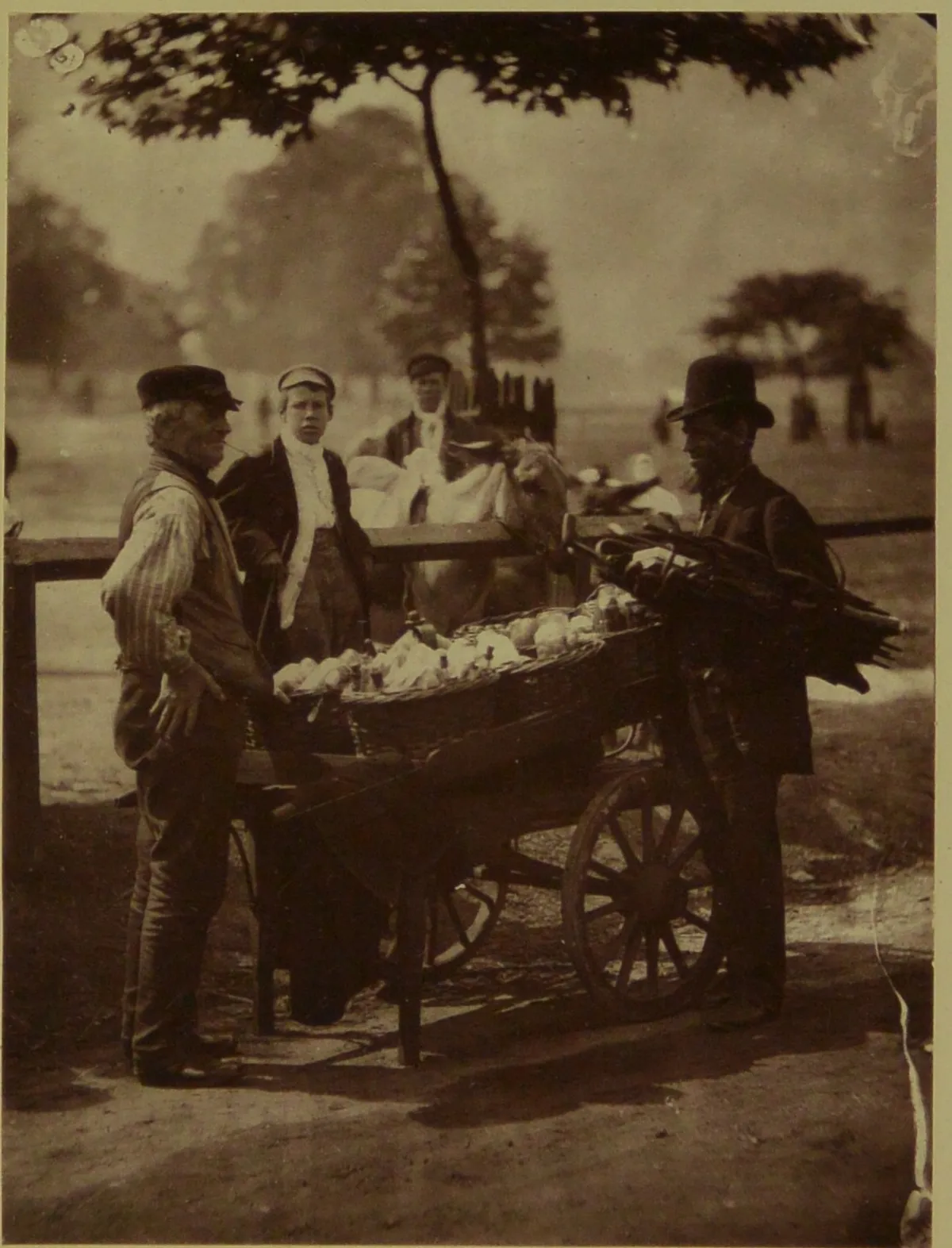
Mostly they were small beers, brewed with yeast and bottled while still working, so they held a little alcohol. Ginger, lemon, hops, birch bark or roots flavored the sugared water, and a day or two of fermentation gave the fizz. By about 1850 the penny bottle of brewed ginger beer, about 49p in today’s money by UK consumer prices (Bank of England), had a rival on London’s streets: a fountain kind, lemon water pumped full of gas.
This story is part of our What Did Victorians Drink? guide.
The label was loose, and it stayed loose into the twentieth century. Home Made Beverages, published in New York in 1919, draws much of its matter from what its publishers, Munn & Co. of Scientific American, had copyrighted between 1891 and 1910, so it records the late-Victorian and Edwardian tradition more than its own year. One of its ginger beers calls for “brandy, ½ pt.” Where that recipe ends, the running head at the top of the page reads “Beverages—Non-Alcoholic.” The heading belongs to the layout, and nobody claims brandy is sober, but the chapters around it show how little the word promised.
Non-alcoholic beers that ferment
The book’s compiler was Albert A. Hopkins. Chapter III is headed “Non-Alcoholic Beers.” Its first recipe, a Beer Tonic, flavors syrup with essential oils: “Mix the oil with 12 oz. of alcohol and add to the plain syrup. Then add 35 gal. of water at blood heat and ferment with sufficient yeast.” A little salicylic acid goes in against “putrefactive fermentation,” and Hopkins reassures the brewer: “The natural vinous ferments will not be obstructed by it.” Vinous fermentation was the period’s name for the kind that makes alcohol.
Birch beer is left “loosely bunged for 2 or 3 days or until fermentation has ceased,” then bottled and corked tight. One root beer decoction is made with a pint of alcohol (“This prevents fermentation”), and the root beer brewed from it with molasses and yeast “will soon ferment and produce a good, drinkable beverage.”
The yeast was there to make the drink fizz, and wherever yeast eats sugar it makes alcohol along with the gas. A short ferment kept the amount small; it never brought it to zero. Home brewing itself was old: in medieval England most ale was brewed by women as part of their household work, as Did Medieval People Really Drink Beer Instead of Water? tells. What was new was brewing mainly for the fizz. Russian households worked their bread drink the same way: Elena Molokhovets’s 1887 bread kvass steeps dried rye bread with treacle, starts it with a little yeast and bottles it after a day, and our alcohol-free bread kvass leaves the yeast out.
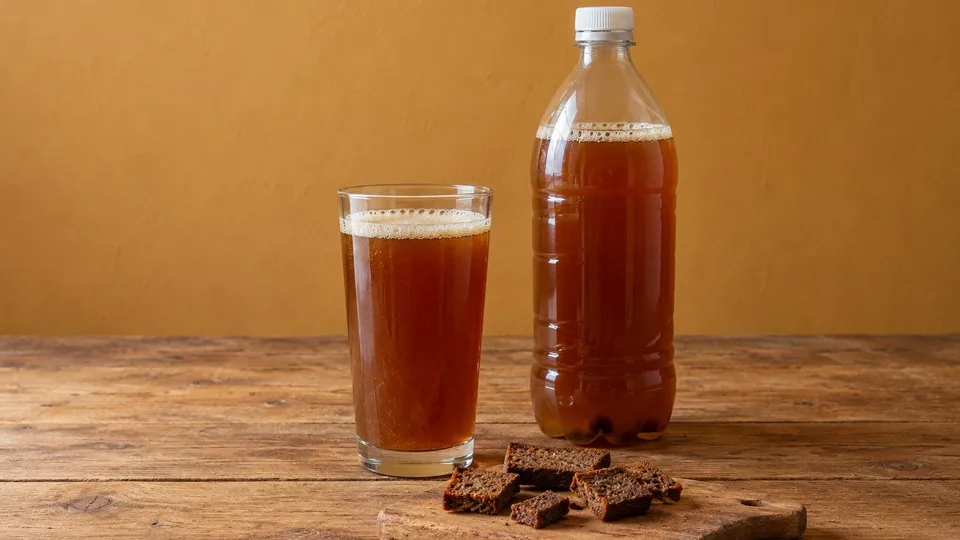 Make it todayBread Kvass, the 24-Hour Rye Kvass from 1887
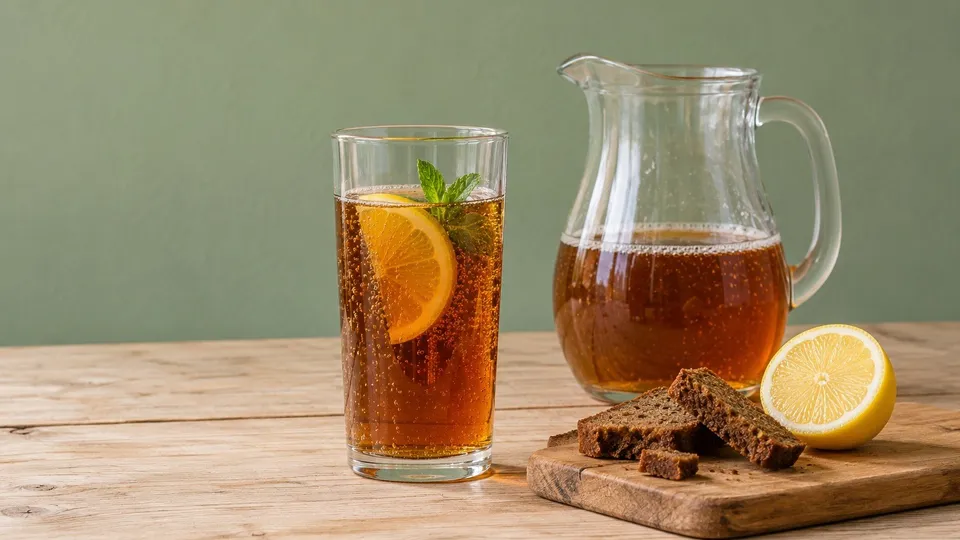 Alcohol-free versionAlcohol-Free Bread Kvass with Lemon and Mint
Half a pint of brandy
The brandy recipe is Ginger Beer No. 2, in “Ginger Ales, Beers, Pop, Etc.”:
Jamaica ginger, 2½ oz.; moist sugar, 3 lb.; cream tartar, 1 oz.; juice and peel of 2 lemons; brandy, ½ pt.; good ale yeast, ¼ pt.; water, 3½ gal. This will produce 4½ doz. bottles of excellent ginger beer, which will keep 12 months.
The brew works for two or three days, is strained “into a cask,” and gets the brandy. “Bung down very close; at the end of 2 weeks draw off and bottle, cork very tightly.” By our arithmetic, half a US pint of brandy at about 40 percent in three and a half gallons comes to roughly 0.7 percent alcohol before the yeast adds any, and the yeast then has two weeks with three pounds of sugar.
Lower on the same page, a ginger beer powder for packets adds: “Some sugar may be added if it be thought desirable to make the packet look bigger.” Even the powder ends in yeast, “set aside to work for 4 days.”
Penny bottles in London
Henry Mayhew, interviewing London’s street traders for London Labour and the London Poor (first published in 1851), dates their ginger beer trade to a drought in 1822. By his time the sellers who “brew their own beer” made half a gross of bottles at a time:
3 gallons of water; 1 lb. of ginger, 6d.; lemon-acid, 2d.; essence of cloves, 2d.; yeast, 2d.; and 1 lb. of raw sugar, 7d. This admixture, the yeast being the last ingredient introduced, stands 24 hours, and is then ready for bottling.
Those ingredients add up to nineteen pence, about £9.60 today, for the seventy-two bottles of half a gross. A pound of sugar to three gallons is about 33 grams a liter: fully fermented, by our arithmetic, it would barely pass 2 percent, and a day’s ferment left it well short of that. It was weak, only lightly sweet and half foam. The bottles were filled only “to the ridge,” Mayhew writes, but the liquid and froth together more than filled a half-pint glass. “Only half froth,” he was told, “is reckoned very fair, and it’s just the same in the shops.” By Mayhew’s reckoning the streets sold close to 4.8 million bottles a year.
A generation later the brew had hardly changed. Adolphe Smith, writing beside John Thomson’s photographs in Street Life in London (1877), guessed at “about 300,000 gallons of ginger-beer sold per annum in the streets and immediate neighbourhood of London,” and gave the same method: “a little lemon acid, some essence of cloves, loaf sugar, and yeast,” then twenty-four hours’ standing in the bottle. Poorer makers, he adds, boiled the ginger in the copper they washed their linen in.
Ginger beer with no ginger
The other kind came from a machine. “About five years ago,” Mayhew writes, “fountains” for ginger beer had become common in the streets, and the season before there were 200 of them, most hired from the manufacturers. The grandest, a dancing-master’s, was mahogany and “presents somewhat the form of an upright piano on wheels,” drawn by two ponies. Inside, the recipe was cheaper still:
To supply 10 gallons, 2 quarts of lime-juice (as it is called, but it is, in reality, lemon-juice), costing 3s. 6d., are placed in the recess, sometimes with the addition of a pound of sugar (4d.); while some, I am assured, put in a smaller quantity of juice, and add twopennyworth of oil of vitriol, which “brings out the sharpness of the lime-juice.” The rest is water. No process of brewing or fermentation is necessary, for the fixed air pumped into the liquid as it is drawn from the fountain, communicates a sufficient briskness or effervescence.
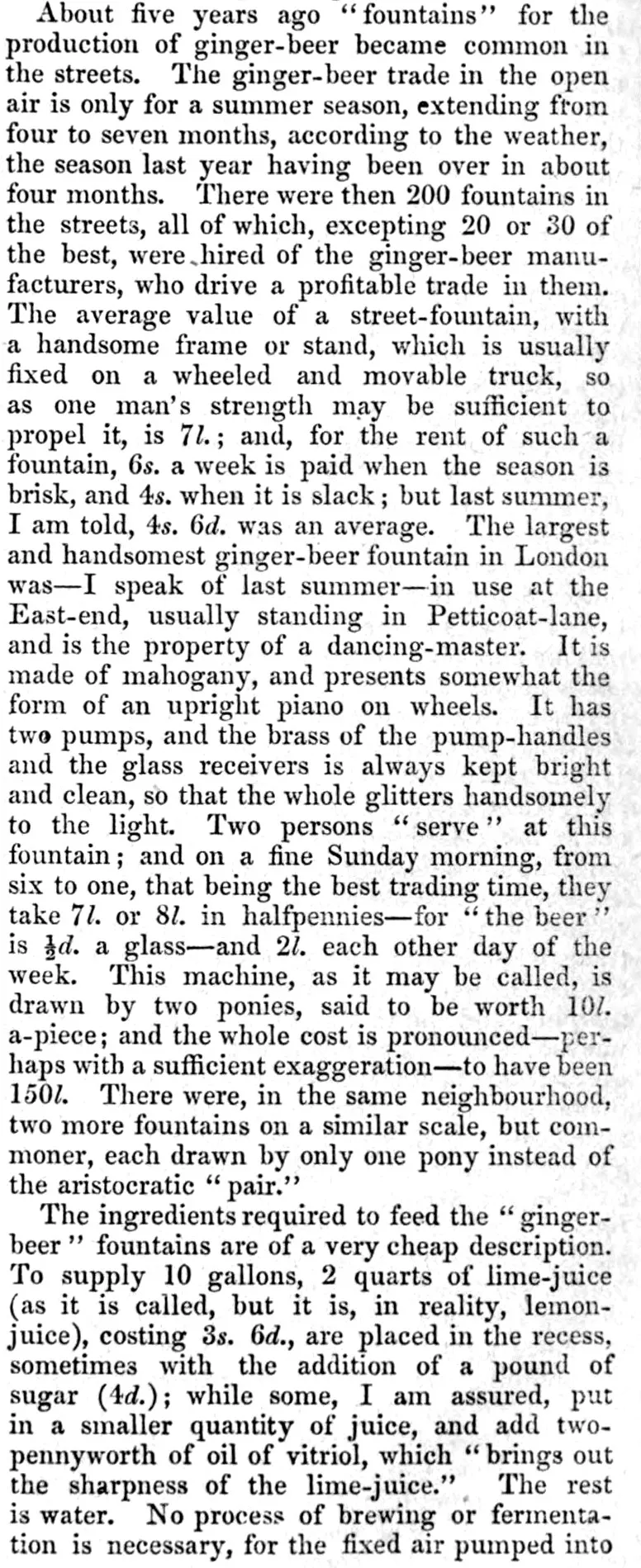 The street ginger-beer fountains, p. 186 in Henry Mayhew, London Labour and the London Poor, vol. 1 (London, 1861).
The juice for ten gallons cost three and sixpence, or about £21 now. Fixed air was carbon dioxide, and oil of vitriol was sulfuric acid; the vitriol comes from Mayhew’s informants (“I am assured”). With no ginger and no yeast, it was the one ginger beer on the street with no alcohol in it. In 1877 Smith found makers using “a little oil of vitriol” too, so that a temperance man loyal to ginger beer through the dog-days might, he wrote, “run as much risk of poisoning himself as the frequenters of public-houses.”
Our alcohol-free ginger beer, the fountain way keeps the fountain’s lemon, sugar, water and gas, puts the ginger back and leaves out the vitriol. Bottled ginger beer also went into the Victorian shandy gaff, half ale and half ginger beer, and the Alcohol-Free Shandy Gaff makes it with a 0.0% ale. For more alcohol-free fizz there is the soda fountain’s Lemon Egg Phosphate or a Ginger Ale Punch. The American soda fountain worked the same way, gas and syrup with no brewing, and in winter it swapped the gas for hot water, as What Did Soda Fountains Sell in Winter? explains.
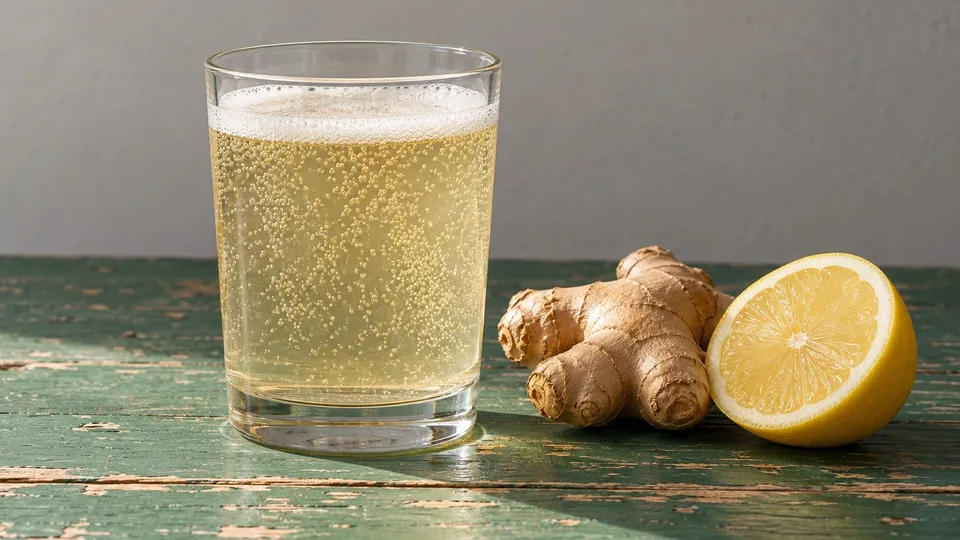 Alcohol-free versionAlcohol-Free Ginger Beer, the Fountain Way
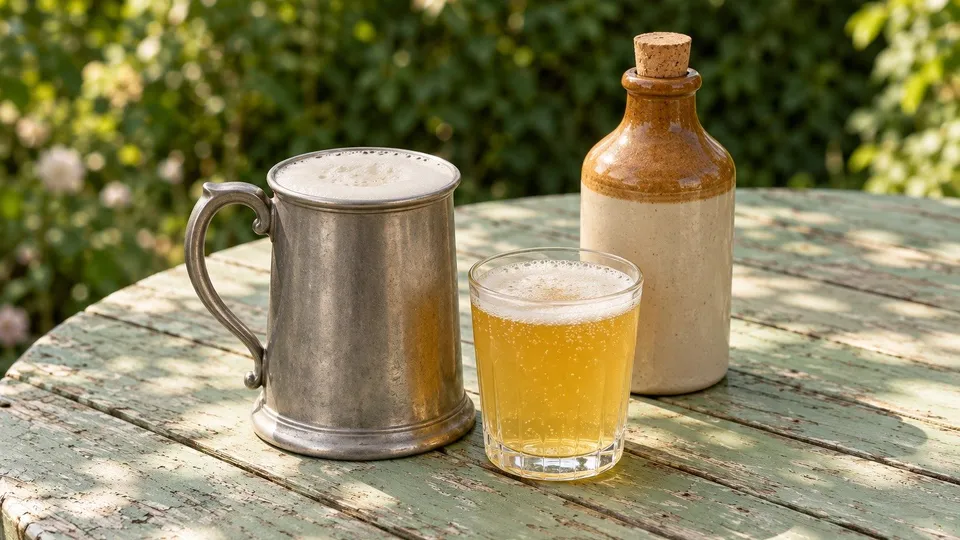 Alcohol-free versionAlcohol-Free Shandy Gaff, Ginger Beer and Alcohol-Free Ale
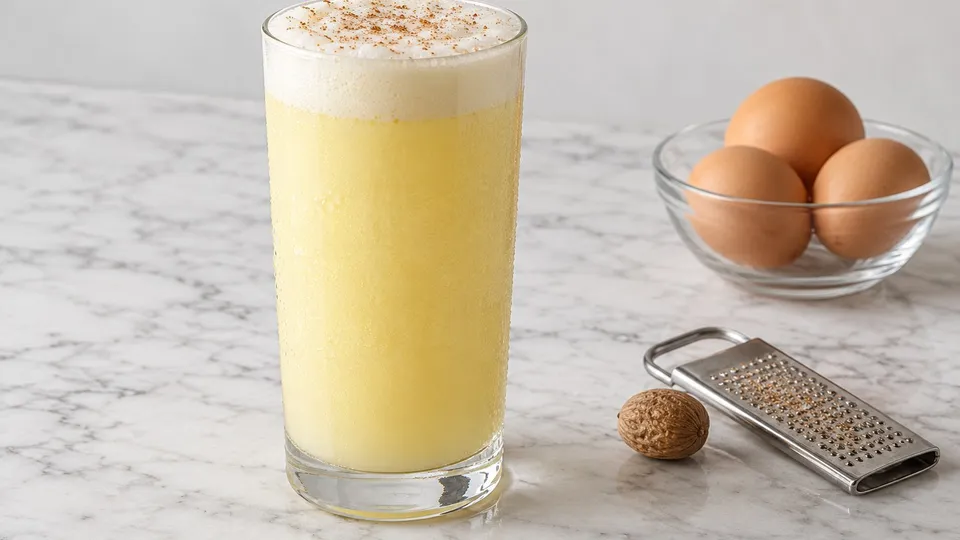 Always alcohol-freeLemon Egg Phosphate, the Soda Fountain Sour
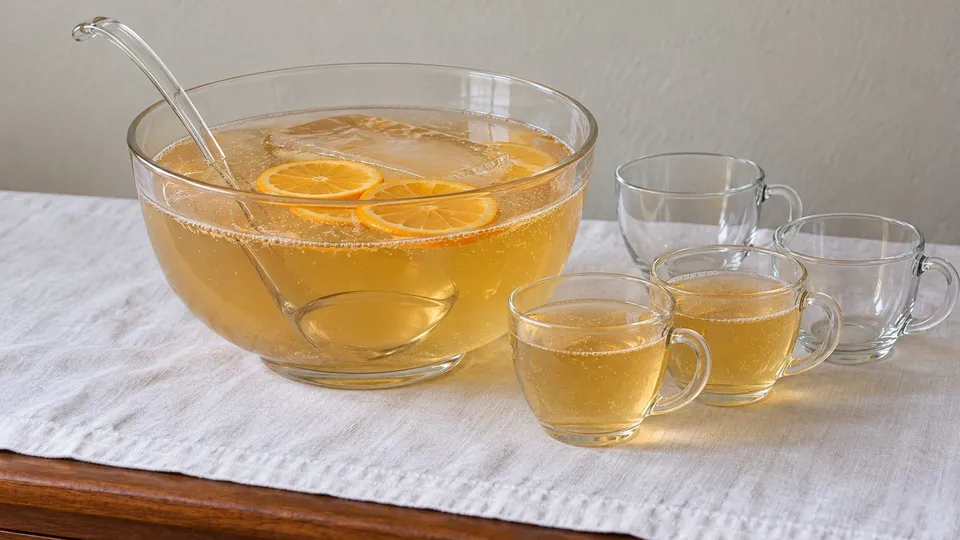 Always alcohol-freeGinger Ale Punch for a Dry Party
Lemon beer, the brewed kind
Hopkins’s Lemon Beer is the simplest brewed one in his chapter:
Boiling water, 1 gal.; lemon, sliced, 1; bruised ginger, 1 oz.; yeast, 1 teacupful; sugar, 1 lb. Let it stand 12 to 20 hours and it is ready to be bottled.
A quarter batch makes about a quart. Pour 950 ml (4 cups) of boiling water over a quarter of a sliced lemon, 7 grams of bruised fresh ginger and 115 grams (½ cup plus 1 tablespoon) of sugar, and stir to dissolve. Cool to lukewarm, then add ⅛ teaspoon of dried yeast, a modern stand-in for Hopkins’s teacupful of liquid yeast. Leave it 12 to 20 hours, strain into plastic soda bottles and leave them 12 to 24 hours more, until firm. Refrigerate and drink within three or four days. The full recipe, with its source and our notes, is Lemon Beer, the Overnight Ginger and Lemon Brew.
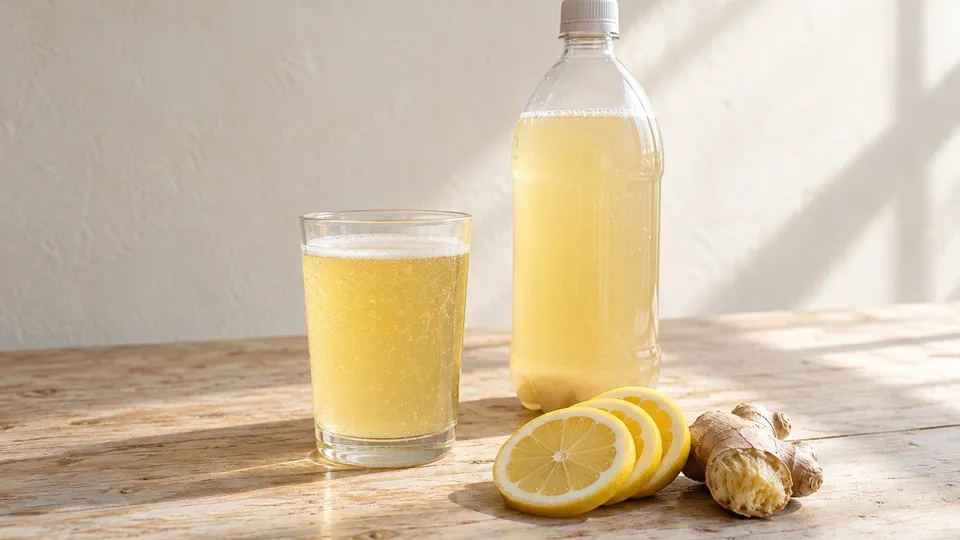 Make it todayLemon Beer, the Overnight Ginger and Lemon Brew
This lemon beer contains a little alcohol, so it is no drink for Dry January. Nobody has measured it, but the batch holds about 120 grams of sugar a liter, and fermenting about 8 grams of it, a fifteenth, is enough to pass half a percent. Use plastic bottles, never glass: a bottled ferment keeps making gas, and glass can burst. If a bottle turns rock-hard, open it slowly over the sink.
Where half a percent came from
The half-percent line came out of American tax law. The Supreme Court’s 1920 ruling in Jacob Ruppert v. Caffey recalls that “since 1902 (Treasury Decision 514) fermented liquor containing as much as one-half of 1 per centum of alcohol” had been treated as taxable. In February 1919 the Commissioner of Internal Revenue ruled such drinks intoxicating, and the Volstead Act of the same year defined beer, wine and other intoxicating malt or vinous liquors as “any such beverages which contain one-half of 1 per centum or more of alcohol by volume.” The Court upheld it.
The number took its legal shape in the very year Hopkins sent his “Non-Alcoholic Beers” to press. The beers in his chapter, worked for days and corked tight, very likely sat above it, closer to Mayhew’s weak penny bottles than to a soft drink. The drink in this story that sat safely below the line was the fountain’s lemon juice, water and gas, the same mix a cheap seller might sharpen with sulfuric acid. A table with drivers or children at it can have the fountain’s fizz without the acid, in our alcohol-free ginger beer, the fountain way: fresh ginger syrup and lemon juice under cold soda water, never fermented, so it stays at zero.
Sources
- Albert A. Hopkins, Home Made Beverages: The Manufacture of Non-Alcoholic and Alcoholic Drinks in the Household (New York: Scientific American Publishing Co., 1919), pp. 55–58 and 71–72.
- Henry Mayhew, London Labour and the London Poor, vol. 1 (London: Griffin, Bohn, 1861; first published 1851), “Of the Street Sale of Ginger-beer, Sherbet, Lemonade, &c.,” pp. 186–189.
- John Thomson and Adolphe Smith, Street Life in London (London: Sampson Low, Marston, Searle & Rivington, 1877), “‘Mush-Fakers’ and Ginger-Beer Makers,” pp. 73–75 and plate. Wellcome Collection copy.
- Jacob Ruppert v. Caffey, 251 U.S. 264 (1920), Legal Information Institute, Cornell Law School.