Defrutum Cooler, Roman Grape Syrup and Water
Reader ratingsGrape juice boiled down to half its volume into the Romans’ defrutum, then stirred into cold water: a dark, sweet, alcohol-free grape drink.
- Recipe makes
- About 500 ml syrup, enough for 10 drinks
- Prep
- Cook
- Total
Includes about 30 minutes for the syrup to cool before bottling.
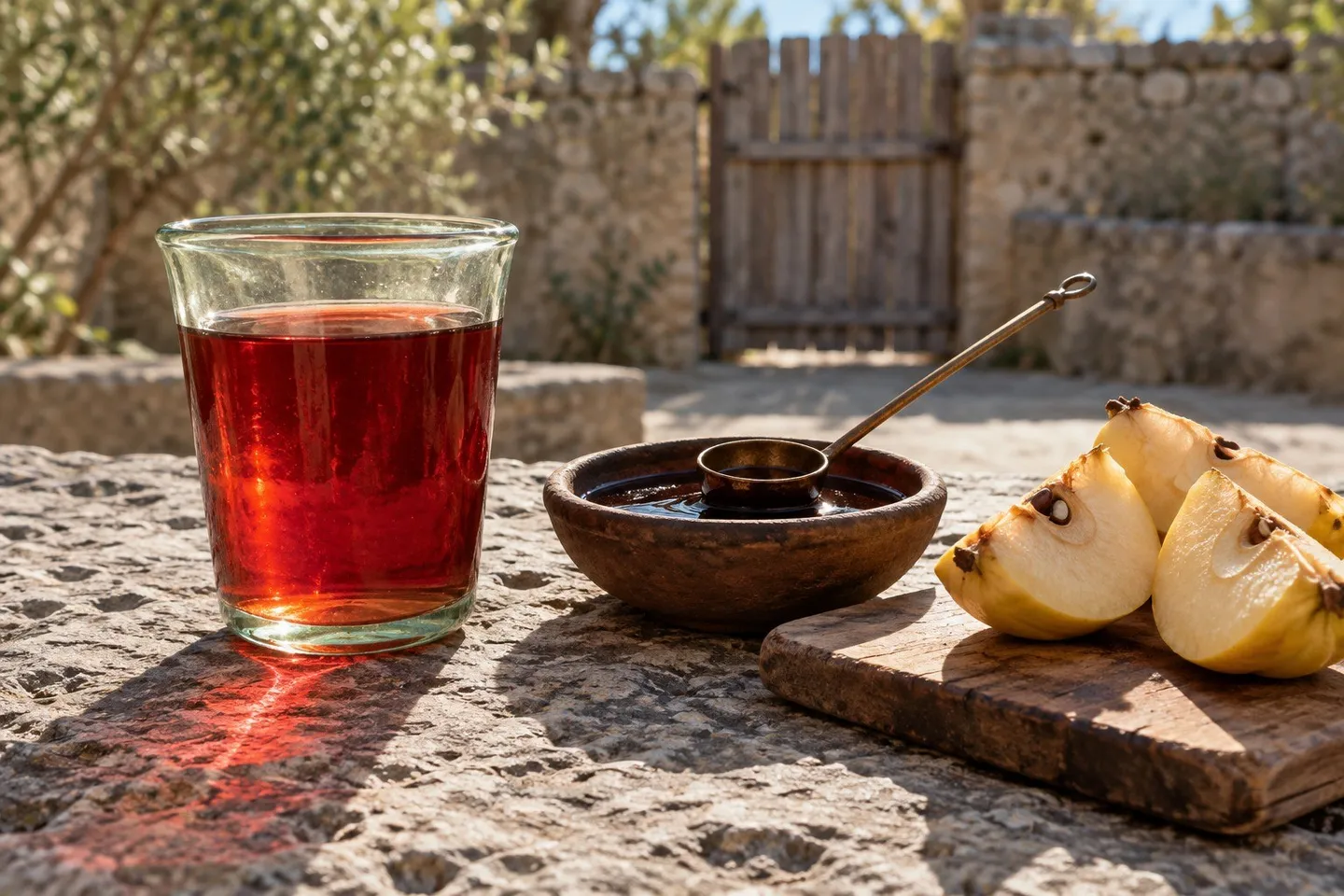
Defrutum syrup diluted with cold water, with the bowl of syrup and a quartered quince.
The story behind the recipe
Pliny the Elder charged two grape syrups with fraud: defrutum and its thicker sister sapa, he says, were “devised for the adulteration of honey.” Defrutum is grape juice boiled down to half its volume, a dark, sweet syrup that Roman farms made at the vintage. Harold Whetstone Johnston says it was a basis for drinks; stirred into cold water, it makes one.
Two measures of boiling
Pliny’s rule is simple: must boiled down to a third is sapa, and must boiled down to half is defrutum. His 1855 translators call it “evidently a kind of grape sirop, or grape jelly,” and add that when cold, the boiled must and honey “would have nearly the same consistency,” which explains the fraud.
Columella, in his farm manual, wanted the best of it. Take the must of “the very ripest grapes” before the stalks are pressed, start the fire “with very small pieces of wood,” skim off the scum with broom strainers and stir with bundles of fennel. Quinces could go in for their scent and come out “when they are throughly boiled.” Most of his defrutum went to preserving wine, but it was also, as Johnston puts it in The Private Life of the Romans (1903), “used as a basis for various beverages.”
Both Romans wanted the pan made of lead. Brass, Columella warns, would “throw out a rust, and corrupt the taste.” By 1855, Pliny’s translators noted, “Vessels of lead are never used for this purpose at the present day.”
Read more about this recipe
A safe pan and a slow simmer
Use a stainless steel or enameled pan; lead is poisonous and can leach into food and drink. For the must, buy pure red grape juice with no sugar or flavoring added. Reduced by half, it turns glossy and thick and tastes of concentrated grape. Columella knew the risk at the end of the boil: must that caught on the pan took on “a bitterness” and was fit for nothing. No Roman gives a ratio for drinking it; we start at one part syrup to four of cold water. Columella’s other way of keeping quinces, packed in honey, gives melomeli.
As to siraeum, by some known as “hepsema,” and which in our language is called “sapa,” it is a product of art and not of Nature, being prepared from must boiled down to one-third: when must is boiled down to one-half only, we give it the name of “defrutum.” All these mixtures have been devised for the adulteration of honey.

Recipe makes: About 500 ml syrup, enough for 10 drinks
Ingredients
For About 500 ml syrup, enough for 10 drinks. Quantities are shown as written.
Quantities as written here, for About 500 ml syrup, enough for 10 drinks.
Syrup
- Red grape juice1 l
- Quince, quartered (optional)1
To serve
- Cold water per drink200 ml
Measurement notes
Ingredients as written here
- 1 l red grape juice
- 1 quince, quartered (optional)
- 200 ml cold water per drink
Equipment
 Wide stainless steel or enameled saucepan
 Wooden spoon
 Heatproof measuring jug
 Clean glass bottle or jar
Instructions
Pour half as much water as you have grape juice into a wide stainless steel or enameled saucepan, stand a wooden spoon upright in it and mark the water level on the handle. Tip the water out.
Pour the red grape juice into the pan and add the quince quarters, if using.
Bring the juice to a simmer over medium-low heat and skim off the foam that rises in the first few minutes.
Keep it at a steady simmer, stirring now and then, for about 40 minutes, until it has reduced to the mark on your spoon. Lower the heat as it thickens so the syrup doesn’t catch on the bottom.
Lift out the quince and let the syrup cool for about 30 minutes. It thickens further as it cools. Pour it into a clean bottle.
For each drink, stir about one part syrup into four parts cold water, then taste and add more syrup or water as you like.
Nutrition
65calories per serving
- Recipe makes
- About 500 ml syrup, enough for 10 drinks
- Servings
- 10
Estimated from the ingredients using USDA FoodData Central values for grape juice, for one drink of 50 ml syrup in water.
Recipe notes
When adjusting quantities
Boil any amount of grape juice down to half its volume; serve about 50 ml of syrup per 200 ml of cold water.
Notes
Quantities mentioned in these notes don’t change when you adjust the batch.
Boiling to half gives Pliny’s defrutum. Go on to a third and you have sapa, which is much thicker and easier to scorch; dilute it more.
A wide pan reduces faster than a deep one, so check the level from about 30 minutes. The quince follows Columella, who lets the maker add quinces “or any other agreeable and suitable odours.” White grape juice works too, for a golden syrup.
Boiled-down must as a sweetener for water is one of the drinks in What Did Romans Drink Besides Wine?.
Storage
Keep the syrup in a clean, closed bottle in the fridge and dilute just before serving.
Scaling changes the ingredients only; glassware, ice and timings need their own judgment. To adapt this recipe further, try the recipe tool at TuneMyRecipe (opens in a new tab), our sister site.
Sources and attribution
Pliny the Elder, The Natural History of Pliny, vol. 3, trans. John Bostock and H. T. Riley (London: Henry G. Bohn, 1855), Book XIV, ch. 11, p. 249; Columella, Of Husbandry (London: A. Millar, 1745), Book XII, chs. XIX–XX, pp. 524–526
Recipe details
- Drink
- Alcohol-free
- Drink family
- Shrubs, Syrups & Cordials
- Era
- Ancient Rome
- Base
- Fruit & juice
- Difficulty
- Easy
- Season
- Summer