Mrs. Beeton’s Lemonade, Made with Boiling Water
Reader ratingsSugar rubbed over lemons until it drinks up their oil, then juice and a quart of boiling water, strained and left to cool: lemonade from Mrs. Beeton’s 1861 book.
- Recipe makes
- About 1.4 liters, 9 small glasses
- Prep
- Cook
- Total
Includes about 1 hour for the lemonade to cool after the boiling water goes in. Chill it longer if you like.
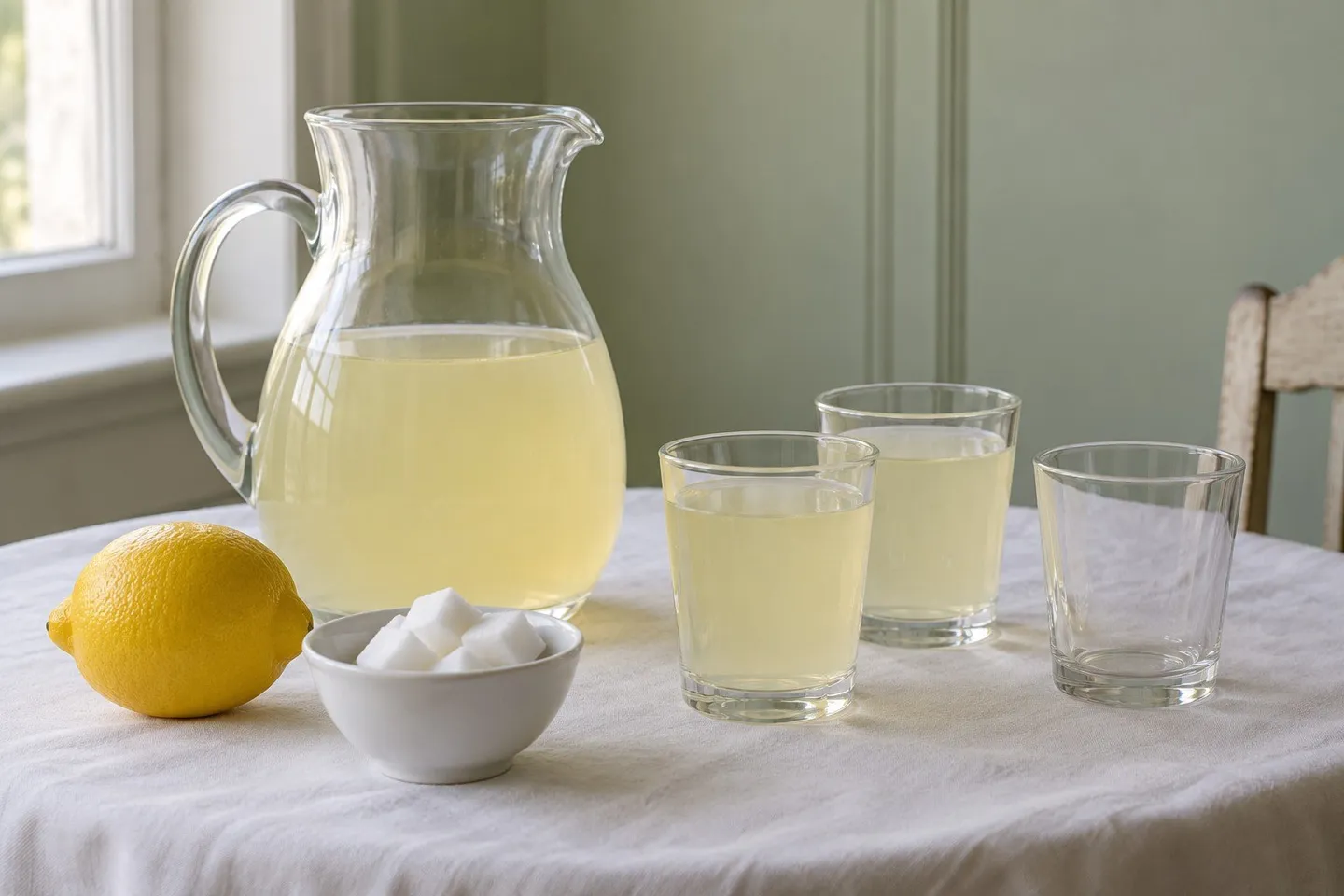
Pale lemonade in a plain glass jug and pressed-glass tumblers, with a lemon and lump sugar, on a white-clothed table in daylight.
The story behind the recipe
Mrs. Beeton made her lemonade hot. Lumps of sugar are rubbed over two lemons until they have soaked up the oil in the peel, then go into a jug with the juice, and a quart of boiling water is poured over the lot. Strained and cooled, it cost, by her reckoning, sixpence a quart, about £2.60 in today’s money by UK consumer prices (Bank of England). In her book it comes just before the negus she called a drink for children’s parties.
A warning in the footnote
The Book of Household Management came out in 1861 with notes of history and advice running under its recipes, and the one beneath the lemonade is a warning. Beeton quotes the French gastronome Brillat-Savarin, writing of “a current opinion among women” that acids, “especially vinegar, are preventives of obesity.” He allows that “Lemonade is, of all acids, the most harmless; but few stomachs can resist it long,” and then tells of a young woman he knew at Dijon in 1776 who had been teased for being plump and drank “a large glass of vinaigre” every day. “She died at eighteen years of age,” he writes, “from the effect of these potions.”
It is a grim note to set under a jug of lemonade, and Beeton prints his story without a word of her own. The recipe above it makes no case for health at all. Its own last word is about pleasure: an egg white beaten in, or a little sherry, would make it nicer still.
Read more about this recipe
Making it today
Beeton’s sugar was loaf sugar, refined white sugar sold as a hard cone and broken into lumps. Sugar cubes do the same job, and grated zest rubbed into granulated sugar comes close. Buy unwaxed lemons, because the peel is the point. The boiling water dissolves the sugar and draws out the oil, and the muslin takes the zest back out, so the lemonade comes out pale and only lightly cloudy.
It is sweet: half a pound of sugar to about 1.4 liters, roughly 157 g a liter. Beeton serves it simply “when cool,” without ice. A London book of 1924 still made its plain lemonade from rind, juice, sugar and boiling water, and built its American lemonade in the glass over shaved ice and soda. This version leaves out her sherry, to keep it alcohol-free, and her egg white, which went in raw.
What else the children drank at their parties in the Christmas season, from tea to weak negus, is the question behind What Did Victorian Children Drink at Christmas?
LEMONADE.
1834. INGREDIENTS.—The rind of 2 lemons, the juice of 3 large or 4 small ones, ½ lb. of loaf sugar, 1 quart of boiling water.
Mode.—Rub some of the sugar, in lumps, on 2 of the lemons until they have imbibed all the oil from them, and put it with the remainder of the sugar into a jug; add the lemon-juice (but no pips), and pour over the whole a quart of boiling water. When the sugar is dissolved, strain the lemonade through a fine sieve or piece of muslin, and, when cool, it will be ready for use. The lemonade will be much improved by having the white of an egg beaten up in it; a little sherry mixed with it, also, makes this beverage much nicer.
Average cost, 6d. per quart.

Recipe makes: About 1.4 liters, 9 small glasses
Ingredients
For About 1.4 liters, 9 small glasses. Quantities are shown as written.
Quantities as written here, for About 1.4 liters, 9 small glasses.
- Unwaxed lemons, for the zest2
- Sugar, as cubes or granulated225 g
- Lemon juice150 ml
- Boiling water1140 ml
Measurement notes
Ingredients as written here
- 2 unwaxed lemons, for the zest
- 225 g sugar, as cubes or granulated
- 150 ml lemon juice
- 1140 ml boiling water
Equipment
 Kettle
 Fine grater (if not using sugar cubes)
 Citrus juicer
 Heatproof jug, at least 1.5 liters
 Fine sieve lined with muslin or a clean cloth
- Serving jug
Instructions
Wash and dry the unwaxed lemons. If you are using sugar cubes, rub a few at a time hard over the lemons until all the yellow peel has been scraped into them and they are damp with oil. Otherwise, finely grate the zest of both lemons and rub it into a few spoonfuls of the sugar with your fingertips until damp and fragrant.
Put the lemony sugar into a heatproof jug with the rest of the sugar.
Squeeze the zested lemons, and more as needed, until you have the lemon juice the list asks for. Pick out the pips and pour the juice into the jug.
Bring the kettle to a full boil and pour the boiling water over the sugar and juice. Stir until all the sugar has dissolved, about 1 minute.
Strain the lemonade through a fine sieve lined with muslin or a clean cloth into a serving jug.
Leave to cool to room temperature, about 1 hour, then serve in small glasses, or chill it first if you prefer it cold.
Nutrition
100calories per serving
- Recipe makes
- About 1.4 liters, 9 small glasses
- Servings
- 9
Estimated from USDA FoodData Central values for granulated sugar and lemon juice, for one of nine 150 ml glasses.
Recipe notes
When adjusting quantities
This is Beeton’s batch as printed, made with one imperial quart of water. Double everything for a larger party.
Notes
Quantities mentioned in these notes don’t change when you adjust the batch.
Beeton’s quantities are the rind of 2 lemons, the juice of 3 large or 4 small ones, ½ lb of loaf sugar and 1 imperial quart of boiling water. In metric that is 225 g of sugar and 1.14 liters of water; 3 large lemons give about 150 ml of juice. The batch makes about 1.4 liters, nine 150 ml glasses.
For a less sweet lemonade, use 150 to 175 g of sugar, and taste before straining.
Beeton’s egg white is left out because it goes in raw. To try it, use pasteurized egg white and whisk it into the cooled lemonade just before serving.
Scaling changes the ingredients only; glassware, ice and timings need their own judgment. To adapt this recipe further, try the recipe tool at TuneMyRecipe (opens in a new tab), our sister site.
Sources and attribution
Isabella Beeton, The Book of Household Management (London: S. O. Beeton, 1861), pp. 889–890, recipe 1834
Recipe details
- Drink
- Alcohol-free
- Drink family
- Sodas & Soft Drinks
- Region
- British
- Era
- 19th century
- Source decade
- 1860s
- Base
- Fruit & juice
- Difficulty
- Easy
- Occasion
- Christmas
- Season
- Winter