American Lemonade, as London Made It
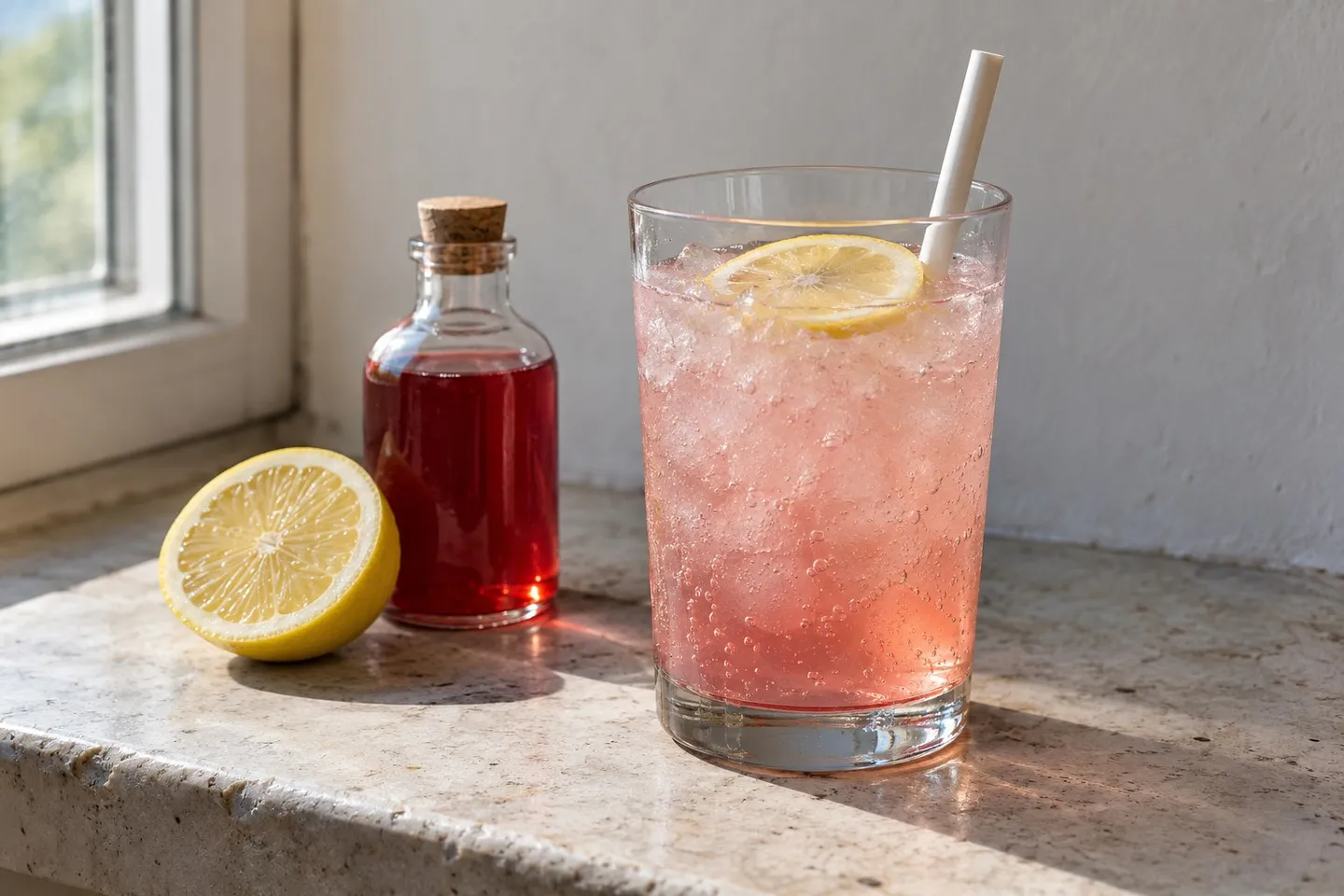
Reader ratingsLemon juice and sugar over shaved ice, homemade strawberry syrup and a fill of soda water, with a straw: a 1924 London book’s idea of American lemonade.
- Recipe makes
- 1 lemonade, plus a bottle of strawberry syrup for more
- Prep
- Cook
- Total
Includes about 1 hour heating the strawberries and 40 minutes for the syrup to cool. Each drink then takes a couple of minutes.
American lemonade over shaved ice with a slice of lemon and a straw, and strawberry syrup.
The story behind the recipe
American lemonade, in a London book of 1924, is lemonade built in the glass like a fountain drink: lemon juice and sugar over shaved ice, a spoonful of strawberry syrup, a fill of soda water, a slice of fruit on top and a straw. The same book’s plain lemonade is a still jug of lemon rind, juice, sugar and boiling water, left to cool; its other lemonades are iced in the jug or made fizzy from syrups and powders.
Why was it called American lemonade?
Home-Made Summer and Winter Drinks is by M. E. Steedman and C. Herman Senn, formerly of the Reform Club, and was published by Ward, Lock. Steedman and Senn’s orangeade is a jug of fresh juice and rind steeped in syrup, with nothing fizzy in it. Its ice cream soda gets the same treatment, with soda water poured from a bottle or siphon held “high above the glass.”
In England the soda fountain was still a novelty, although bottled fizzy drinks sold everywhere. In November 1921 the New York trade paper The Soda Fountain sent Jack Brooks to look. “Britain is a country that is not over-burdened with soda fountains,” he began; you could herd them all into an area the size of Long Island “and then overlook ‘em.” Gordon Selfridge, a former Chicagoan, had put an American soda fountain in his Oxford Street store. Most chemists got no closer than lemon squash, advertised in summer with “a huge stage lemon in the center of the window” and packets of lemonade crystals. The average druggist, Brooks wrote, “does not know a ‘Banana Split’ from a ‘Cleopatra’s Eyebrow.’”
Read more about this recipe
Building the glass today
The strawberry syrup is the book’s own, made by its cranberry syrup method (see the recipe notes), so use ripe, sound strawberries, as the book asks of its cranberries. One large spoonful colors the glass pink, but against a whole lemon and a tablespoon of sugar it stays in the background: this is a lemon drink first.
Shaved or finely crushed ice matters, because it fills half the tumbler and chills the soda as it goes in. More of the period’s soft drinks are collected under without alcohol, but this one is a London idea of America. American home recipes of the time made pink lemonade still and poured it over ice; this is the fountain’s version, shaved ice, syrup, soda and a straw, for a country that had hardly any fountains.
Recipe makes: 1 lemonade, plus a bottle of strawberry syrup for more
Ingredients
For 1 lemonade, plus a bottle of strawberry syrup for more. Quantities are shown as written.
Quantities as written here, for 1 lemonade, plus a bottle of strawberry syrup for more.
Strawberry syrup
- Ripe strawberries450 g
- Sugar, 80 g for every 100 ml of strawberry juice
Per drink
- Lemon1
- Superfine sugar1 metric tbsp (15 ml per tbsp)
- Cold water60 ml
- Shaved or finely crushed ice, to half fill the glass
- Strawberry syrup20 ml
- Soda water, chilled120 ml
- Lemon or orange1 slice
Measurement notes
Ingredients as written here
- 450 g ripe strawberries
- sugar, 80 g for every 100 ml of strawberry juice
- 1 lemon
- 1 tbsp superfine sugar
- 60 ml cold water
- shaved or finely crushed ice, to half fill the glass
- 20 ml strawberry syrup
- 120 ml soda water, chilled
- 1 slice lemon or orange
Equipment
 Heatproof bowl and a saucepan to stand it in
 Jelly bag or sieve lined with muslin
 Small saucepan
 Clean bottle for the syrup
 Large tumbler and a straw
Instructions
For the syrup, hull the strawberries, mash them in a heatproof bowl, cover it and stand it in a saucepan of simmering water. Heat for about 1 hour, topping up the water as needed, until the fruit has given up its juice.
Pour the fruit into a jelly bag or a sieve lined with muslin over a bowl and let the juice drip through without pressing. Measure it.
Put the juice in a small saucepan with the sugar, weighed at the rate the list gives for the juice you measured. Stir over low heat until the sugar has dissolved, then simmer for 5 minutes, skimming off any foam. Leave to cool, about 40 minutes, and bottle.
For each drink, squeeze and strain the juice of the lemon into a large tumbler. Add the superfine sugar and cold water and stir until the sugar has dissolved.
Half fill the glass with shaved ice, then add the strawberry syrup.
Fill the glass with soda water, put the slice of lemon or orange on top and serve with a straw.
Nutrition
105calories per serving
- Recipe makes
- 1 lemonade, plus a bottle of strawberry syrup for more
Estimated from the ingredients using USDA FoodData Central values for lemon juice, sugar and strawberries, for one glass with 20 ml of the syrup.
Recipe notes
When adjusting quantities
The syrup scales with the fruit; use 80 g sugar for every 100 ml of juice. The drink ingredients are for one glass.
Notes
Quantities mentioned in these notes don’t change when you adjust the batch.
The book’s cranberry syrup, which its strawberry syrup follows, takes 12 lb of fruit cooked for 2 hours in a jar in boiling water, then 1 pound of sugar to every pint of juice, boiled for 15 minutes. The pint is the Imperial pint of about 568 ml, so the ratio is about 80 g sugar to 100 ml juice. A pound of strawberries heats through faster than twelve, so this batch cooks for 1 hour and simmers for 5 minutes.
The “wineglassful” of water is taken as 60 ml, a common period value; definitions vary. The “large tablespoonful” of syrup is taken as 20 ml, and the tablespoon of superfine sugar as a level 15 ml spoon.
This lemonade closes Five Alcohol-Free Drinks for a 1920s Party, where Britain’s bottled drinks and scarce fountains get more room.
Storage
Keep the strawberry syrup in a clean, closed bottle in the fridge.
Scaling changes the ingredients only; glassware, ice and timings need their own judgment. To adapt this recipe further, try the recipe tool at TuneMyRecipe (opens in a new tab), our sister site.
Sources and attribution
M. E. Steedman and C. Herman Senn, Home-Made Summer and Winter Drinks, new edition (London: Ward, Lock & Co., 1924), pp. 13, 59–60 and 84
Recipe details
- Drink
- Alcohol-free
- Drink family
- Sodas & Soft Drinks
- Region
- British
- Era
- Jazz Age
- Source decade
- 1920s
- Base
- Fruit & juice
- Difficulty
- Easy
- Season
- Summer