What Did the Pilgrims Drink?
Beer from England and a bottle of strong water on the Mayflower, then New England spring water ashore. No record says what was drunk at the 1621 harvest feast.
Beer was the Pilgrims’ everyday drink, and they sailed with it, along with a supply of “strong water,” or spirits. Ashore at Plymouth the beer ran short within weeks, the ship’s crew kept what was left, and the settlers drank water, which the men who wrote about it praised again and again. As for the harvest celebration of 1621 now called the first Thanksgiving, the one eyewitness account names fowl and deer and not a single drink. Water is the likeliest answer; nobody wrote it down.
This story is part of our What Did People Drink in the 1600s? 17th-Century Drinks and Recipes guide.
The line most often quoted about their drinking is real, though it usually comes with the wrong author and a bigger claim than it makes.
Beer and strong water
The first printed account of the colony, A Relation or Iournall of the beginning and proceedings of the English Plantation setled at Plimoth, appeared in London in 1622. It is known as Mourt’s Relation, after the “G. Mourt” who signed its preface, and its journal was written by William Bradford and Edward Winslow, two of the settlers. Its first drink appears on November 16, 1620, on the first exploring march at Cape Cod. The men walked all morning without finding fresh water, “for we brought neither Beere nor Water with vs, and our victuals was onely Bisket and Holland cheese, and a little Bottle of aquavite, so as we were sore a thirst.”
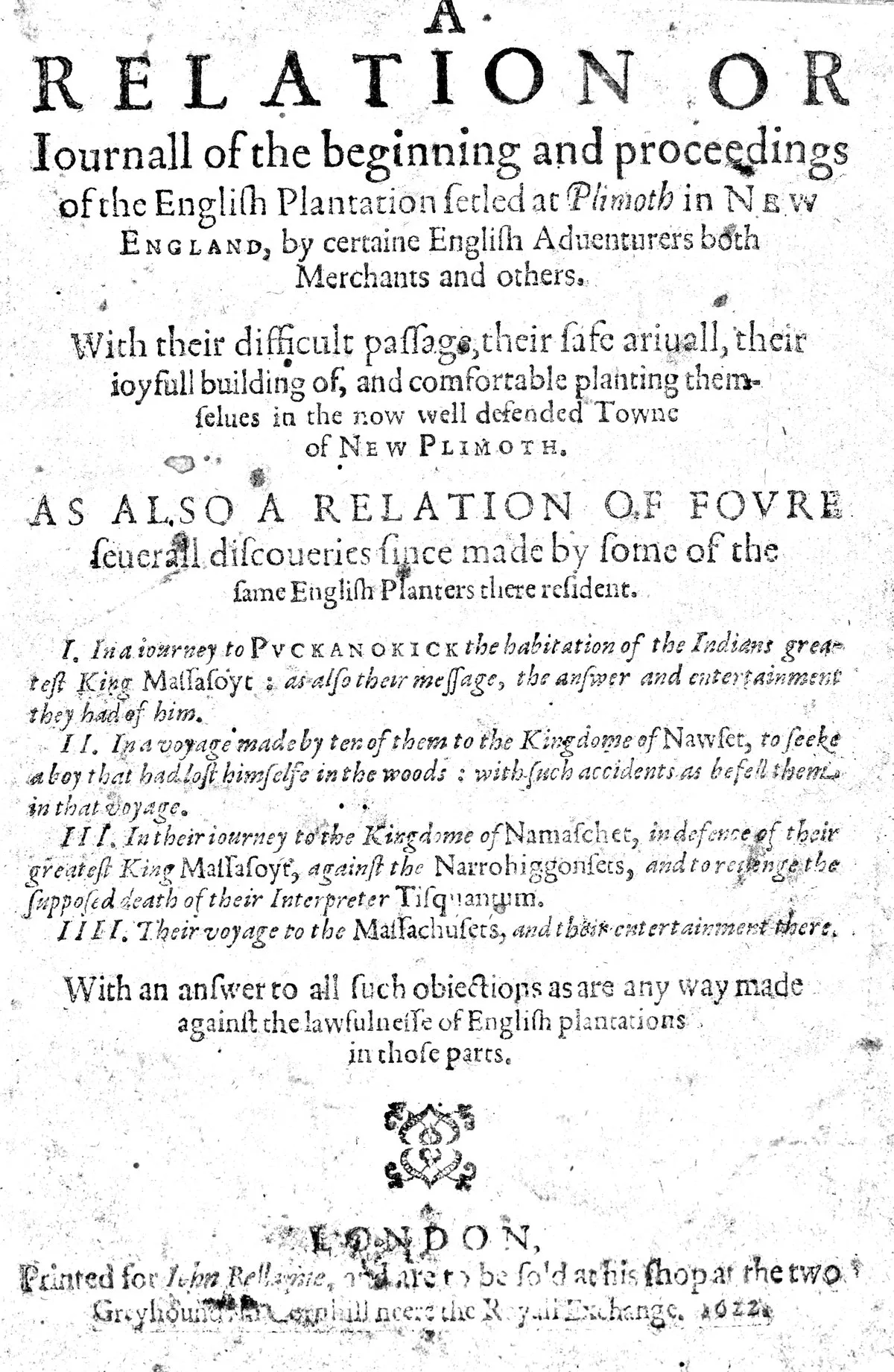 Title page of Mourt’s Relation (London: John Bellamie, 1622). Boston Public Library copy.
Then they found springs in a valley, “and sat vs downe and drunke our first New-England water with as much delight as euer we drunke drinke in all our liues.” Bradford told the same moment years later in his own history, Of Plimoth Plantation, written between about 1630 and 1650 and first printed in 1856. The water, he wrote, “was now in thir great thirste as pleasante unto them as wine or bear had been in for-times.”
Aqua vitae, by 1620, generally meant a distilled spirit, and Mourt’s Relation calls it “strong water” elsewhere. It went to guests. When Samoset, who had met the English before, came into the settlement in March 1621, “he asked some beere, but we gaue him strong water, and bisket, and butter, and cheese, & pudding, and a peece of a mallerd.” At the treaty with the Wampanoag leader Massasoit on March 22, 1621, the governor “called for some strong water, and drunke to him, and he drunke a great draught that made him sweate all the while after.”
Especially, our beer
The famous sentence is on page 23 of Mourt’s Relation, on the morning the settlers chose their site. Websites often credit it to “Bradford’s diary”; the words are in that 1622 journal. The settlers “could not now take time for further search or consideration, our victuals being much spent, especially, our Beere, and it being now the 19. of December.” The date is a slip: the journal has just called the day before “Tuesday the 19.”, and the book’s 1865 editor, Henry Martyn Dexter, dates this morning to Wednesday, December 20, 1620.
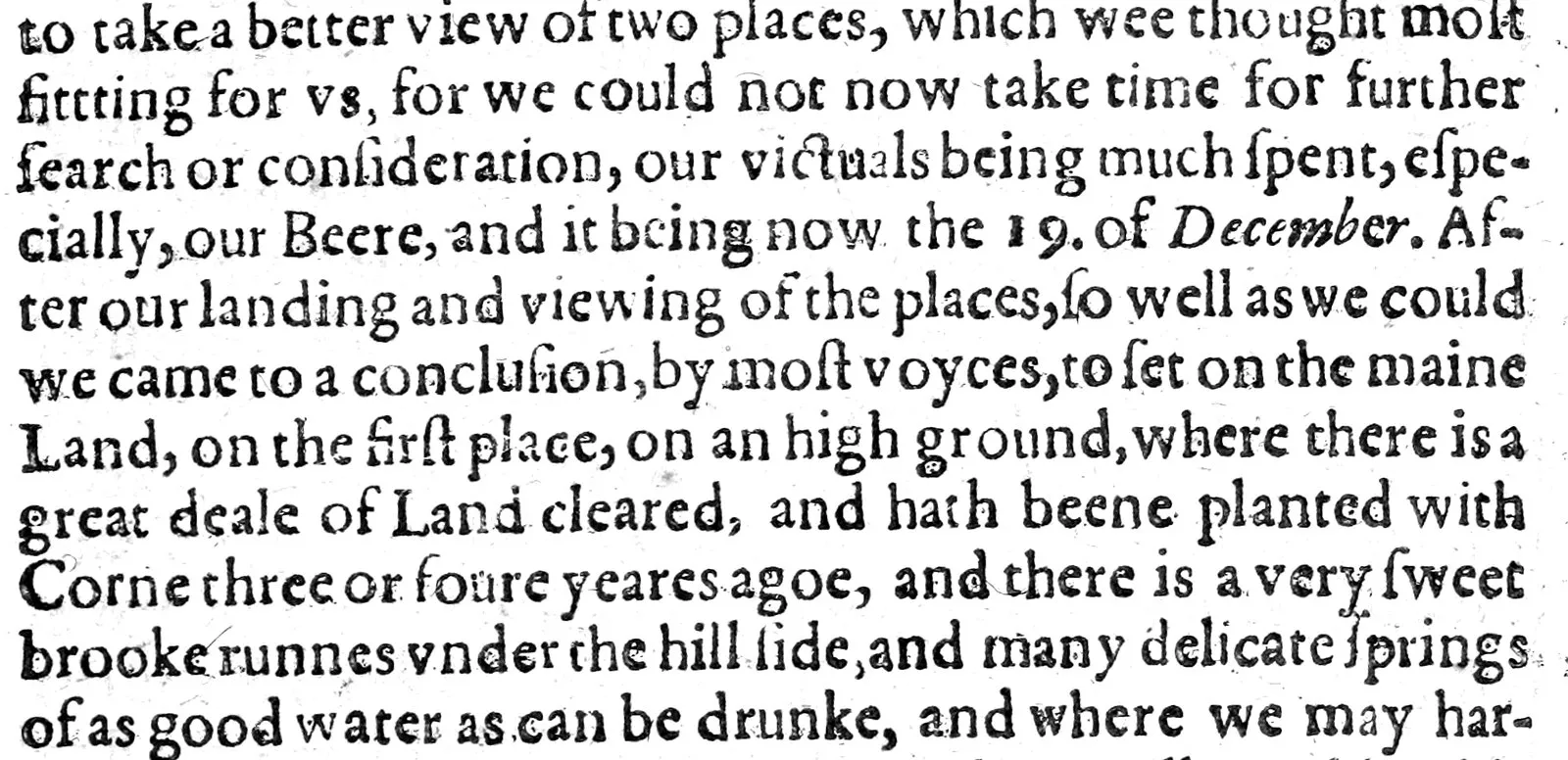 “Our victuals being much spent, especially, our Beere”: the day the settlers chose Plymouth, in Mourt’s Relation (1622), p. 23.
Read on, and the same sentence chooses the place partly for its water: “a very sweet brooke runnes vnder the hill side, and many delicate springs of as good water as can be drunke.” Two days earlier the explorers had called the water there “the best water that ever we drunke.”
So low beer was one reason to stop looking, alongside the food, the winter and a sick company. Two weeks before, at Cape Cod, the argument for settling quickly had been the same mix: “we had yet some Beere, Butter, Flesh, and other such victuals left, which would quickly be all gone.” The beer was “much spent,” not gone. In 1620 “beer” meant the hopped drink, not ale; how hops came into English brewing is told in When Did English Beer Get Its Hops?. On Christmas Day, “we began to drinke water aboord, but at night the Master caused vs to haue some Beere.” The popular version, that the Pilgrims landed at Plymouth Rock because they ran out of beer, takes one clause and adds a rock that no source of the 1620s mentions.
The sailors kept the beer
What happened next is in Bradford’s history. That first winter, as sickness spread among the settlers, the passengers “were hasted a shore and made to drinke water, that ye sea-men might have ye more bear.” One of the sick asked for “a small cann of beere,” and the crew answered “that if he were their owne father he should have none.” Bradford adds a note to that sentence: “Which was this author him selfe.” The man refused his can of beer was Bradford.
Then the disease spread to the crew. Almost half of them died, among them the boatswain, the gunner, three quartermasters and the cook. The master, Bradford writes, “was something strucken and sent to ye sick a shore and tould ye Govr he should send for beer for them that had need of it, though he drunke water homward bound.”
Fears about the water
The worry came before anyone had tasted it. When the congregation in Leiden debated emigrating in 1617, one objection, as Bradford records it, was that “the chang of aire, diate, & drinking of water, would infecte their bodies with sore sicknesses, and greevous diseases.” Seven years later, critics in England were still saying “The water is not wholsome.” Bradford’s answer: “If they mean, not so wholsome as ye good beere and wine in London, (which they so dearly love,) we will not dispute with them; but els, for water, it is as good as any in ye world.”
The fear was about habit, diet and the medicine of the day, which counted beer as strengthening food for an English body. The same reasoning ran through English advice for centuries, as Did Medieval People Really Drink Beer Instead of Water? shows. Once in New England, the men who wrote about the springs liked them. In the hungry year of 1623, Bradford says, the best the colony could set before friends was “a lobster, or a peece of fish, without bread or any thing els but a cupp of fair spring water.”
Settlers in neighboring Massachusetts Bay said much the same. Francis Higginson, who reached Salem in 1629, wrote in 1630 that his stomach had once needed drink “both strong and stale,” but “now I can and doe often times drink New-England water verie well.” William Wood, who lived in the Bay colony for about four years, was more careful in New Englands Prospect (1634). The country was “as well watered as any land vnder the Sunne,” he wrote, “yet dare I not preferre it before good Beere, as some have done, but any man will choose it before bad Beere, Wheay, or Buttermilke.”
The harvest feast of 1621
Everything known about the event now called the first Thanksgiving comes from a letter Edward Winslow wrote at Plymouth on December 11, 1621, printed in Mourt’s Relation. The harvest brought “a good increase of Indian-Corne, and our Barly indifferent good.” The governor sent four men fowling “that so we might after a more speciall manner reioyce together,” and they shot enough birds to feed the company for almost a week. Massasoit came “with some ninetie men, whom for three dayes we entertained and feasted, and they went out and killed five Deere.”
That is the whole account. Winslow lists the fowl, the deer, the guests and the firing of guns for recreation, and he says nothing about drink. The likeliest answer is water. Beer is possible only if some of that barley had been malted and brewed in time, which no one recorded. Strong water had gone to Massasoit before, but there is no word of it at the feast. Apple cider, often named in modern menus, is the least likely of all: Plymouth had no bearing orchards in 1621. Cider did become plentiful, but John Josselyn, who visited in the 1630s and 1660s, was the one to report it “very plentiful in the Countrey,” in a book of 1674.
The same letter tells newcomers what to bring. Their “Cask for Beere and Water” should be iron-bound, and they should pack “iuyce of Lemons, and take it fasting, it is of good vse; for hot waters, Anni-seed water is the best, but vse it sparingly.”
Pumpkins, parsnips and wine
One verse turns up in almost every account of Pilgrim drinking:
If barley be wanting to make into malt, We must be contented and think it no fault; For we can make liquor to sweeten our lips, Of pumpkins and parsnips and walnut tree chips.
It is a stanza of a ballad known as “New England’s Annoyances,” and the earliest printing Albert Matthews found is in the Massachusetts Spy of February 3, 1774. The Massachusetts Magazine printed it again in January 1791 as “Our Forefather’s Song,” “composed about the year 1630,” and explained that it had been “taken memoriter, from the lips of an old Lady, at the advanced period of 92.” That makes it a colonial folk song with a traditional date. If that date is right, the song was remembered for a century and a half before anyone printed it. It records the joke New Englanders told about making do, with nothing in it tied to the harvest of 1621.
Wine is the better measure of how much changed. In 1646, Bradford noted beside a 1624 letter that “what is now more plentifull then wine? and that of ye best, coming from Malago, ye Cannaries, and other places.” His complaint had turned around: “ther is now more cause to complaine of ye excess and ye abuse of wine (through mens corruption) even to drunkennes, then of any defecte or wante of ye same.”
The nearest recipe
No recipe for the Mayflower’s beer survives. It was bought before sailing, and in June 1620 Robert Cushman, writing from London, complained about the way beer and other provisions were being bought in several places. The nearest thing is in Gervase Markham’s The English Hus-wife, a household manual printed in 1615 and again in 1623, in the Pilgrims’ own years. Its “ordinary beere” is “that wherewith either Nobleman, Gentleman, Yeoman, or Husbandman shall maintaine his family the whole yeere,” and a weaker second beer came from the same grain.
Ordinary Beer, the Household Brew of 1623 scales Markham’s proportions to a 10-liter home brew of about 4% ABV, with notes on the small beer of about 1 to 2%. For a drink with no alcohol at all, Sweet Wort, the Malt Drink Before the Beer stops before the yeast goes in. The recipe is modern. Plymouth’s documented alcohol-free drink was spring water, and that needs no recipe. The Dutch colony on the Hudson, founded a few years later, drank beer first too, strong and small, taxed by the half barrel, as What Did People Drink in New Netherland? tells.
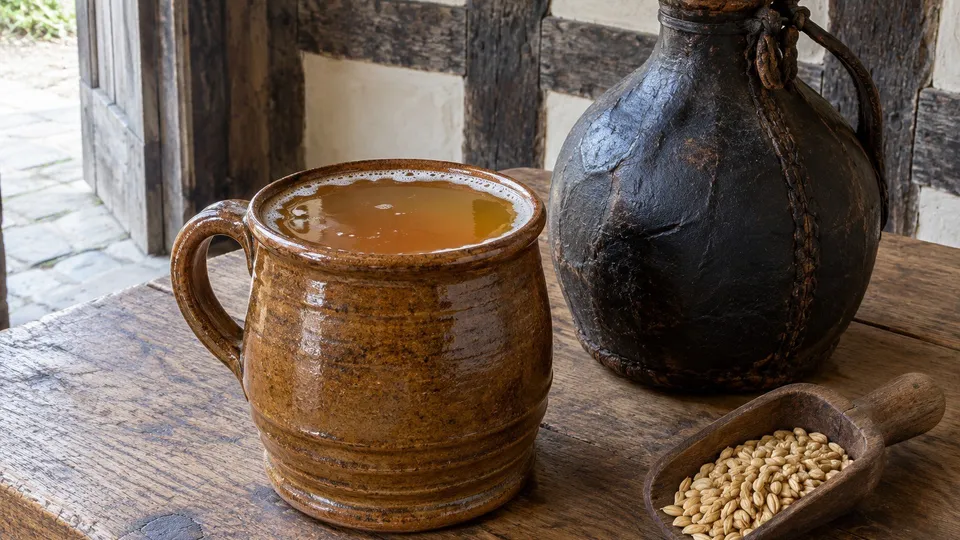 Make it todayOrdinary Beer, the Household Brew of 1623
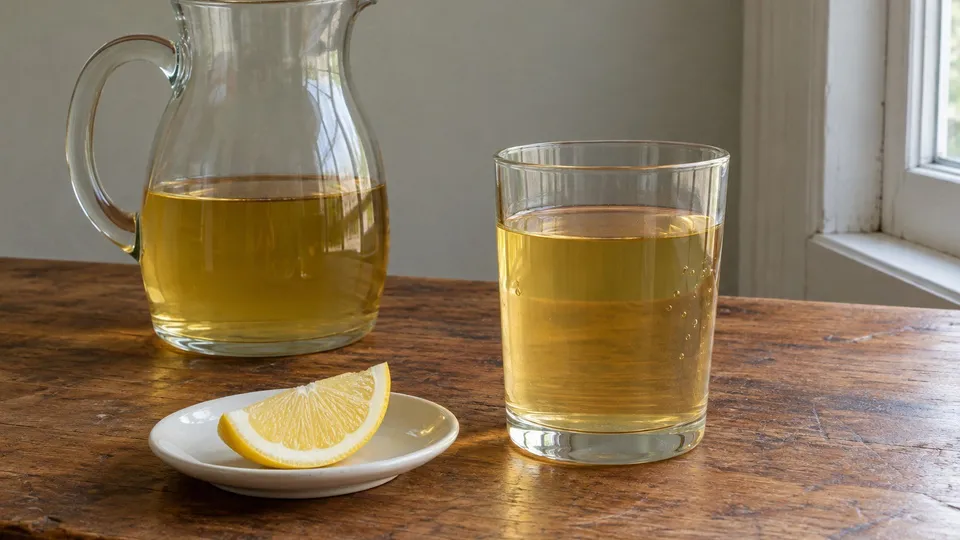 Alcohol-free versionSweet Wort, the Malt Drink Before the Beer
Two English ale drinks from a few generations earlier, Posset Ale and Ale Caudle, show what a household of the period did with its beer once it was brewed. Brewing the ordinary beer takes the most planning, since it is drunk at a fortnight old; a batch started in early November is ready well before Thanksgiving.
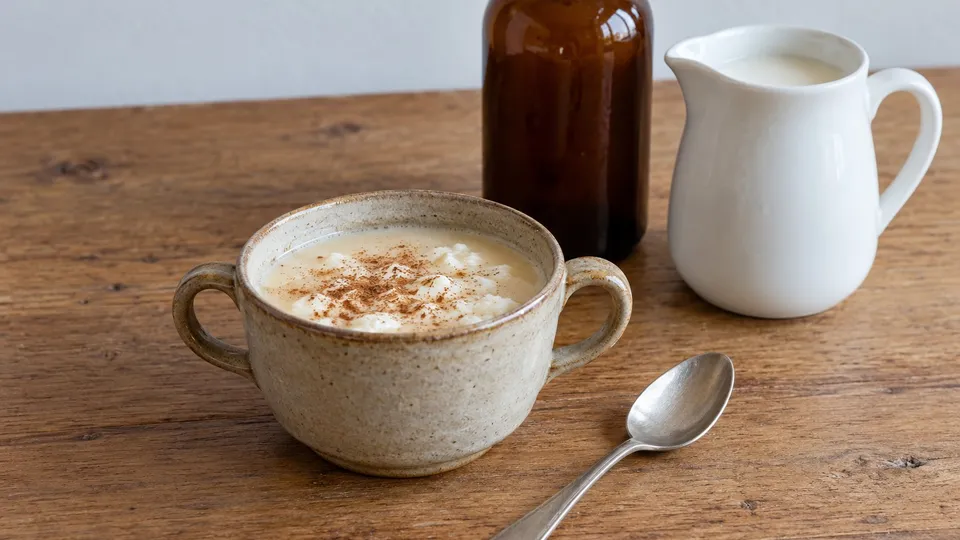 Make it todayPosset Ale, Hot Milk Curdled with Ale
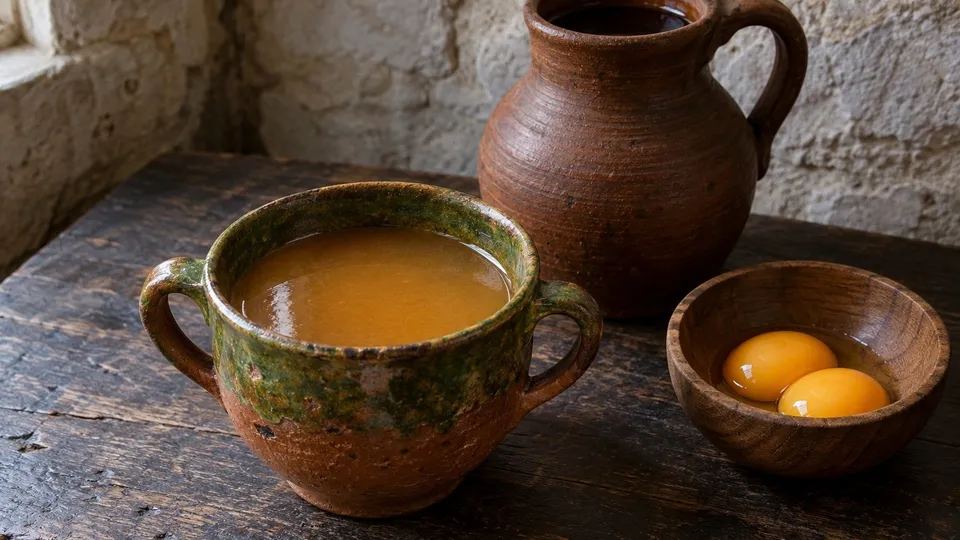 Make it todayAle Caudle, Warm Ale Thickened with Egg Yolks
For what was on the plate, our sister site The Forgotten Menu has the food of the 1621 harvest feast (opens in a new tab).
Sources
- [William Bradford and Edward Winslow], A Relation or Iournall of the beginning and proceedings of the English Plantation setled at Plimoth in New England (“Mourt’s Relation”) (London: John Bellamie, 1622), title page and pp. 5, 23, 61. Boston Public Library copy, archive.org.
- Mourt’s Relation or Journal of the Plantation at Plymouth, ed. Henry Martyn Dexter (Boston: John Kimball Wiggin, 1865), pp. 39, 62–67, 84, 93, 133, 141–142 and note 234.
- William Bradford, History of Plymouth Plantation, ed. Charles Deane (Boston: Massachusetts Historical Society, 1856), pp. 25, 57, 81, 92, 146, 159, 162.
- Francis Higginson, New-Englands Plantation (London, 1630), sig. C1 verso.
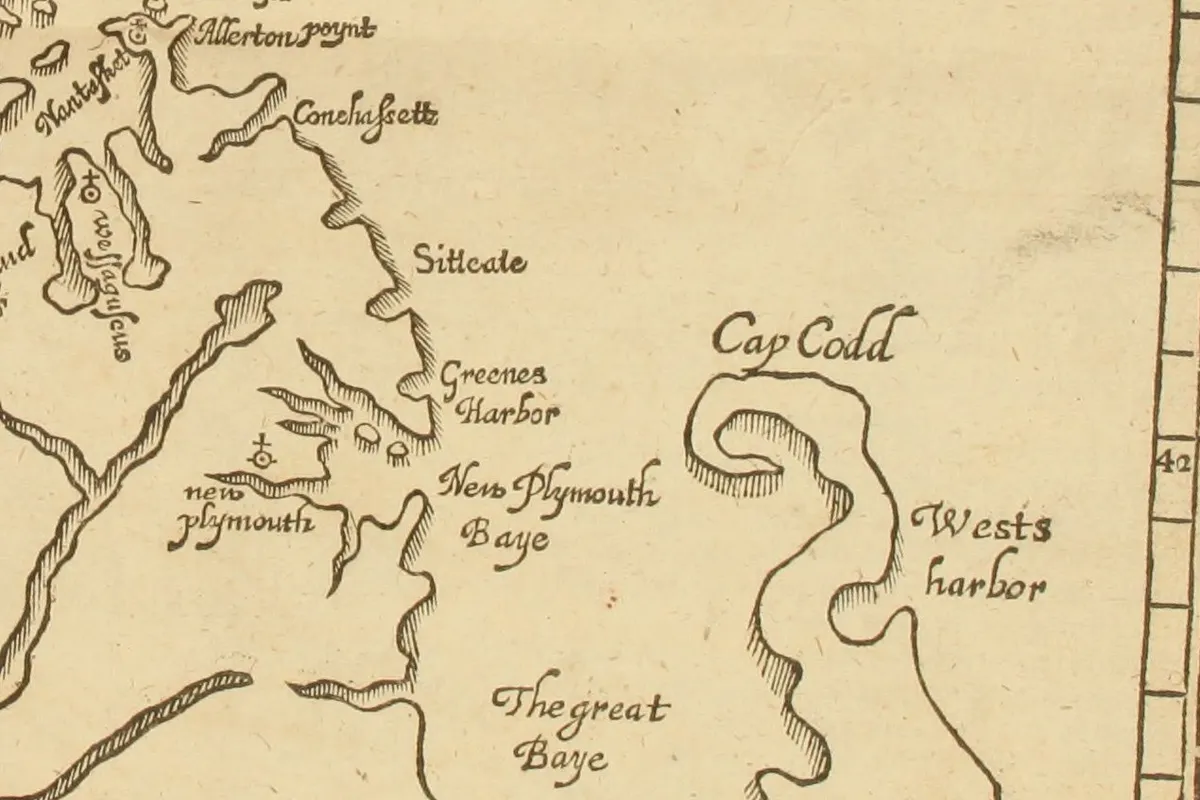
- William Wood, New Englands Prospect (London: Tho. Cotes for Iohn Bellamie, 1634), p. 14 and map.
- John Josselyn, An Account of Two Voyages to New-England (London: Giles Widdows, 1674), p. 189.
- Gervase Markham, The English Hus-wife, in Countrey Contentments (London: J. B. for R. Jackson, 1623), pp. 225–227.
- “Our Forefather’s Song,” The Massachusetts Magazine 3, no. 1 (Boston, January 1791), pp. 52–53.
- Albert Matthews, “Old Ballad called New England’s Annoyances,” Publications of the Colonial Society of Massachusetts 18 (Transactions 1915–1916), on the Massachusetts Spy printing of February 3, 1774.