Sweet Wort, the Malt Drink Before the Beer
Reader ratingsMalt boiled with a few hops, chilled and cut with sparkling water: the sweet, unfermented wort that 17th-century beer started from, made as a modern alcohol-free drink.
- Recipe makes
- About 2.2 liters, 6 glasses
- Prep
- Cook
- Total
Includes about 1 hour to chill the wort before it is mixed and served.
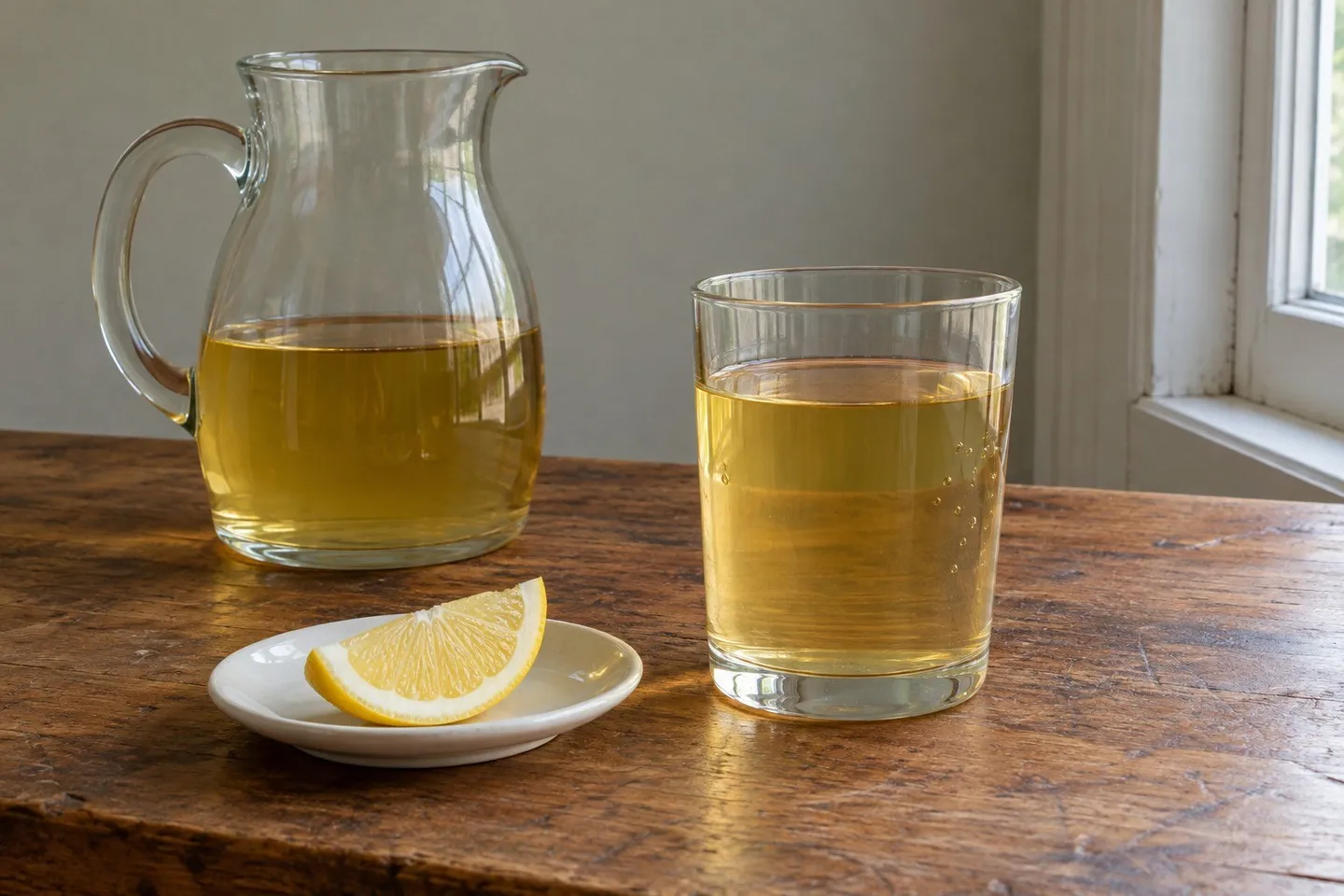
Sweet wort in a plain tumbler, with a glass jug of more and a lemon wedge.
The story behind the recipe
Sweet wort is beer before the yeast: malt steeped in hot water, drained, and boiled with a few hops. Every brewer in the 1620s made it, and no period source we know of serves it as a drink, because the next step turned it into beer. This modern alcohol-free drink is taken from that halfway point, then cooled and cut with sparkling water.
Where Markham stopped
Gervase Markham’s The English Hus-wife (1623) gives the method for the ordinary household beer of the Pilgrims’ England. He wakes his yeast, the barm, in a bowl with “some of the first wort (before the hops come into it),” what a modern brewer calls making a starter.
Everything before that bowl is alcohol-free. Malt is barley that has been sprouted and dried, and in the hot water its starch turns to sugar, which is why wort tastes of malt and is plainly sweet. The hops, used here at Markham’s low rate, add a faint bitterness and keep the sweetness from cloying.
Read more about this recipe
Malt extract in place of the mash
Dried malt extract is wort with the water taken out, sold by home-brewing suppliers, so this version skips the mash and simply dissolves it. Boiled with a pinch of hops, it gives a concentrate about as strong as the wort for Markham’s beer, too sweet to drink neat. Mixing it half and half with sparkling water is our choice, and makes a light, malty, golden drink with a soft fizz. The squeeze of lemon follows Edward Winslow, who told new colonists in 1621 to bring “iuyce of Lemons,” though he meant it as medicine.
Once their beer ran short, the settlers at Plymouth drank water, as What Did the Pilgrims Drink? tells it, and the beer this wort would have become is Ordinary Beer, the Household Brew of 1623. For a malt drink with no hops and no fizz, the 1890s soda fountain stirred malted milk into hot water and seasoned it with salt and pepper: Hot Malted Milk.
Recipe makes: About 2.2 liters, 6 glasses
Ingredients
For About 2.2 liters, 6 glasses. Quantities are shown as written.
Quantities as written here, for About 2.2 liters, 6 glasses.
- Light dried malt extract120 g
- Water1.2 l
- Whole dried hops (about 4 cones), an English variety such as Fuggle or East Kent Golding1 g
- Sparkling water, chilled1.1 l
- Lemon wedges, to serve (optional)
Measurement notes
Ingredients as written here
- 120 g light dried malt extract
- 1.2 liters water
- 1 g whole dried hops (about 4 cones), an English variety such as Fuggle or East Kent Golding
- 1.1 liters sparkling water, chilled
- lemon wedges, to serve (optional)
Equipment
 Saucepan, at least 2 liters, stainless steel or enamel
 Fine strainer
 Large jug or bottle with a lid, for the fridge
Instructions
Put the water in a saucepan and whisk in the light dried malt extract a spoonful at a time, off the heat, until there are no lumps.
Bring to a boil, stirring, and watch it closely for the first few minutes: malt foams up and boils over easily. Turn the heat down to a steady simmer.
Add the whole dried hops and simmer for 15 minutes.
Pour the wort through a fine strainer into a jug, discarding the hops. Cool it quickly by standing the jug in a sink of cold water, then cover it and chill in the fridge for about an hour, until cold.
To serve, half fill each glass with cold wort and top up with the sparkling water. Add a lemon wedge if you like.
Nutrition
75calories per serving
- Recipe makes
- About 2.2 liters, 6 glasses
- Servings
- 6
Estimated from USDA FoodData Central values for barley malt flour as a stand-in for light dried malt extract, for one glass of wort cut half and half with sparkling water, without the lemon.
Recipe notes
When adjusting quantities
Keep 100 g of malt extract to each liter of water, and dilute the chilled wort with an equal volume of sparkling water.
Notes
Quantities mentioned in these notes don’t change when you adjust the batch.
This makes about 1.1 liters of concentrated wort at a gravity of roughly 1.040, close to the wort for the ordinary beer. Mixed with the same volume of sparkling water it comes to about 1.020, half as strong.
To make it from grain instead, the way Markham did, hold 250 g crushed pale ale malt in 1.5 liters of water at 67 °C for an hour, strain and press out about 1.2 liters of wort, and boil it for 30 minutes with the 1 g of hops. If you are brewing the ordinary beer, set aside a liter of the boiled small-beer wort before the yeast goes in, chill it, and drink it as it is.
Wort is low in acid, at about pH 5.2 to 5.5, so keep it in the fridge and drink it within 2 to 3 days. Left warm, wild yeast will start fermenting it, and it will no longer be alcohol-free.
Storage
Keep the wort covered in the fridge and drink it within 2 to 3 days. Never seal it in bottles or jars at room temperature.
Scaling changes the ingredients only; glassware, ice and timings need their own judgment. To adapt this recipe further, try the recipe tool at TuneMyRecipe (opens in a new tab), our sister site.
Sources and attribution
A modern alcohol-free companion to the ordinary beer in Gervase Markham, The English Hus-wife (London, 1623), pp. 226–227
Recipe details
- Drink
- Alcohol-free
- Region
- British
- Era
- 17th century
- Base
- Barley & grain
- Difficulty
- Easy
- Season
- Autumn