Ale Caudle, Warm Ale Thickened with Egg Yolks
Reader ratingsMalty ale stirred over low heat with beaten egg yolks until it thickens like a thin custard: the medieval caudle, made safe with a thermometer.
- Recipe makes
- About 550 ml, 2 cups
- Prep
- Cook
- Total
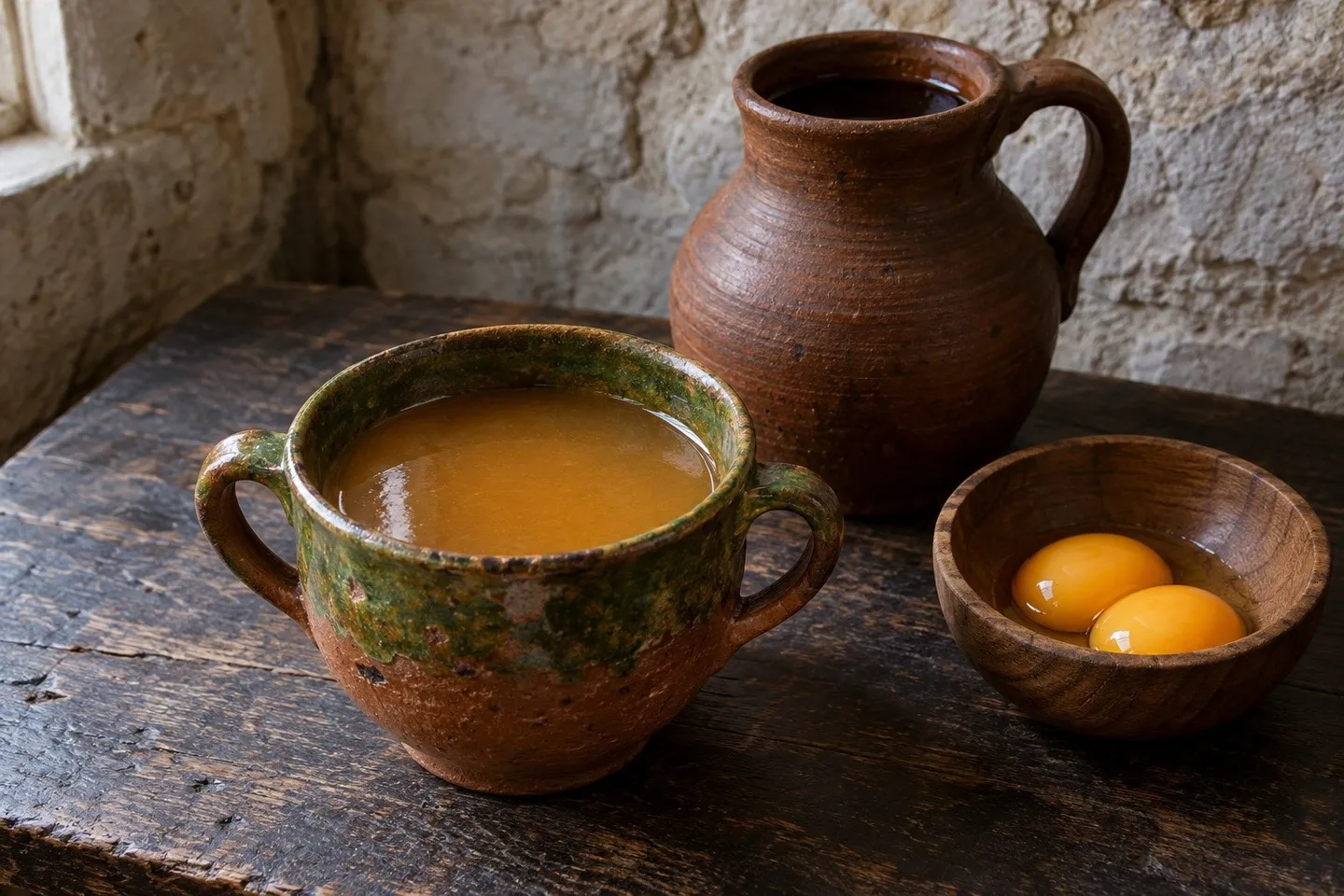
Ale caudle in a two-handled green-glazed earthenware cup, with a clay jug of ale and two egg yolks in a wooden bowl.
The story behind the recipe
“Þou marres alle,” warns a fifteenth-century cook’s verse: put salt in a caudle and you spoil it all. Ale caudle is warm ale thickened with beaten egg yolks, stirred over the fire like a thin custard and drunk from a cup, and the verse gives the whole method in sixteen rhyming lines, with one more rule: never let it boil.
Ten yolks and a large cup
The verse is in Liber Cure Cocorum, a cookery poem in a northern English dialect that its editor, Richard Morris, placed in the fifteenth century, “probably not much earlier than the time of Henry VI.” It breaks ten eggs, keeps the yolks, throws out the “strene,” which we read as the stringy cord in the white, and beats them into “a cup fulle large” of good ale. If the pot boils anyway, the poet has a rescue: crumble fine white bread into cold ale and stir that in.
Other kitchens dressed it up. A Bodleian manuscript printed by Thomas Austin in 1888 thickens its caudle with wheat starch and sweetens it with sugar or honey, colored with saffron.
By 1542 Andrew Boorde’s Dyetary was allowing caudles to the sick: “Ale-brues, caudelles, and colesses, for weke men and feble stomackes, the whiche can not eate solydate meate.”
Read more about this recipe
Hot, never boiling
Egg mixtures are safe once they reach 71°C (160°F), the USDA’s figure, and that is well short of a boil, so a thermometer satisfies the food inspector and the poet at once. Ten yolks to a large cup makes something close to a spoon custard; four yolks to half a liter of ale stays pourable, and that ratio is our choice. The verse asks for ale, and Boorde draws the line between the two drinks: “Ale is made of malte and water,” while “Bere is made of malte, of hoppes, and water.” So choose the maltiest, least bitter ale you can find, such as a brown ale or a mild. Honey and saffron, from the Bodleian version, are optional. It comes out a little under 4% ABV. Another fifteenth-century kitchen kept an alcohol-free almond caudle, with no ale at all: Cheaut. By Shakespeare’s day hot ale also went into lambswool, with the pulp of roasted apples beaten in.
Breke ten egges in cup fulle fayre, Do away þe white with oute diswayre;
Þo strene also þou put away And swyng þy ȝolkes with spone I þe say;
Þen mynge hom wele with gode ale, A cup fulle large take þou schalle,
Set hit on fyre, styr hit, I telle, Bewar þer with þat hit never welle;
Ȝif þou cast salt þer to, iwys Þou marres alle, so have I blis.
At þo fyrst assay þou take hit doun, When hit wolde welle, þys caudel broun,
Ȝif þat hit welle, as may be falle, Þus helpe hit þen I wot þou schalle;
Storve myed wastel with colde ale þen, And cast þer to, sethe hit I ken.

Recipe makes: About 550 ml, 2 cups
Ingredients
For About 550 ml, 2 cups. Quantities are shown as written.
Quantities as written here, for About 550 ml, 2 cups.
- Large egg yolks4
- Malty brown ale or mild500 ml
- Honey (optional)1 metric tbsp (15 ml per tbsp)
- Saffron threads (optional)1 pinch
Measurement notes
Ingredients as written here
- 4 large egg yolks
- 500 ml malty brown ale or mild
- 1 tbsp honey (optional)
- 1 pinch saffron threads (optional)
Equipment
 Small heavy saucepan
 Whisk
 Instant-read thermometer
 Fine sieve
Instructions
Separate the eggs and put the egg yolks in a bowl, picking out any stringy white cords with a teaspoon. Whisk the yolks with a splash of the malty brown ale, a few spoonfuls, until smooth.
Warm the rest of the ale in a small heavy saucepan over low heat, with the saffron threads crumbled in if you are using them, until it steams and reaches about 60°C. Do not let it simmer.
Pour about a third of the warm ale onto the yolks in a thin stream, whisking all the time, then pour the mixture back into the pan.
Stir constantly over low heat until the caudle reaches 71 to 75°C on the thermometer and thinly coats the back of a spoon, about 4 to 6 minutes. Never let it bubble; if it starts to steam hard, lift the pan off the heat and keep stirring.
Take the pan off the heat and stir in the honey, if using. Pour through a fine sieve into warmed cups and drink while hot.
Nutrition
250calories per serving
- Recipe makes
- About 550 ml, 2 cups
- Servings
- 2
Estimated from the ingredients using USDA FoodData Central values for egg yolks, regular beer and honey, including the optional honey; a stronger ale adds a little more.
Recipe notes
Notes
Quantities mentioned in these notes don’t change when you adjust the batch.
The verse, glossed: swyng means beat; mynge hom means mix them; welle means boil up; myed wastel is crumbled bread of fine white flour. We read strene as the cord in the egg white.
If the caudle does start to curdle, take it off the heat and whisk hard, or follow the poet: stir in a spoonful of fine white breadcrumbs soaked in cold ale, then strain. Make caudle just before drinking, and don’t reheat it.
Use the freshest eggs you can, and keep the yolks in the fridge until you start. Pasteurized yolks also work.
Where caudle sat among the ales, waters and milks of the period is the subject of Did Medieval People Really Drink Beer Instead of Water?.
Scaling changes the ingredients only; glassware, ice and timings need their own judgment. To adapt this recipe further, try the recipe tool at TuneMyRecipe (opens in a new tab), our sister site.
Sources and attribution
Liber Cure Cocorum, ed. Richard Morris (London: Philological Society, A. Asher & Co., 1862), “For a cawdel”, pp. 51–52
Recipe details
- Drink family
- Hot Drinks
- Region
- British
- Era
- Medieval
- Base
- Beer & ale
- Difficulty
- Intermediate
- Season
- Winter