Ordinary Beer, the Household Brew of 1623
Reader ratingsPale malt and a light hand of English hops, mashed, boiled an hour and drunk at a fortnight old: Gervase Markham’s everyday beer of 1623, scaled to a 10-liter home brew.
- Recipe makes
- About 10 liters ordinary beer, plus about 3.3 liters small beer
- Prep
- Cook
- Total
Brew day is about 5 hours. The beer then ferments for 5 to 7 days and is ready to drink at about two weeks, as Markham says.
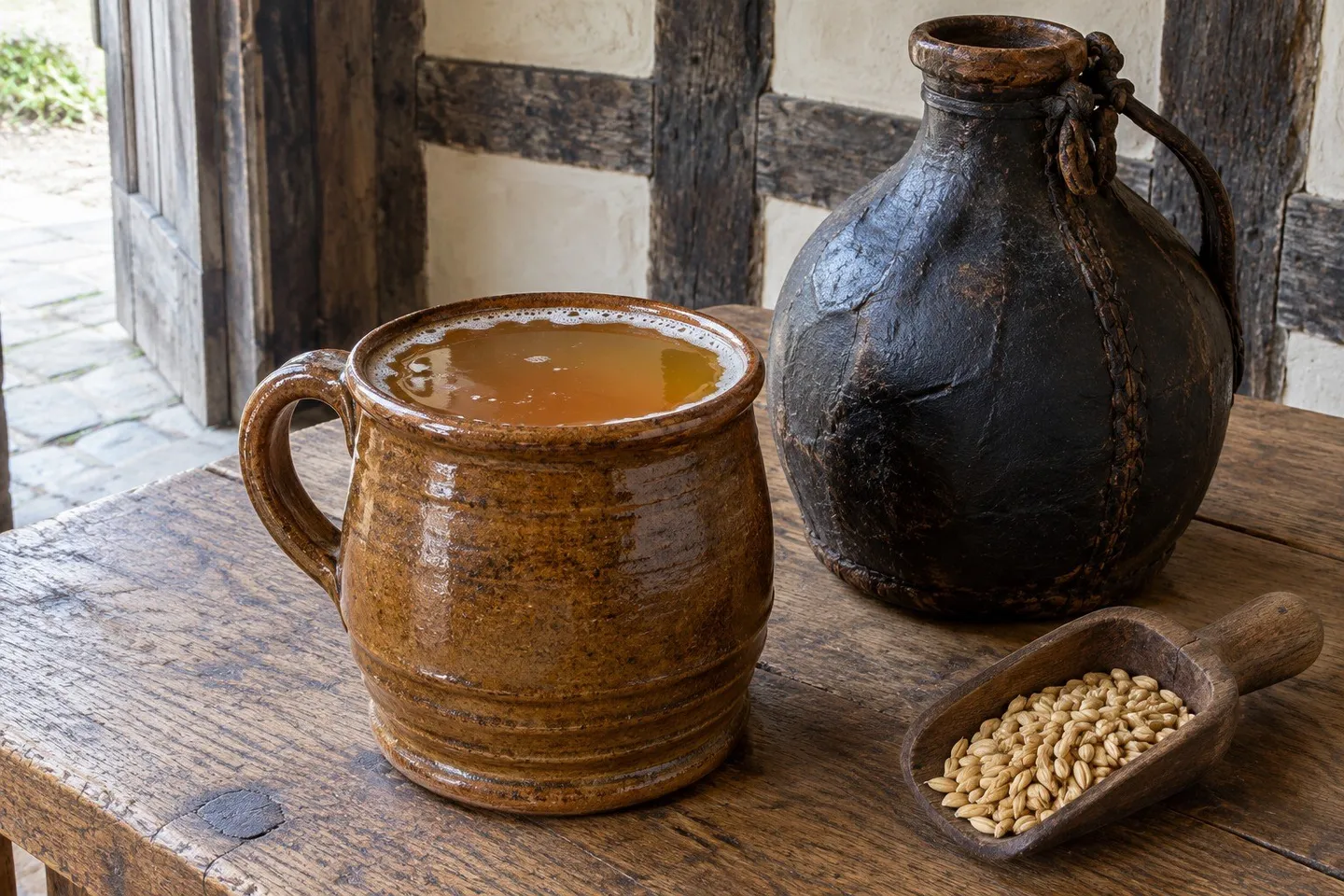
Hazy pale amber beer in a brown stoneware mug, with a black leather bottle and a scoop of malted barley.
The story behind the recipe
Ordinary beer was the drink an English household brewed for itself and drank all year, at table and at work. Gervase Markham needs only two pages of The English Hus-wife (1623) for the whole method. It is a mild, lightly hopped beer of about 4% ABV, ready at a fortnight, with a weaker small beer drawn from the same grain. The Pilgrims sailed with beer bought before they left, and ran short of it within weeks of reaching Plymouth.
A quarter to three hogsheads
Markham’s measure is a quarter of malt, eight bushels or about 152 kilograms, to three hogsheads of beer, about 750 liters. “Hauing age and good caske to lie in,” he says, “it will be strong enough for any good mans drinking.” His hops come at a pound and a half to the quarter, and of the weaker small beer from the same grain he allows no more than one hogshead to three of the better.
His brewhouse vessels have names that read strangely now. The mash stood in the “Mash-fat,” the wort boiled in the “lead,” and it fermented in the “Guil-fat.” The yeast was “barme,” and as it worked a “blacke skumme or mother” rose, which the brewer lifted off by hand. He closed the casks with clay, and promised that no beer would “ripen sooner, for it may bee drunke at a fortnights age.”
Read more about this recipe
Ten liters on the stove
Scaled to 10 liters, Markham’s quarter becomes 2 kg of pale ale malt and his hops 9 g, which makes a beer with very little bitterness by modern standards. The water volumes are ours, since Markham gives none. Boiling water poured straight onto malt, as he says, would stop the malt from turning its starch to sugar, and his big wooden vat cooled it down; a thermometer does that job here. Modern chilling, a sanitized fermenter and an airlock stand in for the overnight open cooler, the clay and the vent-hole. A boiler of stainless steel replaces the lead, for safety.
How the beer ran short at Plymouth, and what the settlers drank once it did, is in What Did the Pilgrims Drink?. For a drink from the same brew with no alcohol, take the wort before the yeast: Sweet Wort, the Malt Drink Before the Beer. An English cook of the period would also curdle hot milk with ale for Posset Ale.
Touching ordinary Beere, which is that wherewith either Nobleman, Gentleman, Yeoman, or Husbandman shall maintaine his family the whole yeere; it is meet first that our English Hus-wife respect the proportion or allowance of malt due to the same, which amongst the best Husbands is thought most conuenient, and it is held, that to draw from one quarter of good malt three Hogsheads of beere, is the best ordinary proportion that can be allowed, and hauing age and good caske to lie in, it will be strong enough for any good mans drinking.
Now for the brewing of ordinary Beere, your malt being well ground and put in your Mash-fat, and your liquor in your leade ready to boile, you shall then by little and little with scoopes or pailes put the boiling liquor to the mault, and then stirre it euen to the bottome exceedingly well together (which is called the mashing of the malt) then the liquor swimming in the top couer all ouer with more malt, and so let it stand an howre and more in the mash-fat, during which space you may if you please heate more liquor in your lead for your second or small drinke; this done, plucke vp your mashing stroame, and let the first liquor runne gently from the malt, either in a cleane trough or other vessels prepared for the purpose, and then stopping the mash-fat againe, put the second liquor to the mault and stirre it well together; then your leade being emptied put your first liquor or wort therein, and then to euery quarter of malt put a pound and a half of the best hops you can get; and boile them an hower together, till taking vp a dishfull thereof you see the hops shrinke into the bottome of the dish; this done put the wort through a straight siue which may draine the hoppes from it into your cooler, which standing ouer the Guil-fat, you shall in the bottom thereof set a great bowle with your barme, and some of the first wort (before the hops come into it) mixt together, that it may rise therein, and then let your wort drop or run gently into the dish with the barme which stands in the Guil-fat, and this you shall do the first day of your brewing, letting your cooler drop all the night following, and some part of the next morning, and as it droppeth if you finde that a blacke skumme or mother riseth vpon the barme, you shall with your hand take it off and cast it away, then nothing being left in the cooler, and the beere well risen, with your hand stirre it about and so let it stand an hower after, and then beating it and the barme exceeding well together, tunne it vp in the Hogsheads being cleane washt and scalded, and so let it purge: and herein you shall obserue not to tun your vessels too full, for feare thereby it purge too much of the barm away: when it hath purged a day and a night, you shall close vp the bung holes with clay, and only for a day or two after keepe a vent-hole in it, and after close it vp as close as may bee.
Now for your second or small drinke which are left vpon the graine, you shall suffer it there to stay but an hower or a little better, and then drain it off also, which done, put it into the lead with the former hops and boile the other also, then cleere it from the hops and couer it verie close till your first beere be tunn’d, and then as before put it also to barme and so tunne it vp also in smaller vessels, and of this second beere you shall not draw aboue one Hogshead to three of the better. Now there be diuers other waies & obseruations for the brewing of ordinarie Beere, but none so good so easie, so readie and quicklie performed as this before shewed: neither will anie beere last longer or ripen sooner, for it may bee drunke at a fortnights age, and will last as long and liuely.

Recipe makes: About 10 liters ordinary beer, plus about 3.3 liters small beer
Ingredients
For About 10 liters ordinary beer, plus about 3.3 liters small beer. Quantities are shown as written.
Quantities as written here, for About 10 liters ordinary beer, plus about 3.3 liters small beer.
Ordinary beer
- Crushed pale ale malt2 kg
- Water, for the first mash14.5 l
- Whole dried hops, an English variety such as Fuggle or East Kent Golding (about 4 to 5% alpha acid)9 g
- Dry English ale yeast1 packageAuthor measures: about 11 g.
Small beer (optional)
- Water, for the second mash5 l
- Dry English ale yeast4 g
Measurement notes
Ingredients as written here
- 2 kg crushed pale ale malt
- 14.5 liters water, for the first mash
- 9 g whole dried hops, an English variety such as Fuggle or East Kent Golding (about 4 to 5% alpha acid)
- 1 packet dry English ale yeast (about 11 g)
- 5 liters water, for the second mash
- 4 g dry English ale yeast
Equipment
 Stainless-steel or enamel stockpot, at least 20 liters, with a lid
- Second pot, about 8 liters
 Large mesh brewing bag
 Thermometer
 Hydrometer
 Fermenter with airlock, about 15 liters
- Small fermenter with airlock, about 5 liters, for the small beer
 No-rinse sanitizer
 Strainer
 Siphon tube
 Swing-top bottles or jugs
Instructions
Clean and sanitize the fermenters, airlocks, strainer and anything else that will touch the beer after it has been boiled and cooled.
Heat the water for the first mash in the large pot to about 70 °C. Turn off the heat, set the mesh bag in the pot and stir in the crushed pale ale malt a little at a time, breaking up any lumps. The mash should settle at 65 to 67 °C; if it sits above 67 °C, stir in a little cold water.
Cover the pot and leave the mash to stand for 60 to 75 minutes, checking once that it has not dropped below 63 °C. Meanwhile, heat the water for the second mash to 75 °C in the second pot.
Lift the bag out of the large pot and let it drain over the pot for a few minutes without squeezing, leaving the first wort behind.
Lower the bag into the hot water in the second pot, stir the grain well, cover and leave it for 60 minutes.
Bring the first wort to a boil, add the whole dried hops and boil steadily, uncovered, for 60 minutes, until about a fifth of it has boiled away. Skim off any foam that rises at the start.
Chill the wort quickly to 18 to 20 °C, with a wort chiller or by standing the covered pot in a sink or tub of cold water. Strain it into the sanitized large fermenter, keeping the hops.
Sprinkle the dry English ale yeast over the cooled wort, or first stir it into a cup of the wort and leave it 15 minutes to wake, as Markham does with his barm. Fit the airlock.
For the small beer, lift the bag from the second pot and let it drain, then bring the second wort to a boil with the used hops and boil for 60 minutes, until it has reduced by about a third. Strain, chill to 18 to 20 °C, pour into the small fermenter and add the dry English ale yeast for the small beer. Fit the airlock.
Leave both to ferment at 18 to 20 °C for 5 to 7 days. Skim off any dark scum from the first frothy days if you like.
Fermentation is finished when two hydrometer readings taken 3 days apart are the same and at about 1.012 or below. If the reading stops above about 1.015, it has stalled: keep it at 18 to 22 °C for another week and measure again, and don’t bottle it until it comes down. Siphon the beer off the yeast into clean, sanitized swing-top jugs or bottles, leaving the sediment behind, and keep them somewhere cool.
Drink from about two weeks after brewing, poured gently from the jug so the haze of yeast stays at the bottom.
Nutrition
200calories per serving
- Recipe makes
- About 10 liters ordinary beer, plus about 3.3 liters small beer
- Servings
- 20
Estimated from the beer’s expected starting and finishing gravities (about 1.043 and 1.011) with the standard brewers’ calorie formula, for a 500 ml serving of the ordinary beer, close to the USDA FoodData Central value for regular beer.
Recipe notes
When adjusting quantities
Markham’s proportion is one quarter of malt to three hogsheads of beer, which works out at 2 kg of malt and 9 g of hops for 10 liters. Keep the water volumes in step with the malt.
Notes
Quantities mentioned in these notes don’t change when you adjust the batch.
Expect the ordinary beer to come out at about 4% ABV, from a starting gravity near 1.043, and the small beer at about 1 to 2%. Both are estimates: Markham’s malt, hops and yeast were not ours. Small beer is not alcohol-free and is not a drink for children. Its 4 g of yeast is about a third of a second 11 g packet.
Without priming sugar, the beer stays still or only lightly sparkling, much as it came from Markham’s cask. If you bottle it with priming sugar for more fizz, wait until fermentation has fully finished, measure the sugar exactly, and condition the bottles below about 25 °C: unfinished beer or too much sugar can burst glass bottles (Craft Beer & Brewing, “Safety First: Don’t Get Bottle Bombed”). Open a swing-top once a day for the first few days to let out any pressure.
Never brew in a lead or lead-glazed vessel. Markham’s “lead” was the brewhouse boiler of his day, and the FDA warns that lead leaches from cookware into food and drink. Use stainless steel or enamel.
In the United States, an adult may brew beer at home for personal or family use, not for sale: up to 100 gallons a year, or 200 gallons for a household of two or more adults (27 CFR § 25.205). State and local law can be stricter, and rules differ in other countries, so check yours.
Scaling changes the ingredients only; glassware, ice and timings need their own judgment. To adapt this recipe further, try the recipe tool at TuneMyRecipe (opens in a new tab), our sister site.
Sources and attribution
Gervase Markham, The English Hus-wife, in Countrey Contentments (London: J. B. for R. Jackson, 1623), Book 2, ch. 7, pp. 225–227
Recipe details
- Drink family
- Wine, Beer & Mead
- Region
- British
- Era
- 17th century
- Difficulty
- Advanced
- Season
- Autumn