Posset Ale, Hot Milk Curdled with Ale
Reader ratingsVery hot milk poured onto cold ale and left to set into soft curds in a warm whey, sweetened with honey and strewn with cinnamon and ginger.
- Recipe makes
- About 500 ml, 2 cups
- Prep
- Cook
- Total
Includes about 5 minutes for the curd to set.
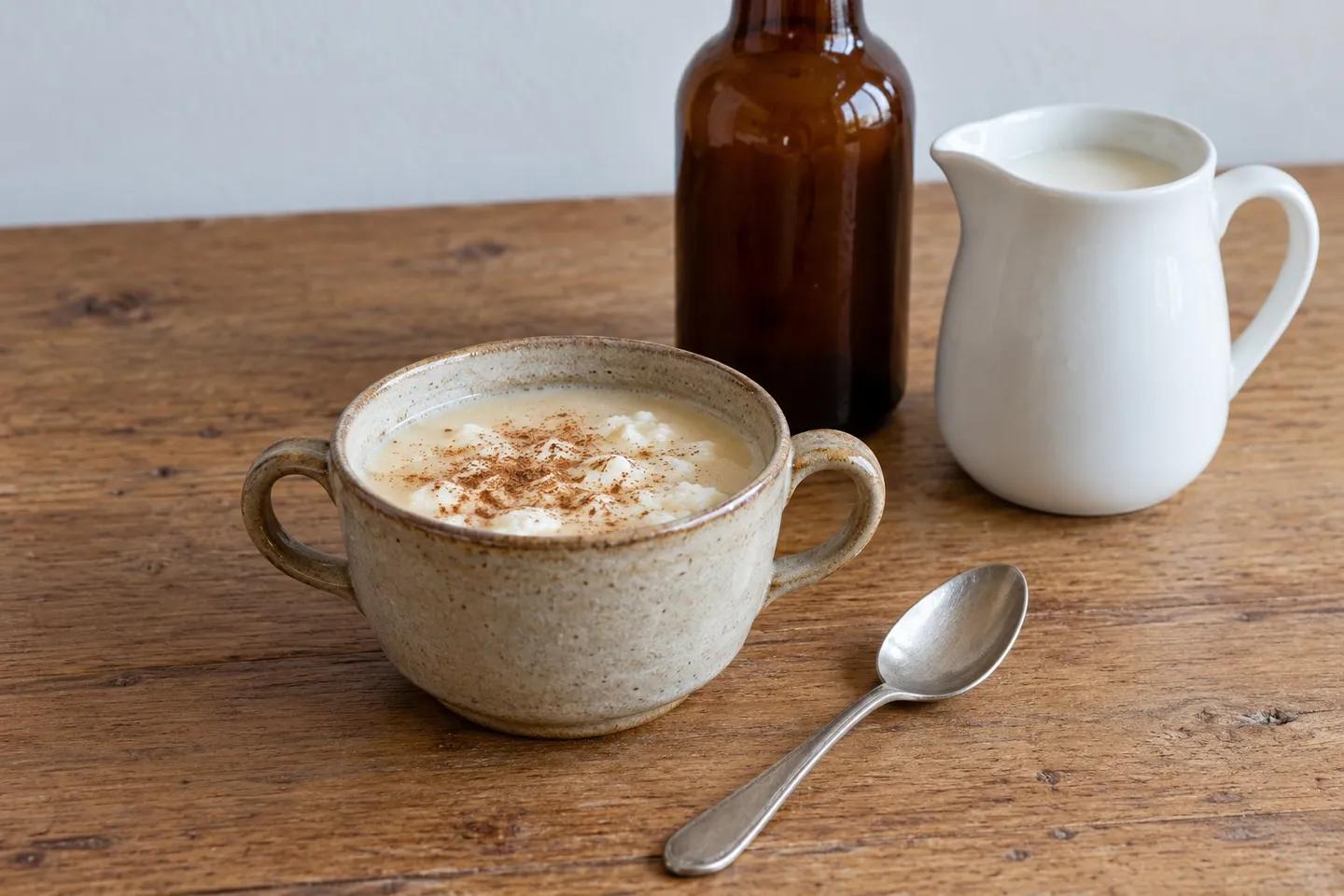
Posset ale in a two-handled cup, dusted with cinnamon and ginger.
The story behind the recipe
Andrew Boorde gave the whole method for posset ale in one line in 1542: very hot milk poured onto cold ale, which sets into soft curds floating in a warm whey. The drink is older than his book: an English cookbook of about 1430 begins a fish-day dish with “a styf Poshote of Milke an Ale,” as if every cook already knew how to make one.
The curd that closes the stomach
John Russell, the mid-fifteenth-century household officer whose Boke of Nurture trains a nobleman’s servants, groups posset with milk, cream, curds and junket. These, he warns, “close a mannes stomak / and so dothe þe possate,” so his master should eat hard cheese afterward.
The 1430 cookbook, Harleian MS. 279, edited by Thomas Austin in 1888, does more with it. Its cook strains the curds of a stiff posset with sweet white wine, sweetens them with sugar or honey, “but nowt to moche,” and strews cinnamon and ginger on top. The same edition prints an alcohol-free hot cup: cheaut, almond milk boiled once with sugar and salt, which Harleian MS. 4016, of about 1450, places directly beneath an almond caudle made with ale.
Boorde’s Dyetary of Helth calls posset ale “a temporate drynke,” good, he says, for a hot liver and for fevers. By 1869 possets had retreated to the bedroom, taken “in cases of catarrh,” and Cups and Their Customs refused to print a single recipe: they “appear to us to be too much associated with tallow applied to the nose.” The book did find room for hot ale beaten with roasted apples, as lambswool.
Read more about this recipe
How was posset made?
The same book quotes Dr. Johnson’s definition, “milk curdled with wine and other acids,” and here the ale is meant to do the curdling. Boorde’s rule matters most: the milk goes in hot and the ale stays cold. The proportions are ours: three parts whole milk to two of a malty, lightly hopped ale. The honey and the strewing of cinnamon and ginger come from the 1430 cook, kept light, as that cook advised. With that much milk, the cup comes in around 2% ABV. Ale Caudle thickens ale with egg yolks instead.
Poset ale is made with hote mylke & colde ale; it is a temporate drynke, and is good for a hote lyuer, and for hote feuers, specyally yf colde herbes be soden in it.

Recipe makes: About 500 ml, 2 cups
Ingredients
For About 500 ml, 2 cups. Quantities are shown as written.
Quantities as written here, for About 500 ml, 2 cups.
- Malty brown ale or mild200 ml
- Honey2 metric tsp (5 ml per tsp)
- Whole milk300 ml
- Ground cinnamon1 pinch
- Ground ginger1 pinch
Measurement notes
Ingredients as written here
- 200 ml malty brown ale or mild
- 2 tsp honey
- 300 ml whole milk
- 1 pinch ground cinnamon
- 1 pinch ground ginger
Equipment
 Small saucepan
 Heatproof jug or bowl
Instructions
Pour the malty brown ale into a heatproof jug or bowl and stir in the honey until it dissolves. Keep the ale cold.
Heat the whole milk in a small saucepan until it froths up and is just about to boil.
Pour the hot milk onto the ale in one go, from a little height. Do not stir.
Cover and leave for about 5 minutes, until soft curds have formed and float in a thin whey. If no curd has formed, pour everything back into the pan and warm it very gently, without boiling, until the curds separate; next time, use a little more ale or make sure the milk is right at the boil when you pour.
Strew the ground cinnamon and ground ginger over the top and serve in small cups, with a spoon for the curds.
Nutrition
160calories per serving
- Recipe makes
- About 500 ml, 2 cups
- Servings
- 2
Estimated from the ingredients using USDA FoodData Central values for whole milk, regular beer and honey, counting the curds, which are eaten with a spoon.
Recipe notes
Notes
Quantities mentioned in these notes don’t change when you adjust the batch.
This is posset the drink, not the modern lemon posset, a set cream dessert. Posset ale was hot milk turned by ale into soft curds in a warm whey, drunk warm, with a spoon for the curds.
Russell’s possate and the cookbook’s poshote are both period spellings of posset. “Nowt to moche” means not too much.
Boorde’s suggestion of boiling “colde herbes” in the posset is a period medical idea, and he doesn’t name the herbs; this recipe leaves them out.
The curd depends on the milk being very hot when it meets the cold ale, so pour it straight from the heat. Drink the posset as soon as it has set; it doesn’t keep.
Boorde’s rule of hot milk onto cold ale comes up again in Did Medieval People Really Drink Beer Instead of Water?, with the other ales of a medieval household.
Scaling changes the ingredients only; glassware, ice and timings need their own judgment. To adapt this recipe further, try the recipe tool at TuneMyRecipe (opens in a new tab), our sister site.
Sources and attribution
Andrew Boorde, A Compendyous Regyment or a Dyetary of Helth (1542), ed. Frederick J. Furnivall (London: Early English Text Society, 1870), ch. X, p. 257
Recipe details
- Drink family
- Hot Drinks
- Region
- British
- Era
- Medieval
- Difficulty
- Easy
- Season
- Winter