What Did People Drink in New Netherland?
Beer first, strong or small, brewed in the colony and taxed by the barrel; wine and brandy by ship; and by 1679 Barbados rum the Dutch called kill-devil.
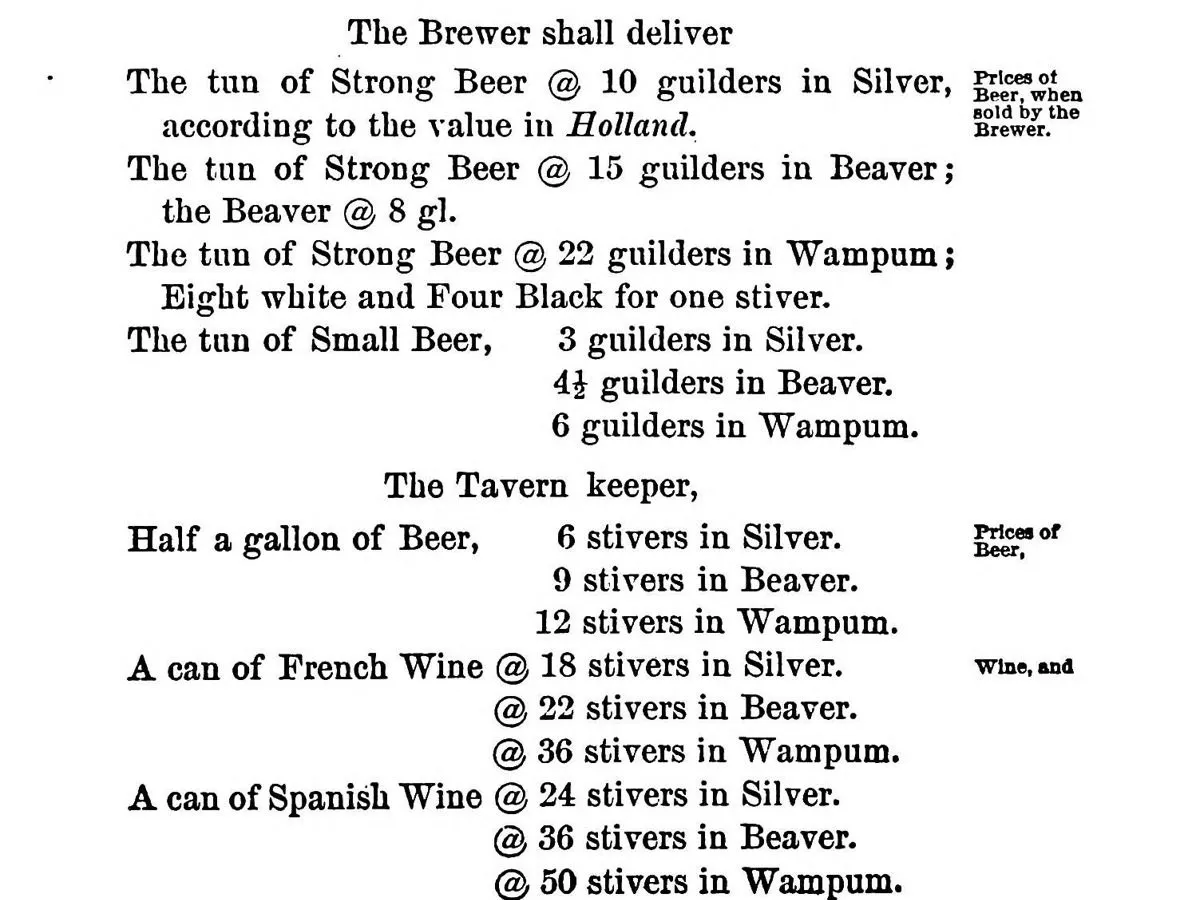
People in New Netherland, the Dutch colony on the Hudson from the 1620s to 1664, drank beer first: strong beer and a cheaper small beer, brewed in the colony and taxed by the half barrel. Wine from France and Spain and brandy came by ship and cost more. The colony’s own laws are the best record, because the Director General kept taxing the drink and fixing its price. By 1679, under English rule, Dutch-speaking farmers on Long Island poured cider and a great deal of Barbados rum, which they called kill-devil.
This story is part of our What Did People Drink in the 1600s? 17th-Century Drinks and Recipes guide.
Beer by the half barrel
The first tax was for a war. In June 1644 the Director General and Council ordered that “there shall be paid on each half barrel of Beer tapt by the Tavern Keepers, two Guilders, one-half payable by the Brewer and one-half by the Tapster,” with four stivers on each quart of Spanish wine and brandy and two on French wine, “until the good God grant us Peace.” Twenty stivers made a guilder.
Small beer, the weak everyday kind, was the poor household’s drink. When a 1651 ordinance barred brewers from selling beer by the small measure, it still let some inhabitants “lay in small Beer free of Excise with liberty to retail the same at a reasonable advance by the small measure,” so as “not to subject the Poor to inconvenience.”
Each new tax brought the same complaint. In November 1655 the council heard that the brewers, “on the imposition or increase of any Taxes, are making their Beer, each time, thinner and poorer, and will, notwithstanding, have the same price.” It capped “a gauged Tun of strong New Netherland Beer” at twenty guilders, roughly €320 today by Dutch consumer prices (IISG and CBS), and told the brewers to make it “not weaker than has been hitherto manufactured.” That is the complaint as the council recorded it; whether the beer really got thinner, the ordinance doesn’t prove.
Silver, beaver or wampum
Wampum, strings of white and black shell beads made by the Native peoples of the coast, passed as money in the colony. In November 1658 the council ordered that brewers, tapsters and grocers sell “at three prices, to wit, Silver money, Beaver, or Wampum,” with wampum at “Eight white and Four Black for one stiver.” The list is the picture at the top of this page.
A tun of strong beer cost 10 guilders in silver, roughly €140 today; a tun of small beer cost 3, about €40. In the tavern, half a gallon of beer was 6 stivers in silver, about €4, a can of French wine 18 and a can of Spanish wine 24, about €16, with “A gill of Brandy @ 5 stivers,” about €3.40. A gill of brandy cost nearly as much as half a gallon of beer. The silver prices were set “according to the value in Holland”; the beaver and wampum prices don’t translate into today’s money.
Kandeel and currant syrup
No New Netherland home recipe for a drink survives in these records, but Dutch cookbooks of the same years show what a household from the old country knew. De Verstandige Kock, printed in Amsterdam in 1667 and again in 1669, has a hot wine thickened with eggs:
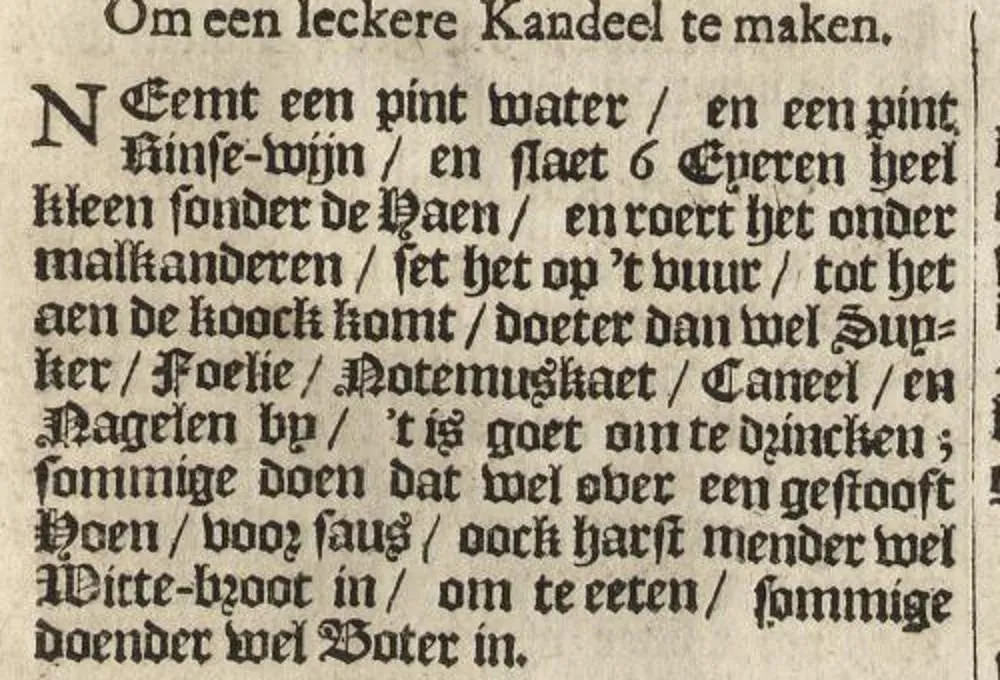 “Om een leckere Kandeel te maken,” in De Verstandige Kock (Amsterdam: Marcus Doornick, 1669), p. 17. Getty Research Institute, Internet Archive.
In our translation: “Take a pint of water and a pint of Rhenish wine, and beat 6 eggs very small,” stir it together and set it on the fire, then add sugar, mace, nutmeg, cinnamon and cloves. “It is good to drink.” Some poured it over a stewed hen as a sauce, some put white bread in it, and “some put butter in it.” We make it as Kandeel, the Dutch Hot Wine with Eggs of 1669, an egg-thickened cousin of the English ale caudle.
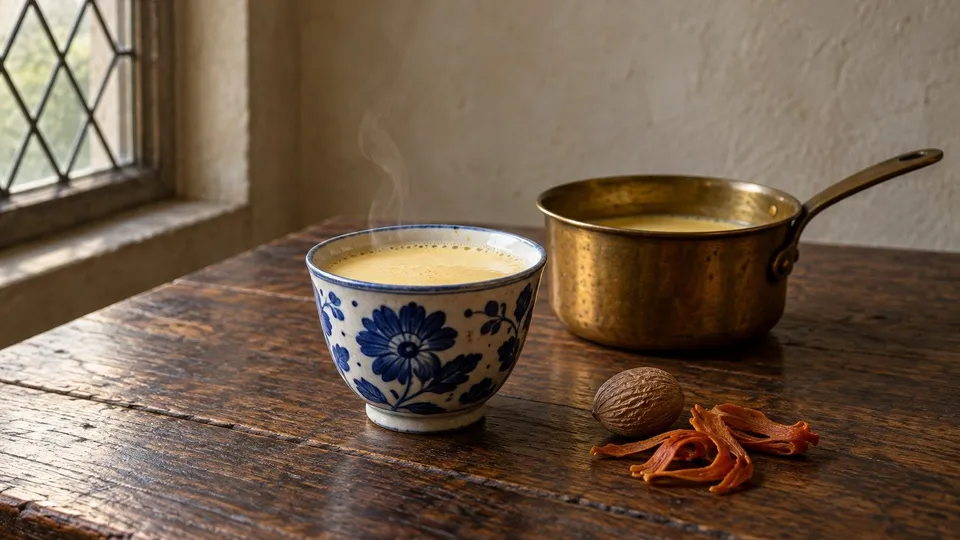 Make it todayKandeel, the Dutch Hot Wine with Eggs of 1669
 Make it todayAle Caudle, Warm Ale Thickened with Egg Yolks
The confectionery section of the same 1669 volume boils three pounds of currant juice with two of sugar “to a thin syrup,” which, it claims, is good “in all hot fevers, in the plague,” and “quenches thirst.” A spoonful stirred into cold water is our Currant Syrup and Water, the alcohol-free drink of this story. Nothing in the colony’s records says these exact recipes crossed the Atlantic; they are what a Dutch cook of the time could find in print.
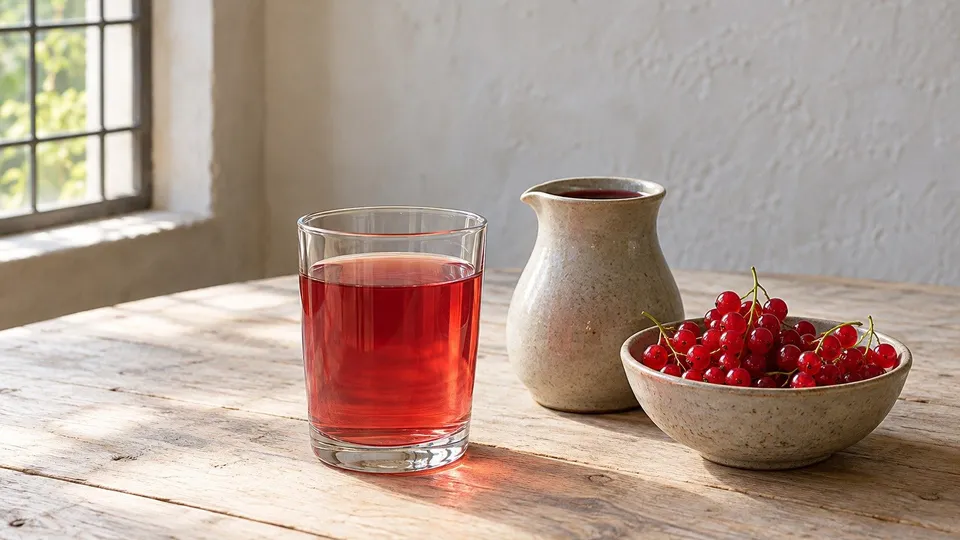 Always alcohol-freeCurrant Syrup and Water, a Dutch Cooler of 1669
Kill-devil and new cider
The English took the colony in 1664 and renamed it New York, but many of its farmers still spoke Dutch. Fifteen years later two Dutch missionaries, Jasper Danckaerts and Peter Sluyter, walked through what is now Brooklyn. Danckaerts kept a journal, disapproving by design, and it was published in English in 1867.
On September 29, 1679, farmers near Gowanus shared “whether it was milk, cider, fruit or tobacco, and especially, and first and most of all, miserable rum or brandy which had been brought from Barbadoes and other islands, and which is called by the Dutch kill-devil. All these people are very fond of it, and most of them extravagantly so, although it is very dear and has a bad taste.” How that island spirit found its way into the punch bowl and later the cocktail is told in From Punch Bowl to Shaker.
The same day they drank “the first new cider, which was very fine.” At New Utrecht they had “some good beer a year old,” and at New Harlem a sheriff kept a house “constantly filled with people, all the time drinking, for the most part, that execrable rum,” though he “had also the best cider we have tasted.” Cider was the drink of the English colonies too, as in What Did Early Americans Drink at Harvest?, and beer was the Pilgrims’ drink up the coast at Plymouth, the subject of What Did the Pilgrims Drink?.
Tea in Albany
By the middle of the next century the Dutch families upriver in Albany had taken to tea. The Swedish naturalist Pehr Kalm stayed there in June 1749:
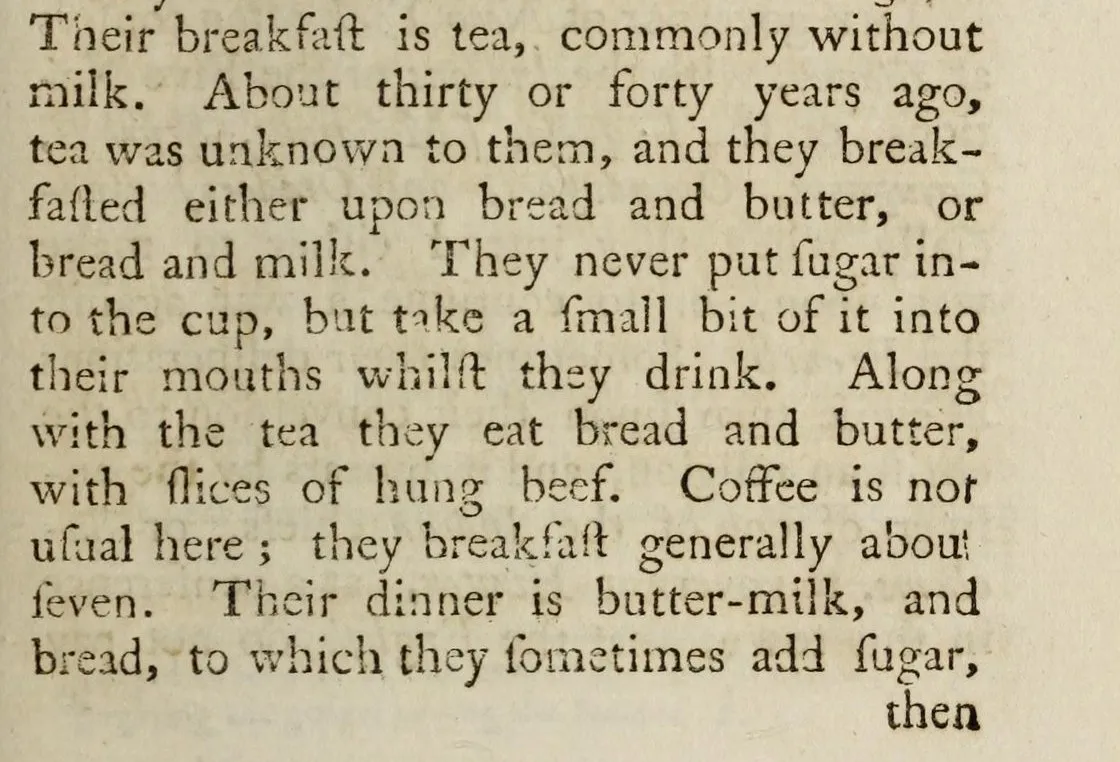 Pehr Kalm, Travels into North America, trans. John Reinhold Forster, vol. 2 (London, 1770), p. 267.
With the tea came bread and butter “with slices of hung beef,” and “Coffee is not usual here.” With dinner, Kalm wrote on the next page, “They commonly drink very small beer, or pure water.” That is Albany, eighty-five years after the English took over, not New Amsterdam in the 1650s; by Kalm’s own reckoning, tea had reached those households only since the 1710s. How Europeans first learned to brew the leaf is in How Were Coffee, Tea and Chocolate Made in 1685?.
The plainest drink in this story is the one you can make in five minutes: Albany Breakfast Tea with Sugar in the Mouth, black tea without milk and a small lump of sugar held on the tongue, as Kalm saw it.
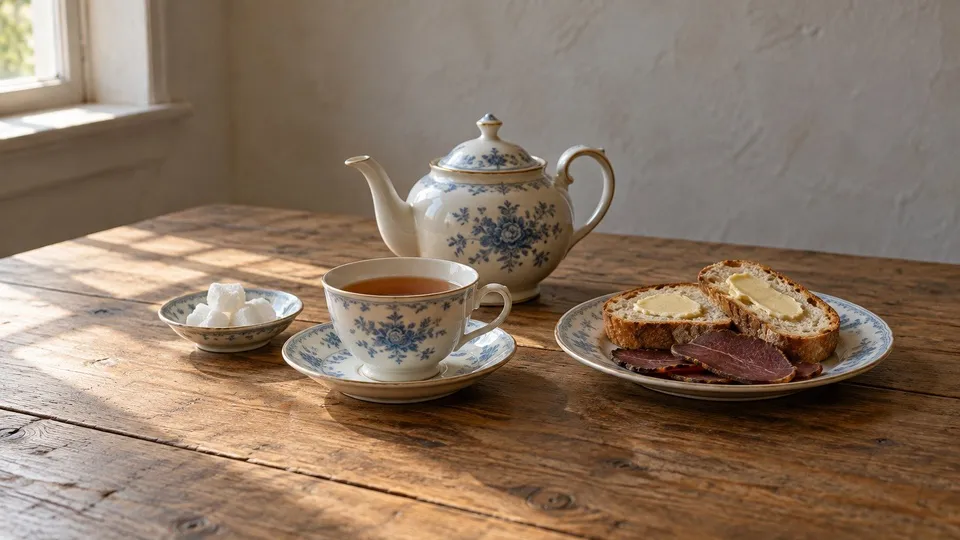 Always alcohol-freeAlbany Breakfast Tea with Sugar in the Mouth, 1749
For what was on the plate, our sister site The Forgotten Menu has Dutch herring and the war of 1665 (opens in a new tab).
Sources
- E. B. O’Callaghan, ed., Laws and Ordinances of New Netherland, 1638–1674 (Albany: Weed, Parsons & Co., 1868), pp. 39, 122, 203–204, 359–360.
- De Verstandige Kock, in Het vermakelijck landt-leven (Amsterdam: Marcus Doornick, 1669), Kock p. 17; De Verstandige Confituurmaker, p. 32.
- Jasper Danckaerts and Peter Sluyter, Journal of a Voyage to New York in 1679–80, trans. Henry C. Murphy (Brooklyn: Long Island Historical Society, 1867), pp. 113, 120–121, 129, 137.
- Pehr Kalm, Travels into North America, trans. John Reinhold Forster, vol. 2 (London: T. Lowndes, 1770), pp. 267–268.