What Did Early Americans Drink at Harvest?
Switchel in the July hayfield, molasses and water pushed as a cure for harvest rum, then cider in the fall: sweet when fresh, hard once it worked.
At haying time, early American farmhands drank switchel: a jug of cold water sweetened with molasses or maple sugar, and by the middle of the nineteenth century sharpened with vinegar and spiced with ginger. From at least 1805, newspapers and farm papers pressed it on haymakers as a replacement for the rum that usually went out to the field, although some people put the rum in anyway. When the apples came in, the drink was cider, called “sweet” while it was fresh juice and “hard” once it had fermented. In 1840 a barrel of hard cider became the emblem of a presidential campaign.
This story is part of our What Did People Drink in the 1800s? 19th-Century Drinks and Recipes guide.
These were the drinks of the farm year after independence, from the July hayfield to the November table. Neither needed more than a farm kept in its cellar or bought at the store, and both appear in print far more often in advice to farmers than in cookbooks.
A jug of molasses and water
The earliest known switchel in print turns up as an insult. In a poem on the demolition of Dartmouth’s old log college, dated New Year’s Eve 1789 and printed in his 1795 collection, Philip Freneau sets “high-proof wines” against “spiritless switchel” and “vile hogo drams.” His footnote explains the word for readers who might not know it: “A mixture of molasses and water.” Spiritless meant exactly that. There was no alcohol in it.
Molasses, the dark syrup left from making cane sugar, was New England’s everyday sweetener. John Russell Bartlett’s Dictionary of Americanisms gave the same definition in 1848, “Molasses and water; a common beverage in New England,” and only in his second edition of 1859 did he add that “sometimes, a little vinegar is added.”
Drink switchel, not flip
What the reformers wanted out of the hayfield was rum, in flip, toddy and punch, and they went after it decades before the temperance movement had a name.
On June 22, 1805, a Philadelphia weekly, The Evening Fire-Side, ran a column headed “Attention, Hay-Makers!” It tells the laborers “do not drink flip,” a mix of rum, beer and sugar, and “Do not drink toddy or milk punch,” and then offers its list: “Drink switchel—that is, molasses or maple sugar mixed with water.” Whey, milk and water, spruce beer or small beer would also do, and so would cider, if it was watered.
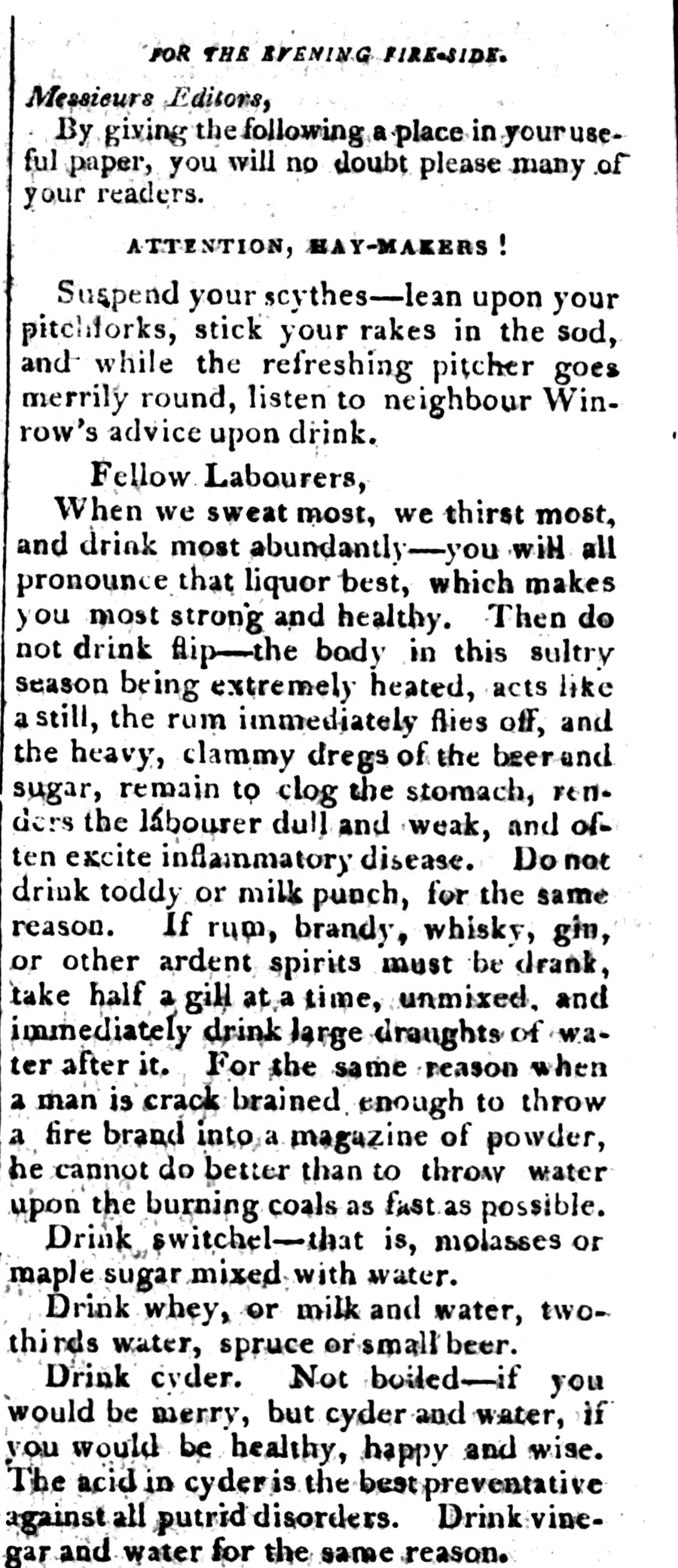 “Attention, Hay-Makers!”, The Evening Fire-Side (Philadelphia), June 22, 1805, p. 222.
That column is also the only period source known to name maple sugar for switchel. Every later recipe uses molasses.
Fourteen years later the idea had reached the county agricultural societies. In August 1819, the Albany farm paper The Plough Boy reported that the Tompkins County Agricultural Society in New York had resolved to stop giving out ardent spirits for getting in the harvest, “by substituting malt liquor, milk and water, or switchel. This is as it should be, and worthy of general imitation.”
Vinegar, ginger and a gray jug
By 1856 switchel had a recipe with amounts, and the vinegar and ginger had arrived. The Friends’ Intelligencer, a Quaker weekly in Philadelphia, printed a “Harvest Drink” of ten gallons of cold water, a gallon of molasses, a quart of vinegar and a quarter pound of ground ginger, “a thousand times better than with rum.” The Maine Farmer ran the same recipe that month, and the Maryland Farmer printed the same proportions in 1870, specifying cider vinegar and recommending it to “those who wisely avoid strong liquors.” That recipe, scaled down to a liter of water, is our Switchel, the 1856 Harvest Drink.
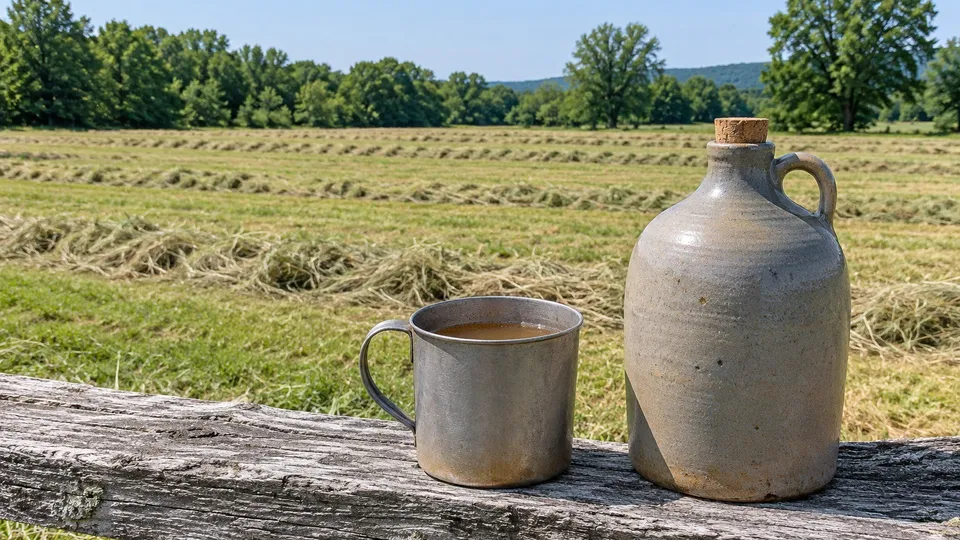 Always alcohol-freeSwitchel, the 1856 Harvest Drink
The American Agriculturist described the drink in July 1865 as “a homely substitute for lemonade, but very good and much better than many things that are drank,” and placed it squarely “in the hay field.” Later writers put it in a jug or a pail. In 1873 Augusta Larned called it “an innoxious and economical substitute for spirits and beer, invented by some one of our rural forefathers.” B. P. Shillaber’s 1879 book about a boy, Ike Partington, leaves “a large tin pail over in the shadow of the wall,” holding switchel made of “water, molasses, ginger, and a little old cider-vinegar.”
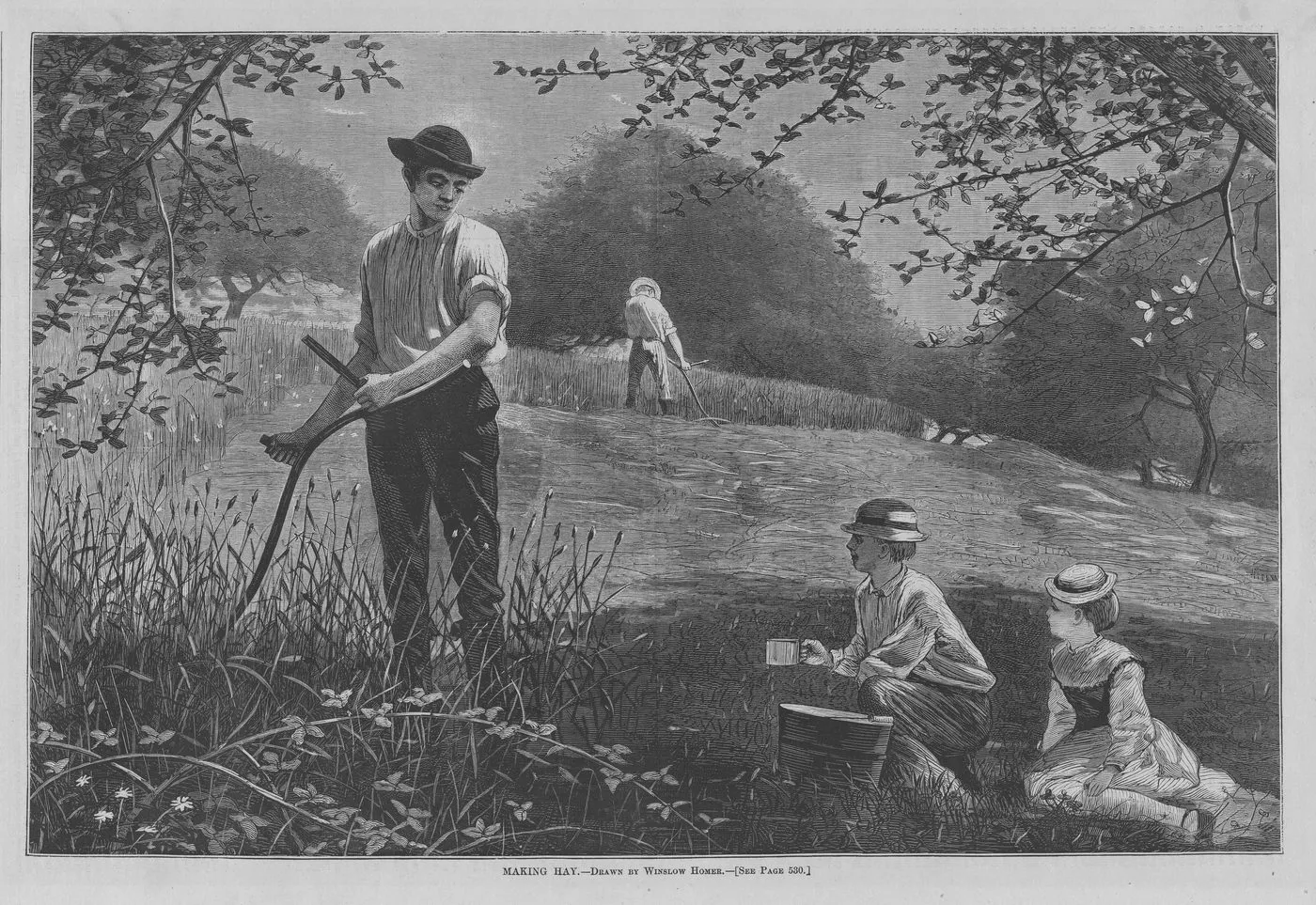 Winslow Homer, “Making Hay,” wood engraving in Harper’s Weekly, 1872. Children have carried a pail and a tin cup out to the mowers. The Metropolitan Museum of Art (Open Access, public domain).
Not everyone liked it. A serial story in Harper’s Bazar in 1881 has a visitor “even tasting the switchel—a vile compound of ginger, molasses, and vinegar, much affected by haymakers, but which, with the best will in the world, he could not like.”
Nor was every switchel dry. Looking back about fifty years in 1867, a writer in The Harvard Advocate recalled that among students “the favorite beverage was switchel; a compound of rum, molasses, and ginger, the receipt for which was imported from the rural districts.” The name covered both versions, and the temperance press simply left out the rum.
Parson Weems at Bunker Hill
The best switchel story is also the least reliable. In the 1808 edition of his Life of George Washington, Mason Locke Weems, the author who gave the world the cherry tree, describes the battle of Bunker Hill in 1775, where “the dauntless Yankees still drank their Switchel, and plied their work.” His footnote calls it “a mild moralizing malmsey, made of molasses and water, which the prudent Yankees drink to the great benefit of their health and senses, while their southern neighbours are be-fooling and be-poisoning themselves with grog.”
Weems is the only known source for switchel at Bunker Hill, and he wrote more than thirty years after the battle. Read it as legend. It shows that by 1808 switchel was a Yankee habit worth a joke, and tells us nothing about what the troops drank. Two modern claims need the same caution. “Haymaker’s punch,” the name often given to switchel today, is a modern one: the only use before 1940 that we found dates from 1919. Nor does any known period source say that switchel came from the Caribbean.
Sweet in the fall, hard by winter
After the hay came the apples, and Americans divided their cider in two. In a 1922 Department of Agriculture bulletin, the plant physiologist Joseph S. Caldwell explained that “sweet” or “hard” was “prefixed to indicate whether fermentation has not or has occurred,” and that in England and France “the word ‘cider’ used alone refers to a fermented product, our ‘hard cider.’” He opened by calling unfermented apple juice, or sweet cider, “the great American beverage.” The 1899 census had counted 55,280,199 gallons of cider made on farms; in 1909 there were 332,810 farms making it.
Sweet cider didn’t stay sweet for long. Left in the barrel, it worked. A cider recipe credited to Sir Paul Neale, printed in Sir Kenelm Digby’s Closet in 1669, warns that “upon every working it grows harder.” A 1906 federal bulletin reckoned that apple juice could develop “about 6 per cent of alcohol” in a hard cider, about the strength of a strong beer.
Cider also went to the holiday table. In Northwood, her 1827 novel of New England life, Sarah Josepha Hale sets out a Thanksgiving dinner of turkey, chicken pie and pumpkin pie, and on the sideboard “decanters and bottles; the former filled with currant wine and the latter with excellent cider and ginger beer, a beverage Mrs. Romelee prided herself on preparing in perfection. There were no foreign wines or ardent spirits, Squire Romelee being a consistent moralist.” Hale later campaigned for Thanksgiving to become a national holiday, and her table is a picture of what she thought it should be, not a record of any one farm. The British side of the ginger beer story is in What Were Victorian Non-Alcoholic Beers?
A barrel of hard cider
Soon after the Whig convention at Harrisburg nominated William Henry Harrison for president, a Democratic paper, the Baltimore Republican, sneered at him: “Give him a barrel of hard cider, and settle a pension of two thousand a year upon him, and my word for it, he will sit the remainder of his days in his log cabin, by the side of a sea coal fire, and study moral philosophy.” Two thousand dollars a year in 1840 would be about $65,000 in today’s money, by US consumer prices.
The Whigs took the insult as a gift. A North Carolina paper, the Hillsborough Recorder, reprinted it that fall to remind voters who had started it, and the log cabin and the cider barrel became the campaign’s emblems.
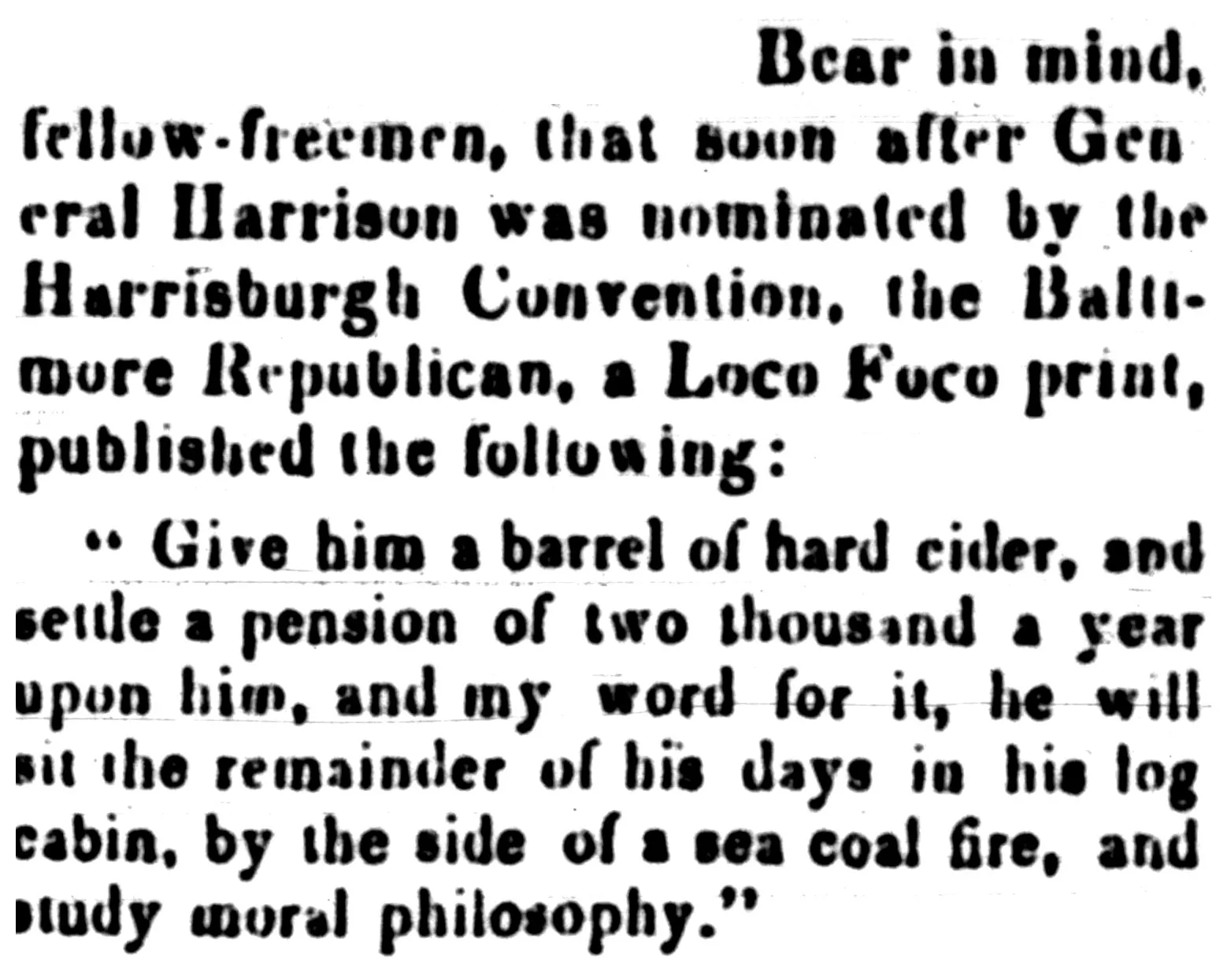 The “barrel of hard cider” line, as reprinted in the Hillsborough Recorder (North Carolina), October 1, 1840.
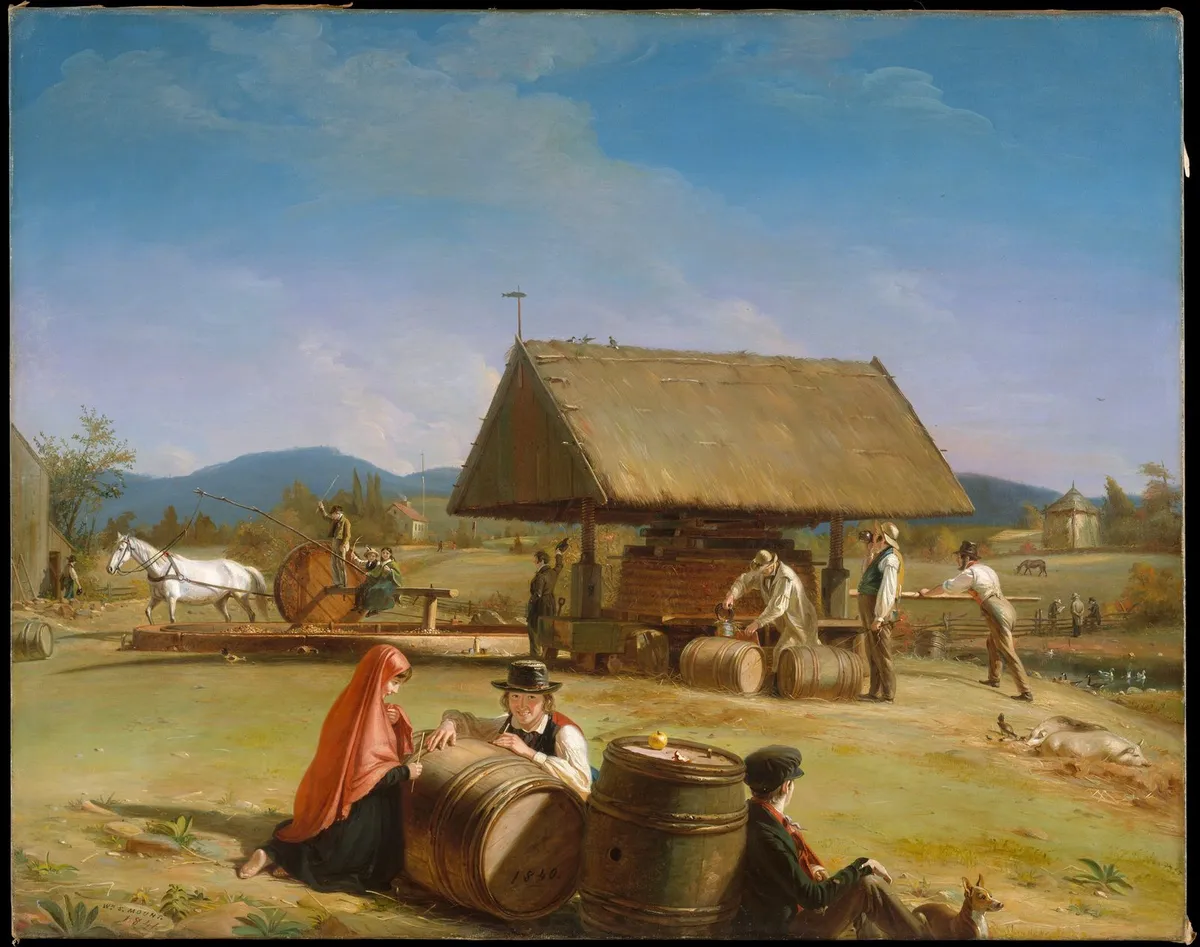
At an Anson County Whig meeting that July, the Fayetteville Observer reported, the procession included “a Log Cabin, in which were the revolutionary soldiers, with a barrel of hard cider and a gourd.” Harrison won. William Sidney Mount painted his Cider Making, at the top of this page, in the same campaign season, with “1840” lettered on a barrel in the foreground; the Metropolitan Museum’s catalog and a 1975 study in the Metropolitan Museum Journal read the picture as a Whig allegory.
A jug for July, a pan for November
Switchel is the easiest drink here to make, and the one most worth reviving for Dry January or a hot July: no alcohol, no cooking, a jug and four ingredients. The 1856 Harvest Drink keeps the printed proportions. The Maple Switchel with Ginger and Cider Vinegar swaps in maple syrup, after the 1805 column; putting maple together with the later vinegar and ginger is a modern combination, and the recipe says so. Its distant cousin is the Roman soldier’s posca, vinegar and water with no sugar at all, though nothing links the two drinks but the idea.
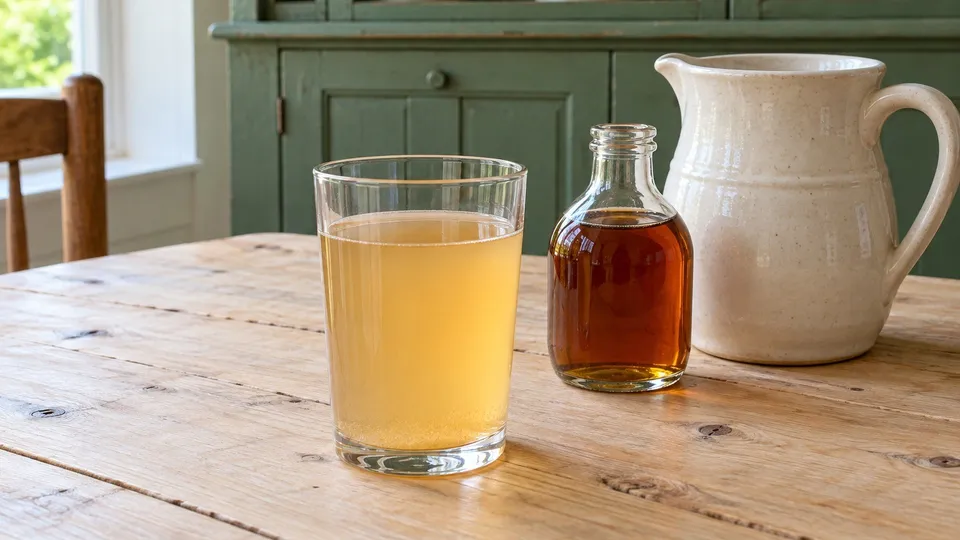 Always alcohol-freeMaple Switchel with Ginger and Cider Vinegar
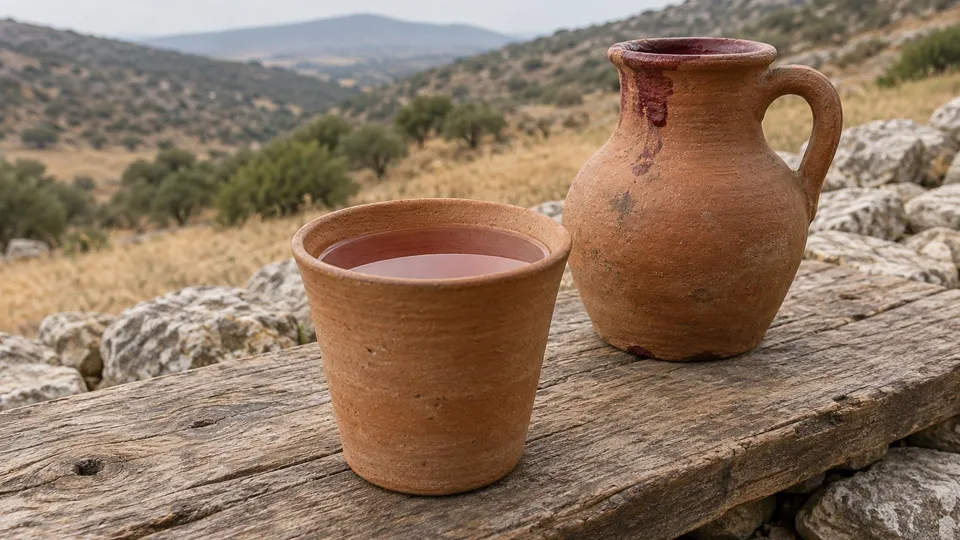 Always alcohol-freePosca, the Roman Soldier’s Vinegar Drink
For the cider side of the year, Mulled Sweet Cider with Nutmeg and Cloves comes from Helen Watkeys Moore’s 1919 book of drinks “free from the alcoholic taint.” It is a hot drink for a Thanksgiving table that would have suited Squire Romelee. Hard cider is left out: the period methods call for a press, casks and months of waiting. The English answer was lambswool, hot ale with roasted apples. The temperance campaigners who wanted rum out of the hayfield had British counterparts who wanted beer out of the pub, and Coffee Taverns, the Victorian Answer to the Pub follows them into the coffee taverns.
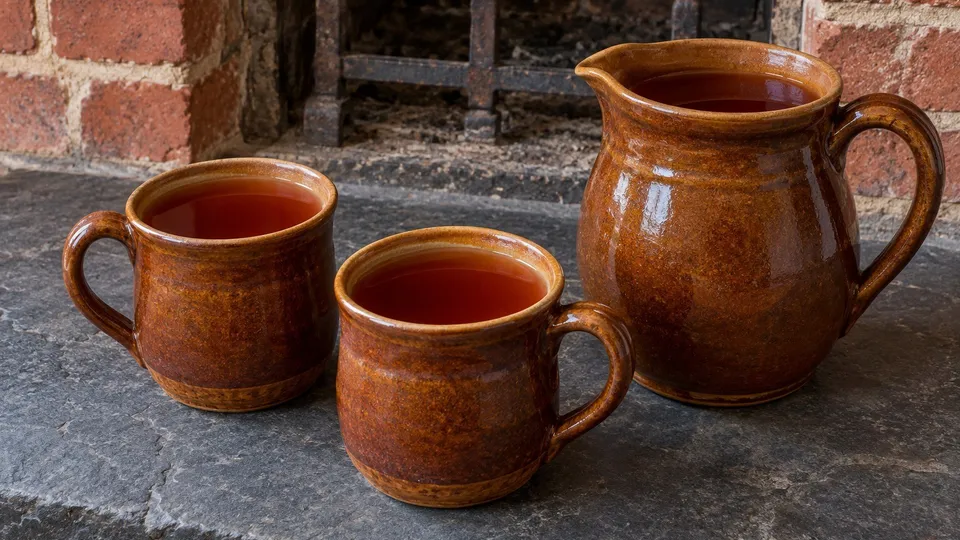 Always alcohol-freeMulled Sweet Cider with Nutmeg and Cloves
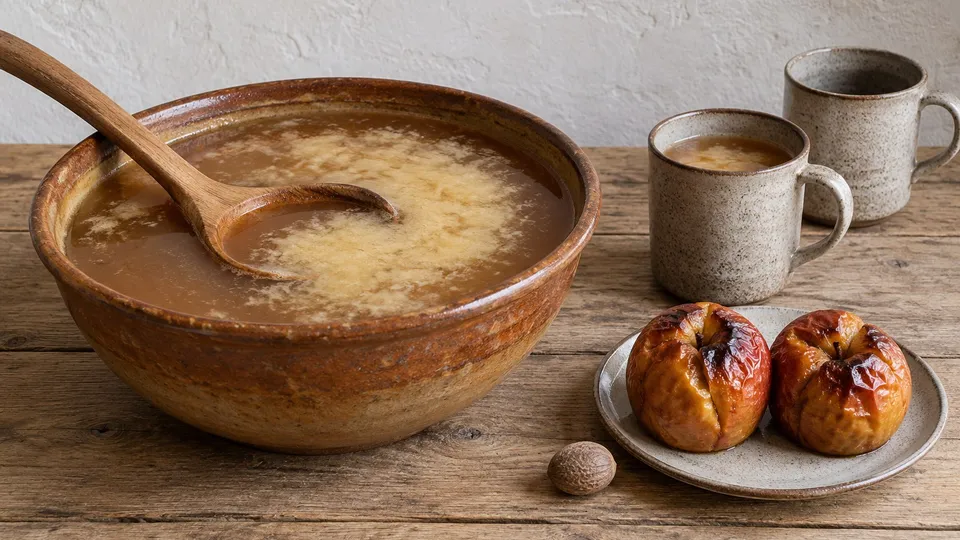 Make it todayLambswool, Hot Spiced Ale with Roasted Apples
Back on the farm, the jug comes first. Switchel takes five minutes to shake together and keeps for two days in the fridge, so make it the morning before a long day outdoors.
Sources
- Philip Freneau, Poems Written between the Years 1768 & 1794 (Monmouth, NJ, 1795), “On the Demolition of a Log-College,” p. 375.
- “Attention, Hay-Makers!”, The Evening Fire-Side; or, Literary Miscellany (Philadelphia), vol. 1 no. 28, June 22, 1805, p. 222.
- [Mason Locke Weems], The Life of George Washington, 7th ed. (Philadelphia, 1808), chap. IX, p. 74.
- “Ardent Spirits,” The Plough Boy (Albany), vol. 1 no. 10, August 7, 1819.
- [Sarah Josepha Hale], Northwood; a Tale of New England, vol. 1 (Boston: Bowles & Dearborn, 1827), pp. 109–110.
- Hillsborough Recorder (Hillsborough, NC), October 1, 1840, p. [2], quoting the Baltimore Republican.
- Fayetteville Observer (Fayetteville, NC), July 15, 1840, p. [2].
- John Russell Bartlett, Dictionary of Americanisms (New York: Bartlett & Welford, 1848), p. 347; 2nd ed. (Boston: Little, Brown, 1859), p. 468.
- “Harvest Drink,” Friends’ Intelligencer (Philadelphia), vol. 13 no. 16, July 5, 1856, p. 254; the same text in the Maine Farmer (Augusta), July 31, 1856, p. [1].
- “Summer Drinks,” American Agriculturist (New York), vol. 24 no. 7, July 1865, p. 222.
- “They Never Do So Now,” The Harvard Advocate, vol. 4 no. 1 (1867), p. 3.
- “Harvest Drink,” Maryland Farmer, vol. 7 no. 7, July 1870, p. 195.
- Augusta Larned, “The Switchel Jug,” Christian Union, vol. 8 no. 5, July 30, 1873, p. 97.
- B. P. Shillaber, Ike Partington; or, The Adventures of a Human Boy and His Friends (Boston: Lee and Shepard, 1879), p. 95.
- Harper’s Bazar, vol. 14 no. 4, January 22, 1881, p. 55.
- Sir Kenelm Digby, The Closet of the Eminently Learned Sir Kenelme Digbie Kt. Opened (London: H. Brome, 1669), p. 118.
- U.S. Department of Agriculture, Industrial Alcohol: Uses and Statistics, Farmers’ Bulletin 269 (1906), p. 18.
- Helen Watkeys Moore, On Uncle Sam’s Water Wagon (New York: G. P. Putnam’s Sons, 1919), p. vi.
- Joseph S. Caldwell, Farm Manufacture of Unfermented Apple Juice, Farmers’ Bulletin 1264 (USDA, 1922), pp. 3–5.
- The Metropolitan Museum of Art, William Sidney Mount, Cider Making, 66.126, catalog entry; Winslow Homer, Making Hay, 28.111.5(1).