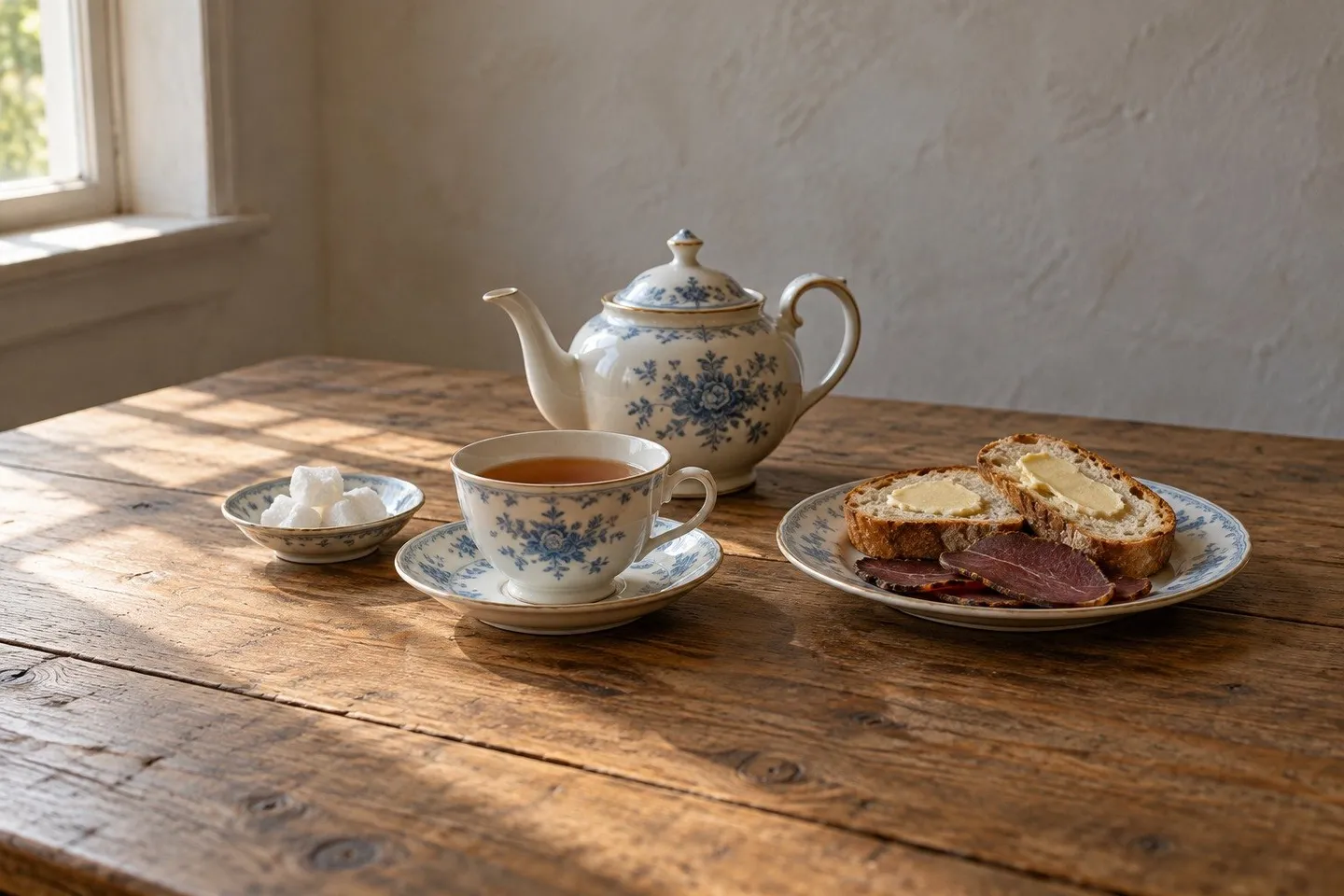
Albany Breakfast Tea with Sugar in the Mouth, 1749
Reader ratingsBlack tea without milk, drunk with a small lump of sugar held in the mouth: breakfast tea as a Swedish visitor saw the Dutch of Albany take it in 1749.
- Recipe makes
- About 400 ml, 2 cups
- Prep
- Cook
- Total
Black tea without milk, with lump sugar and bread and butter with hung beef, as Kalm described an Albany breakfast.
The story behind the recipe
“Their breakfast is tea, commonly without milk.” So wrote the Swedish naturalist Pehr Kalm of the Dutch families of Albany, where he stayed in June 1749. “They never put sugar into the cup, but take a small bit of it into their mouths whilst they drink.” This recipe is that cup: plain tea, no milk, and the sugar on the tongue rather than in the tea.
Tea, bread and hung beef
Kalm’s account is short and exact. “About thirty or forty years ago, tea was unknown to them, and they breakfasted either upon bread and butter, or bread and milk.” By his visit they ate bread and butter with the tea, “with slices of hung beef,” and “Coffee is not usual here; they breakfast generally about seven.” With dinner, he wrote on the next page, “They commonly drink very small beer, or pure water.” Albany had been English since 1664, but its families still kept Dutch ways; what their grandparents drank in New Netherland, from strong beer to Barbados rum, is in What Did People Drink in New Netherland?
Read more about this recipe
Our version
Kalm doesn’t name the tea. We use a plain loose black tea, our choice, brewed at about 2 grams to a 200 ml cup. A small sugar cube or a rough lump of sugar does the job. Hold it between the teeth or on the tongue and sip the tea through it. The source says nothing about how it tasted. For tea as Europeans first learned to make it, from a 1685 handbook, try Tea the Chinese Way.
Their breakfast is tea, commonly without milk. About thirty or forty years ago, tea was unknown to them, and they breakfasted either upon bread and butter, or bread and milk. They never put sugar into the cup, but take a small bit of it into their mouths whilst they drink. Along with the tea they eat bread and butter, with slices of hung beef. Coffee is not usual here; they breakfast generally about seven.

Recipe makes: About 400 ml, 2 cups
Ingredients
For About 400 ml, 2 cups. Quantities are shown as written.
Quantities as written here, for About 400 ml, 2 cups.
- Loose black tea4 g
- Water400 ml
- Small sugar lumps2
Measurement notes
Ingredients as written here
- 4 g loose black tea
- 400 ml water
- 2 small sugar lumps
Equipment
 Kettle
 Teapot
 Tea strainer
Instructions
Bring the water to a boil and pour a little into the teapot to warm it, then pour that out.
Put the loose black tea in the pot, pour on the rest of the boiling water and let it steep for 3 to 4 minutes.
Pour the tea through the strainer into the cups. Add no milk and no sugar to the cup.
Put a sugar lump in your mouth, hold it there and drink the tea through it, as the Albany households did.
Nutrition
20calories per serving
- Recipe makes
- About 400 ml, 2 cups
- Servings
- 2
Estimated from USDA FoodData Central values for brewed black tea and one 5 g sugar lump per cup.
Recipe notes
When adjusting quantities
Use about 2 g of tea and 200 ml of water per cup, with one small sugar lump each.
Notes
Quantities mentioned in these notes don’t change when you adjust the batch.
Serve it with bread and butter, and thin slices of dried beef if you like, for the breakfast Kalm described.
A second steeping of the same leaves makes a weaker second cup.
Scaling changes the ingredients only; glassware, ice and timings need their own judgment. To adapt this recipe further, try the recipe tool at TuneMyRecipe (opens in a new tab), our sister site.
Sources and attribution
Pehr Kalm, Travels into North America, trans. John Reinhold Forster, vol. 2 (London: T. Lowndes, 1770), p. 267
See the original pages (scan at Internet Archive) (opens in a new tab)
Recipe details
- Drink
- Alcohol-free
- Drink family
- Hot Drinks
- Era
- 18th century
- Difficulty
- Easy