Currant Syrup and Water, a Dutch Cooler of 1669
Reader ratingsRed currant juice boiled with sugar to a thin syrup, three parts to two, and stirred into cold water: a thirst-quencher from an Amsterdam book of 1669.
- Recipe makes
- About 350 ml syrup, enough for about 10 glasses
- Prep
- Cook
- Total
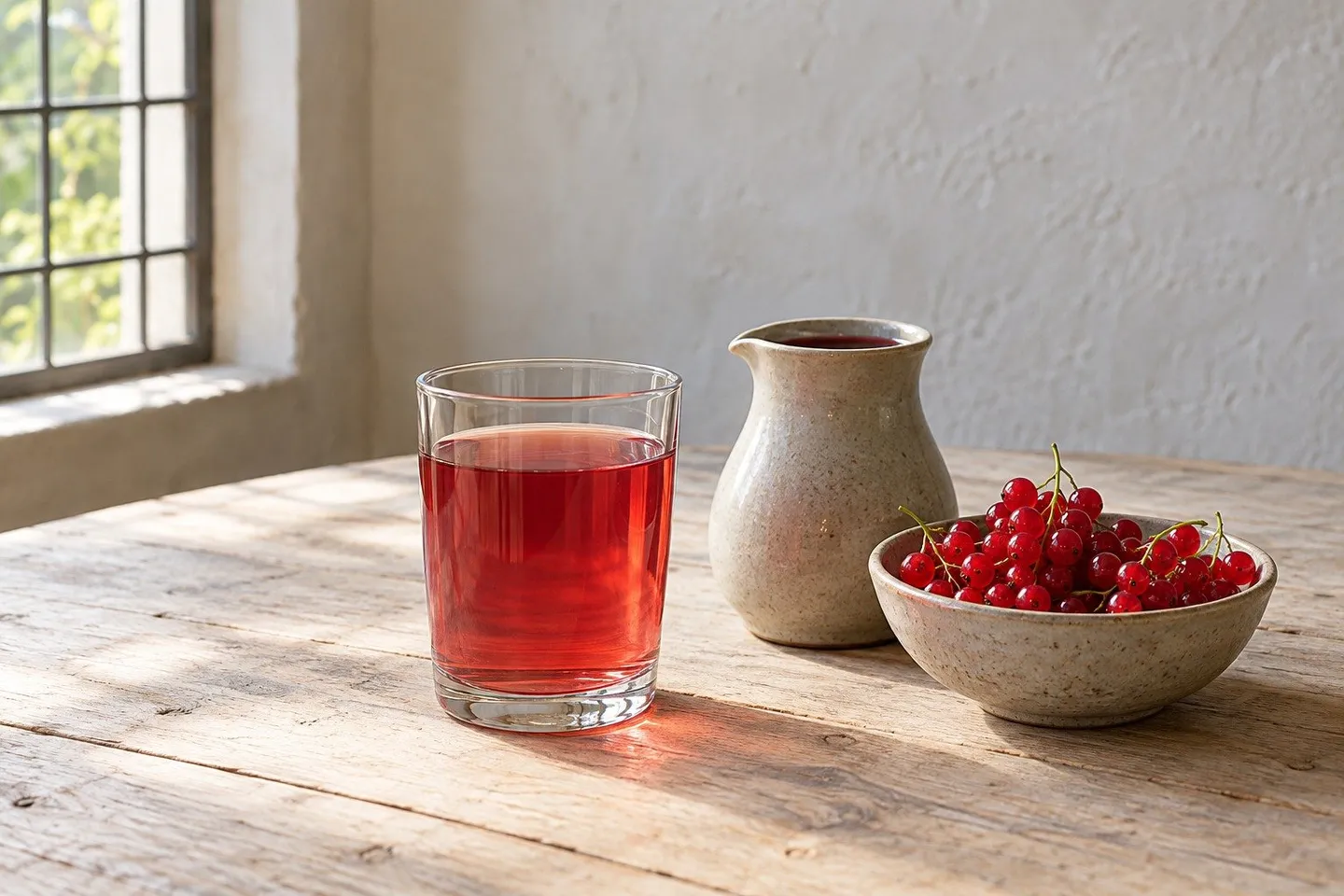
Currant syrup stirred into water, with the syrup in a jug and fresh red currants.
The story behind the recipe
“Take three pounds of currant juice and two pounds of sugar, boil them together to a thin syrup.” That is the whole method of this syrup from De Verstandige Confituurmaker, “The Sensible Confectioner,” the sweet-making part of a Dutch household book printed in Amsterdam in 1669. Stirred into cold water, it makes a tart red drink with no alcohol in it.
Good in all hot fevers
The book recommends the syrup as much for health as for pleasure. “This syrup is good in all hot fevers, in the plague; it quenches thirst, it strengthens the heart, the stomach and the liver in every hot sickness.” Those claims are the book’s, not ours. The same volume has a hot wine thickened with eggs, made here as Kandeel, and how both fit beside the beer and rum of the Dutch colony on the Hudson is in What Did People Drink in New Netherland?
Read more about this recipe
Our version
The book’s “Aelbesien” are currants; the next recipe on the same page names red ones, and red currants are what we use. We keep the book’s three parts of juice to two of sugar by weight, at a tenth of the size. The page says how to make the syrup but not how to drink it; a spoonful or two in a glass of cold water is our choice. The sources say nothing about how it tasted. For a later American drink colored with berry juice, try Kellogg’s pink lemonade.
Om Syroop van Aelbesien te maken. Neemt drie pont sap van Aelbesien en twee pont Suycker / ziedt het te samen tot een dunne Syroop: Dese Syroop is goet in alle heete koortsen, in de pest; sy verslaet den dorst, sy sterckt ‘t Herte, de Mage en de Lever in alle heete sieckte.
Our translation: To make syrup of currants. Take three pounds of currant juice and two pounds of sugar, boil them together to a thin syrup. This syrup is good in all hot fevers, in the plague; it quenches thirst, it strengthens the heart, the stomach and the liver in every hot sickness.

Recipe makes: About 350 ml syrup, enough for about 10 glasses
Ingredients
For About 350 ml syrup, enough for about 10 glasses. Quantities are shown as written.
Quantities as written here, for About 350 ml syrup, enough for about 10 glasses.
- Red currant juice300 g
- Sugar200 g
- Cold water, to serve
Measurement notes
Ingredients as written here
- 300 g red currant juice
- 200 g sugar
- Cold water, to serve
Equipment
 Saucepan
 Fine sieve or jelly bag
 Clean bottle or jar
Instructions
Strip the currants from their stalks, crush them in a bowl and press them through the fine sieve or a jelly bag to make the red currant juice. Weigh the juice.
Put the juice and the sugar in the saucepan, keeping three parts of juice to two of sugar by weight if you have more or less juice.
Bring it to a boil over medium heat, stirring until the sugar dissolves, then boil gently for about 5 minutes, skimming off any foam, until it is a thin syrup that just coats a spoon.
Let it cool, then pour it into the clean bottle or jar and keep it in the fridge.
To serve, stir a spoonful or two of syrup into a glass of cold water, tasting as you go.
Nutrition
80calories per serving
- Recipe makes
- About 350 ml syrup, enough for about 10 glasses
- Servings
- 10
Estimated for one glass with 30 ml of syrup from USDA FoodData Central values for red currant juice and granulated sugar.
Recipe notes
When adjusting quantities
Keep the juice and sugar at three parts to two by weight. Serve about 30 ml of syrup to 200 ml of cold water.
Notes
Quantities mentioned in these notes don’t change when you adjust the batch.
About 450 g of fresh red currants give 300 g of juice. Thirty milliliters of syrup to 200 ml of water is a good starting point.
The syrup keeps for about two weeks in the fridge. Frozen red currants work as well as fresh.
Blackcurrants make a darker, stronger syrup; the 1669 page doesn’t name them, so that is a swap, not the book’s recipe.
Scaling changes the ingredients only; glassware, ice and timings need their own judgment. To adapt this recipe further, try the recipe tool at TuneMyRecipe (opens in a new tab), our sister site.
Sources and attribution
De Verstandige Confituurmaker, in Het vermakelijck landt-leven (Amsterdam: Marcus Doornick, 1669), “Om Syroop van Aelbesien te maken”, p. 32; translation ours
See the original pages (scan at Internet Archive) (opens in a new tab)
Recipe details
- Drink
- Alcohol-free
- Drink family
- Shrubs, Syrups & Cordials
- Region
- Dutch
- Era
- 17th century
- Base
- Fruit & juice
- Difficulty
- Easy
- Season
- Summer