What Did People Drink in a Wild West Saloon?
Whiskey at two bits a glass, lager near a brewery, bitters, champagne after a strike and black coffee on the trail: what the frontier drank, 1849 to 1900.
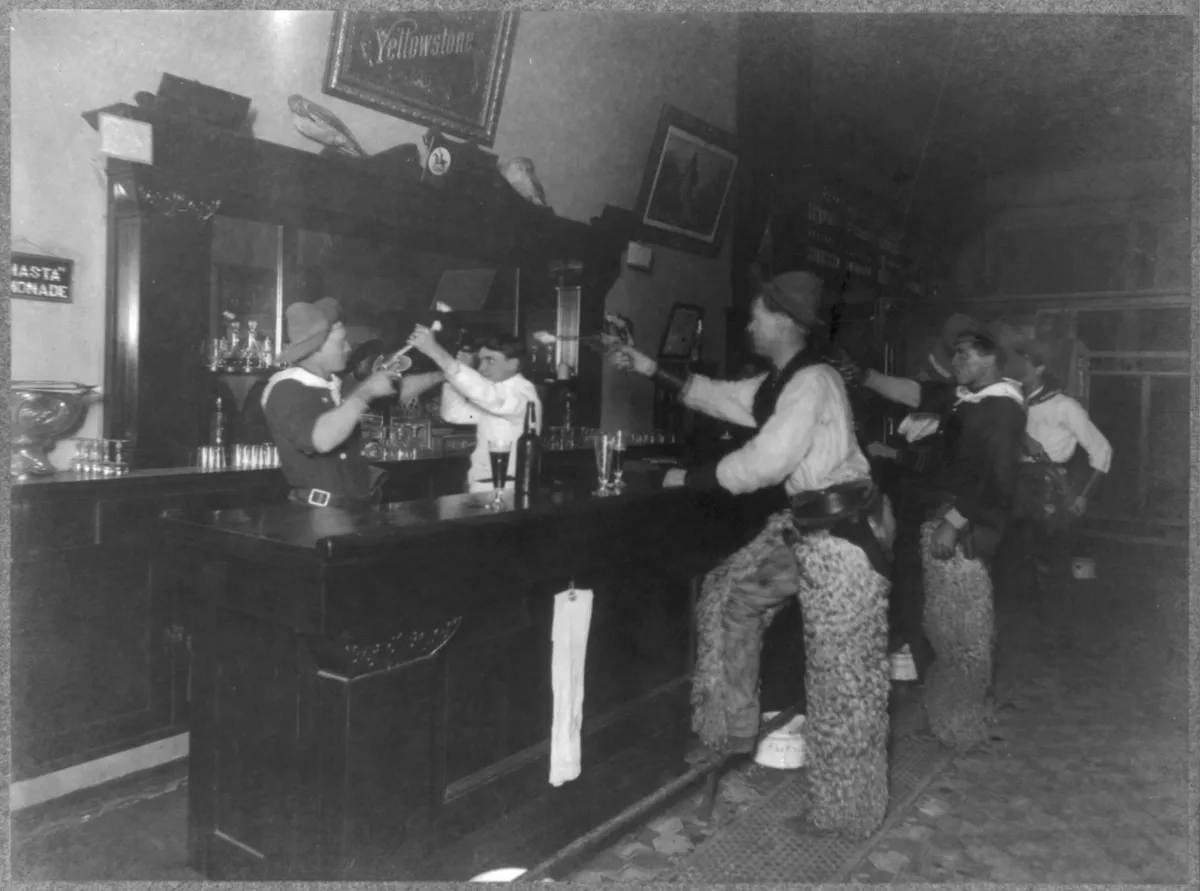
Mostly whiskey, poured straight and sold at a flat two bits, or 25 cents, a drink (about $8.30 in today’s money, by US consumer prices, taking the price in Andy Adams’s trail novel, set in Montana in 1882). Much of it was distilled nearby, blended or faked. Where a brewery stood close there was lager, bitters were sold as medicine as well as at the bar, and miners who struck it rich bought champagne. Mixed drinks were mainly a San Francisco and big-town trade. Off the bar, on the trail, at the stage stations and in the cow camps, the West drank black boiled coffee, and a traveler who wanted something sharp and cold could stir up lemonade from a powder.
This story is part of our Wild West Drinks guide.
How much did a drink cost in a Wild West saloon?
Mark Twain, who went west by stagecoach in 1861, told of a man in a “Californian bar-room” who “enters a saloon (twenty-five cents is the price for anything and everything, and specie the only money used) and lays down a half dollar; calls for whiskey and drinks it”. California paid in gold and silver coin while the East used paper greenbacks through the Civil War years, so a conversion of that quarter (about $5.30 today, at 1865 prices) gives only the order of magnitude.
The rule still held twenty years later in Montana. In Andy Adams’s The Log of a Cowboy (1903), a novel drawn from the author’s years on the trail, the hands reach a town on the Yellowstone in August 1882 and come back with “the report that a shave was two-bits and a drink the same price.” They tie up behind The Buffalo Bull saloon and line up “for our first drink since leaving Ogalalla.”
Buying a drink was rarely a private act. “You have no notion of what ‘treating’ means on the Western slope,” Rudyard Kipling wrote from San Francisco in 1889. “It is more than an institution; it is a religion.” Three friends walk to the nearest bar and “take three straight whiskys,” and, he added, “It is not etiquette yet to refuse a treat.” The drink bought lunch as well. In a bar-room “full of bad Salon pictures,” Kipling found men “wolfing food from a counter”: “It was the institution of the ‘Free Lunch’ that I had struck. You paid for a drink and got as much as you wanted to eat.”
“In Nevada, for a time, the lawyer, the editor, the banker, the chief desperado, the chief gambler, and the saloon keeper, occupied the same level in society, and it was the highest,” Twain wrote in Roughing It (1872). The cheapest way to be looked up to was “to stand behind a bar, wear a cluster-diamond pin, and sell whisky.”
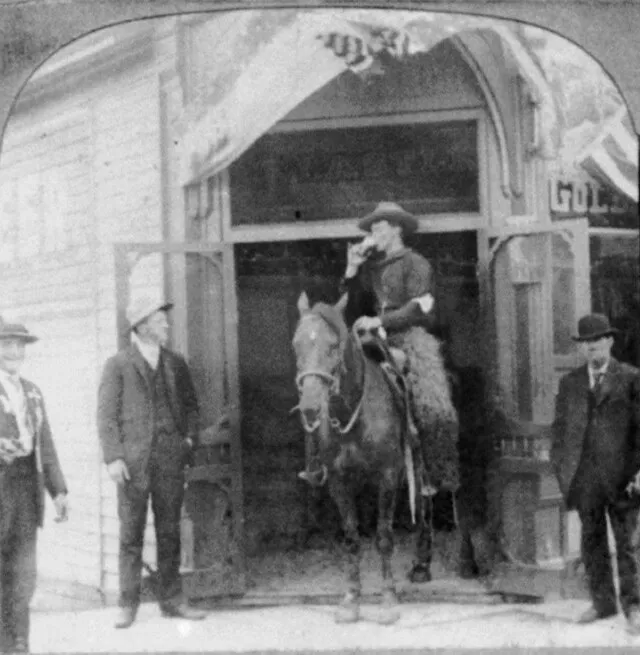 “The Thirsty Cowpuncher,” one half of a stereograph copyrighted in 1907 by Ed. Tangen of Boulder, Colorado, probably posed. Library of Congress, Prints and Photographs Division.
What did they call whiskey in the Old West?
Richard Burton, the English traveler who crossed the plains to Salt Lake City in 1860, wrote of the overland teamster that “He can do nothing without whisky, which he loves to call tarantula juice, strychnine, red-eye, corn juice, Jersey lightning, leg-stretcher, ‘tangle-leg,’ and many other hard and grotesque names”. Twain’s Nevada called it “tangle-foot.” Burton’s footnote gives a recipe for the stuff: tangle-leg “is said to be made of diluted alcohol, nitric acid, pepper, and tobacco, and will upset a man at a distance of 400 yards from the demijohn.” He was quoting a joke, and it belongs with the jokes; it says nothing reliable about what went into a barrel.
Burton was plainer about Utah. Its whiskey was distilled from wheat only, and “This ‘Valley Tan,’ being generally pure, is better than the alcohol one part and water one part, colored with burnt sugar and flavored with green tea, which is sold under the name of Cognac.” It is one traveler’s report from one territory, but a precise one: half alcohol, half water, burnt sugar and green tea. Where the name came from, and what Mark Twain made of it, is in What Was Valley Tan?
Spirit was often made close to the customer. George Ruxton, in Adventures in Mexico and the Rocky Mountains (1848), describes “The Taos whisky, a raw, fiery spirit which they manufacture,” with “a ready market in the mountains among the trappers and hunters,” and on the same page an American named Lee “had set up a distillery.” “Taos lightning,” the name often given to it now, is not in Ruxton.
Blending and doctoring were legal trades with federal names. From the act of July 1, 1862, anyone who “mixes distilled spirits, whisky, brandy, gin, or wine, with any other materials for sale under the name of whisky” was a rectifier, as Harvey Wiley set out in Beverages and Their Adulteration (1919). Spirits could wait in bond untaxed for a year at first, and from 1879 for three.
The tasting notes that survive are short and unkind. At the El Dorado in San Francisco in 1849, Bayard Taylor found “a spacious bar, supplied with all kinds of bad liquors.” Joseph McCoy, writing in 1874 about the drovers’ sprees at Abilene, Kansas, blamed “his anger and bad whisky” for urging a man “on to deeds of blood and death.” Around 1900, in Kansas, then a dry state, Carry Nation smashed a keg in Medicine Lodge that a druggist swore held “California brandy.” By her own partisan account, when he tasted it in court he “pronounced it ‘a poor quality of sour wash whiskey.’”
“Rotgut” is older than any of this. Edward Emerson’s Beverages, Past and Present (1908) lists it among the old English names for small beer, beside “whip-belly-vengeance.” The word meant weak, bad beer long before it meant frontier whiskey.
Lager, bitters and champagne
Beer went where the breweries were. In Utah in 1860, Burton counted “two large and eight small breweries in which a palatable Lager-bier is made,” and he rated ale and cakes above the local spirit, that “villainous distillation.”
Bitters sat between the drugstore and the bar. Jerry Thomas’s Whiskey Cocktail of 1862 takes “2 do. bitters (Bogart’s)” with gum syrup and a wine-glass of whiskey; TuneMyRecipe (opens in a new tab) has it. Long after the frontier years, the Internal Revenue’s 1917 list of alcoholic medicinal preparations still named western makers, among them an Aromatic Bitters from Hanigan Bros. of Denver, while the ruling set apart “the class of compounds usually described by the term ‘cocktail bitters,’ which are suitable for and usually used as beverages.”
Champagne was for a strike. In the diggings of 1849, Taylor saw men “who had never before had a thought of luxury beyond a good beef-steak and a glass of whiskey, drinking their champagne at ten dollars a bottle,” about $390 today.
Mixed drinks were a city trade
Jerry Thomas’s How to Mix Drinks (1862) names California for one drink, a hot one: “This drink is very popular in California,” he writes of his Hot Egg Nogg, the cold Egg Nogg made with boiling water in place of ice. His title page lists him as “principal Bar-tender at the Metropolitan Hotel, New York, and the Planter’s House, St. Louis,” and says nothing of San Francisco, where later writers put him during the gold rush; no period source puts him there. Shaken drinks needed ice, and in the mining camps ice was an imported luxury.
A sour of whiskey, lemon and sugar shows up in the 1887 edition of Thomas’s Bar-Tender’s Guide, two years after his death. The 1862 book had brandy, gin and Santa Cruz rum sours but no whiskey one. Our Whiskey Sour follows the 1887 recipe, strained into a claret glass at about 22% alcohol.
San Francisco’s most storied punch has the thinnest paper trail. Kipling sent his readers to “a semi-subterranean bar tended by a German with long blond locks and a crystalline eye” in San Francisco’s business quarter, to ask for a Button Punch. “’Twill take ten minutes to brew, but the result is the highest and noblest product of the age. No man but one knows what is in it.” He names no pisco, no Bank Exchange and no Duncan Nicol, the Scot who ran the Bank Exchange bar in its last decades. Reading his Button Punch as Pisco Punch is a later identification. Nicol died in 1926, and later accounts say the secret went with him; the recipe now credited to the bar, with pisco, lemon and pineapple, comes from a 1941 letter published in 1973: a reconstruction, not a period record.
Coffee away from the bar
Most western drinking happened away from the saloon, and most of it was coffee. Randolph Marcy’s handbook for emigrants, The Prairie Traveler (1859), allows each person “15 lbs. of coffee, and 25 lbs. of sugar” for 110 days on the road: about 62 grams of coffee and 103 grams of sugar a day.
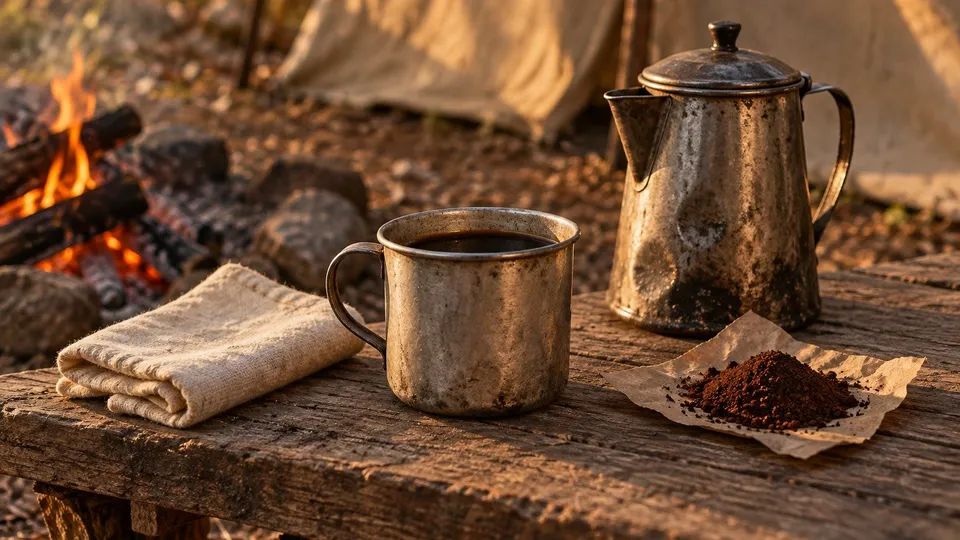
The cow camps drank it black. McCoy watched the hands “stow away one or more quarts of the strongest coffee imaginable, without sugar or cream, indeed you would hesitate, if judging it from appearance, whether to call it coffee or ink.” “The coffee-pot, the camp kettle and the skillet,” he added, “are the only culinary articles used.” In Adams’s novel, the trail boss hands out “a package of Arbuckle coffee” as a gift.
Stage-road coffee was worse. Burton’s prairie breakfast began with “the coffee—three parts burnt beans, which had been duly ground to a fine powder and exposed to the air, lest the aroma should prove too strong for us.” In Utah, he reported, “coffee of 10 cents per lb. in the States here costs 40-50 cents,” about $3.60 against $14 to $18 a pound in today’s money, so “burnt beans or toasted corn” usually took its place.
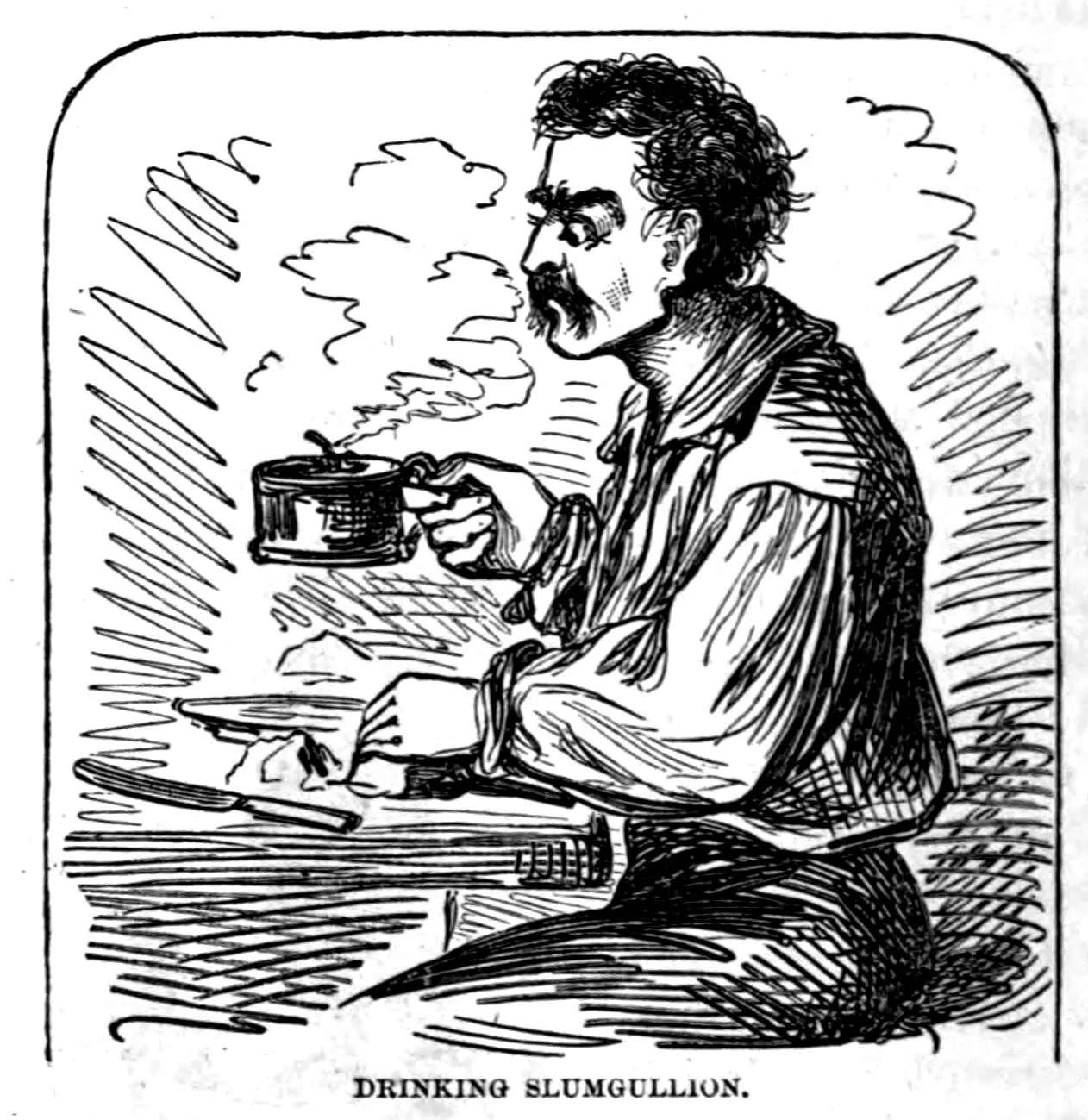 “Drinking Slumgullion,” wood engraving from Mark Twain, Roughing It (Hartford: American Publishing Co., 1872), p. 44.
At one station in 1861, Twain’s host poured a “Slum-gullion” that “really pretended to be tea, but there was too much dish-rag, and sand, and old bacon-rind in it to deceive the intelligent traveler.” Twain asked for coffee instead, and the station-boss glared: “Coffee! Well, if that don’t go clean ahead of me, I’m d——d!” The passengers gave up the meal and paid “our dollar apiece” for it, about $36 today. Tea made with care, the next year’s Army way, is our Camp Tea: leaves wetted a minute ahead, a minute’s boil under a lid, and five minutes by the fire.
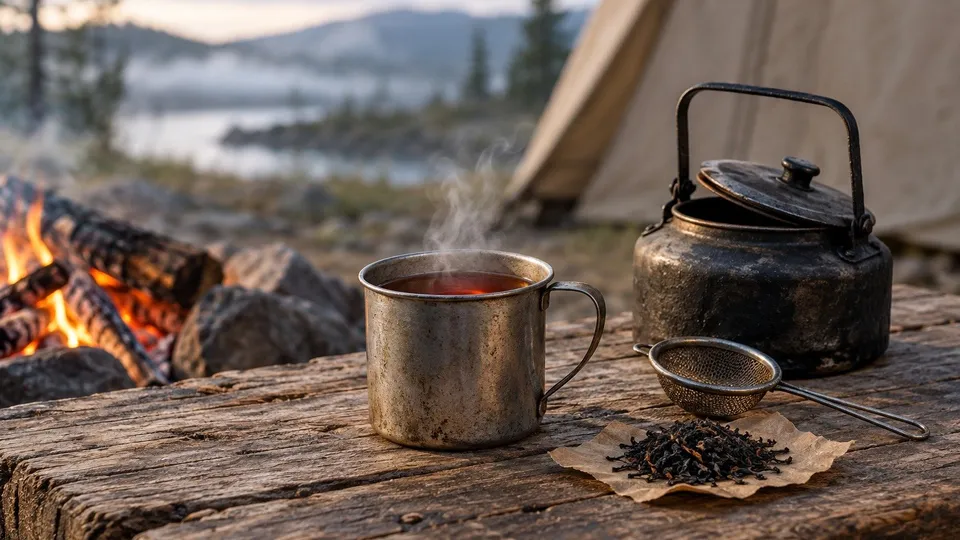 Always alcohol-freeCamp Tea, the Union Army Way of 1862
Lemonade from a jar
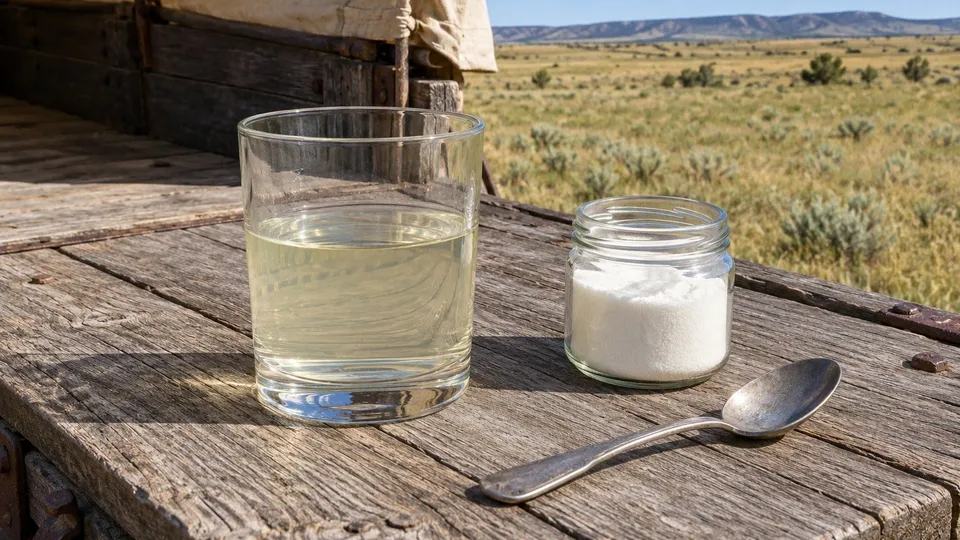
For something cold without alcohol, the trail had its own answer. Marcy told travelers short of vegetables to carry citric acid against scurvy, because it “answers a good purpose, and is very portable. When mixed with sugar and water, with a few drops of the essence of lemon, it is difficult to distinguish it from lemonade.” Thomas printed the same three ingredients, by weight, among the temperance drinks in his 1862 book as Lemonade Powders: a pound of sugar, an ounce of acid and twenty drops of essence of lemon, kept “very dry.” With an ounce of carbonate of soda in the batch, it fizzed. His Soda Nectar does the same with fresh lemon juice, sugar and water, to be drunk “while the mixture is in an effervescing state.”
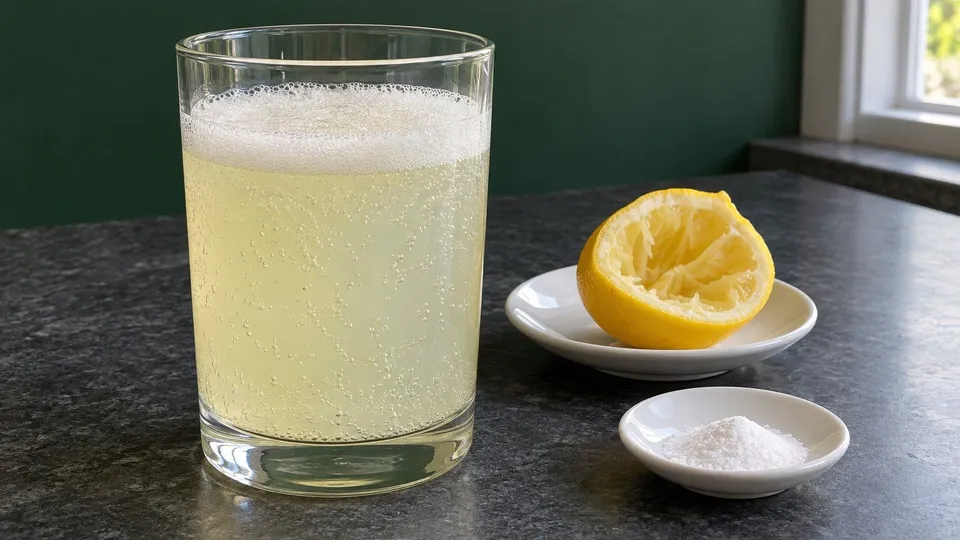 Always alcohol-freeSoda Nectar, Fizzy Lemonade by the Glass
The film cowboy who walks into a saloon and orders sarsaparilla has no period source behind him in any of these accounts. Root beer and its brewed cousins, the Victorian non-alcoholic beers, were real, but a home brew was not always free of alcohol. In 1916 the Philadelphia pharmacist Charles LaWall measured a bottled root beer as it stood: 1.52 percent alcohol after eleven days, and no higher ten days later. Batches he left standing three hours before bottling, in bottles filled only part way, reached 1.77 percent. Root beer mixed from syrup and carbonated water at the soda fountain was another matter: he put the alcohol from its extract at no more than 0.05 percent. The mining towns made their own soda water, and one of their soda works still stands, as The Stone Soda Works of Hangtown tells.
Of all these drinks, the trail lemonade is the easiest to make today: a bag of superfine sugar, a packet of food-grade citric acid and a few drops of lemon oil make a batch of Lemonade Powders good for about eighteen glasses, five minutes’ work.
Saloon drinks you can make
Most saloon whiskey was drunk straight, so the closest drink to the bar is a plain pour. The mixed drinks below come from Jerry Thomas’s bar books, which puts them nearer a city bar with ice than a mining-camp saloon, and the last one needs no bar at all.
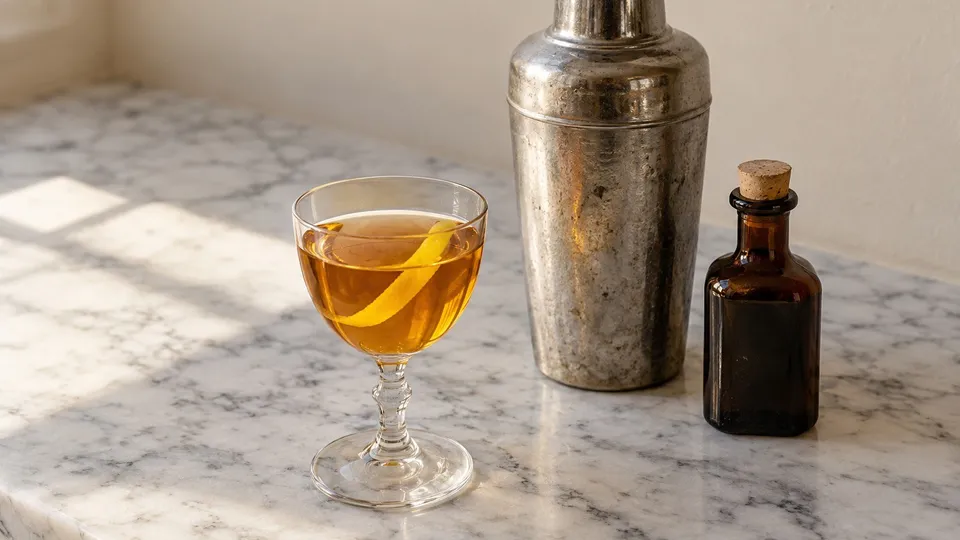 Cook this recipe: The 1862 Whiskey Cocktail Behind the Old Fashioned.
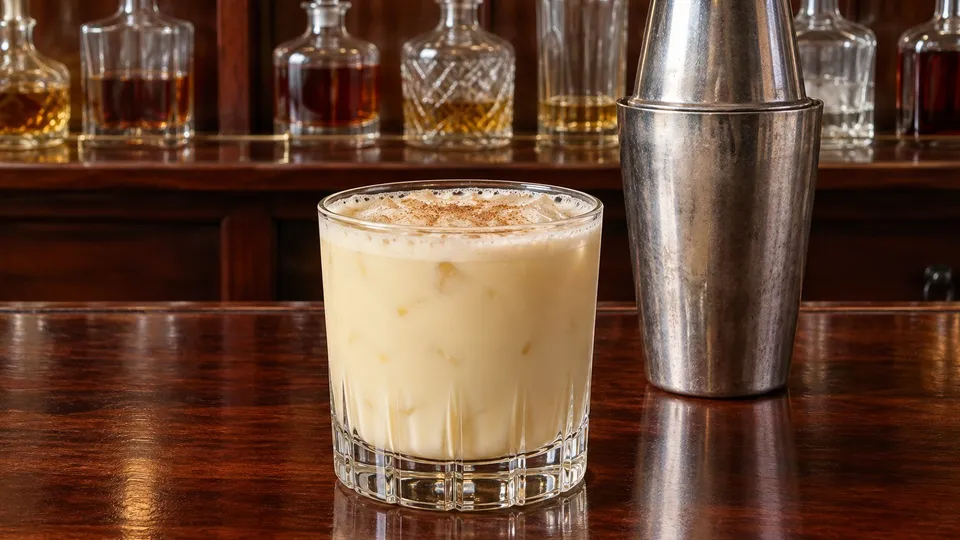 Cook this recipe: Egg Nogg, the 1862 Bar Eggnog.
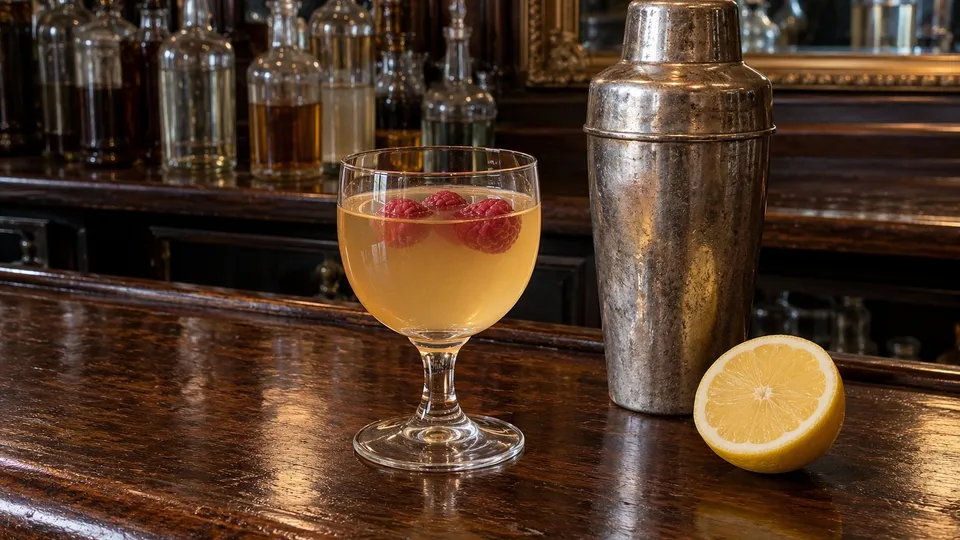 Cook this recipe: Whiskey Sour, the 1887 Bar Recipe.
 Cook this recipe: Lemonade Powders, the Trail Lemonade of 1862.
What was the most popular drink in the Old West?
Whiskey, poured straight at two bits a glass (about $8.30 today, by US consumer prices), in the saloon. Away from the bar, on the trail, at the stage stations and in the cow camps, it was coffee.
Did they drink real whiskey in saloons?
Often it was local, blended or doctored. Rectifying, mixing spirit with other materials and selling it as whiskey, was a legal trade with a federal name from 1862. Burton found Utah’s wheat whiskey “generally pure” and the “Cognac” beside it half alcohol and half water, colored with burnt sugar.
Did cowboys order sarsaparilla in saloons?
Not in any account used here. The cowboy who orders sarsaparilla at the bar comes from the films. Root beer and its cousins were real drinks, but none of these sources puts one on a saloon counter.
What did cowboys drink on the trail?
Black coffee, by the quart. Joseph McCoy, writing of the cow camps, described “the strongest coffee imaginable, without sugar or cream.” Emigrants who wanted something cold could stir lemonade from citric acid and sugar, as Marcy’s handbook told them.
That cup is the one to make: our Camp Coffee, the Union Army Way of 1862 boils the grounds two minutes and settles them with a splash of cold water, and it is the closest recipe we have to the black coffee McCoy found in the cow camps.
 Always alcohol-freeCamp Coffee, the Union Army Way of 1862
For what was on the plate, our sister site The Forgotten Menu has the bread baked at Fort Larned in 1868 (opens in a new tab).
Sources
- Andy Adams, The Log of a Cowboy: A Narrative of the Old Trail Days (Boston: Houghton Mifflin, 1903), pp. 141, 334–335. A novel.
- Richard F. Burton, The City of the Saints, and Across the Rocky Mountains to California (New York: Harper, 1862), pp. 24, 84, 320.
- Edward R. Emerson, Beverages, Past and Present, vol. 2 (1908), p. 248.
- Rudyard Kipling, From Sea to Sea: Letters of Travel, vol. 1 (Toronto: G. N. Morang, 1899), pp. 440–441, 455–456.
- Randolph B. Marcy, The Prairie Traveler (New York: Harper, 1859), pp. 33, 36.
- Charles H. LaWall, “The Percentage of Alcohol in Home-Made Root Beer,” American Journal of Pharmacy 88 (August 1916), pp. 355–358.
- Joseph G. McCoy, Historic Sketches of the Cattle Trade of the West and Southwest (Kansas City: Ramsey, Millett & Hudson, 1874), pp. 10, 138.
- Carry A. Nation, The Use and Need of the Life of Carry A. Nation (Topeka: F. M. Steves, 1904), p. 47.
- George F. Ruxton, Adventures in Mexico and the Rocky Mountains (New York: Harper, 1848), p. 200.
- Bayard Taylor, Eldorado, or, Adventures in the Path of Empire (New York: Putnam, 1856 printing), pp. 118, 255.
- Jerry Thomas, How to Mix Drinks, or, The Bon-Vivant’s Companion (New York: Dick & Fitzgerald, 1862), title page, pp. 40, 50, 83–86.
- Jerry Thomas, The Bar-Tender’s Guide (New York, 1887), p. 40.
- Mark Twain, Roughing It (Hartford: American Publishing Co., 1872), pp. 43–45, 336, 339–340, 403–404.
- Harvey W. Wiley, Beverages and Their Adulteration (Philadelphia: Blakiston, 1919), pp. 293–294, 397.
- William Bronson, “Secrets of Pisco Punch Revealed,” California Historical Quarterly 52, no. 3 (1973), pp. 229–240, as summarized by JSTOR Daily; “‘Pisco Punch’ Secret Lost,” San Francisco Chronicle, February 10, 1926, as reprinted on Alcademics (the original page not seen); Wikipedia, “Pisco punch” (accessed October 21, 2026). Cited, not quoted.
- “A dispute with the bartender,” photograph, c. 1907, Library of Congress, Prints and Photographs Division, https://www.loc.gov/item/2012649630/ (opens in a new tab).
- Ed. Tangen, “The Thirsty Cowpuncher,” stereograph (Boulder, Colo., 1907), Library of Congress, Prints and Photographs Division, https://www.loc.gov/item/2004682069/ (opens in a new tab).