What Was Valley Tan?
Valley Tan was the Salt Lake Valley’s word for anything homemade, above all its raw wheat whiskey, praised by Richard Burton and mocked by Mark Twain.
Valley Tan was the Salt Lake Valley’s word for anything made at home, and the thing it stuck to hardest was the local whiskey. In the 1850s and 1860s Utah’s settlers distilled it from wheat, and travelers on the overland road met it at the stage stations and in Salt Lake City. Richard Burton, who came through in 1860, found it “generally pure.” Mark Twain, a year later, joked that it was made of “(imported) fire and brimstone.” No recipe for it survives, so what we know comes from those two writers and from the advertisements and complaints in the city’s army newspaper.
This story is part of our Wild West Drinks guide.
Why was it called Valley Tan?
Burton gives the reason in a footnote. At the Green River stage station, in what is now Wyoming, he noticed “a store where Mr. Burton (of Maine) sells ‘Valley Tan’ whisky,” and he explained the name at the foot of the page: “Tannery was the first technological process introduced into the Mormon Valley: hence all home industry has obtained the sobriquet of ‘Valley Tan.’”
So the word first meant local leather, then anything local. Salt Lake City even had a newspaper called The Valley Tan from 1858 to 1860. Twain knew the wider meaning too, which is why he hedged: “Valley tan (or, at least, one form of valley tan) is a kind of whisky, or first cousin to it”. By the time he wrote, the whiskey was the one form most people meant.
A whiskey made from wheat
Burton, the English explorer, took Utah’s distilling seriously enough to compare it with the East’s. “The whisky of Utah Territory, unlike the Monongahela or rye of Pennsylvania, and the Bourbon, or maize brandy of Kentucky, is distilled from wheat only; it is, in fact, the korn schnapps of the trans-Rhenine region.” A German grain spirit, in other words, more than an American whiskey.
He thought it the better choice in Salt Lake City: “This ‘Valley Tan,’ being generally pure, is better than the alcohol one part and water one part, colored with burnt sugar and flavored with green tea, which is sold under the name of Cognac.” That is faint praise, measured against a fake brandy, and he did not stop there. “Ale and cakes are in higher flavor than the ‘villainous distillation,’” he added, and the valley had “two large and eight small breweries in which a palatable Lager-bier is made.”
Nobody recorded how long it was kept before it was sold, how strong it was, or whether it saw a barrel at all. Burton’s “wheat only” is one traveler’s report from one year. The way he compares it with schnapps and with burnt-sugar cognac suggests a clear, raw spirit, but that is a reading of his words, not something he says.
A “squar’ drink” with Porter Rockwell
Burton also drank it, and in famous company: with Orrin Porter Rockwell, Brigham Young’s bodyguard and a much-argued-over figure in Utah’s history, whom Burton calls both “Peter” and “Porter.” Rockwell “sent to the neighboring distillery for a bottle of Valley Tan,” and it arrived discreetly: “The aguardiente was smuggled in under a cloth.” The company was invited to join him in a “squar’ drink,” which Burton glosses as “spirits without water.”
The toast was a single word, “Wheat!”, “that is to say, ‘good,’” Burton explains, and by his count they had “at least four” of them. Those are the only details he gives. The legends that gathered around Rockwell are another subject; for the drink, Burton’s page is the whole record.
“Made of (imported) fire and brimstone”
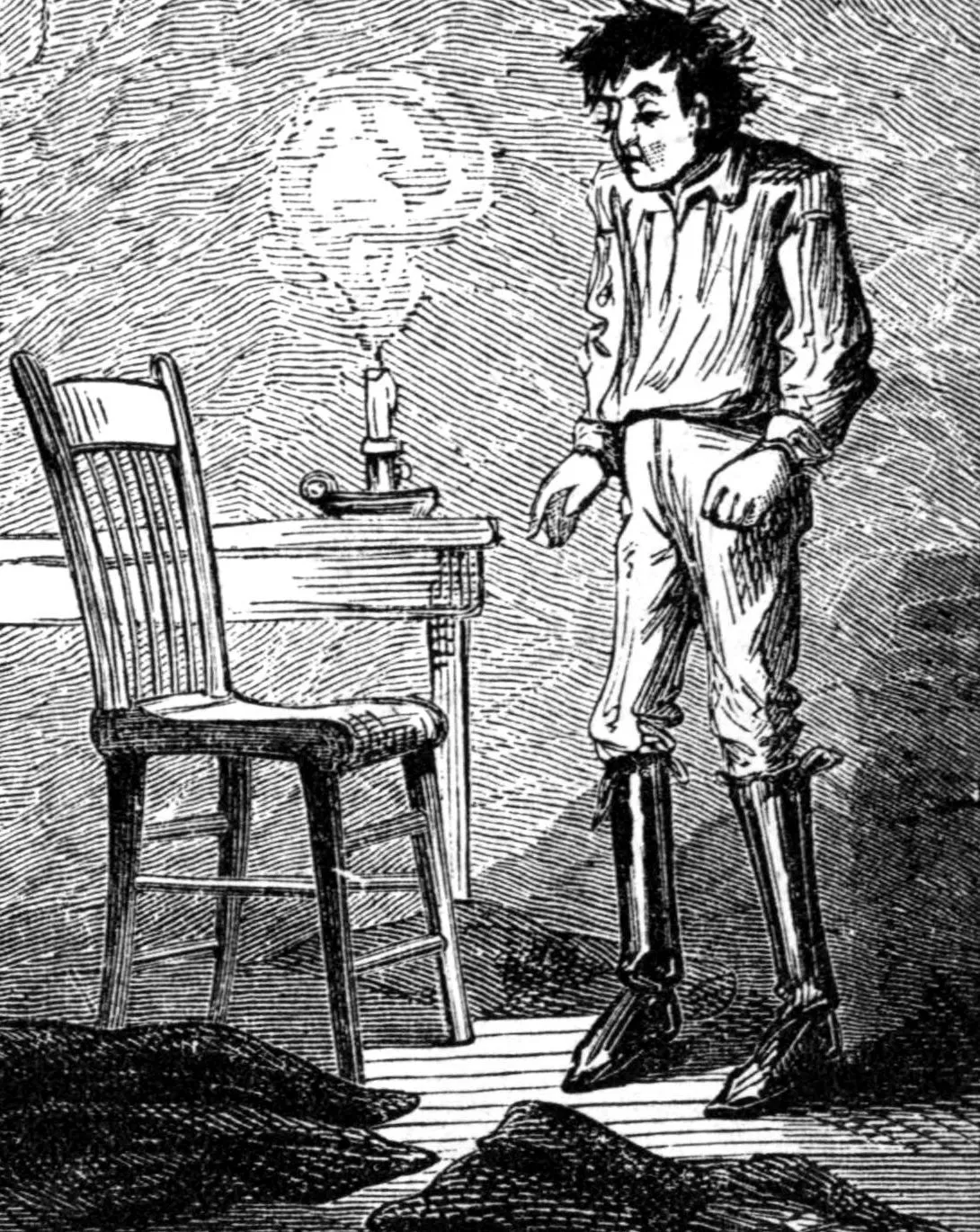
Twain crossed in the summer of 1861 and wrote it up ten years later in Roughing It (1872). His Valley Tan comes in a comic scene. While the travelers spent an hour with the town’s “Gentiles,” the non-Mormons, their fellow passenger Bemis “took care of himself,” and came back to the hotel room “about eleven o’clock, full of cheerfulness, and talking loosely, disjointedly and indiscriminately,” hanging his coat and vest on the floor on either side of a chair. The engraving at the top of this page shows the result, captioned “Effects of ‘Valley Tan.’”
“It was the exclusively Mormon refresher, ‘valley tan,’” Twain wrote, and after a sentence on what it was, he went on: “Tradition says it is made of (imported) fire and brimstone. If I remember rightly no public drinking saloons were allowed in the kingdom by Brigham Young, and no private drinking permitted among the faithful, except they confined themselves to ‘valley tan.’” It is a joke, told from memory a decade later, and it should be read as one, not as an account of what the church allowed. What it does show is that by 1861 an outsider arriving in Salt Lake City heard about the local whiskey almost at once.
Sold by the quart
The Union Vedette, the newspaper of the US Army post at Camp Douglas above the city, had nothing kind to say about it. The paper was hostile to the Mormon leadership, and its claims are its own. In March 1864 it complained of “a public semi-official institution on the most prominent thoroughfare, where ‘liquid damnation’ otherwise yclept Valley Tan is vended by the quart. Salt Lake City, unlike other places of equal magnitude, is remarkable for the fact that there is not within its bounds a single dram shop where a drink of spirits can be purchased.”
According to the Vedette, the store belonged to a high city official who was also a church dignitary, and since it sold nothing smaller than a quart, its customers drank in the street. Whether or not that was fair, it fits Twain’s half-remembered picture: Valley Tan was sold, but the city did not have saloons in the way a mining town did.
Pure, or “worked over”
A year later a saloon keeper turned Valley Tan into a selling point. W. L. Sholes of the United States Saloon took space in the Vedette on March 18, 1865:
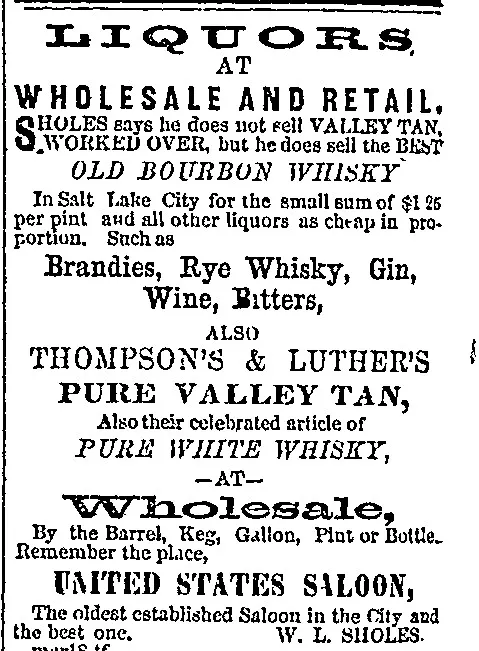 W. L. Sholes’s advertisement for the United States Saloon in the Union Vedette (Camp Douglas, Salt Lake City), March 18, 1865, p. 2. Utah Digital Newspapers.
“SHOLES says he does not sell VALLEY TAN, WORKED OVER,” it begins, before offering “the BEST OLD BOURBON WHISKY In Salt Lake City for the small sum of $1.25 per pint.” That is about $26 a pint in today’s money, by the US consumer price index, though the army paid in paper greenbacks and everything in Utah cost more than in the East. Lower down, the same advertisement offers “THOMPSON’S & LUTHER’S PURE VALLEY TAN” and “PURE WHITE WHISKY,” by “the Barrel, Keg, Gallon, Pint or Bottle.”
So by 1865 Valley Tan was a trade product with makers’ names on it, sold wholesale by the barrel, and buyers knew to worry about it. “Worked over” probably meant spirit that had been doctored or redistilled after it left the maker, the same fear Burton had about the burnt-sugar cognac. Sholes’s answer was to sell the “pure” kind by name. Whether Thompson and Luther’s “white whisky” was unaged, as the word suggests today, the advertisement does not say.
What was in the glass
Put together, the sources describe a clear wheat spirit made in the valley, drunk neat, sold by the quart in the city and by the barrel to the trade, rough enough for a joke and pure enough, at its best, to beat the fake brandy. They do not give a mash bill, a strength or a single tasting note beyond “Wheat!” There is no Valley Tan recipe to make, and we have not invented one.
What the rest of the frontier drank, from tangle-leg to trail coffee, is in What Did People Drink in a Wild West Saloon?. Travelers who stayed off the spirit on the same road could stir up Lemonade Powders from a jar.
 Always alcohol-freeLemonade Powders, the Trail Lemonade of 1862
For a taste of what a city bar did with whiskey two years after Burton drank with Rockwell, make Jerry Thomas’s 1862 Whiskey Cocktail: the plain drink of whiskey, gum syrup and bitters, later called the Old Fashioned, shows how much a little sugar and bitters could do for a raw spirit.
 Make it todayThe 1862 Whiskey Cocktail Behind the Old Fashioned
Sources
- Richard F. Burton, The City of the Saints, and Across the Rocky Mountains to California (New York: Harper, 1862), pp. 170, 320, 449.
- Mark Twain, Roughing It (Hartford: American Publishing Co., 1872), ch. 13, pp. 108–109.
- “A Public Nuisance,” Union Vedette (Camp Douglas, Salt Lake City), March 21, 1864, p. 2, Utah Digital Newspapers, https://newspapers.lib.utah.edu/details?id=21200431 (opens in a new tab).
- W. L. Sholes, advertisement, Union Vedette (Camp Douglas, Salt Lake City), March 18, 1865, p. 2, Utah Digital Newspapers, https://newspapers.lib.utah.edu/details?id=21212348 (opens in a new tab).