Camp Coffee, the Union Army Way of 1862
Reader ratingsGround coffee boiled two minutes, settled with a splash of cold water and strained through flannel: the coffee a Union commissary taught company cooks in 1862.
- Recipe makes
- 2 cups, about 8 fl oz each
- Prep
- Cook
- Total
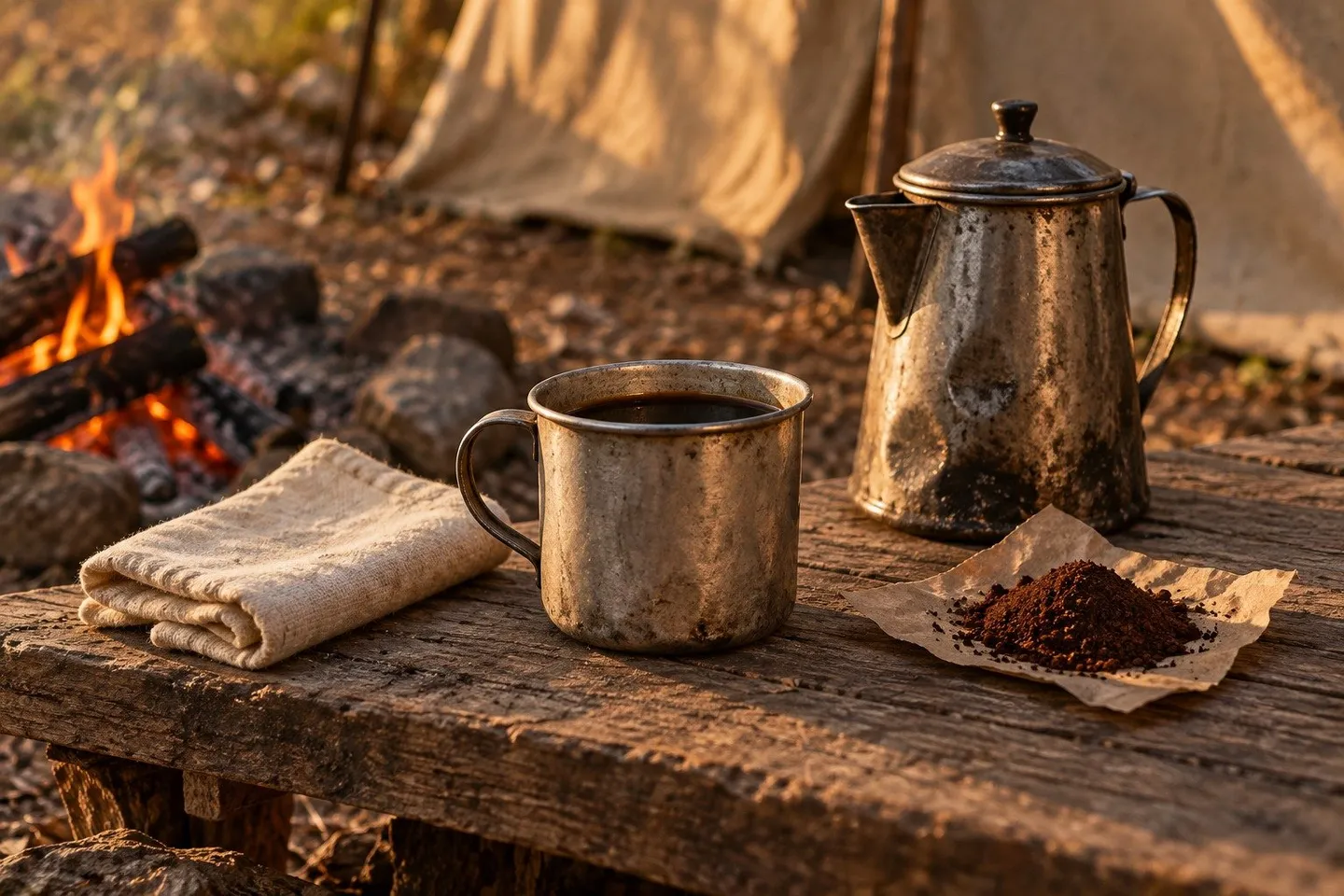
Camp coffee in a tin cup beside a dented coffee pot and grounds on brown paper, by a campfire and tent.
The story behind the recipe
Sanderson told Union company cooks to boil coffee in the kettle, settle it with a dash of cold water and pour it off through flannel. James M. Sanderson, a captain and commissary of subsistence of volunteers, set it down for the company cooks of the Army of the Potomac in a government pamphlet of January 1862: “Of all the articles of diet afforded the soldier none is more important or popular than his coffee.”
A ration, not a cup
The coffee came as an ingredient. The Army’s regulations of 1861 allowed 10 pounds of coffee and 15 pounds of sugar to every 100 rations, about 45 grams of coffee a man a day, and someone still had to roast, grind and boil it. Sanderson wanted each company to buy a small roaster, a mill and a strainer from the company fund, and to scour the kettles “with ashes and hot water.” For a whole company he measured out “so many rations of water,” plus five more “for lee-way,” so the coffee lost nothing in strength or quantity. John D. Billings, a veteran writing in 1887, remembered it less neatly: company coffee that was often poor, and men brewing their own in tin cans with wire handles.
Read more about this recipe
Making it today
Sanderson gives no weight of coffee for the kettle, so the half ounce to two cups here is our choice. Ready-ground coffee stands in for his roasting and double grinding. A pan with room to spare replaces his kettle filled “very nearly to the top,” which would boil over on a stove. It is alcohol-free; add sugar at the table if you like.
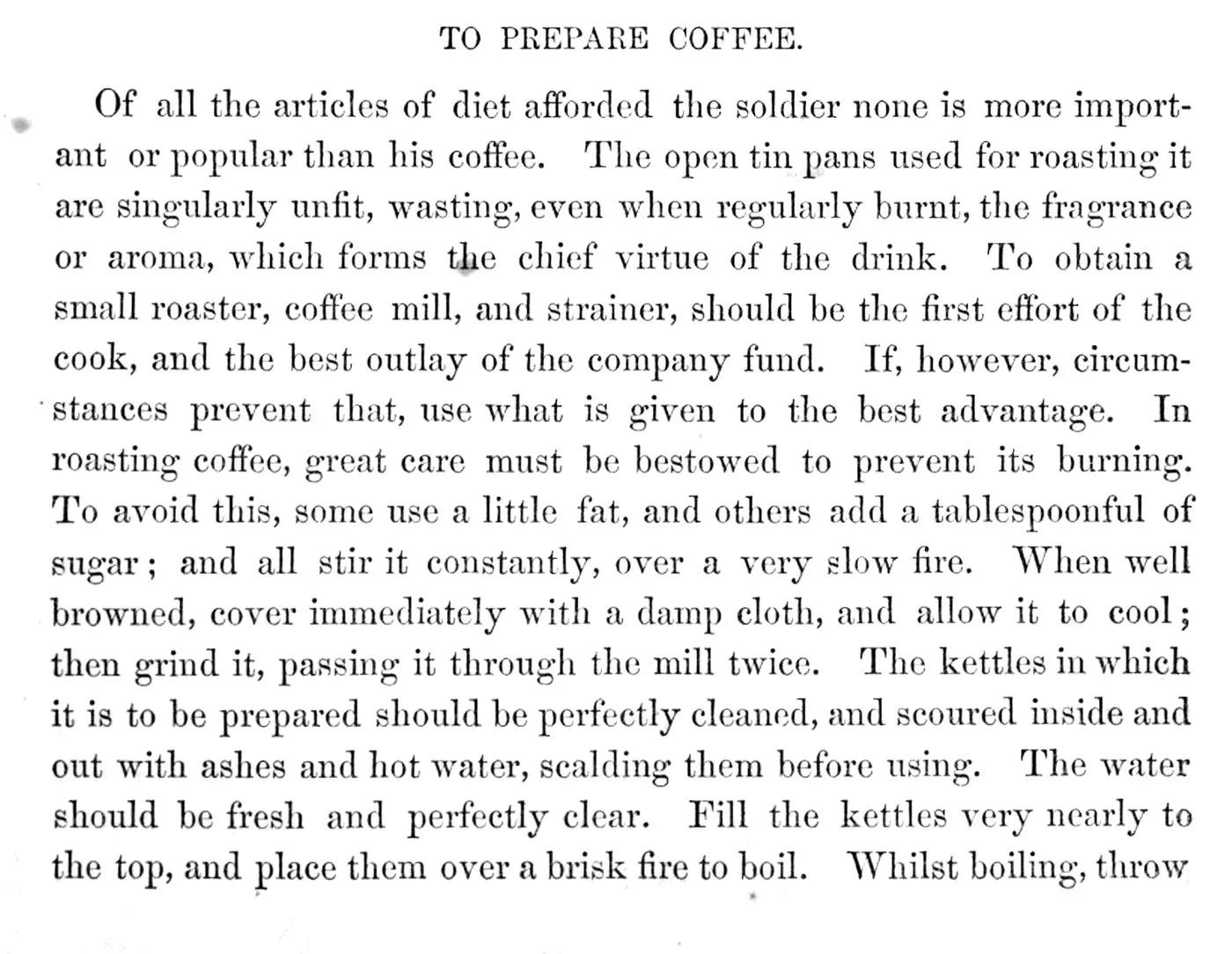
Of all the articles of diet afforded the soldier none is more important or popular than his coffee. The open tin pans used for roasting it are singularly unfit, wasting, even when regularly burnt, the fragrance or aroma, which forms the chief virtue of the drink. To obtain a small roaster, coffee mill, and strainer, should be the first effort of the cook, and the best outlay of the company fund. If, however, circumstances prevent that, use what is given to the best advantage. In roasting coffee, great care must be bestowed to prevent its burning. To avoid this, some use a little fat, and others add a tablespoonful of sugar; and all stir it constantly, over a very slow fire. When well browned, cover immediately with a damp cloth, and allow it to cool; then grind it, passing it through the mill twice. The kettles in which it is to be prepared should be perfectly cleaned, and scoured inside and out with ashes and hot water, scalding them before using. The water should be fresh and perfectly clear. Fill the kettles very nearly to the top, and place them over a brisk fire to boil. Whilst boiling, throw in the coffee, which should be slightly moistened before with warm (not hot) water; and, stirring it into the water, let it boil up briskly for two minutes; then dash in a cup of cold fresh water, and take it off the fire immediately. Let it stand five minutes, to allow the grains to settle, and then pass it slowly through a flannel strainer into another kettle, from which it is served. By this mode alone can the coffee be prevented from being impregnated with the dust formed by grinding it, and make it palatable and wholesome. Whatever number of men may have to be served, measure out carefully so many rations of water, adding five for lee-way, so that it may lose nothing in strength or quantity.

Recipe makes: 2 cups, about 8 fl oz each
Ingredients
For 2 cups, about 8 fl oz each. Quantities are shown as written.
Quantities as written here, for 2 cups, about 8 fl oz each.
- Ground roasted coffee3 tbsp
- Water1 3/4 cups
- Warm water1 tbsp
- Cold water1 tbsp
Measurement notes
Ingredients as written here
- 3 tbsp ground roasted coffee
- 1 3/4 cups water
- 1 tbsp warm water
- 1 tbsp cold water
Equipment
 Saucepan
 Coffee filter
 Jug
Instructions
Rinse the saucepan, jug and cloth filter with boiling water.
Moisten the ground roasted coffee with the warm water.
Bring the water to a brisk boil, stir in the damp grounds and let it boil for 2 minutes, watching that it doesn’t boil over.
Add the cold water and take the pan off the heat at once.
Leave it for 5 minutes so the grounds settle.
Pour slowly through the cloth filter into the jug, leaving the heavy sediment behind, then top up with hot water to the full yield and serve black.
Nutrition
2calories per serving
- Recipe makes
- 2 cups, about 8 fl oz each
- Servings
- 2
USDA SR26 report 14209, brewed coffee, about 2 kcal per 8 fl oz cup, black.
Recipe notes
When adjusting quantities
Sanderson gives no ratio of coffee to water. Keep about 1/2 oz (14 g) of ground coffee to each 2 cups of finished coffee.
Notes
Quantities mentioned in these notes don’t change when you adjust the batch.
Changes from the source: the 3 tablespoons (about 14 g) of coffee, all the water amounts and the top-up to 2 cups are ours, since Sanderson gives no ratio. Store-bought ground coffee replaces his roasting (with a little fat or a spoonful of sugar to stop it burning), cooling under a damp cloth and grinding twice. Washing up replaces scouring with ashes. His “cup of cold fresh water” is for a company kettle; a tablespoon does the same job in a small pan.
His closing rule, “adding five for lee-way,” means five extra rations of water for the kettle, not five percent. He doesn’t say how much water a ration was.
The navy’s side of the ration, where the grog was halved and tea given out in 1824, is in Half the Grog and a Pint of Tea. For his tea, made in the same kind of kettle, see Camp Tea, the Union Army Way of 1862.
Scaling changes the ingredients only; glassware, ice and timings need their own judgment. To adapt this recipe further, try the recipe tool at TuneMyRecipe (opens in a new tab), our sister site.
Sources and attribution
James M. Sanderson, Camp Fires and Camp Cooking; or, Culinary Hints for the Soldier (Washington: Government Printing Office, 1862), “To Prepare Coffee”, pp. 11–12
Recipe details
- Drink
- Alcohol-free
- Drink family
- Hot Drinks
- Region
- American
- Era
- 19th century
- Difficulty
- Easy