The 1862 Whiskey Cocktail Behind the Old Fashioned
Reader ratingsGum syrup, two dashes of bitters and a wine-glass of whiskey, shaken with fine ice and strained over a piece of lemon peel: Jerry Thomas’s 1862 Whiskey Cocktail, the plain drink later called the Old Fashioned.
- Recipe makes
- 1 drink, about 3 fl oz
- Prep
- Total
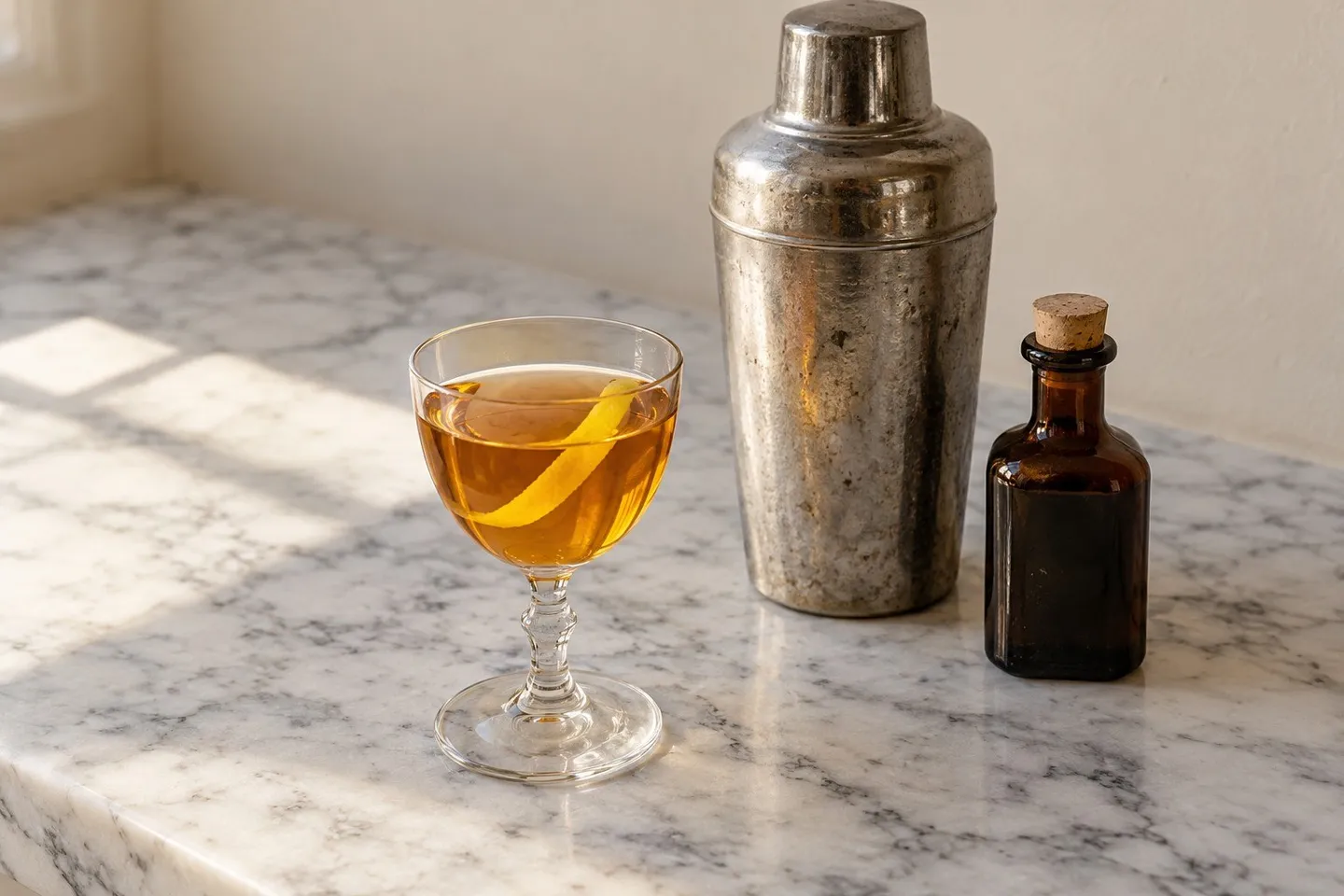
The 1862 whiskey cocktail strained into a small stemmed wine glass, with a twist of lemon peel.
The story behind the recipe
The original Old Fashioned is the plain whiskey cocktail: whiskey, sugar, water and bitters, with a piece of lemon peel. The oldest recipe for it in a bar book is No. 109 in Jerry Thomas’s How to Mix Drinks of 1862: three or four dashes of gum syrup, two of Bogart’s bitters and a wine-glass of whiskey, shaken with fine ice and strained into a wine glass, with a piece of lemon peel. That is the version below. The name came later, once newer cocktails had made the plain one old-fashioned.
How a cocktail got old
Those four parts are the oldest definition of a cocktail on record. On May 13, 1806, a Hudson, New York, paper, The Balance and Columbian Repository, answered a reader who wanted to know what a cock-tail was: “a stimulating liquor, composed of spirits of any kind, sugar, water, and bitters.” The editor added that it was good for electioneering, since a man who had swallowed a glass would swallow anything.
Then the cocktail grew. The 1887 edition of Thomas’s book keeps the plain Whiskey Cocktail but adds an Improved one, with maraschino, absinthe and a twist of lemon rind. The name was in a New York paper by 1884 and in a Chicago bar book by 1888, the story told in How Old Is the Old Fashioned? By 1900, Harry Johnson’s bartenders’ manual prints an “Old Fashioned Whiskey Cocktail” built in a whiskey tumbler: a quarter teaspoon of sugar, two small lumps of ice, bitters and a wine-glass of whiskey, stirred and served “in the same glass.” Curaçao or absinthe goes in only “if required.” Louisville’s Pendennis Club is often named as its birthplace, but the earliest source we have found for that claim is from 1931.
Thomas’s No. 109 is where The Bartenders Who Wrote Down the Classic Cocktails begins, beside his note that the cocktail was “a modern invention.”
Read more about this recipe
The 1862 glass and the 1900 glass
Thomas’s wine-glass is 2 fluid ounces. With a teaspoon of syrup and the water from shaking, the drink comes to about 3 fl oz at roughly 32% ABV, a little over one and a half US standard drinks. Bogart’s bitters are long gone; Angostura is the usual stand-in. Johnson’s tumbler version, stirred over ice, is closer to the Old Fashioned bars build now; today’s orange peel and cherry came later still.
TuneMyRecipe (opens in a new tab) has a stirred version of the same 1862 recipe, and Thomas’s Whiskey Sour of 1887 adds lemon juice to the same wine-glass of bourbon or rye. Two decades on, the Manhattan of 1884 made the whiskey share its glass with Italian vermouth. The Horse’s Neck keeps the lemon peel and swaps the whiskey for ginger ale.
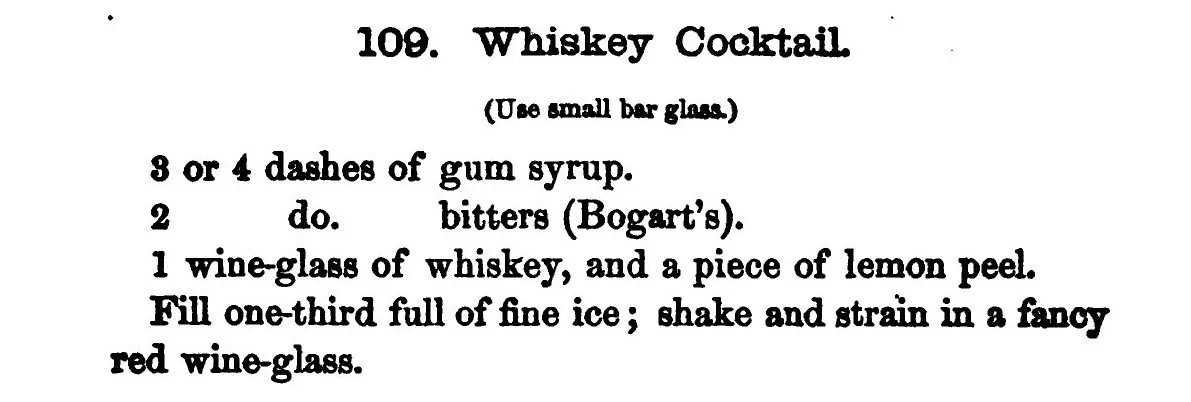
109. Whiskey Cocktail.
(Use small bar glass.)
3 or 4 dashes of gum syrup.
2 do. bitters (Bogart’s).
1 wine-glass of whiskey, and a piece of lemon peel.
Fill one-third full of fine ice; shake and strain in a fancy red wine-glass.

Recipe makes: 1 drink, about 3 fl oz
Ingredients
For 1 drink, about 3 fl oz. Quantities are shown as written.
Quantities as written here, for 1 drink, about 3 fl oz.
- Simple syrup1 tsp
- Aromatic bitters2 dashes
- Bourbon2 fl oz
- Strip lemon peel1
- Crushed ice1/2 cup
Measurement notes
Ingredients as written here
- 1 tsp simple syrup
- 2 dashes aromatic bitters
- 2 fl oz bourbon
- 1 strip lemon peel
- 1/2 cup crushed ice
Equipment
 Cocktail shaker and strainer
 Small stemmed wine glass or claret glass
 Peeler
Instructions
Pour the simple syrup, aromatic bitters and bourbon into the shaker.
Add the crushed ice, close the shaker and shake hard for about 10 seconds.
Strain into a small stemmed wine glass, with no ice in the glass.
Twist the lemon peel over the drink to release its oil, drop it in and serve.
Nutrition
165calories per serving
- Recipe makes
- 1 drink, about 3 fl oz
Estimated from USDA FoodData Central values for 90-proof whiskey and granulated sugar (for the gum syrup), plus the bitters.
Recipe notes
When adjusting quantities
This is one drink. Shake no more than two at a time so each gets enough ice.
Notes
Quantities mentioned in these notes don’t change when you adjust the batch.
Thomas only says “whiskey”; his 1887 edition names Bourbon or rye for the Improved version, so either suits. His “fancy red wine-glass” is read here as a small stemmed wine glass.
The 1900 Old Fashioned, as Harry Johnson printed it: in a whiskey tumbler, stir 1/4 tsp sugar with a few drops of water (the water is our addition) until it dissolves, add two small ice cubes, 2 or 3 dashes of aromatic bitters and 2 fl oz whiskey, and stir until well mixed. Squeeze a piece of lemon peel over the top and serve in the same glass. Johnson allows a dash or two of curaçao “if required.” The 1902 Cocktail Book makes it the same way with a lump of sugar crushed in a little hot water, and serves it with the spoon left in the glass.
Sixty years on, a London bartender kept the sugar and bitters and swapped the whiskey for non-alcoholic cider: the Jersey Cocktail.
Scaling changes the ingredients only; glassware, ice and timings need their own judgment.
Sources and attribution
Jerry Thomas, How to Mix Drinks, or, The Bon-Vivant’s Companion (New York: Dick & Fitzgerald, 1862), No. 109, “Whiskey Cocktail”, p. 50; the 1900 tumbler version from Harry Johnson, New and Improved Illustrated Bartenders’ Manual (New York, 1900), “Old Fashioned Whiskey Cocktail”, p. 242
See the original pages (scan at Internet Archive) (opens in a new tab)
Recipe details
- Drink family
- Cocktails & Mixed Drinks
- Region
- American
- Era
- 19th century
- Source decade
- 1860s
- Base
- Whisky
- Difficulty
- Easy