Soda Nectar, Fizzy Lemonade by the Glass
Reader ratingsThe juice of a lemon, three-quarters of a tumbler of water and sugar, with a little baking soda stirred in last so it foams: Jerry Thomas’s Soda Nectar of 1862.
- Recipe makes
- 1 large glass, about 240 ml
- Prep
- Total
Drink it as soon as the soda goes in; the fizz lasts less than a minute.
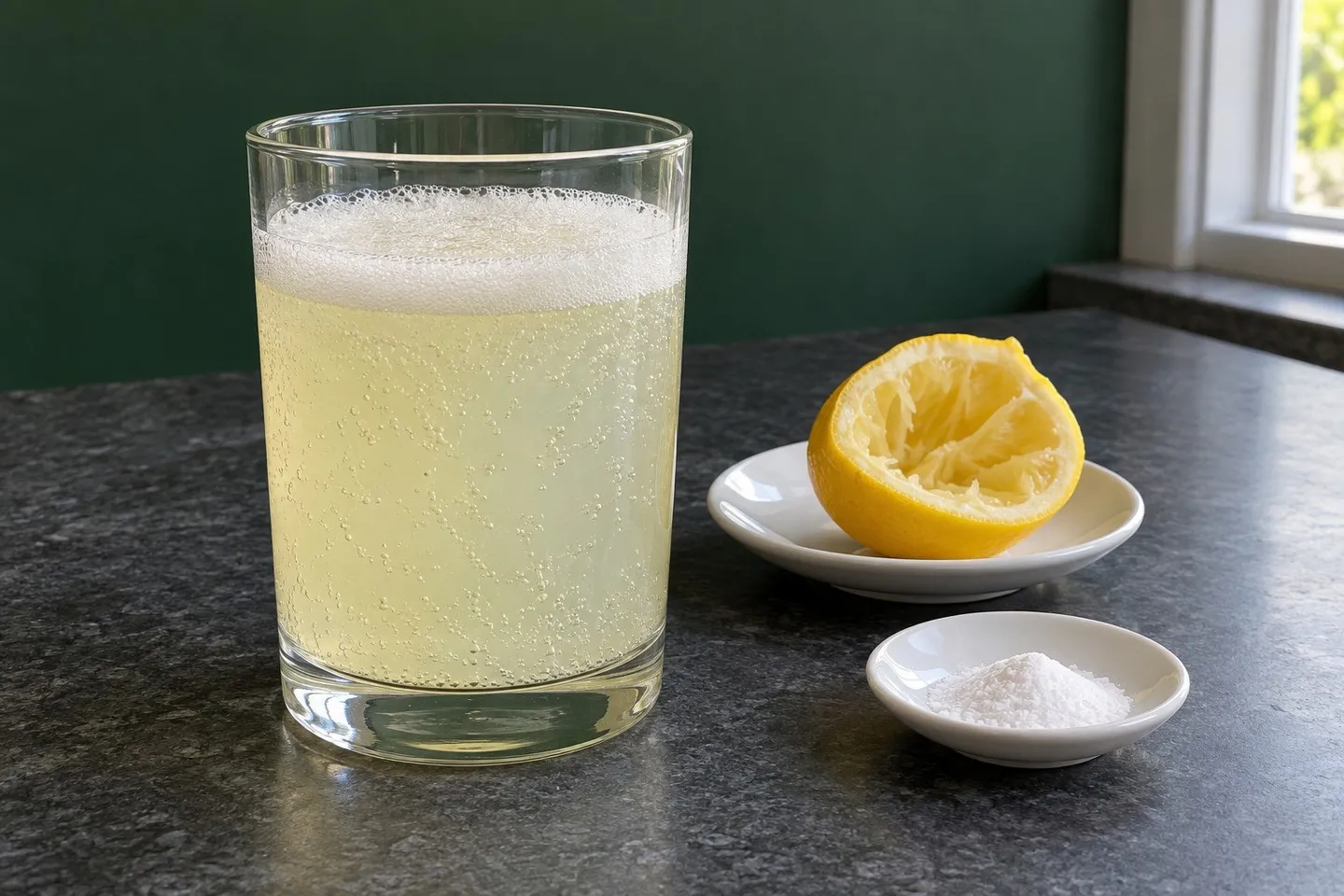
Soda Nectar foaming in a large tumbler, with a squeezed lemon half and a saucer of baking soda on a dark stone counter.
The story behind the recipe
Stir a little baking soda into a sweetened glass of lemon juice and water and it foams up on its own. Jerry Thomas called that Soda Nectar: the juice of a lemon strained into three-quarters of a tumbler of water, sweetened, then half a small teaspoon of carbonate of soda stirred in, to be drunk “while the mixture is in an effervescing state.” It is No. 228 in his How to Mix Drinks (1862), and it needs no soda-water bottle and no fountain.
A bar book’s temperance page
Thomas filed it under a heading of its own, No. 221, “Temperance Drinks.” The word did not mean free of wine. Three lemonades open the section, and two of them carry it: No. 222 is finished with a dash of port, and No. 224, a lemonade “Fine for parties,” is made “much nicer” with a little sherry. Only the one between them, No. 223, a Plain Lemonade “from a recipe by the celebrated Soyer,” is plain lemons, sugar and water.
Soda Nectar is the quick, single-glass member of the family. The “carbonate of soda” of 1862 cookery is the baking soda (sodium bicarbonate) of today. It meets the citric acid in the lemon juice and foams up at once, so the large tumbler Thomas asks for leaves room for the foam. His lemonade powders, a dry mix on the same plan, turn up beside the whiskey and the trail coffee in What Did People Drink in a Wild West Saloon?
Thomas’s No. 222, with its spoonful of raspberry or strawberry syrup over shaved ice, is close kin to the American lemonade a London book printed in 1924, which tops the glass with soda water.
(Use large tumbler.)
Juice of 1 lemon.
¾ tumblerful of water.
Powdered white sugar to taste.
½ small teaspoonful of carbonate of soda.
Strain the juice of the lemon, and add it to the water, with sufficient white sugar to sweeten the whole nicely. When well mixed, put in the soda, stir well, and drink while the mixture is in an effervescing state.

Recipe makes: 1 large glass, about 240 ml
Ingredients
For 1 large glass, about 240 ml. Quantities are shown as written.
Quantities as written here, for 1 large glass, about 240 ml.
- Fresh lemon juice (1 lemon)45 ml
- Cold water180 ml
- Superfine sugar20 g
- Baking soda1/4 metric tsp (5 ml per tsp)
Measurement notes
Ingredients as written here
- 45 ml fresh lemon juice (1 lemon)
- 180 ml cold water
- 20 g superfine sugar
- 1/4 tsp baking soda
Equipment
 Citrus juicer
 Tea strainer
 Large tumbler, about 12 fl oz
 Spoon
Instructions
Squeeze the lemon and strain the fresh lemon juice through a tea strainer into a large tumbler.
Add the cold water and the superfine sugar and stir until the sugar has dissolved. Taste, and add a little more sugar if you like.
Tip in the baking soda, stir quickly and drink at once while it foams.
Nutrition
90calories per serving
- Recipe makes
- 1 large glass, about 240 ml
Estimated from USDA FoodData Central values for fresh lemon juice and granulated sugar; the baking soda adds no calories.
Recipe notes
When adjusting quantities
This is one glass. Make each glass separately, since the fizz is over in seconds; never use more than 1/2 level tsp of baking soda per lemon.
Notes
Quantities mentioned in these notes don’t change when you adjust the batch.
Use the large glass Thomas asks for, so the foam has room.
A tumbler here is taken as 240 ml, so three-quarters is 180 ml of water. Thomas leaves the sugar “to taste”; 20 g is our choice, between one and two tablespoons. His half of a small teaspoon of soda comes to roughly 2 ml, about 2 g; we use a level quarter teaspoon, about 1.2 g, some 40% less, so the drink stays tart.
The chemistry sets the ceiling. A lemon’s 45 ml of juice holds about 2.2 g of citric acid, enough to use up about 2.9 g of baking soda, so the quarter teaspoon fizzes completely and leaves more than half the acid behind. Don’t go above half a level teaspoon (about 2.4 g) per lemon.
Each glass carries about 0.3 g of sodium, so skip it on a low-sodium diet. Sodium bicarbonate is a GRAS food ingredient under the FDA’s 21 CFR 184.1736; washing soda, which is sodium carbonate, is not a stand-in.
For a party, Thomas’s Plain Lemonade (No. 223, p. 83) makes a big still batch: slice 3 lemons thinly, bruise them in a bowl with 225 g of white or brown sugar, add 3.8 liters of water and stir well. It comes out light, about 60 g of sugar per liter.
Scaling changes the ingredients only; glassware, ice and timings need their own judgment. To adapt this recipe further, try the recipe tool at TuneMyRecipe (opens in a new tab), our sister site.

Sources and attribution
Jerry Thomas, How to Mix Drinks, or, The Bon-Vivant’s Companion (New York: Dick & Fitzgerald, 1862), No. 228, p. 85
See the original pages (scan at Internet Archive) (opens in a new tab)
Recipe details
- Drink
- Alcohol-free
- Drink family
- Sodas & Soft Drinks
- Region
- American
- Era
- 19th century
- Source decade
- 1860s
- Base
- Fruit & juice
- Difficulty
- Easy
- Season
- Summer