Camp Tea, the Union Army Way of 1862
Reader ratingsLeaves pre-steeped a minute, boiled a minute under a lid and rested five by the fire, in his method: the tea a Union commissary taught company cooks in 1862.
- Recipe makes
- 2 cups, about 8 fl oz each
- Prep
- Cook
- Total
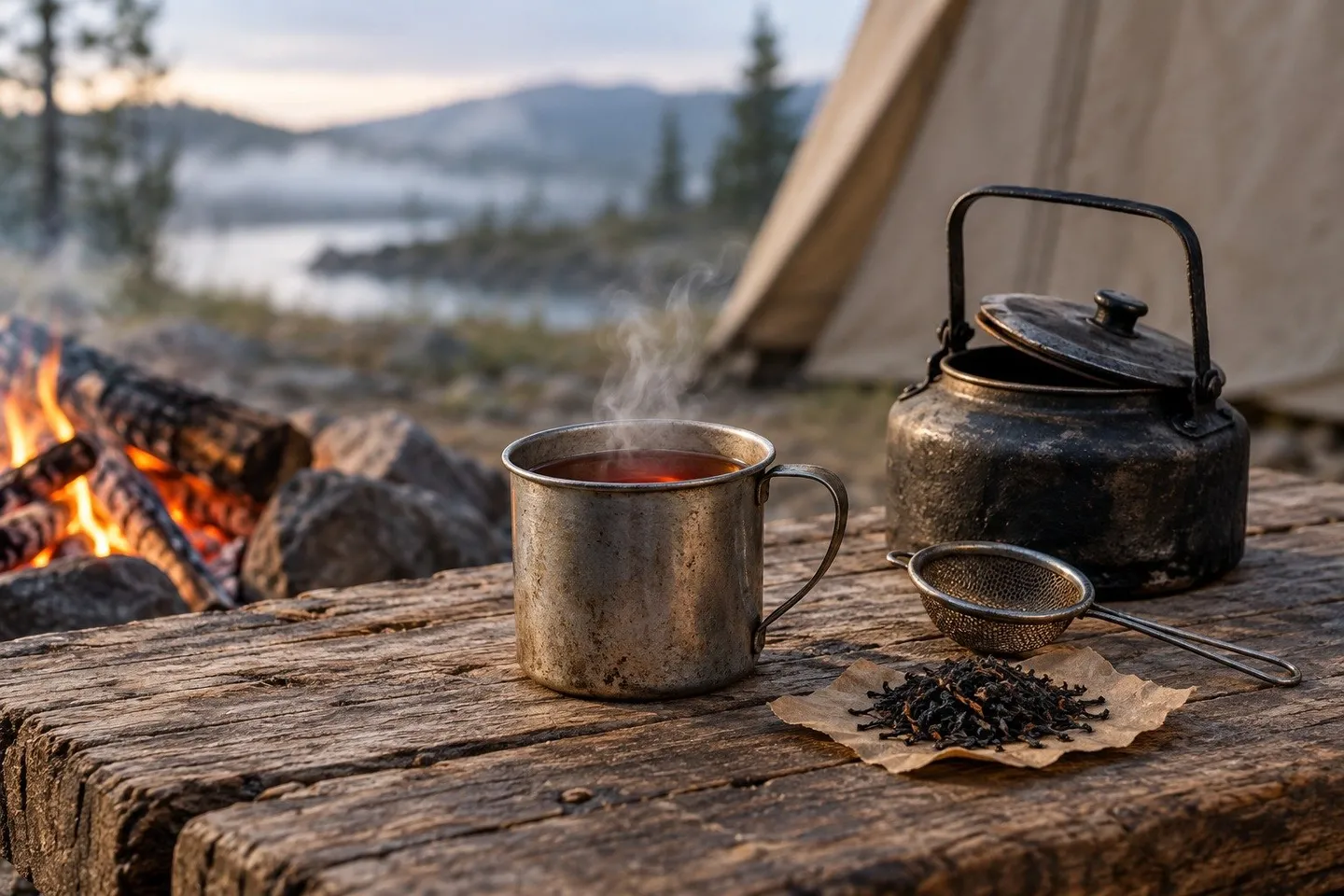
Camp tea steaming in a tin cup beside a blackened kettle, a strainer and loose tea, by a morning campfire.
The story behind the recipe
Sanderson told Union company cooks to brew tea in the kettle in three short steps: leaves wetted with boiling water a minute ahead, a minute’s boil under a lid, and five minutes standing by the fire. James M. Sanderson, a commissary of subsistence, printed the method beside his coffee in Camp Fires and Camp Cooking, a government pamphlet of January 1862 for the cooks of the Army of the Potomac. He wanted the kettles “as clean and as bright as they can be made,” the water “free from all impurities,” and the fire “bright” and “clear.”
The rarer ration
Tea was an alternative, not an extra. The Army’s 1861 regulations allowed 10 pounds of coffee or 1½ pounds of tea to every 100 rations, with the sugar. John D. Billings, a Union veteran writing in 1887, remembered tea as rare, especially outside the hospitals late in the war. The method is here because the commissary thought it worth printing, not because every company drank it. At sea, the Royal Navy halved its grog and gave out tea in 1824, as Half the Grog and a Pint of Tea tells. In camp the coffee came first, as Camp Coffee, the Union Army Way of 1862 shows.
Read more about this recipe
Making it today
Sanderson names no amount of tea or water, so 4 grams of black tea to two cups is our choice. The minute’s pre-steep is his, and so is the minute on the heat. Leave the lid slightly ajar, as his cover had “a very small hole in it.” It is alcohol-free; sugar and milk are optional.
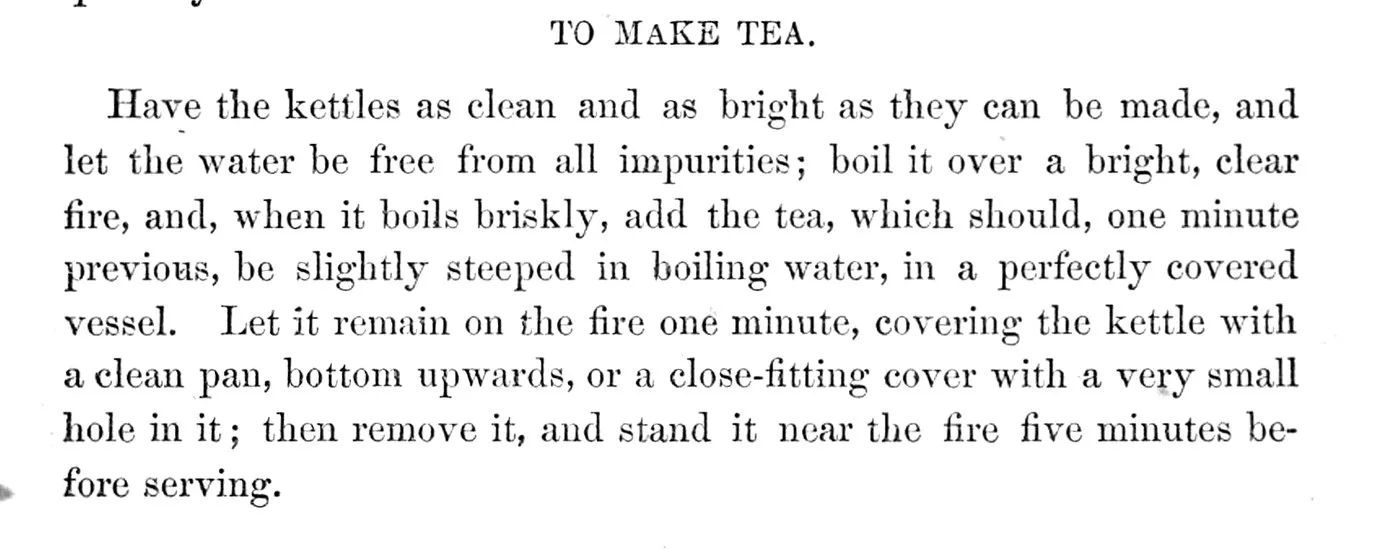
Have the kettles as clean and as bright as they can be made, and let the water be free from all impurities; boil it over a bright, clear fire, and, when it boils briskly, add the tea, which should, one minute previous, be slightly steeped in boiling water, in a perfectly covered vessel. Let it remain on the fire one minute, covering the kettle with a clean pan, bottom upwards, or a close-fitting cover with a very small hole in it; then remove it, and stand it near the fire five minutes before serving.

Recipe makes: 2 cups, about 8 fl oz each
Ingredients
For 2 cups, about 8 fl oz each. Quantities are shown as written.
Quantities as written here, for 2 cups, about 8 fl oz each.
- Loose black tea2 tsp
- Boiling water2 tbsp
- Water1 7/8 cups
Measurement notes
Ingredients as written here
- 2 tsp loose black tea
- 2 tbsp boiling water
- 1 7/8 cups water
Equipment
 Small bowl
 Saucepan
 Strainer
 Jug
Instructions
Bring the water to a brisk boil in the saucepan.
Meanwhile put the loose black tea in the small bowl, pour over the boiling water, cover and leave for 1 minute.
Add the leaves and their water to the boiling pan, set the lid on slightly ajar and keep it boiling for 1 minute.
Take the pan off the heat and let it stand, covered, for 5 minutes.
Strain into the jug, top up with hot water to the full yield if needed and serve.
Nutrition
0calories per serving
- Recipe makes
- 2 cups, about 8 fl oz each
- Servings
- 2
Plain brewed black tea, about 0 kcal per cup at label precision (Bigelow nutrition FAQ), without sugar or milk.
Recipe notes
When adjusting quantities
Sanderson gives no quantity of tea. Keep about 4 g of leaves to each 2 cups.
Notes
Quantities mentioned in these notes don’t change when you adjust the batch.
Changes from the source: the tea, its weight and all the water amounts are ours; Sanderson gives none. An off-heat rest in the covered pan replaces standing the kettle “near the fire.” Straining is ours too; he doesn’t say how the leaves were kept out of the cup.
The pre-steeping water is part of the total, so the batch comes to about 2 cups before losses.
Scaling changes the ingredients only; glassware, ice and timings need their own judgment. To adapt this recipe further, try the recipe tool at TuneMyRecipe (opens in a new tab), our sister site.
Sources and attribution
James M. Sanderson, Camp Fires and Camp Cooking; or, Culinary Hints for the Soldier (Washington: Government Printing Office, 1862), “To Make Tea”, p. 12
Recipe details
- Drink
- Alcohol-free
- Drink family
- Hot Drinks
- Region
- American
- Era
- 19th century
- Difficulty
- Easy