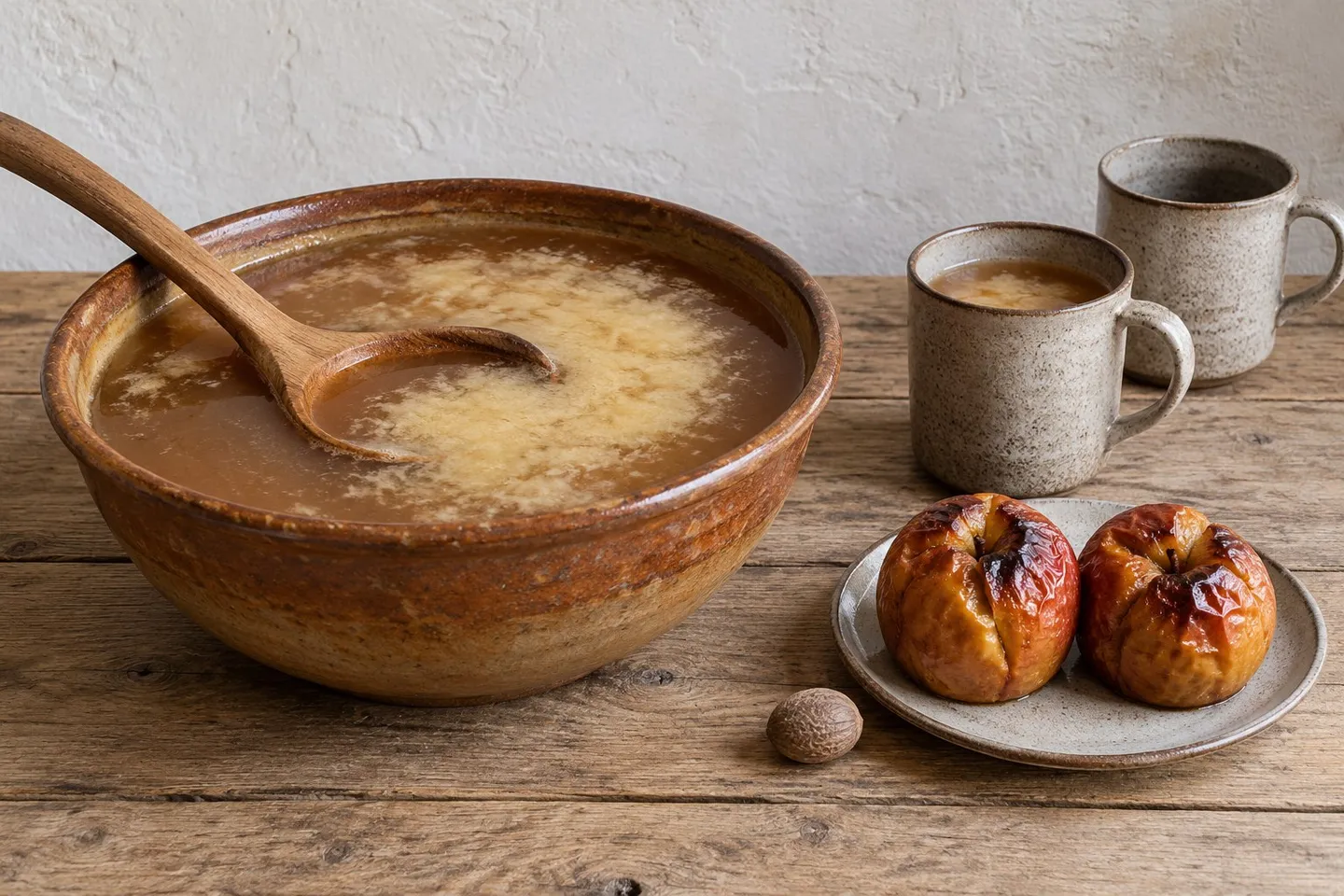
Lambswool, Hot Spiced Ale with Roasted Apples
Reader ratingsStrong hot ale with the soft pulp of roasted apples, nutmeg, ginger and raw sugar beaten in: the Elizabethan winter drink, from the 1869 recipe.
- Recipe makes
- About 900 ml, 4 mugs
- Prep
- Cook
- Total
Includes about 40 minutes for roasting the apples.
Lambswool in an earthenware bowl, with roasted apples and two mugs.
The story behind the recipe
A crab apple roasting in the fire is the first sign of lambswool on record, in a play printed in 1595. The drink is hot ale with the soft pulp of roasted apples beaten into it, sweetened and spiced with nutmeg and ginger. Neither Richard II’s cookery roll nor the fifteenth-century cookbooks edited by Thomas Austin, Richard Morris and Robina Napier mention it, and that Elizabethan line already treats it as an ordinary thing to make by the fire.
Crabs in the fire
In George Peele’s The Old Wives’ Tale, Clunch the smith gives the order: “Lay a crab in the fire to roast for lamb’s-wool.” The crab is a crab apple, small and sour. Shakespeare’s Puck plays tricks with the same thing in A Midsummer Night’s Dream: “sometime lurk I in a gossip’s bowl / In very likeness of a roasted crab,” bobbing against the drinker’s lips until “on her withered dewlap pour the ale.” In 1648 Robert Herrick’s Twelfth Night poem crowns a bowl “With gentle lamb’s wool” and tells the reader to “Add sugar, nutmeg, and ginger.”
The name is a puzzle. One plain explanation is that the apple pulp, broken up in the ale, looks like soft fleece, though no early writer says so. Cups and Their Customs (1869) has a grander one: the drink was named for “La Mas-ubal,” the first of November, “a day dedicated to the angel presiding over fruits and seeds,” later “corrupted into ‘lamb’s wool.’” It cites no source for this, so treat it as legend. The eve of that day, Halloween, is where a letter of 1784 found lambswool in Ireland, made with ale “or sometimes with milk”; Lambswool with Milk is that alcohol-free version.
Read more about this recipe
A pint and three apples
The 1869 book is also the first of these sources to set down a full recipe: a quart of “strong hot ale,” the pulp of six roasted apples, nutmeg, ginger and enough raw sugar to sweeten, stirred “assiduously” and served hot. This version halves it, keeping the British Imperial pint. A sharp cooking apple is the nearest thing to a sour crab, and it collapses to a soft pulp in the oven. Use a strong ale of about 6 to 7%; the apple dilutes it to roughly 4% ABV. Morris’s Liber cure cocorum, silent on lambswool, does have a warm, honey-sweet cup that is alcohol-free: water gruel, oat groats boiled in water with honey. Two other hot ale drinks from the same cellar are Ale Caudle and Posset Ale. Did Medieval People Really Drink Beer Instead of Water? covers the everyday ale behind all three. Herrick’s Twelfth Night wassail bowl, a mixture the eighteenth century also called lambswool, is in Wassail, from a Greeting to a Christmas Bowl.
To one quart of strong hot ale add the pulp of six roasted apples, together with a small quantity of grated nutmeg and ginger, with a sufficient quantity of raw sugar to sweeten it; stir the mixture assiduously, and let it be served hot.

Recipe makes: About 900 ml, 4 mugs
Ingredients
For About 900 ml, 4 mugs. Quantities are shown as written.
Quantities as written here, for About 900 ml, 4 mugs.
- Large sharp cooking apples3
- Strong ale570 ml
- Demerara sugar, or to taste2 metric tbsp (15 ml per tbsp)
- Freshly grated nutmeg1/4 metric tsp (5 ml per tsp)
- Ground ginger1/2 metric tsp (5 ml per tsp)
Measurement notes
Ingredients as written here
- 3 large sharp cooking apples
- 570 ml strong ale
- 2 tbsp demerara sugar, or to taste
- 1/4 tsp freshly grated nutmeg
- 1/2 tsp ground ginger
Equipment
 Baking dish
 Saucepan
 Whisk or fork
 Wide bowl or jug, to serve
Instructions
Heat the oven to 200°C. Put the whole sharp cooking apples in a baking dish and roast for 35 to 45 minutes, until the skins split and the flesh is completely soft.
When the apples are cool enough to handle, scoop the flesh into a bowl, discarding the skins, cores and seeds. Beat the pulp with a fork or whisk until smooth.
Warm the strong ale in a saucepan over low heat until it steams. Do not let it boil.
Whisk the apple pulp, demerara sugar, nutmeg and ground ginger into the hot ale, stirring hard until the pulp is well mixed through. Taste and add more sugar if you like.
Pour into a warmed bowl or jug and serve hot in mugs, stirring again as you ladle.
Nutrition
155calories per serving
- Recipe makes
- About 900 ml, 4 mugs
- Servings
- 4
Roughly estimated from published values for strong ale, cooking apples and demerara sugar, counting only the apple pulp that goes into the ale.
Recipe notes
When adjusting quantities
Doubling every amount gives the 1869 recipe: an Imperial quart of ale to six apples.
Notes
Quantities mentioned in these notes don’t change when you adjust the batch.
The 1869 quart is the British Imperial quart of about 1,137 ml; this recipe uses half, one Imperial pint (about 570 ml), with three apples to match. Real crab apples work if you can get them; roast enough to give about the same amount of pulp.
For the 1869 “raw sugar,” a raw cane sugar such as demerara or light muscovado is the nearest modern choice.
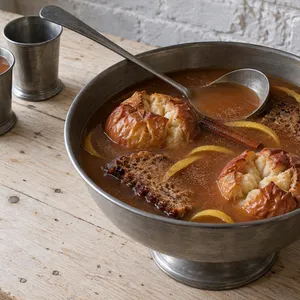
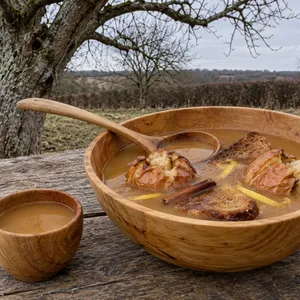
The same book prints a Wassail Bowl of warm beer, sugar, nutmeg, ginger, sherry, lemon and toasted bread, which it calls “of equal antiquity, and of nearly the same composition.”
Scaling changes the ingredients only; glassware, ice and timings need their own judgment. To adapt this recipe further, try the recipe tool at TuneMyRecipe (opens in a new tab), our sister site.
Sources and attribution
Cups and Their Customs (London: John Van Voorst, 1869), “Lamb’s Wool”, p. 41