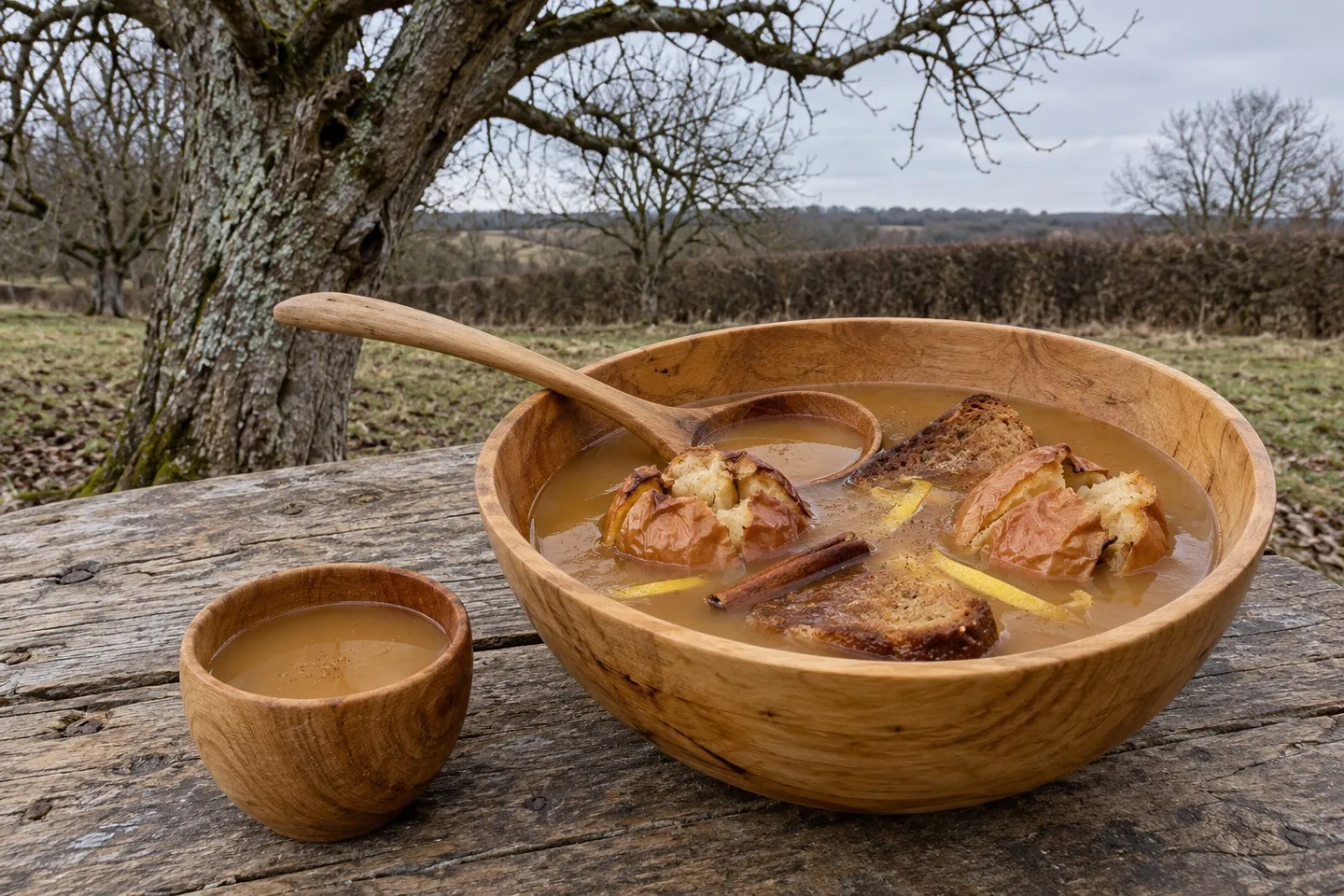
Alcohol-Free Wassail, Hot Spiced Apple Juice with Roasted Apples
Reader ratingsCloudy apple juice heated with cinnamon, ginger, lemon and nutmeg, with roasted apples and toast floating in the bowl: our modern alcohol-free take on the 1869 wassail.
- Recipe makes
- About 1.5 liters, 10 cups
- Prep
- Cook
- Total
Includes 35 to 45 minutes for roasting the apples; the juice heats with its spices at the same time.
Alcohol-free wassail in a maple bowl with roasted apples and toast, a wooden ladle and cup beside it.
The story behind the recipe
Alcohol-free wassail is cloudy apple juice heated with cinnamon, ginger, nutmeg and lemon, with roasted apples and toast floating in the bowl. It is our own adaptation of the 1869 Wassail Bowl in William Terrington’s Cooling Cups and Dainty Drinks. It keeps his spices, the juice and peel of a lemon, two roasted apples and two slices of toast, and puts the same volume of apple juice in place of his quart of hot ale and half bottle of sherry.
The orchard’s half of the custom
The period bowls all held ale, wine or cider, and apple juice comes in by way of the orchard. Wassail had an orchard side as well as a fireside one, and on Twelfth Eve in Devon, as John Brand was told in 1790, the household carried “a large milk-pan full of cider, having roasted apples pressed into it” out to the apple trees, drank to the best of them and threw what was left at the trees. Cider is fermented apple juice. This bowl is the same drink before the yeast gets to it.
Indoors, the bowl was something to eat from as well as drink. In Yorkshire on Wassail Eve, a letter to the Gentleman’s Magazine reported in 1784, each person had a turn “by taking with a spoon, out of the ale, a roasted apple, and eating it, and then drinking the healths of the company out of the bowl.” A spoonful of soft apple in each cup does the same job here. How the orchard custom grew up beside the old toast and the doorstep bowl is told in Wassail, from a Greeting to a Christmas Bowl.
Read more about this recipe
Juice, apples and sugar
Use cloudy, unfiltered apple juice. In the United States it is sold as apple cider, which there means fresh juice, not the alcoholic hard cider. Clear juice works but makes a thinner bowl. A sharp cooking apple such as a Bramley roasts until its skin splits and its flesh turns to fluff, and it falls apart when spooned. A firm dessert apple holds its shape and looks tidier floating.
The juice is already sweet, so the sugar is optional. The Victorians added plenty: Cups and Their Customs, also of 1869, put a pound of raw sugar into three quarts of beer. Half a nutmeg seasons the whole batch.
The ale version this comes from is Terrington’s Wassail Bowl, and its older cousin, which mixes the soft flesh of roasted apples into hot ale, is Lambswool.
Recipe makes: About 1.5 liters, 10 cups
Ingredients
For About 1.5 liters, 10 cups. Quantities are shown as written.
Quantities as written here, for About 1.5 liters, 10 cups.
- Large cooking apples, such as Bramley2
- Cloudy apple juice1.5 l
- Cinnamon sticks2
- Fresh ginger, sliced15 g
- Lemon1
- Freshly grated nutmeg1 1/2 metric tsp (5 ml per tsp)
- Bread2 slices
- Demerara sugar (optional)2 metric tbsp (15 ml per tbsp)
Measurement notes
Ingredients as written here
- 2 large cooking apples, such as Bramley
- 1.5 liters cloudy apple juice
- 2 cinnamon sticks
- 15 g fresh ginger, sliced
- 1 lemon
- 1 1/2 tsp freshly grated nutmeg
- 2 slices bread
- 2 tbsp demerara sugar (optional)
Equipment
 Baking dish
 Large saucepan
 Vegetable peeler
 Heatproof bowl, warmed, to serve
 Ladle and heatproof cups
Instructions
Set the oven to 200°C. Roast the cooking apples whole in a baking dish for 35 to 45 minutes, until they have burst and are soft to the core.
While they roast, peel the lemon in long strips with a vegetable peeler and squeeze out its juice.
Pour the cloudy apple juice into a large saucepan with the cinnamon sticks, fresh ginger and lemon strips. Warm it until it steams and hold it there, just short of simmering, for 10 minutes. Keep it off a hard boil.
Toast the bread golden on each side and quarter each slice.
Off the heat, stir in the lemon juice and the freshly grated nutmeg. Taste before adding any demerara sugar, and add it a spoonful at a time.
Warm the serving bowl by swirling hot water in it and pouring it away. Set the roasted apples in the bowl, pour the spiced juice over them (strain out the cinnamon, ginger and peel first if you prefer), and lay the toast on the surface at the last moment.
Serve in heatproof cups, each with a spoon of the soft apple.
Nutrition
75calories per serving
- Recipe makes
- About 1.5 liters, 10 cups
- Servings
- 10
Roughly estimated from USDA FoodData Central values for unsweetened apple juice, lemon juice and nutmeg, without the optional sugar and counting none of the toast or roasted apples.
Recipe notes
When adjusting quantities
1.5 liters of apple juice takes the place of the 1869 recipe’s quart of ale and half bottle of sherry. For twice as much, double everything, including the apples and toast.
Notes
Quantities mentioned in these notes don’t change when you adjust the batch.
This wassail has no alcohol in it: unfermented apple juice, fruit, spices and toast. Check the label says apple juice or fresh apple cider, not hard cider. The bread contains gluten; leave the toast out for a gluten-free bowl.
Serve it hot but not scalding, since sweet juice clings to the skin. A bowl warmed with hot water is less likely to crack, and heatproof cups matter with small children at the table.
Terrington’s 1869 recipe asks for a quarter ounce of nutmeg, about 7 g, or roughly one whole nutmeg, and the same weight of ginger and of cinnamon. This bowl uses half of one (1 1/2 tsp grated), about a third of a gram in each cup. Reported cases of nutmeg poisoning start at about 5 g eaten at once, so this is an everyday kitchen amount.
Fresh ginger is a modern choice. For something closer to 1869, use 7 g of dried ginger root, bruised, or 1 tbsp of ground ginger, which makes the juice cloudier.
Scaling changes the ingredients only; glassware, ice and timings need their own judgment. To adapt this recipe further, try the recipe tool at TuneMyRecipe (opens in a new tab), our sister site.
Sources and attribution
A modern alcohol-free adaptation of the “Wassail Bowl” in William Terrington, Cooling Cups and Dainty Drinks (London: Routledge, 1869), p. 201
See the original pages (scan at Internet Archive) (opens in a new tab)
Recipe details
- Drink
- Alcohol-free
- Drink family
- Hot Drinks
- Region
- British
- Era
- 19th century
- Difficulty
- Easy
- Occasion
- Christmas
- Season
- Winter