Lambswool with Milk, Roasted Apples Beaten into Hot Milk
Reader ratingsThe soft pulp of roasted apples beaten into hot milk with nutmeg, ginger and sugar: the milk lambswool of an Irish Halloween, from a 1784 letter.
- Recipe makes
- About 900 ml, 4 mugs
- Prep
- Cook
- Total
Includes about 40 minutes for roasting the apples; warm the milk while they cool enough to handle.
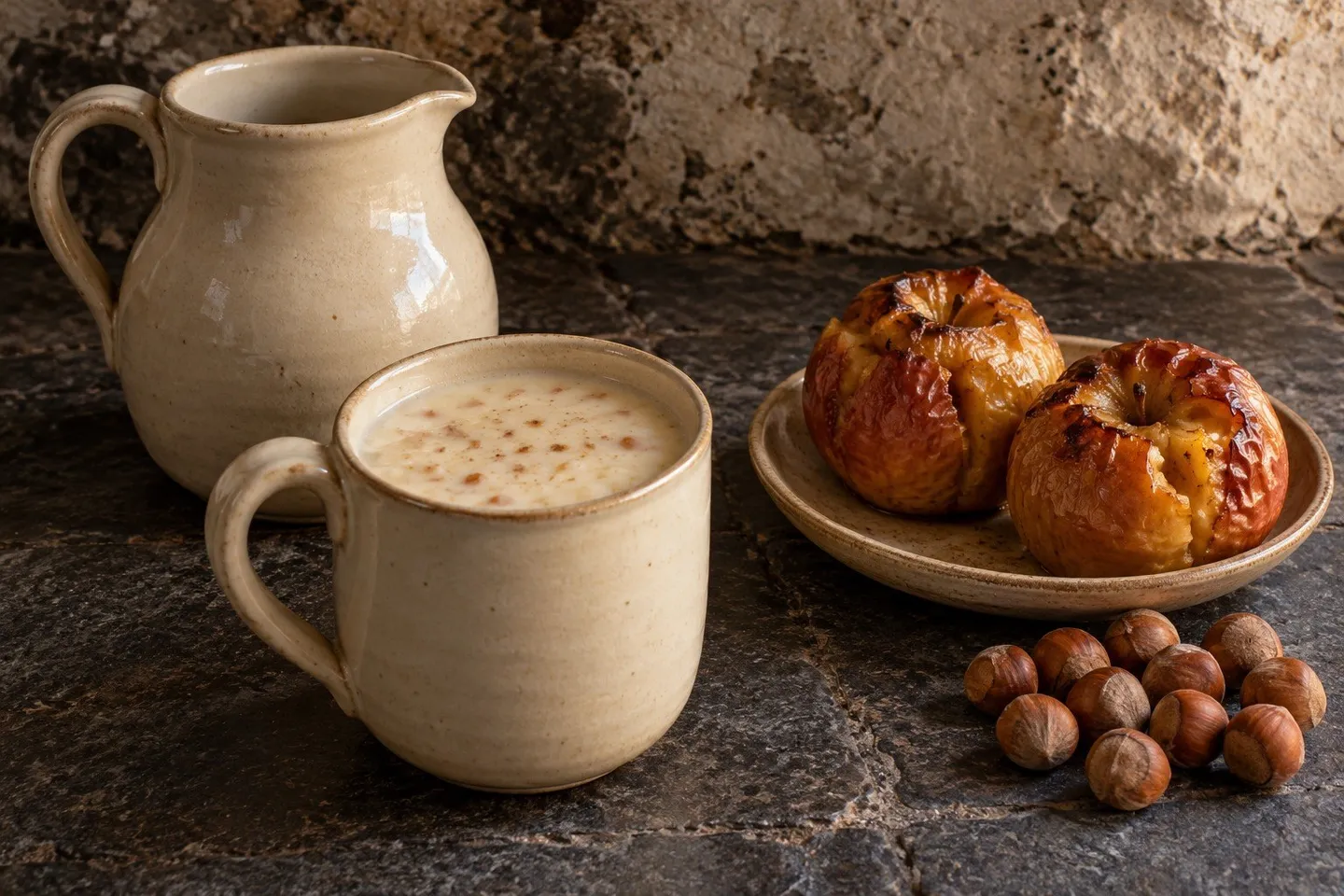
Lambswool with milk in a cream earthenware mug and jug, with two roasted apples and hazelnuts on a slate hearth.
The story behind the recipe
Lambswool with milk is roasted apple, beaten soft into hot milk and sweetened. It is the alcohol-free form of an old ale drink, and it was made for Halloween itself: in a letter to the Gentleman’s Magazine of May 1784, a correspondent signing only “D. A. B.” had met lambswool “in Ireland, where it is a constant ingredient at a merry-making on Holy-eve,” made “by bruising roasted apples and mixing them with ale, or sometimes with milk.”
Apples, nuts and the grate
The letter is short on method and long on the evening. Nuts and apples were served with it as a matter of course, and young people laid nuts in pairs on the bar of the grate, named each pair for a couple and watched how they burned. Better-off households, the writer adds, had once used white wine in place of the ale. The ale version was already old in England by then: a smith in George Peele’s play of 1595 orders a crab apple put in the fire to roast for it.
Read more about this recipe
Making it today
The 1784 letter gives no amounts and names no spices, so both are ours. We follow the Victorian ale recipe in Cups and Their Customs (1869), which beats the pulp of six roasted apples into a quart of hot ale with nutmeg, ginger and raw sugar, and put whole milk in place of the ale at half the quantity: three apples to an Imperial pint.
A sharp cooking apple such as a Bramley roasts to a fluff that beats smoothly into the milk. That sharpness is also acid, and acid can split very hot milk, so the pulp goes in off the heat. The result is thick enough to want a spoon at the bottom of the mug.
The ale original is our Lambswool, and how Ireland, Yorkshire, Scotland and a 1903 New York party book each kept the night is told in Apples, Ale and Nuts: The Old Drinks of Halloween.
I have often met with it in Ireland, where it is a constant ingredient at a merry-making on Holy-eve, or the evening before All Saints day; and it is made there by bruising roasted apples and mixing them with ale, or sometimes with milk.

Recipe makes: About 900 ml, 4 mugs
Ingredients
For About 900 ml, 4 mugs. Quantities are shown as written.
Quantities as written here, for About 900 ml, 4 mugs.
- Large cooking apples, such as Bramley3
- Whole milk570 ml
- Demerara sugar, or to taste2 metric tbsp (15 ml per tbsp)
- Freshly grated nutmeg1/4 metric tsp (5 ml per tsp)
- Ground ginger1/2 metric tsp (5 ml per tsp)
Measurement notes
Ingredients as written here
- 3 large cooking apples, such as Bramley
- 570 ml whole milk
- 2 tbsp demerara sugar, or to taste
- 1/4 tsp freshly grated nutmeg
- 1/2 tsp ground ginger
Equipment
 Baking dish
 Saucepan
 Sieve
 Whisk
 Heatproof bowl or jug
Instructions
Set the oven to 200°C. Roast the cooking apples whole in a baking dish for 35 to 45 minutes, until the skins split and the flesh is soft right through.
Let the apples cool for a few minutes, then scoop the flesh away from the skins and cores. Push it through a sieve with the back of a spoon, or mash it smooth with a fork.
Warm the whole milk in a saucepan over medium heat until it steams and small bubbles form at the edge. Do not let it boil.
Take the pan off the heat. Stir in the demerara sugar, nutmeg and ground ginger.
Add the apple pulp a spoonful at a time, whisking after each, until it is all beaten in.
Pour into a warmed jug or bowl and serve hot in mugs, with a spoon for the apple that settles.
Watch it made
Nutrition
140calories per serving
- Recipe makes
- About 900 ml, 4 mugs
- Servings
- 4
Roughly estimated from USDA FoodData Central values for whole milk, cooking apple flesh and demerara sugar, counting only the apple pulp that goes into the milk.
Recipe notes
When adjusting quantities
Three apples to a pint of milk is half the 1869 ale recipe’s six apples to a quart. Double everything for eight mugs.
Notes
Quantities mentioned in these notes don’t change when you adjust the batch.
Changes from the sources: the 1784 letter gives the milk version without amounts or spices. The proportion of apple to liquid comes from the 1869 ale recipe, halved, with whole milk in place of strong ale. That recipe asks only for a little nutmeg and ginger and enough raw sugar to sweeten, so the spice and sugar amounts and the choice of demerara are ours. Sieving the pulp is our choice for a smoother mug; the letter says only that the apples were bruised.
If the milk starts to look grainy as the apple goes in, it is splitting from the fruit’s acid. It is still safe to drink. Next time let the milk cool a little more before adding the pulp, or use a sweeter dessert apple, which has less acid and roasts a little firmer.
The drink is alcohol-free and contains milk. For a dairy-free mug, an unsweetened oat drink takes the milk’s place, though it is our substitution, not the period’s.
It is best drunk as soon as it is made. Keep leftovers in the fridge; reheat them gently and whisk again.
Scaling changes the ingredients only; glassware, ice and timings need their own judgment. To adapt this recipe further, try the recipe tool at TuneMyRecipe (opens in a new tab), our sister site.
Sources and attribution
Lambswool made “sometimes with milk” on Holy Eve in Ireland: letter signed D. A. B., The Gentleman’s Magazine, vol. 54 (May 1784), p. 343; amounts and spices adapted from “Lamb’s Wool”, Cups and Their Customs (London: John Van Voorst, 1869), p. 41
Recipe details
- Drink
- Alcohol-free
- Drink family
- Hot Drinks
- Region
- Irish
- Era
- 18th century
- Difficulty
- Easy
- Occasion
- Halloween
- Season
- Autumn