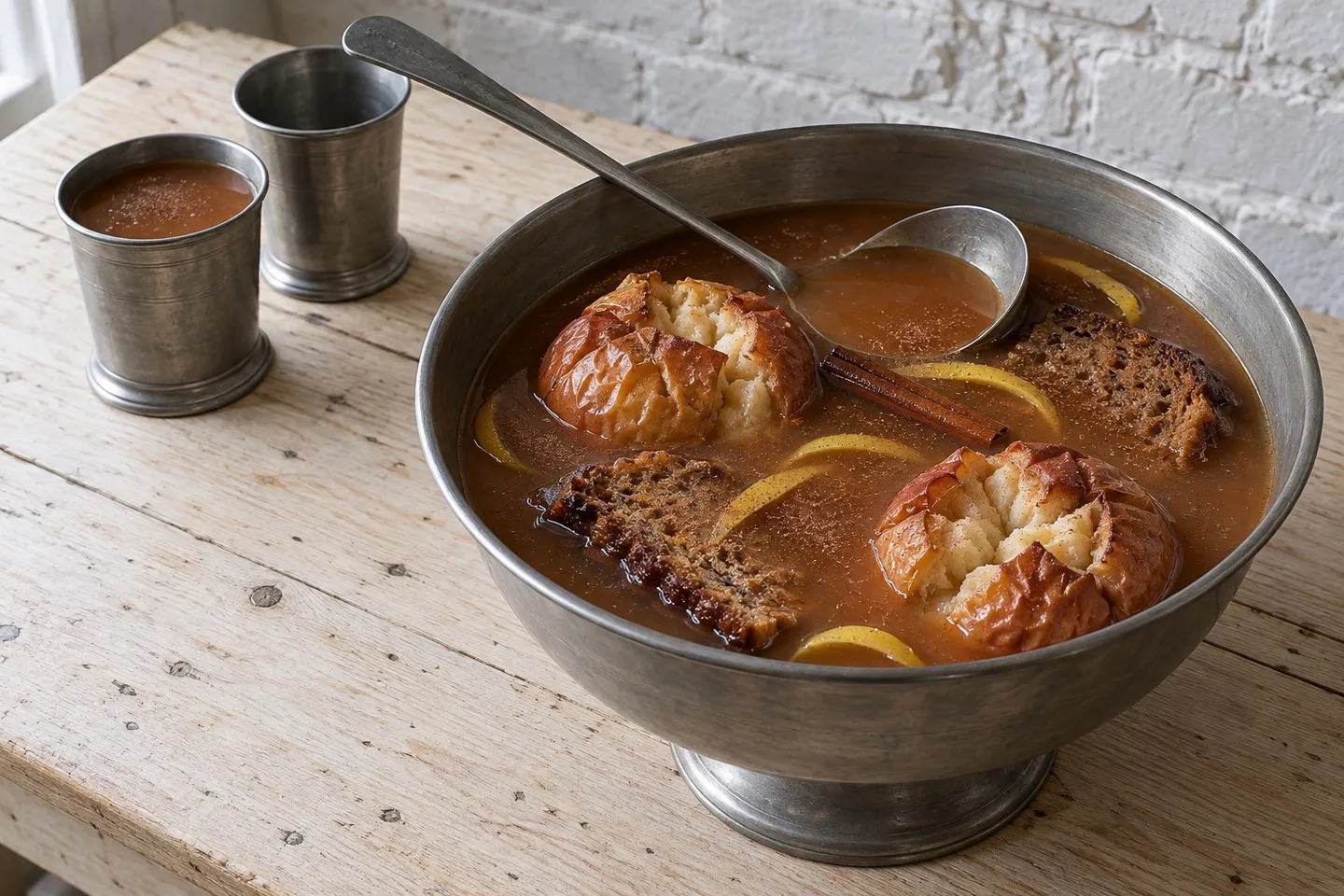
Wassail Bowl, Hot Ale and Sherry with Roasted Apples
Reader ratingsHot ale with sherry, nutmeg, ginger, cinnamon and lemon, served with roasted apples and toast floating in the bowl: the Christmas wassail as printed in 1869.
- Recipe makes
- About 1.5 liters, 10 cups
- Prep
- Cook
- Total
Includes 35 to 45 minutes for roasting the apples; the ale heats with its spices at the same time.
Hot spiced ale and sherry in a footed pewter bowl, with split roasted apples and soaked toast floating in it, a pewter ladle and two pewter beakers.
The story behind the recipe
William Terrington’s Wassail Bowl of 1869 puts the whole old bowl into one recipe: hot ale, nutmeg, ginger, sugar, toast and roasted apples, with cinnamon, lemon and half a bottle of sherry added the Victorian way. It is a single sentence in Cooling Cups and Dainty Drinks, a London book of cups, punches and mixed drinks, and the finished bowl comes out at about 7 to 8% alcohol, a little more with a strong oloroso.
A survival by 1869
Terrington was probably a pen name; The Oxford Companion to Spirits and Cocktails finds no one behind it. Earlier in the book he retells the legend of Rowena’s cup and notes that “Wassail songs and the wassail bowl were amongst the most noted of the Christmas festivities.” By then it was kept up mostly as an old custom. Oxford Night Caps wrote in 1847 of “persons who keep up the ancient custom of regaling their friends and neighbours on Christmas-eve and Twelfth-eve with a Wassail Bowl, with roasted apples floating in it, and which is generally ushered in with great ceremony.”
Sherry was the century’s addition. The older accounts give ale, sugar, nutmeg, toast and roasted crab apples. At Oxford, Jesus College added four glasses of sherry to its version, called Swig; Terrington used half a bottle to a quart of ale. On his next page he prints a “Sir Walter Scott’s Wassail Bowl” of sponge cake and macaroons soaked in sherry, raisin wine, champagne and Chablis; Terrington gives no source for the name. Jesus College’s ten-gallon bowl, Irving’s fictional one and the customs older than both are in Wassail, from a Greeting to a Christmas Bowl.
Read more about this recipe
Ale, sherry and spice
Terrington’s quart is the British Imperial quart, about 1,140 ml. Choose an amber or brown ale of about 5% that is not very hoppy, since a hoppy ale turns harsh when heated. A medium or oloroso sherry sits well with brown ale; a fino gives a paler, drier bowl. “Sweeten to taste” is all the book says about sugar, so start with 50 g of demerara and add more if you like.
The 1869 recipe asks for a quarter ounce each of nutmeg, ginger and cinnamon, and for nutmeg that is nearly a whole one. Half is plenty. Heat the bowl gently and never let it boil, which drives off the alcohol. The same bowl’s older form, strong ale thickened with the pulp of roasted apples, is Lambswool, and the Alcohol-Free Wassail makes it with cloudy apple juice.
To 1 quart of hot ale add grated nutmeg, ginger, and cinnamon, of each ¼ oz., and ½ bottle of sherry, 2 good slices of toasted bread, juice of 1 lemon, peel of same, and 2 well-roasted apples; sweeten to taste.

Recipe makes: About 1.5 liters, 10 cups
Ingredients
For About 1.5 liters, 10 cups. Quantities are shown as written.
Quantities as written here, for About 1.5 liters, 10 cups.
- Large cooking apples, such as Bramley2
- Amber or brown ale1140 ml
- Cinnamon sticks2
- Dried ginger root, bruised7 g
- Lemon1
- Medium or oloroso sherry375 ml
- Freshly grated nutmeg1 1/2 metric tsp (5 ml per tsp)
- Demerara sugar, or to taste50 g
- Thick slices bread2
Measurement notes
Ingredients as written here
- 2 large cooking apples, such as Bramley
- 1140 ml amber or brown ale
- 2 cinnamon sticks
- 7 g dried ginger root, bruised
- 1 lemon
- 375 ml medium or oloroso sherry
- 1 1/2 tsp freshly grated nutmeg
- 50 g demerara sugar, or to taste
- 2 thick slices bread
Equipment
 Baking dish
 Large saucepan
 Vegetable peeler
 Heatproof bowl, warmed, to serve
 Ladle and heatproof cups
Instructions
Heat the oven to 200°C. Put the whole cooking apples in a baking dish and roast for 35 to 45 minutes, until the skins split and the flesh is soft right through.
Meanwhile, pare the peel from the lemon in strips with a vegetable peeler, then squeeze the juice.
Put the amber or brown ale, cinnamon sticks, dried ginger root and lemon peel in a large saucepan. Heat gently until steaming, then keep it just below a simmer for 10 minutes. Do not let it boil.
Toast the bread until brown on both sides and cut each slice in half.
Add the sherry, the lemon juice, the freshly grated nutmeg and the demerara sugar to the ale. Stir until the sugar dissolves and heat until it steams again, still without boiling. Taste and add more sugar if you like.
Fill a heatproof bowl with hot water to warm it, then empty it. Put the roasted apples in the bowl and pour the hot ale over them, leaving the spices and peel in or straining them out as you like. Float the toast on top just before serving.
Ladle into heatproof cups, with a little soft roasted apple in each.
Nutrition
130calories per serving
- Recipe makes
- About 1.5 liters, 10 cups
- Servings
- 10
Roughly estimated from USDA FoodData Central values for regular beer, dessert wine, brown sugar and lemon juice, counting none of the toast or roasted apples and ignoring alcohol lost to heat.
Recipe notes
When adjusting quantities
This is the 1869 batch: one Imperial quart of ale to half a bottle of sherry. For twice as much, double everything, including the apples and toast.
Notes
Quantities mentioned in these notes don’t change when you adjust the batch.
The 1869 quart is the British Imperial quart of about 1,137 ml, rounded to 1,140 ml. A wine bottle of the time held about 758 ml, so half a bottle is about 380 ml; a modern 375 ml half bottle is the nearest match. A quarter ounce is about 7 g. Two cinnamon sticks weigh about that; for the ginger, 1 tbsp of ground ginger will do instead of the dried root, though it clouds the bowl further.
Strength is our arithmetic, not a measurement: 1,140 ml of 5% ale and 375 ml of 17% sherry hold about 121 ml of alcohol in roughly 1.6 liters, about 7.6% ABV before any is lost to heat. A fino at 15% brings it nearer 7%, and a 20% oloroso takes it to about 8.3%. Nobody recorded the strength of Terrington’s ale.
Do not flame or boil it: hot ale and sherry give off alcohol vapor that can catch light, so keep the pan away from open flames. Hot, sweet liquid scalds and clings, so warm the bowl first, use heatproof cups, and keep it out of reach of children. Don’t bottle leftovers to keep; Oxford Night Caps bottled its Swig to drink fizzy, and ale and sugar sealed in a bottle can build up enough pressure to burst it. The toast contains gluten.
The book’s quarter ounce of nutmeg is about a whole one, which leaves the bowl gritty and dominated by it; half a nutmeg gives about a third of a gram per cup. Nutmeg is harmful only in large amounts: reported poisonings involve 5 g or more eaten at once, and the Tennessee Poison Center puts the usual figure at 15 to 20 g, two to three tablespoons of ground nutmeg.
Scaling changes the ingredients only; glassware, ice and timings need their own judgment. To adapt this recipe further, try the recipe tool at TuneMyRecipe (opens in a new tab), our sister site.
Sources and attribution
William Terrington, Cooling Cups and Dainty Drinks (London: Routledge, 1869), “Wassail Bowl”, p. 201
See the original pages (scan at Internet Archive) (opens in a new tab)
Recipe details
- Drink family
- Hot Drinks
- Region
- British
- Era
- 19th century
- Source decade
- 1860s
- Base
- Beer & aleWine
- Difficulty
- Easy
- Occasion
- Christmas
- Season
- Winter