Wassail, from a Greeting to a Christmas Bowl
A toast meaning “be healthy,” then a Christmas bowl of hot spiced ale with toast and roasted apples, carried door to door and drunk to the apple trees.
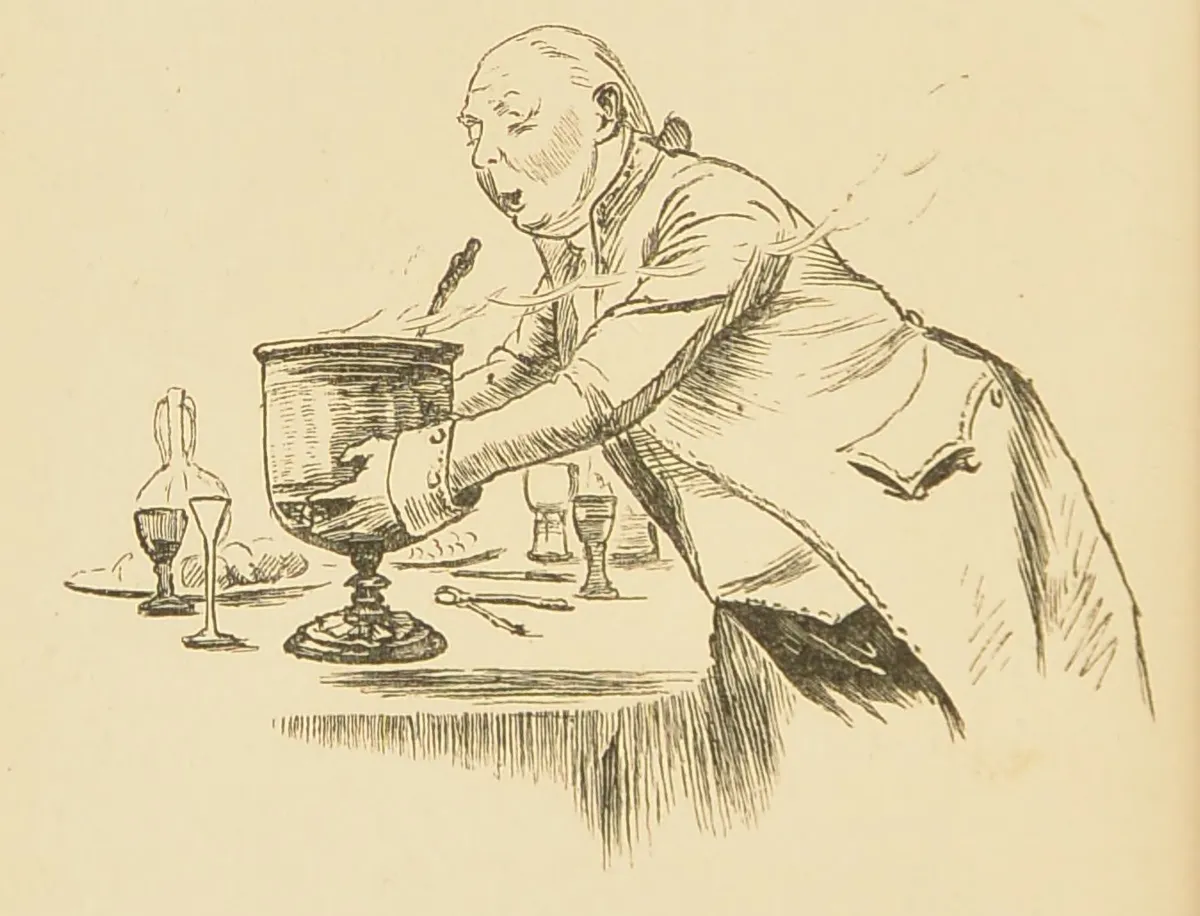
Wassail began as words said over a cup. The drinker called out “wassail,” from an old greeting meaning “be healthy,” and the person he drank to answered “drinc heil,” drink health. The name passed to what was in the cup. Robert Herrick’s wassail bowl of 1648 held ale with sugar, nutmeg and ginger, 18th-century accounts add toast and roasted apples floating in it, and it went round between Christmas and Twelfth Night. The same mixture also went by the name lambswool. The Victorian books served it hot, often with sherry added, and some bowls were made of wine alone.
This story is part of our Christmas Drinks From History guide.
One word covered three customs, and they are easier to follow kept apart. There was the toast, said at any table. There was the bowl that young women and poorer neighbors carried from door to door around Christmas and New Year, singing and expecting something in return. And there was the bowl taken out to the orchard on Twelfth Eve, when cider was drunk to the apple trees and the rest thrown at them for a good crop.
A toast with a legend
The oldest story about wassail is a legend. Geoffrey of Monmouth, whose history of the kings of Britain dates from about 1136, tells how Rowena, the daughter of the Saxon leader Hengist, came before the British king Vortigern “bearing a golden cup full of wine” and greeted him: “Lauerd king wacht heil!” The king needed an interpreter, who told him what to say back: “Drinc heil!” Vortigern answered, took the cup from her hand, kissed her and drank.
Geoffrey’s history is largely invented, and Rowena’s cup belongs with the rest of it. What the passage does record is a habit of Geoffrey’s own day. “From that time to this,” he writes, “it has been the custom in Britain, that he who drinks to any one says, ‘Wacht heil!’ and he that pledges him, answers ‘Drinc heil!’” By the 1130s the toast and its reply were familiar enough to need a story of how they began.
The story lasted. In 1869 William Terrington’s Cooling Cups and Dainty Drinks had Rowena kneeling with her cup and saying “Hlaford Kyning, waes-hael!” and offered it as the origin of drinking healths, “it is said.” Antiquaries went after the word itself. In John Brand’s Observations on Popular Antiquities, as revised in 1813, “Wassail is derived from the Anglo-Saxon Wæs hæl, be in health.” Chambers’s Book of Days put the two halves of the toast on either side of a bowl to head its page for New Year’s Day.
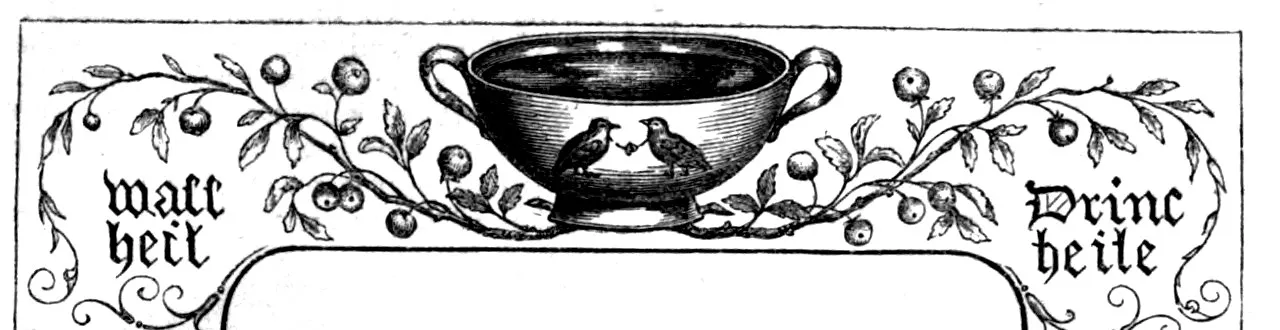 “Wass heil” and “Drinc heile” around a wassail bowl: headpiece for the first of January in Robert Chambers’s The Book of Days, vol. 1 (Edinburgh: W. & R. Chambers, 1863), p. 23.
What went in the bowl
At some point the cry became the name of the drink. The household rules for Henry VII’s court, as Brand quotes them, set out what happened on Twelfth Night: “When the steward came in at the doore with the Wassel, he was to crie three tymes, Wassel, Wassel, Wassel; and then the chappell (the chaplain) was to answere with a songe.” The wassail here is something carried through a door.
What it was made of comes from Robert Herrick, whose Twelfth Night poem of 1648 fills the bowl with lambswool, sugar, nutmeg, ginger and a good store of ale, all “To make the wassaile a swinger.” The 18th-century scholar Thomas Warton, quoted by Brand, put the recipe in one sentence: “The composition was ale, nutmeg, sugar, toast, and roasted crabs or apples. It was also called Lambs’ Wool.” Crabs were crab apples, small and sour. A Yorkshire correspondent of the Gentleman’s Magazine in 1784 confirmed the name: “The ingredients put into the bowl, viz. ale, sugar, nutmeg, and roasted apples, were usually called Lambs’ Wool, and the night on which it is used to be drunk (generally on the Twelfth Eve) was commonly called Wassail Eve.”
The base was plain brown ale, the everyday drink of English households that could brew or buy it, as our story on whether medieval people really drank beer instead of water explains. Our Lambswool follows an 1869 recipe for the same ale-and-apple mixture, with the pulp of roasted apples stirred through the hot ale. In Ireland the same bowl belonged to Halloween, as Apples, Ale and Nuts: The Old Drinks of Halloween tells.
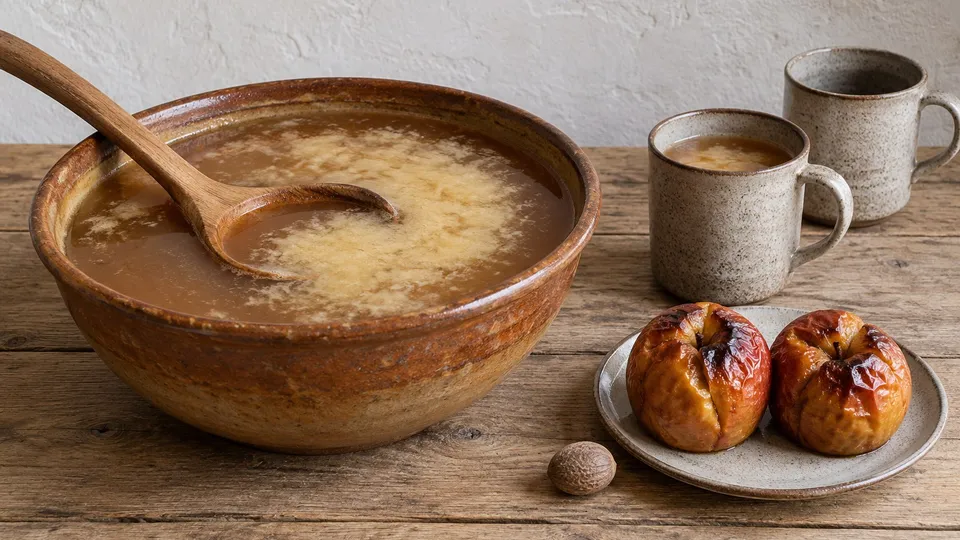 Make it todayLambswool, Hot Spiced Ale with Roasted Apples
From door to door
The second custom took the bowl out of the house. “There was an antient custom, which is yet retained in many places, on New Year’s Eve,” Brand writes: “young women went about with a Wassail Bowl of spiced ale, with some sort of verses that were sung by them as they went from door to door.” Another letter to the Gentleman’s Magazine, in 1784, describes the same round at Christmas, made “for the poorer people to go from door to door with a Wassail Cup, adorned with ribbons, and a golden apple at the top, singing and begging money for it.” The point, the writer thought, was that “they also might procure lamb’s wool to fill it, and regale themselves as well as the rich.”
The antiquary Samuel Lysons sent Brand the song of the Gloucestershire wassailers, who arrived with “a great bowl, dressed up with garlands and ribbons”:
Wassail! Wassail! all over the town, Our toast it is white, our ale it is brown: Our bowl it is made of a maplin tree, We be good fellows all; I drink to thee.
A maplin tree is a maple, so this bowl was wooden. Not everyone welcomed the visit. The 17th-century lawyer John Selden, quoted by Brand from his Table-Talk, used the wassailers to mock the Pope, who, “in sending relicks to Princes, does as wenches do to their Wassels at New Year’s tide—they present you with a cup, and you must drink of a slabby stuff, but the meaning is, You must give them money, ten times more than it is worth.” Slabby means sloppy, which with toast and apple pulp in the ale it would have been.
Wassailing the apple trees
The third custom went to the orchard. Among his Christmas Eve ceremonies Herrick has a four-line charm:
Wassaile the Trees, that they may beare You many a Plum, and many a Peare: For more or lesse fruits they will bring, As you doe give them Wassailing.
Brand heard how it was done in Devon in 1790. After supper the household went into the orchard “with a large milk-pan full of cider, having roasted apples pressed into it.” Each person took an earthenware cup of it, stood under one of the better trees, passing over the poor bearers, and said:
Health to thee, good apple tree, Well to bear, pocket-fulls, hat-fulls, Peck-fulls, bushel-bag-fulls!
“And then drinking up part of the contents, he throws the rest, with the fragments of the roasted apples, at the tree. At each cup the company set up a shout.” The orchard bowl held cider, the apple’s own drink. An Exmoor glossary quoted by Brand called the custom “a relic of the heathen sacrifice to Pomona,” the Roman goddess of fruit. That was a guess in its day, and no evidence came with it.
The Squire’s silver bowl
Washington Irving put a grand wassail bowl into fiction. His Sketch Book (1820) sends its narrator to Christmas at Bracebridge Hall, an invented country house, where after dinner “the butler brought in a huge silver vessel of rare and curious workmanship.” The Squire had mixed it himself, and it was “composed of the richest and raciest wines, highly spiced and sweetened, with roasted apples bobbing about the surface.” When Randolph Caldecott illustrated the Christmas chapters as Old Christmas in 1876, he drew the butler setting it down and the Squire raising it to his guests.
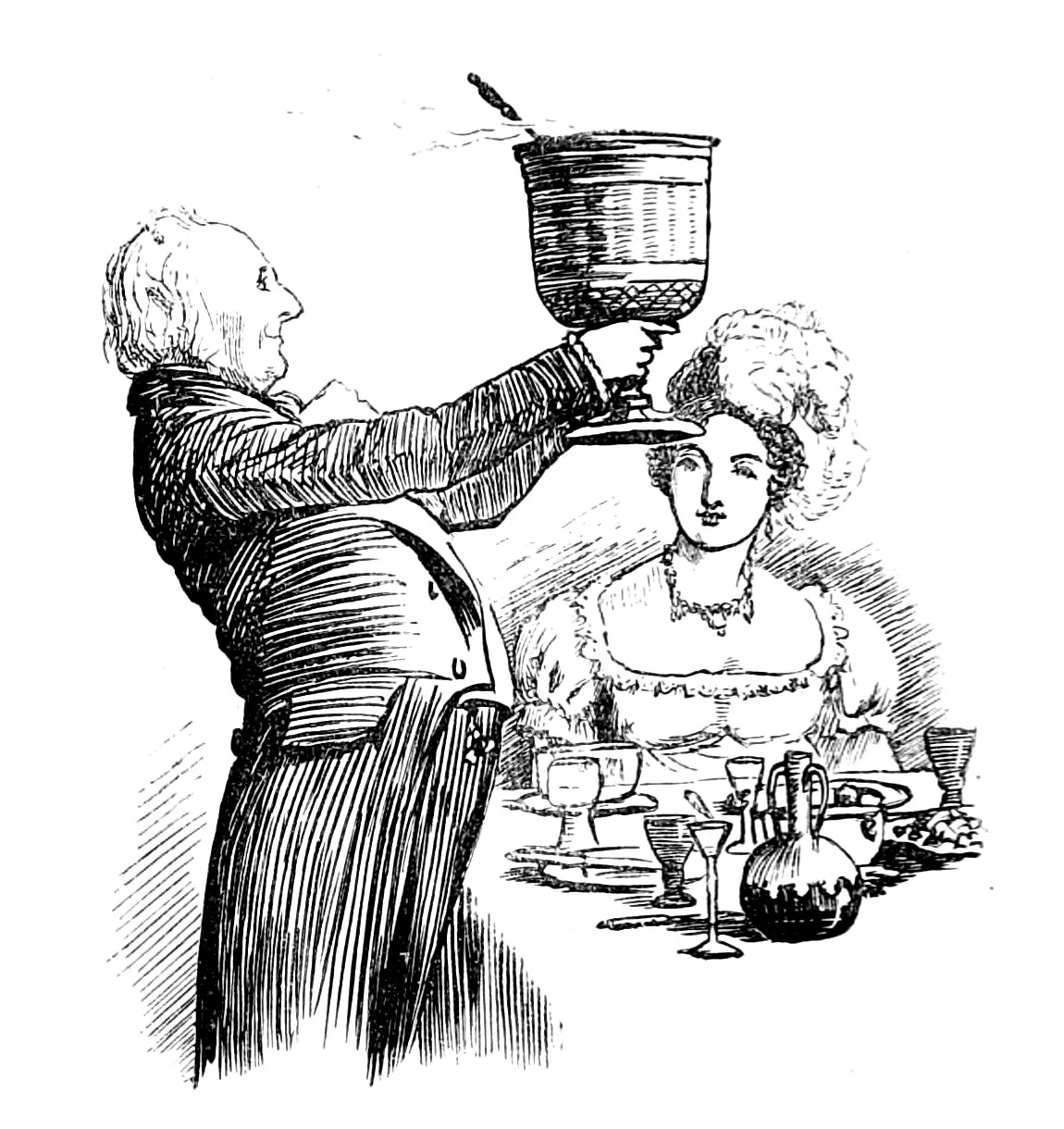 “The Squire’s Toast”: the wassail bowl raised at Bracebridge Hall. Randolph Caldecott’s drawing for Washington Irving’s Old Christmas (London: Macmillan, 1876), p. 134.
Irving’s footnote describes the ale bowl that farmers still made: “The Wassail Bowl was sometimes composed of ale instead of wine; with nutmeg, sugar, toast, ginger, and roasted crabs: in this way the nut brown beverage is still prepared in some old families, and round the hearths of substantial farmers at Christmas.”
Sherry, wine and Oxford Swig
By the 19th century, printed recipes had started to add sherry to the ale. Oxford Night Caps, the book of university drinks that printed the Oxford recipe for smoking bishop, gave “The Wassail Bowl, or Swig, as it is termed at Jesus College” in its 1847 edition. The college drank it at dinner and supper, and on St David’s Day it filled “an immense silver gilt bowl, containing ten gallons,” presented by Sir Watkin W. Wynne in 1732. The recipe puts half a pound of Lisbon sugar into warm beer with nutmeg and ginger, adds four glasses of sherry and five more pints of beer, and leaves it covered for two or three hours before slices of brown toast go in, so Swig was drunk cold. It could even be bottled and drunk a few days later, fizzing. The book also noted what had changed: the bowl “was formerly prepared in nearly the same way as at present, excepting that roasted apples, or crab apples, were introduced instead of toasted bread.”
Two London drinks books of 1869 kept the sherry. Cups and Their Customs used a pound of raw sugar, three quarts of beer, four glasses of sherry, lemon and three slices of toast. Terrington’s version is the fullest: hot ale with nutmeg, ginger and cinnamon, half a bottle of sherry, the juice and peel of a lemon, toast and two roasted apples. Our Wassail Bowl is made from it, at about 7 to 8% alcohol.
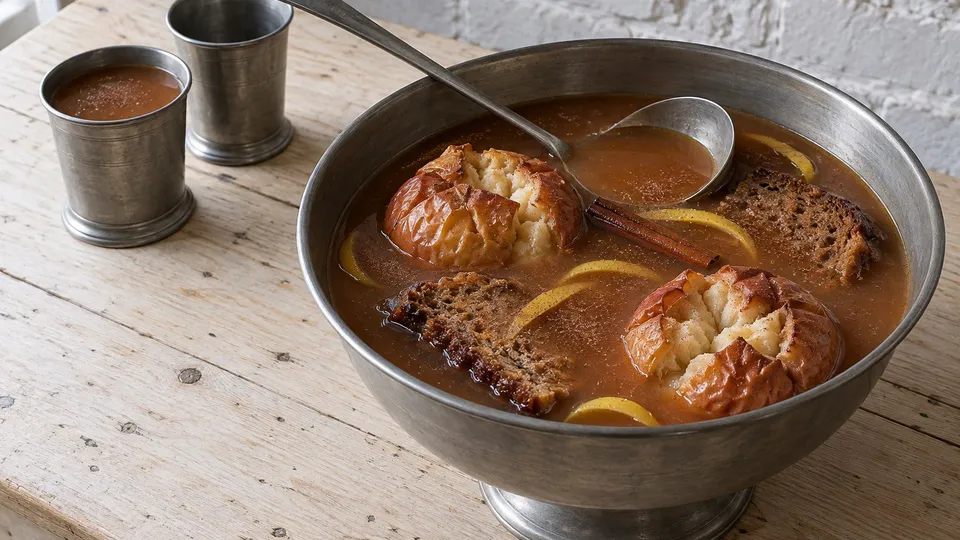 Make it todayWassail Bowl, Hot Ale and Sherry with Roasted Apples
Some bowls dropped the ale altogether. A recipe from the Mark Lane Express, reprinted in the Book of Days, simmered seven spices in a teacup of water, heated them with two to six bottles of port, sherry or madeira and plenty of loaf sugar, frothed the hot wine with a dozen yolks and six whites of egg, and finished: “toss in 12 fine soft roasted apples, and send it up hot.” It is a printed recipe close to the Squire’s fictional bowl of wines with apples bobbing in it.
An apple-juice bowl
We have found no period recipe for wassail without alcohol, so our Alcohol-Free Wassail is a modern adaptation. It heats cloudy apple juice with Terrington’s cinnamon, ginger, nutmeg and lemon, and floats the roasted apples and toast on top. The apple juice is the orchard bowl’s cider before it ferments, a short step from the Devon milk-pan of cider with roasted apples pressed into it. Make the apple-juice bowl for Twelfth Night, when wassail went round in Herrick’s day; the apples roast while the juice steeps, and it fills ten cups in under an hour.
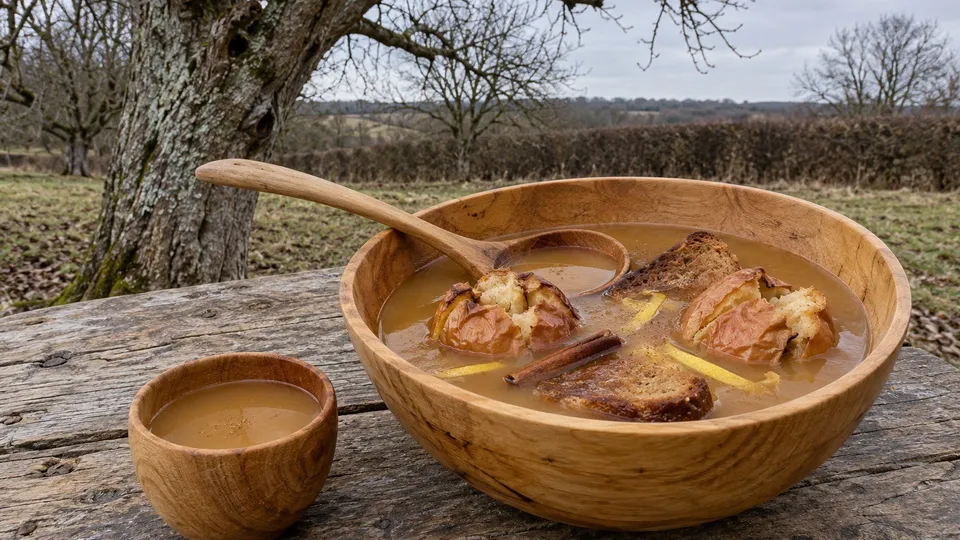 Alcohol-free versionAlcohol-Free Wassail, Hot Spiced Apple Juice with Roasted Apples
Sources
- Geoffrey of Monmouth, British History, book VI, ch. 12, trans. Aaron Thompson, rev. J. A. Giles, in Six Old English Chronicles (London: H. G. Bohn, 1848), p. 186.
- John Brand, Observations on Popular Antiquities, arranged and revised by Henry Ellis, vol. 1 (London: Rivington et al., 1813), pp. 1–3, 6, 27–28, 30.
- Robert Herrick, Hesperides (London: John Williams and Francis Eglesfield, 1648), pp. 311, 376–377.
- Washington Irving, The Sketch Book of Geoffrey Crayon, Gent., vol. 2 (London: John Murray, 1820), “The Christmas Dinner,” pp. 117–118.
- Washington Irving, Old Christmas, ill. Randolph Caldecott (London: Macmillan, 1876), pp. 132, 134. Wellcome Collection copy.
- [Richard Cook, attrib.], Oxford Night Caps, 4th ed. (Oxford: Henry Slatter, 1847), pp. 37–39.
- [Henry Porter and George Edwin Roberts], Cups and Their Customs, 2nd ed. (London: John Van Voorst, 1869), p. 41.
- William Terrington, Cooling Cups and Dainty Drinks (London: Routledge, 1869), pp. 161, 201.
- Robert Chambers (ed.), The Book of Days, vol. 1 (Edinburgh: W. & R. Chambers, 1863), pp. 23, 28.